| Record Information |
|---|
| Version | 1.0 |
|---|
| Creation Date | 2016-05-26 01:55:28 UTC |
|---|
| Update Date | 2016-11-09 01:19:05 UTC |
|---|
| Accession Number | CHEM030484 |
|---|
| Identification |
|---|
| Common Name | Squalene |
|---|
| Class | Small Molecule |
|---|
| Description | |
|---|
| Contaminant Sources | |
|---|
| Contaminant Type | Not Available |
|---|
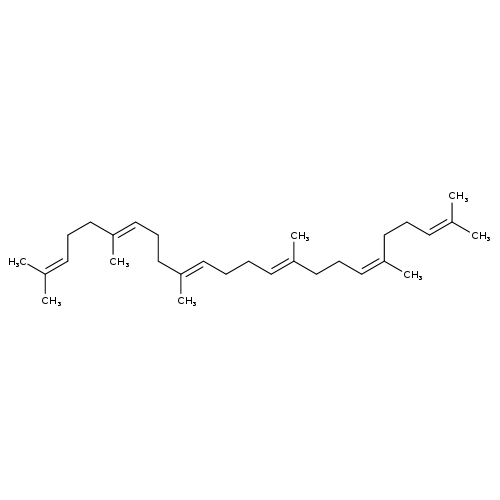
| Chemical Structure | |
|---|
| Synonyms | | Value | Source |
|---|
| (all-e)-2,6,10,15,19,23-Hexamethyl-2,6,10,14,18,22-tetracosahexaene | HMDB | | (e,e,e,e)-Squalene | HMDB | | 2,6,10,15,19,23-Hexamethyl-2,6,10,14,18,22-tetracosahexaene | HMDB | | all-trans-Squalene | HMDB | | nikko Squalane ex | HMDB | | Spinacen | HMDB | | Spinacene | HMDB | | Squalen | HMDB | | trans-Squalene | HMDB |
|
|---|
| Chemical Formula | C30H50 |
|---|
| Average Molecular Mass | 410.718 g/mol |
|---|
| Monoisotopic Mass | 410.391 g/mol |
|---|
| CAS Registry Number | 7683-64-9 |
|---|
| IUPAC Name | (6Z,10E,14E,18E)-2,6,10,15,19,23-hexamethyltetracosa-2,6,10,14,18,22-hexaene |
|---|
| Traditional Name | (6Z,10E,14E,18E)-2,6,10,15,19,23-hexamethyltetracosa-2,6,10,14,18,22-hexaene |
|---|
| SMILES | CC(C)=CCC\C(C)=C/CC\C(C)=C\CC\C=C(/C)CC\C=C(/C)CCC=C(C)C |
|---|
| InChI Identifier | InChI=1S/C30H50/c1-25(2)15-11-19-29(7)23-13-21-27(5)17-9-10-18-28(6)22-14-24-30(8)20-12-16-26(3)4/h15-18,23-24H,9-14,19-22H2,1-8H3/b27-17+,28-18+,29-23-,30-24+ |
|---|
| InChI Key | YYGNTYWPHWGJRM-FLHYQJCXSA-N |
|---|
| Chemical Taxonomy |
|---|
| Description | belongs to the class of organic compounds known as triterpenoids. These are terpene molecules containing six isoprene units. |
|---|
| Kingdom | Organic compounds |
|---|
| Super Class | Lipids and lipid-like molecules |
|---|
| Class | Prenol lipids |
|---|
| Sub Class | Triterpenoids |
|---|
| Direct Parent | Triterpenoids |
|---|
| Alternative Parents | |
|---|
| Substituents | - Triterpenoid
- Branched unsaturated hydrocarbon
- Unsaturated aliphatic hydrocarbon
- Unsaturated hydrocarbon
- Olefin
- Acyclic olefin
- Hydrocarbon
- Aliphatic acyclic compound
|
|---|
| Molecular Framework | Aliphatic acyclic compounds |
|---|
| External Descriptors | |
|---|
| Biological Properties |
|---|
| Status | Detected and Not Quantified |
|---|
| Origin | Not Available |
|---|
| Cellular Locations | Not Available |
|---|
| Biofluid Locations | Not Available |
|---|
| Tissue Locations | Not Available |
|---|
| Pathways | Not Available |
|---|
| Applications | Not Available |
|---|
| Biological Roles | Not Available |
|---|
| Chemical Roles | Not Available |
|---|
| Physical Properties |
|---|
| State | Not Available |
|---|
| Appearance | Not Available |
|---|
| Experimental Properties | | Property | Value |
|---|
| Melting Point | Not Available | | Boiling Point | Not Available | | Solubility | Not Available |
|
|---|
| Predicted Properties | |
|---|
| Spectra |
|---|
| Spectra | | Spectrum Type | Description | Splash Key | View |
|---|
| Predicted GC-MS | Predicted GC-MS Spectrum - GC-MS (Non-derivatized) - 70eV, Positive | splash10-05y1-4879000000-643c1d087f1a2f3e2e16 | Spectrum | | LC-MS/MS | LC-MS/MS Spectrum - Quattro_QQQ 10V, Positive (Annotated) | splash10-047r-1944600000-5faa7a5eb4804dfad261 | Spectrum | | LC-MS/MS | LC-MS/MS Spectrum - Quattro_QQQ 25V, Positive (Annotated) | splash10-000i-4867900000-dcd3ba4f6ee550dc565b | Spectrum | | LC-MS/MS | LC-MS/MS Spectrum - Quattro_QQQ 40V, Positive (Annotated) | splash10-000i-2944400000-8be7743f6b07ba138c24 | Spectrum | | Predicted LC-MS/MS | Predicted LC-MS/MS Spectrum - 10V, Positive | splash10-03di-0323900000-5bedc30817d5c5d01efb | Spectrum | | Predicted LC-MS/MS | Predicted LC-MS/MS Spectrum - 20V, Positive | splash10-0cdl-4984100000-300a277b16ec703823d5 | Spectrum | | Predicted LC-MS/MS | Predicted LC-MS/MS Spectrum - 40V, Positive | splash10-0aou-7596000000-05f1c221b7c0392d38d0 | Spectrum | | Predicted LC-MS/MS | Predicted LC-MS/MS Spectrum - 10V, Negative | splash10-0a4i-0000900000-b358bb76b170bbf30138 | Spectrum | | Predicted LC-MS/MS | Predicted LC-MS/MS Spectrum - 20V, Negative | splash10-0a4i-0000900000-263e0536e44752c47006 | Spectrum | | Predicted LC-MS/MS | Predicted LC-MS/MS Spectrum - 40V, Negative | splash10-052f-1879100000-92ff711655668bba23d8 | Spectrum | | 1D NMR | 1H NMR Spectrum | Not Available | Spectrum | | 2D NMR | [1H,13C] 2D NMR Spectrum | Not Available | Spectrum |
|
|---|
| Toxicity Profile |
|---|
| Route of Exposure | Not Available |
|---|
| Mechanism of Toxicity | Not Available |
|---|
| Metabolism | Not Available |
|---|
| Toxicity Values | Not Available |
|---|
| Lethal Dose | Not Available |
|---|
| Carcinogenicity (IARC Classification) | Not Available |
|---|
| Uses/Sources | Not Available |
|---|
| Minimum Risk Level | Not Available |
|---|
| Health Effects | Not Available |
|---|
| Symptoms | Not Available |
|---|
| Treatment | Not Available |
|---|
| Concentrations |
|---|
| Not Available |
|---|
| External Links |
|---|
| DrugBank ID | Not Available |
|---|
| HMDB ID | HMDB0000256 |
|---|
| FooDB ID | FDB015781 |
|---|
| Phenol Explorer ID | Not Available |
|---|
| KNApSAcK ID | Not Available |
|---|
| BiGG ID | Not Available |
|---|
| BioCyc ID | Not Available |
|---|
| METLIN ID | Not Available |
|---|
| PDB ID | Not Available |
|---|
| Wikipedia Link | Squalene |
|---|
| Chemspider ID | Not Available |
|---|
| ChEBI ID | Not Available |
|---|
| PubChem Compound ID | 11975273 |
|---|
| Kegg Compound ID | Not Available |
|---|
| YMDB ID | Not Available |
|---|
| ECMDB ID | Not Available |
|---|
| References |
|---|
| Synthesis Reference | Not Available |
|---|
| MSDS | Not Available |
|---|
| General References | | 1. Peng, Wanxi; Li, Kaifu. Method of preparation of squalene. Faming Zhuanli Shenqing Gongkai Shuomingshu (2006), 9pp. | | 2. Peng, Wanxi; Li, Kaifu. Method of preparation of squalene. Faming Zhuanli Shenqing Gongkai Shuomingshu (2006), 9pp. | | 3. Strauss JS, Stranieri AM, Farrell LN, Downing DT: The effect of marked inhibition of sebum production with 13cis-retinoic acid on skin surface lipid composition. J Invest Dermatol. 1980 Feb;74(2):66-7. | | 4. Grimes DS, Hindle E, Dyer T: Sunlight, cholesterol and coronary heart disease. QJM. 1996 Aug;89(8):579-89. | | 5. Relas H, Gylling H, Miettinen TA: Dietary squalene increases cholesterol synthesis measured with serum non-cholesterol sterols after a single oral dose in humans. Atherosclerosis. 2000 Oct;152(2):377-83. | | 6. Nikkila K, Hockerstedt K, Miettinen TA: Serum and hepatic cholestanol, squalene and noncholesterol sterols in man: a study on liver transplantation. Hepatology. 1992 May;15(5):863-70. | | 7. Gylling H, Relas H, Miettinen HE, Radhakrishnan R, Miettinen TA: Delayed postprandial retinyl palmitate and squalene removal in a patient heterozygous for apolipoprotein A-IFIN mutation (Leu 159-->Arg) and low HDL cholesterol level without coronary artery disease. Atherosclerosis. 1996 Dec 20;127(2):239-43. | | 8. Rajaratnam RA, Gylling H, Miettinen TA: Independent association of serum squalene and noncholesterol sterols with coronary artery disease in postmenopausal women. J Am Coll Cardiol. 2000 Apr;35(5):1185-91. | | 9. Rajaratnam RA, Gylling H, Miettinen TA: Serum squalene in postmenopausal women without and with coronary artery disease. Atherosclerosis. 1999 Sep;146(1):61-4. | | 10. Thiele JJ, Weber SU, Packer L: Sebaceous gland secretion is a major physiologic route of vitamin E delivery to skin. J Invest Dermatol. 1999 Dec;113(6):1006-10. | | 11. Relas H, Gylling H, Miettinen TA: Effect of stanol ester on postabsorptive squalene and retinyl palmitate. Metabolism. 2000 Apr;49(4):473-8. | | 12. Gylling H, Vuoristo M, Farkkila M, Miettinen TA: The metabolism of cholestanol in primary biliary cirrhosis. J Hepatol. 1996 Apr;24(4):444-51. | | 13. Chiba K, Yoshizawa K, Makino I, Kawakami K, Onoue M: Changes in the levels of glutathione after cellular and cutaneous damage induced by squalene monohydroperoxide. J Biochem Mol Toxicol. 2001;15(3):150-8. | | 14. Nosaka Y, Yamanishi Y, Hirayama C: Biliary squalene levels in hepatobiliary disease. Gastroenterol Jpn. 1985 Aug;20(4):338-43. | | 15. Kohno Y, Egawa Y, Itoh S, Nagaoka S, Takahashi M, Mukai K: Kinetic study of quenching reaction of singlet oxygen and scavenging reaction of free radical by squalene in n-butanol. Biochim Biophys Acta. 1995 Apr 28;1256(1):52-6. |
|
|---|