Record Information
Version1.0
Creation Date2016-05-26 01:45:21 UTC
Update Date2016-11-09 01:19:02 UTC
Accession NumberCHEM030236
Identification
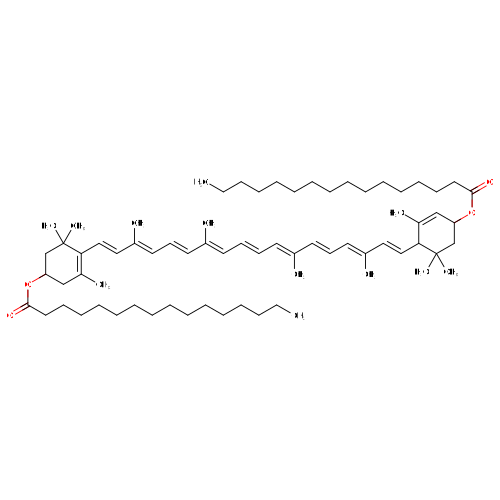
Common NameXantofyl palmitate
ClassSmall Molecule
DescriptionXantofyl palmitate is found in cereals and cereal products. Xantofyl palmitate is a food colourant for butter and bakery products.
Contaminant Sources
  • FooDB Chemicals
Contaminant TypeNot Available
Chemical Structure
Thumb
Synonyms
ValueSource
Xantofyl palmitic acidGenerator
AdaptinolHMDB
AptinolHMDB
e161bHMDB
HelenienHMDB
Helenien, janHMDB
HeligalHMDB
Lutein dipalmitateHMDB
Xantofyl palmitate, innHMDB
Xantophyll dipalmitateHMDB
4-[(1E,3E,5E,7E,9E,11E,13E,15E,17E)-18-[4-(Hexadecanoyloxy)-2,6,6-trimethylcyclohex-1-en-1-yl]-3,7,12,16-tetramethyloctadeca-1,3,5,7,9,11,13,15,17-nonaen-1-yl]-3,5,5-trimethylcyclohex-2-en-1-yl hexadecanoic acidGenerator
Chemical FormulaC72H116O4
Average Molecular Mass1045.689 g/mol
Monoisotopic Mass1044.887 g/mol
CAS Registry Number547-17-1
IUPAC Name4-[(1E,3E,5E,7E,9E,11E,13E,15E,17E)-18-[4-(hexadecanoyloxy)-2,6,6-trimethylcyclohex-2-en-1-yl]-3,7,12,16-tetramethyloctadeca-1,3,5,7,9,11,13,15,17-nonaen-1-yl]-3,5,5-trimethylcyclohex-3-en-1-yl hexadecanoate
Traditional Name4-[(1E,3E,5E,7E,9E,11E,13E,15E,17E)-18-[4-(hexadecanoyloxy)-2,6,6-trimethylcyclohex-2-en-1-yl]-3,7,12,16-tetramethyloctadeca-1,3,5,7,9,11,13,15,17-nonaen-1-yl]-3,5,5-trimethylcyclohex-3-en-1-yl hexadecanoate
SMILESCCCCCCCCCCCCCCCC(=O)OC1CC(C)=C(\C=C\C(\C)=C\C=C\C(\C)=C\C=C\C=C(/C)\C=C\C=C(/C)\C=C\C2C(C)=CC(CC2(C)C)OC(=O)CCCCCCCCCCCCCCC)C(C)(C)C1
InChI IdentifierInChI=1S/C72H116O4/c1-13-15-17-19-21-23-25-27-29-31-33-35-37-49-69(73)75-65-55-63(7)67(71(9,10)57-65)53-51-61(5)47-41-45-59(3)43-39-40-44-60(4)46-42-48-62(6)52-54-68-64(8)56-66(58-72(68,11)12)76-70(74)50-38-36-34-32-30-28-26-24-22-20-18-16-14-2/h39-48,51-55,65-67H,13-38,49-50,56-58H2,1-12H3/b40-39+,45-41+,46-42+,53-51+,54-52+,59-43+,60-44+,61-47+,62-48+
InChI KeyYHGJHDJZIOYZIR-HZXCUAKRSA-N
Chemical Taxonomy
Description belongs to the class of organic compounds known as xanthophylls. These are carotenoids containing an oxygenated carotene backbone. Carotenes are characterized by the presence of two end-groups (mostly cyclohexene rings, but also cyclopentene rings or acyclic groups) linked by a long branched alkyl chain. Carotenes belonging form a subgroup of the carotenoids family. Xanthophylls arise by oxygenation of the carotene backbone.
KingdomOrganic compounds
Super ClassLipids and lipid-like molecules
ClassPrenol lipids
Sub ClassTetraterpenoids
Direct ParentXanthophylls
Alternative Parents
Substituents
  • Xanthophyll
  • Fatty acid ester
  • Fatty acyl
  • Dicarboxylic acid or derivatives
  • Carboxylic acid ester
  • Carboxylic acid derivative
  • Organic oxygen compound
  • Organic oxide
  • Hydrocarbon derivative
  • Organooxygen compound
  • Carbonyl group
  • Aliphatic homomonocyclic compound
Molecular FrameworkAliphatic homomonocyclic compounds
External DescriptorsNot Available
Biological Properties
StatusDetected and Not Quantified
OriginNot Available
Cellular LocationsNot Available
Biofluid LocationsNot Available
Tissue LocationsNot Available
PathwaysNot Available
ApplicationsNot Available
Biological RolesNot Available
Chemical RolesNot Available
Physical Properties
StateNot Available
AppearanceNot Available
Experimental Properties
PropertyValue
Melting PointNot Available
Boiling PointNot Available
SolubilityNot Available
Predicted Properties
PropertyValueSource
Water Solubility5.2e-05 g/LALOGPS
logP10.96ALOGPS
logP22.39ChemAxon
logS-7.3ALOGPS
pKa (Strongest Basic)-6.7ChemAxon
Physiological Charge0ChemAxon
Hydrogen Acceptor Count2ChemAxon
Hydrogen Donor Count0ChemAxon
Polar Surface Area52.6 ŲChemAxon
Rotatable Bond Count42ChemAxon
Refractivity342.25 m³·mol⁻¹ChemAxon
Polarizability140.82 ųChemAxon
Number of Rings2ChemAxon
Bioavailability0ChemAxon
Rule of FiveNoChemAxon
Ghose FilterNoChemAxon
Veber's RuleNoChemAxon
MDDR-like RuleNoChemAxon
Spectra
Spectra
Spectrum TypeDescriptionSplash KeyView
Predicted LC-MS/MSPredicted LC-MS/MS Spectrum - 10V, Positivesplash10-000j-9063324420-f60242c6bb742492ef40Spectrum
Predicted LC-MS/MSPredicted LC-MS/MS Spectrum - 20V, Positivesplash10-0f79-0392468520-d011c3f40b5f83a7805dSpectrum
Predicted LC-MS/MSPredicted LC-MS/MS Spectrum - 40V, Positivesplash10-0ftr-1551259700-0992fe828870e04e7c8bSpectrum
Predicted LC-MS/MSPredicted LC-MS/MS Spectrum - 10V, Negativesplash10-0006-9020000030-5e52f8e11dc2e4f64bbcSpectrum
Predicted LC-MS/MSPredicted LC-MS/MS Spectrum - 20V, Negativesplash10-0a4i-5090030180-61b849d328cd8579ce60Spectrum
Predicted LC-MS/MSPredicted LC-MS/MS Spectrum - 40V, Negativesplash10-0ap0-3090081120-d7ee1a8cdfae037289cbSpectrum
Predicted LC-MS/MSPredicted LC-MS/MS Spectrum - 10V, Negativesplash10-052f-9041010240-ec9667609564dc24aa70Spectrum
Predicted LC-MS/MSPredicted LC-MS/MS Spectrum - 20V, Negativesplash10-0a4r-5091032310-43dc8aa01233b1684fe2Spectrum
Predicted LC-MS/MSPredicted LC-MS/MS Spectrum - 40V, Negativesplash10-0pdj-0520002109-6bd7b271966329a07397Spectrum
Predicted LC-MS/MSPredicted LC-MS/MS Spectrum - 10V, Positivesplash10-000b-9000052410-d863b0ff384c2042daa0Spectrum
Predicted LC-MS/MSPredicted LC-MS/MS Spectrum - 20V, Positivesplash10-000b-0300044900-af89559ad1ecba74dcfaSpectrum
Predicted LC-MS/MSPredicted LC-MS/MS Spectrum - 40V, Positivesplash10-001s-1130093104-cf208e584861b355ec21Spectrum
Toxicity Profile
Route of ExposureNot Available
Mechanism of ToxicityNot Available
MetabolismNot Available
Toxicity ValuesNot Available
Lethal DoseNot Available
Carcinogenicity (IARC Classification)Not Available
Uses/SourcesNot Available
Minimum Risk LevelNot Available
Health EffectsNot Available
SymptomsNot Available
TreatmentNot Available
Concentrations
Not Available
DrugBank IDNot Available
HMDB IDHMDB0036566
FooDB IDFDB015470
Phenol Explorer IDNot Available
KNApSAcK IDC00003774
BiGG IDNot Available
BioCyc IDNot Available
METLIN IDNot Available
PDB IDNot Available
Wikipedia LinkNot Available
Chemspider ID4900218
ChEBI IDNot Available
PubChem Compound ID6373854
Kegg Compound IDC08597
YMDB IDNot Available
ECMDB IDNot Available
References
Synthesis ReferenceNot Available
MSDSNot Available
General References
1. Simons K, Toomre D: Lipid rafts and signal transduction. Nat Rev Mol Cell Biol. 2000 Oct;1(1):31-9.
2. Watson AD: Thematic review series: systems biology approaches to metabolic and cardiovascular disorders. Lipidomics: a global approach to lipid analysis in biological systems. J Lipid Res. 2006 Oct;47(10):2101-11. Epub 2006 Aug 10.
3. Sethi JK, Vidal-Puig AJ: Thematic review series: adipocyte biology. Adipose tissue function and plasticity orchestrate nutritional adaptation. J Lipid Res. 2007 Jun;48(6):1253-62. Epub 2007 Mar 20.
4. Lingwood D, Simons K: Lipid rafts as a membrane-organizing principle. Science. 2010 Jan 1;327(5961):46-50. doi: 10.1126/science.1174621.
5. Yannai, Shmuel. (2004) Dictionary of food compounds with CD-ROM: Additives, flavors, and ingredients. Boca Raton: Chapman & Hall/CRC.
6. The lipid handbook with CD-ROM