Record Information
Version1.0
Creation Date2016-05-26 00:08:47 UTC
Update Date2016-11-09 01:18:35 UTC
Accession NumberCHEM027995
Identification
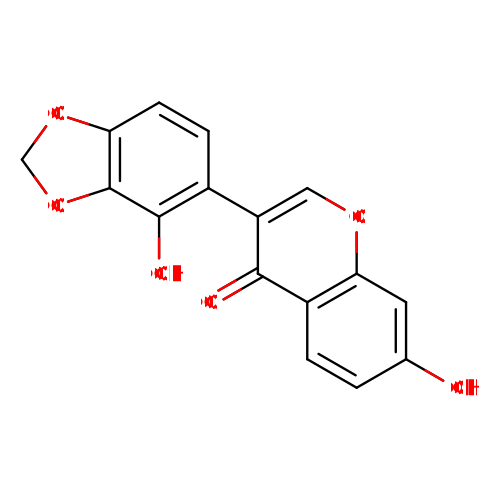
Common NameGlyzaglabrin
ClassSmall Molecule
DescriptionGlyzaglabrin is found in herbs and spices. Glyzaglabrin is isolated from root of Glycyrrhiza glabra (licorice).
Contaminant Sources
  • FooDB Chemicals
Contaminant TypeNot Available
Chemical Structure
Thumb
Synonyms
ValueSource
2',7-Dihydroxy-3',4'-methylenedioxyisoflavoneHMDB
7,2'-Dihydroxy-3',4'-methylenedioxyisoflavoneHMDB
Chemical FormulaC16H10O6
Average Molecular Mass298.247 g/mol
Monoisotopic Mass298.048 g/mol
CAS Registry Number65242-64-0
IUPAC Name7-hydroxy-3-(4-hydroxy-2H-1,3-benzodioxol-5-yl)-4H-chromen-4-one
Traditional Nameglyzaglabrin
SMILESOC1=CC2=C(C=C1)C(=O)C(=CO2)C1=C(O)C2=C(OCO2)C=C1
InChI IdentifierInChI=1S/C16H10O6/c17-8-1-2-10-13(5-8)20-6-11(14(10)18)9-3-4-12-16(15(9)19)22-7-21-12/h1-6,17,19H,7H2
InChI KeyGRMSSCUVELGNHC-UHFFFAOYSA-N
Chemical Taxonomy
Description belongs to the class of organic compounds known as isoflavones. These are polycyclic compounds containing a 2-isoflavene skeleton which bears a ketone group at the C4 carbon atom.
KingdomOrganic compounds
Super ClassPhenylpropanoids and polyketides
ClassIsoflavonoids
Sub ClassIsoflav-2-enes
Direct ParentIsoflavones
Alternative Parents
Substituents
  • Isoflavone
  • Hydroxyisoflavonoid
  • Chromone
  • Benzopyran
  • 1-benzopyran
  • Benzodioxole
  • 1-hydroxy-2-unsubstituted benzenoid
  • Pyranone
  • 1-hydroxy-4-unsubstituted benzenoid
  • Benzenoid
  • Pyran
  • Heteroaromatic compound
  • Oxacycle
  • Organoheterocyclic compound
  • Acetal
  • Hydrocarbon derivative
  • Organooxygen compound
  • Organic oxygen compound
  • Organic oxide
  • Aromatic heteropolycyclic compound
Molecular FrameworkAromatic heteropolycyclic compounds
External Descriptors
Biological Properties
StatusDetected and Not Quantified
OriginNot Available
Cellular LocationsNot Available
Biofluid LocationsNot Available
Tissue LocationsNot Available
PathwaysNot Available
ApplicationsNot Available
Biological RolesNot Available
Chemical RolesNot Available
Physical Properties
StateNot Available
AppearanceNot Available
Experimental Properties
PropertyValue
Melting PointNot Available
Boiling PointNot Available
SolubilityNot Available
Predicted Properties
PropertyValueSource
Water Solubility0.16 g/LALOGPS
logP2.71ALOGPS
logP2.35ChemAxon
logS-3.3ALOGPS
pKa (Strongest Acidic)6.47ChemAxon
pKa (Strongest Basic)-4.7ChemAxon
Physiological Charge-1ChemAxon
Hydrogen Acceptor Count6ChemAxon
Hydrogen Donor Count2ChemAxon
Polar Surface Area85.22 ŲChemAxon
Rotatable Bond Count1ChemAxon
Refractivity75.47 m³·mol⁻¹ChemAxon
Polarizability29.02 ųChemAxon
Number of Rings4ChemAxon
Bioavailability1ChemAxon
Rule of FiveYesChemAxon
Ghose FilterYesChemAxon
Veber's RuleNoChemAxon
MDDR-like RuleNoChemAxon
Spectra
Spectra
Spectrum TypeDescriptionSplash KeyView
Predicted GC-MSPredicted GC-MS Spectrum - GC-MS (Non-derivatized) - 70eV, Positivesplash10-00xr-0290000000-1af27d28183f047e83b8Spectrum
Predicted GC-MSPredicted GC-MS Spectrum - GC-MS (2 TMS) - 70eV, Positivesplash10-00di-6258900000-8f9afff93fed40e8d361Spectrum
Predicted GC-MSPredicted GC-MS Spectrum - GC-MS (Non-derivatized) - 70eV, PositiveNot AvailableSpectrum
Predicted LC-MS/MSPredicted LC-MS/MS Spectrum - 10V, Positivesplash10-0002-0090000000-5bda2756d0ddbfc4a0a3Spectrum
Predicted LC-MS/MSPredicted LC-MS/MS Spectrum - 20V, Positivesplash10-0002-0090000000-920ea4d3542e248ab697Spectrum
Predicted LC-MS/MSPredicted LC-MS/MS Spectrum - 40V, Positivesplash10-03g0-2590000000-c0ead0d703f631524f21Spectrum
Predicted LC-MS/MSPredicted LC-MS/MS Spectrum - 10V, Negativesplash10-0002-0090000000-28ca22ce90df33e58ebbSpectrum
Predicted LC-MS/MSPredicted LC-MS/MS Spectrum - 20V, Negativesplash10-0002-0090000000-aeb617a91b3117584d49Spectrum
Predicted LC-MS/MSPredicted LC-MS/MS Spectrum - 40V, Negativesplash10-004r-4890000000-5075616fa31480d3af74Spectrum
Predicted LC-MS/MSPredicted LC-MS/MS Spectrum - 10V, Negativesplash10-0002-0090000000-96de5c56a94c496da9f8Spectrum
Predicted LC-MS/MSPredicted LC-MS/MS Spectrum - 20V, Negativesplash10-0002-0090000000-ff73fa19df83630a66b7Spectrum
Predicted LC-MS/MSPredicted LC-MS/MS Spectrum - 40V, Negativesplash10-00or-0290000000-5b25734485ad1750b90bSpectrum
Predicted LC-MS/MSPredicted LC-MS/MS Spectrum - 10V, Positivesplash10-0002-0090000000-0e40d1dc69d66b601127Spectrum
Predicted LC-MS/MSPredicted LC-MS/MS Spectrum - 20V, Positivesplash10-0002-0090000000-b9d731bcc7f1987e8394Spectrum
Predicted LC-MS/MSPredicted LC-MS/MS Spectrum - 40V, Positivesplash10-00r2-0190000000-d1410e87c752015ed03aSpectrum
Toxicity Profile
Route of ExposureNot Available
Mechanism of ToxicityNot Available
MetabolismNot Available
Toxicity ValuesNot Available
Lethal DoseNot Available
Carcinogenicity (IARC Classification)Not Available
Uses/SourcesNot Available
Minimum Risk LevelNot Available
Health EffectsNot Available
SymptomsNot Available
TreatmentNot Available
Concentrations
Not Available
DrugBank IDNot Available
HMDB IDHMDB0033859
FooDB IDFDB012043
Phenol Explorer IDNot Available
KNApSAcK IDC00009399
BiGG IDNot Available
BioCyc IDNot Available
METLIN IDNot Available
PDB IDNot Available
Wikipedia LinkNot Available
Chemspider ID4476529
ChEBI IDNot Available
PubChem Compound ID5317777
Kegg Compound IDNot Available
YMDB IDNot Available
ECMDB IDNot Available
References
Synthesis ReferenceNot Available
MSDSNot Available
General References
1. Yannai, Shmuel. (2004) Dictionary of food compounds with CD-ROM: Additives, flavors, and ingredients. Boca Raton: Chapman & Hall/CRC.