| Record Information |
|---|
| Version | 1.0 |
|---|
| Creation Date | 2016-05-25 22:55:18 UTC |
|---|
| Update Date | 2016-11-09 01:18:15 UTC |
|---|
| Accession Number | CHEM026318 |
|---|
| Identification |
|---|
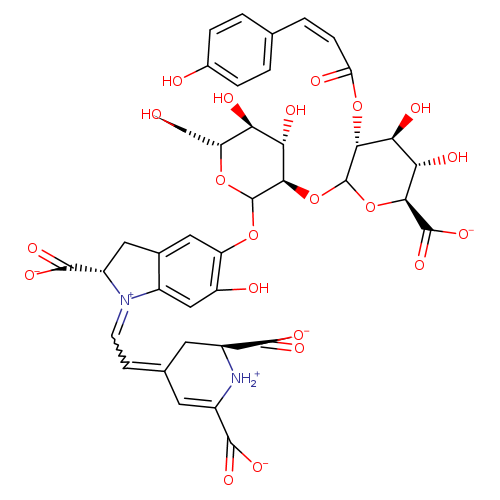
| Common Name | Celosianin |
|---|
| Class | Small Molecule |
|---|
| Description | Celosianin is also known as 4-coumaroylamaranthin. Celosianin is practically insoluble (in water) and a moderately acidic compound (based on its pKa). Celosianin can be found in spinach, which makes celosianin a potential biomarker for the consumption of this food product. |
|---|
| Contaminant Sources | |
|---|
| Contaminant Type | Not Available |
|---|
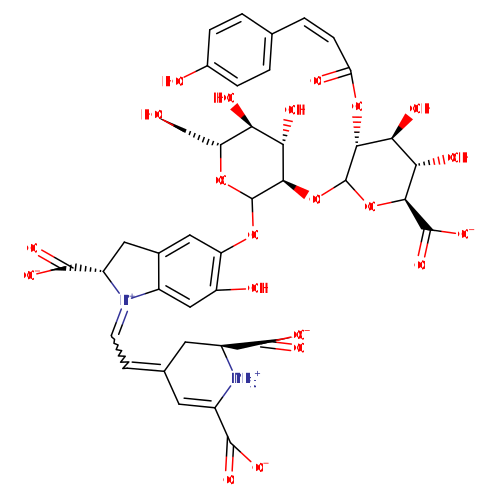
| Chemical Structure | |
|---|
| Synonyms | | Value | Source |
|---|
| 4-Coumaroylamaranthin | MetaCyc |
|
|---|
| Chemical Formula | C39H38N2O21 |
|---|
| Average Molecular Mass | 870.720 g/mol |
|---|
| Monoisotopic Mass | 870.197 g/mol |
|---|
| CAS Registry Number | Not Available |
|---|
| IUPAC Name | (2S,4E)-4-{2-[(2S)-2-carboxylato-5-{[(3R,4S,5S,6R)-3-{[(3R,4S,5S,6S)-6-carboxylato-4,5-dihydroxy-3-{[(2Z)-3-(4-hydroxyphenyl)prop-2-enoyl]oxy}oxan-2-yl]oxy}-4,5-dihydroxy-6-(hydroxymethyl)oxan-2-yl]oxy}-6-hydroxy-2,3-dihydro-1H-1λ⁵-indol-1-ylium-1-ylidene]ethylidene}-1,2,3,4-tetrahydropyridin-1-ium-2,6-dicarboxylate |
|---|
| Traditional Name | (2S,4E)-4-{2-[(2S)-2-carboxylato-5-{[(3R,4S,5S,6R)-3-{[(3R,4S,5S,6S)-6-carboxylato-4,5-dihydroxy-3-{[(2Z)-3-(4-hydroxyphenyl)prop-2-enoyl]oxy}oxan-2-yl]oxy}-4,5-dihydroxy-6-(hydroxymethyl)oxan-2-yl]oxy}-6-hydroxy-2,3-dihydro-1H-1λ⁵-indol-1-ylium-1-ylidene]ethylidene}-2,3-dihydro-1H-pyridin-1-ium-2,6-dicarboxylate |
|---|
| SMILES | OC[C@H]1OC(OC2=C(O)C=C3C(C[C@@H](C([O-])=O)[N+]3=C\C=C3/C[C@H]([NH2+]C(=C3)C([O-])=O)C([O-])=O)=C2)[C@H](OC2O[C@@H]([C@@H](O)[C@H](O)[C@H]2OC(=O)\C=C/C2=CC=C(O)C=C2)C([O-])=O)[C@@H](O)[C@@H]1O |
|---|
| InChI Identifier | InChI=1S/C39H40N2O21/c42-14-25-27(46)28(47)33(62-39-32(30(49)29(48)31(61-39)37(56)57)60-26(45)6-3-15-1-4-18(43)5-2-15)38(59-25)58-24-12-17-11-22(36(54)55)41(21(17)13-23(24)44)8-7-16-9-19(34(50)51)40-20(10-16)35(52)53/h1-9,12-13,20,22,25,27-33,38-39,42,46-49H,10-11,14H2,(H6,43,44,45,50,51,52,53,54,55,56,57)/p-2/t20-,22-,25+,27+,28-,29-,30-,31-,32+,33+,38?,39?/m0/s1 |
|---|
| InChI Key | VYAFZESLHLWKCS-AHJBFHQGSA-L |
|---|
| Chemical Taxonomy |
|---|
| Description | belongs to the class of organic compounds known as betacyanins and derivatives. These are organic compounds containing a glycoside of indolium-2-carboxylic acid attached, with the nitrogen ring of the indolium ring attached to an ethylpyridine-2,6-dicarboxylic acid derivative. Betacyanins are red nitrogenous pigments found in certain plants, such as beetroots. |
|---|
| Kingdom | Organic compounds |
|---|
| Super Class | Alkaloids and derivatives |
|---|
| Class | Betalains |
|---|
| Sub Class | Betacyanins and derivatives |
|---|
| Direct Parent | Betacyanins and derivatives |
|---|
| Alternative Parents | |
|---|
| Substituents | - Betacyanin
- Betaxanthin skeleton
- Pentacarboxylic acid or derivatives
- Phenolic glycoside
- 1-o-glucuronide
- O-glucuronide
- Coumaric acid ester
- Glucuronic acid or derivatives
- Cinnamic acid or derivatives
- Coumaric acid or derivatives
- Hydroxycinnamic acid or derivatives
- Indolecarboxylic acid
- Indolecarboxylic acid derivative
- Cinnamic acid ester
- Disaccharide
- Glycosyl compound
- O-glycosyl compound
- L-alpha-amino acid
- Alpha-amino acid
- Alpha-amino acid or derivatives
- Indole or derivatives
- Styrene
- Tetrahydropyridine
- 1-hydroxy-2-unsubstituted benzenoid
- Phenol
- Beta-hydroxy acid
- Fatty acid ester
- Hydropyridine
- Oxane
- Hydroxy acid
- Monocyclic benzene moiety
- Pyran
- Fatty acyl
- Benzenoid
- Alpha,beta-unsaturated carboxylic ester
- Enoate ester
- Carboxylic acid salt
- Carboxylic acid ester
- Shiff base
- Amino acid
- Secondary alcohol
- Amino acid or derivatives
- Secondary amine
- Acetal
- Carboxylic acid derivative
- Carboxylic acid
- Organoheterocyclic compound
- Secondary aliphatic amine
- Azacycle
- Oxacycle
- Organic salt
- Primary alcohol
- Organic oxygen compound
- Organopnictogen compound
- Carbonyl group
- Organic oxide
- Organic nitrogen compound
- Alcohol
- Hydrocarbon derivative
- Organonitrogen compound
- Amine
- Organooxygen compound
- Organic anion
- Aromatic heteropolycyclic compound
|
|---|
| Molecular Framework | Aromatic heteropolycyclic compounds |
|---|
| External Descriptors | Not Available |
|---|
| Biological Properties |
|---|
| Status | Detected and Not Quantified |
|---|
| Origin | Not Available |
|---|
| Cellular Locations | Not Available |
|---|
| Biofluid Locations | Not Available |
|---|
| Tissue Locations | Not Available |
|---|
| Pathways | Not Available |
|---|
| Applications | Not Available |
|---|
| Biological Roles | Not Available |
|---|
| Chemical Roles | Not Available |
|---|
| Physical Properties |
|---|
| State | Not Available |
|---|
| Appearance | Not Available |
|---|
| Experimental Properties | | Property | Value |
|---|
| Melting Point | Not Available | | Boiling Point | Not Available | | Solubility | Not Available |
|
|---|
| Predicted Properties | |
|---|
| Spectra |
|---|
| Spectra | | Spectrum Type | Description | Splash Key | View |
|---|
| Predicted LC-MS/MS | Predicted LC-MS/MS Spectrum - 10V, Positive | splash10-00dr-0000000090-7ddb6edf6122eec39fa7 | Spectrum | | Predicted LC-MS/MS | Predicted LC-MS/MS Spectrum - 20V, Positive | splash10-00kr-0000000090-4076a38bde894eca3b04 | Spectrum | | Predicted LC-MS/MS | Predicted LC-MS/MS Spectrum - 40V, Positive | splash10-029f-9102110160-1590f76d1b0a2fe3c6cf | Spectrum | | Predicted LC-MS/MS | Predicted LC-MS/MS Spectrum - 10V, Negative | splash10-014i-1000000090-3989263baac35a10489d | Spectrum | | Predicted LC-MS/MS | Predicted LC-MS/MS Spectrum - 20V, Negative | splash10-0159-5100000090-9668ac76a62606c6bd46 | Spectrum | | Predicted LC-MS/MS | Predicted LC-MS/MS Spectrum - 40V, Negative | splash10-0596-9100000000-5f1e642e1790e454ef68 | Spectrum |
|
|---|
| Toxicity Profile |
|---|
| Route of Exposure | Not Available |
|---|
| Mechanism of Toxicity | Not Available |
|---|
| Metabolism | Not Available |
|---|
| Toxicity Values | Not Available |
|---|
| Lethal Dose | Not Available |
|---|
| Carcinogenicity (IARC Classification) | Not Available |
|---|
| Uses/Sources | Not Available |
|---|
| Minimum Risk Level | Not Available |
|---|
| Health Effects | Not Available |
|---|
| Symptoms | Not Available |
|---|
| Treatment | Not Available |
|---|
| Concentrations |
|---|
| Not Available |
|---|
| External Links |
|---|
| DrugBank ID | Not Available |
|---|
| HMDB ID | HMDB0302989 |
|---|
| FooDB ID | FDB007160 |
|---|
| Phenol Explorer ID | Not Available |
|---|
| KNApSAcK ID | Not Available |
|---|
| BiGG ID | Not Available |
|---|
| BioCyc ID | Not Available |
|---|
| METLIN ID | Not Available |
|---|
| PDB ID | Not Available |
|---|
| Wikipedia Link | Not Available |
|---|
| Chemspider ID | Not Available |
|---|
| ChEBI ID | Not Available |
|---|
| PubChem Compound ID | 54740360 |
|---|
| Kegg Compound ID | Not Available |
|---|
| YMDB ID | Not Available |
|---|
| ECMDB ID | Not Available |
|---|
| References |
|---|
| Synthesis Reference | Not Available |
|---|
| MSDS | Not Available |
|---|
| General References | Not Available |
|---|