Record Information
Version1.0
Creation Date2016-05-25 22:01:45 UTC
Update Date2016-11-09 01:17:59 UTC
Accession NumberCHEM024941
Identification
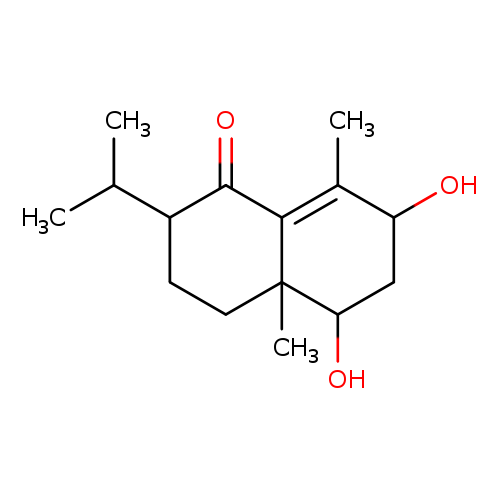
Common NameAcorusdiol
ClassSmall Molecule
DescriptionAcorusdiol is found in herbs and spices. Acorusdiol is a constituent of Acorus calamus (sweet flag)
Contaminant Sources
  • FooDB Chemicals
Contaminant TypeNot Available
Chemical Structure
Thumb
SynonymsNot Available
Chemical FormulaC15H24O3
Average Molecular Mass252.349 g/mol
Monoisotopic Mass252.173 g/mol
CAS Registry Number185307-44-2
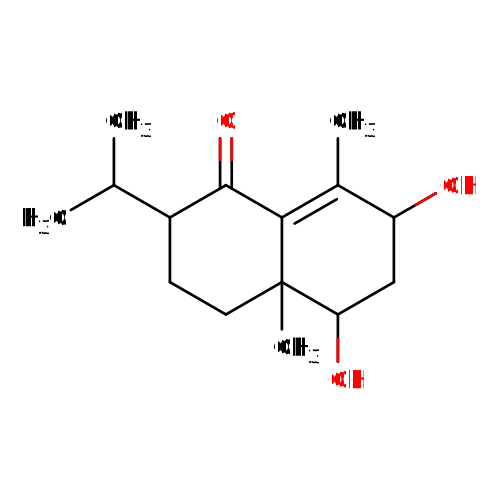
IUPAC Name5,7-dihydroxy-4a,8-dimethyl-2-(propan-2-yl)-1,2,3,4,4a,5,6,7-octahydronaphthalen-1-one
Traditional Name5,7-dihydroxy-2-isopropyl-4a,8-dimethyl-2,3,4,5,6,7-hexahydronaphthalen-1-one
SMILESCC(C)C1CCC2(C)C(O)CC(O)C(C)=C2C1=O
InChI IdentifierInChI=1S/C15H24O3/c1-8(2)10-5-6-15(4)12(17)7-11(16)9(3)13(15)14(10)18/h8,10-12,16-17H,5-7H2,1-4H3
InChI KeyXMGSOQRMWQXOKH-UHFFFAOYSA-N
Chemical Taxonomy
Description belongs to the class of organic compounds known as eudesmane, isoeudesmane or cycloeudesmane sesquiterpenoids. These are sesquiterpenoids with a structure based on the eudesmane skeleton.
KingdomOrganic compounds
Super ClassLipids and lipid-like molecules
ClassPrenol lipids
Sub ClassSesquiterpenoids
Direct ParentEudesmane, isoeudesmane or cycloeudesmane sesquiterpenoids
Alternative Parents
Substituents
  • Eudesmane, isoeudesmane or cycloeudesmane sesquiterpenoid
  • Secondary alcohol
  • Ketone
  • Organic oxygen compound
  • Organic oxide
  • Hydrocarbon derivative
  • Organooxygen compound
  • Carbonyl group
  • Alcohol
  • Aliphatic homopolycyclic compound
Molecular FrameworkAliphatic homopolycyclic compounds
External DescriptorsNot Available
Biological Properties
StatusDetected and Not Quantified
OriginNot Available
Cellular LocationsNot Available
Biofluid LocationsNot Available
Tissue LocationsNot Available
PathwaysNot Available
ApplicationsNot Available
Biological RolesNot Available
Chemical RolesNot Available
Physical Properties
StateNot Available
AppearanceNot Available
Experimental Properties
PropertyValue
Melting PointNot Available
Boiling PointNot Available
SolubilityNot Available
Predicted Properties
PropertyValueSource
Water Solubility2.51 g/LALOGPS
logP1.5ALOGPS
logP1.88ChemAxon
logS-2ALOGPS
pKa (Strongest Acidic)14.21ChemAxon
pKa (Strongest Basic)-3ChemAxon
Physiological Charge0ChemAxon
Hydrogen Acceptor Count3ChemAxon
Hydrogen Donor Count2ChemAxon
Polar Surface Area57.53 ŲChemAxon
Rotatable Bond Count1ChemAxon
Refractivity71.11 m³·mol⁻¹ChemAxon
Polarizability28.65 ųChemAxon
Number of Rings2ChemAxon
Bioavailability1ChemAxon
Rule of FiveYesChemAxon
Ghose FilterYesChemAxon
Veber's RuleNoChemAxon
MDDR-like RuleNoChemAxon
Spectra
Spectra
Spectrum TypeDescriptionSplash KeyView
Predicted GC-MSPredicted GC-MS Spectrum - GC-MS (Non-derivatized) - 70eV, Positivesplash10-0a4i-1390000000-4a0601ebdd5d437ae2aeSpectrum
Predicted GC-MSPredicted GC-MS Spectrum - GC-MS (2 TMS) - 70eV, Positivesplash10-003r-8169000000-6ae8a45ef09484f1ea13Spectrum
Predicted GC-MSPredicted GC-MS Spectrum - GC-MS (Non-derivatized) - 70eV, PositiveNot AvailableSpectrum
Predicted LC-MS/MSPredicted LC-MS/MS Spectrum - 10V, Positivesplash10-0f79-0190000000-03370f2da654021bf57eSpectrum
Predicted LC-MS/MSPredicted LC-MS/MS Spectrum - 20V, Positivesplash10-0frm-4980000000-c8c115496f7cb00ff501Spectrum
Predicted LC-MS/MSPredicted LC-MS/MS Spectrum - 40V, Positivesplash10-0a4i-9210000000-4876c23c12f30ee75139Spectrum
Predicted LC-MS/MSPredicted LC-MS/MS Spectrum - 10V, Negativesplash10-0udi-0090000000-362b8b897678fcb02029Spectrum
Predicted LC-MS/MSPredicted LC-MS/MS Spectrum - 20V, Negativesplash10-0ue9-0390000000-56fa179a6c8c828af8a5Spectrum
Predicted LC-MS/MSPredicted LC-MS/MS Spectrum - 40V, Negativesplash10-0udi-2930000000-71ab0c2357b16472adceSpectrum
Predicted LC-MS/MSPredicted LC-MS/MS Spectrum - 10V, Negativesplash10-0udi-0090000000-96235d738c6453145a08Spectrum
Predicted LC-MS/MSPredicted LC-MS/MS Spectrum - 20V, Negativesplash10-0udi-0090000000-f018be26ea71f3d1e5c8Spectrum
Predicted LC-MS/MSPredicted LC-MS/MS Spectrum - 40V, Negativesplash10-0ug0-2950000000-763d6a086c396b4fb2a8Spectrum
Predicted LC-MS/MSPredicted LC-MS/MS Spectrum - 10V, Positivesplash10-000i-0090000000-89593438bc6d1727bae6Spectrum
Predicted LC-MS/MSPredicted LC-MS/MS Spectrum - 20V, Positivesplash10-000i-0290000000-122f0e125336dee59326Spectrum
Predicted LC-MS/MSPredicted LC-MS/MS Spectrum - 40V, Positivesplash10-00o3-9510000000-79fc9d9a6cb5a1c7e796Spectrum
Toxicity Profile
Route of ExposureNot Available
Mechanism of ToxicityNot Available
MetabolismNot Available
Toxicity ValuesNot Available
Lethal DoseNot Available
Carcinogenicity (IARC Classification)Not Available
Uses/SourcesNot Available
Minimum Risk LevelNot Available
Health EffectsNot Available
SymptomsNot Available
TreatmentNot Available
Concentrations
Not Available
DrugBank IDNot Available
HMDB IDHMDB0030919
FooDB IDFDB002885
Phenol Explorer IDNot Available
KNApSAcK IDC00054659
BiGG IDNot Available
BioCyc IDNot Available
METLIN IDNot Available
PDB IDNot Available
Wikipedia LinkNot Available
Chemspider ID35013289
ChEBI IDNot Available
PubChem Compound ID85231214
Kegg Compound IDNot Available
YMDB IDNot Available
ECMDB IDNot Available
References
Synthesis ReferenceNot Available
MSDSNot Available
General References
1. Simons K, Toomre D: Lipid rafts and signal transduction. Nat Rev Mol Cell Biol. 2000 Oct;1(1):31-9.
2. Watson AD: Thematic review series: systems biology approaches to metabolic and cardiovascular disorders. Lipidomics: a global approach to lipid analysis in biological systems. J Lipid Res. 2006 Oct;47(10):2101-11. Epub 2006 Aug 10.
3. Sethi JK, Vidal-Puig AJ: Thematic review series: adipocyte biology. Adipose tissue function and plasticity orchestrate nutritional adaptation. J Lipid Res. 2007 Jun;48(6):1253-62. Epub 2007 Mar 20.
4. Lingwood D, Simons K: Lipid rafts as a membrane-organizing principle. Science. 2010 Jan 1;327(5961):46-50. doi: 10.1126/science.1174621.
5. Yannai, Shmuel. (2004) Dictionary of food compounds with CD-ROM: Additives, flavors, and ingredients. Boca Raton: Chapman & Hall/CRC.
6. The lipid handbook with CD-ROM