Record Information
Version1.0
Creation Date2016-05-25 21:13:28 UTC
Update Date2026-04-06 02:00:47 UTC
Accession NumberCHEM023673
Identification
Common NameColupulone
ClassSmall Molecule
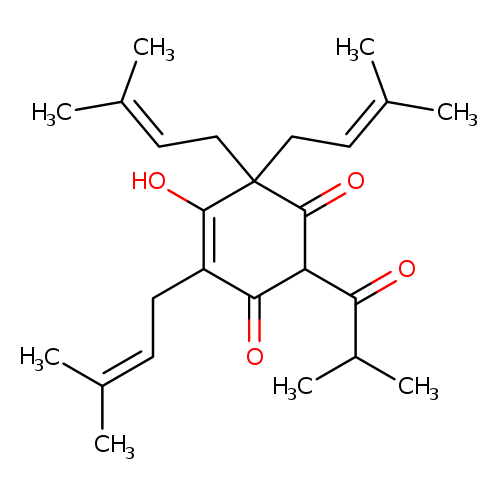
DescriptionColupulone is found in alcoholic beverages. Colupulone is a constituent of the resin of English hops
Contaminant Sources
  • FooDB Chemicals
Contaminant TypeNot Available
Chemical Structure
Thumb
Synonyms
ValueSource
CO-LupuloneHMDB
Chemical FormulaC25H36O4
Average Molecular Mass400.551 g/mol
Monoisotopic Mass400.261 g/mol
CAS Registry Number468-27-9
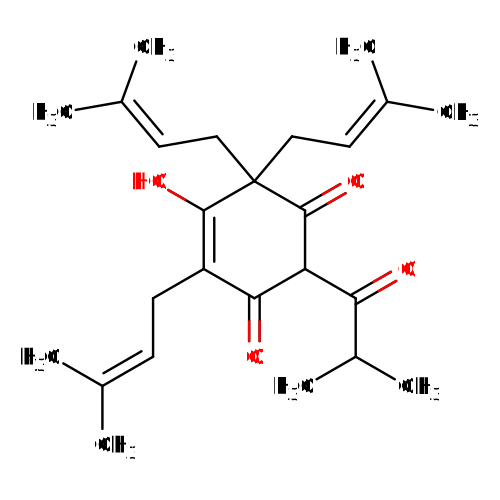
IUPAC Name5-hydroxy-4,6,6-tris(3-methylbut-2-en-1-yl)-2-(2-methylpropanoyl)cyclohex-4-ene-1,3-dione
Traditional Name5-hydroxy-4,6,6-tris(3-methylbut-2-en-1-yl)-2-(2-methylpropanoyl)cyclohex-4-ene-1,3-dione
SMILESCC(C)C(=O)C1C(=O)C(CC=C(C)C)=C(O)C(CC=C(C)C)(CC=C(C)C)C1=O
InChI IdentifierInChI=1S/C25H36O4/c1-15(2)9-10-19-22(27)20(21(26)18(7)8)24(29)25(23(19)28,13-11-16(3)4)14-12-17(5)6/h9,11-12,18,20,28H,10,13-14H2,1-8H3
InChI KeyFJDKDBGVEXNOEZ-UHFFFAOYSA-N
Chemical Taxonomy
Description belongs to the class of organic compounds known as m-benzoquinones. These are benzoquinones where the two C=O groups are attached at the 1- and 3-position, respectively.
KingdomOrganic compounds
Super ClassOrganic oxygen compounds
ClassOrganooxygen compounds
Sub ClassCarbonyl compounds
Direct ParentM-benzoquinones
Alternative Parents
Substituents
  • M-benzoquinone
  • Cyclohexenone
  • 1,3-diketone
  • 1,3-dicarbonyl compound
  • Vinylogous acid
  • Enol
  • Organic oxide
  • Hydrocarbon derivative
  • Aliphatic homomonocyclic compound
Molecular FrameworkAliphatic homomonocyclic compounds
External DescriptorsNot Available
Biological Properties
StatusDetected and Not Quantified
OriginNot Available
Cellular LocationsNot Available
Biofluid LocationsNot Available
Tissue LocationsNot Available
PathwaysNot Available
ApplicationsNot Available
Biological RolesNot Available
Chemical RolesNot Available
Physical Properties
StateNot Available
AppearanceNot Available
Experimental Properties
PropertyValue
Melting PointNot Available
Boiling PointNot Available
SolubilityNot Available
Predicted Properties
PropertyValueSource
Water Solubility0.0052 g/LALOGPS
logP4.23ALOGPS
logP6.6ChemAxon
logS-4.9ALOGPS
pKa (Strongest Acidic)5.52ChemAxon
pKa (Strongest Basic)-6.2ChemAxon
Physiological Charge-1ChemAxon
Hydrogen Acceptor Count4ChemAxon
Hydrogen Donor Count1ChemAxon
Polar Surface Area71.44 ŲChemAxon
Rotatable Bond Count8ChemAxon
Refractivity122.01 m³·mol⁻¹ChemAxon
Polarizability46.65 ųChemAxon
Number of Rings1ChemAxon
Bioavailability1ChemAxon
Rule of FiveNoChemAxon
Ghose FilterNoChemAxon
Veber's RuleNoChemAxon
MDDR-like RuleNoChemAxon
Spectra
Spectra
Spectrum TypeDescriptionSplash KeyView
Predicted GC-MSPredicted GC-MS Spectrum - GC-MS (Non-derivatized) - 70eV, Positivesplash10-0abl-9327000000-a2b2418ee20b5fe6fddcSpectrum
Predicted GC-MSPredicted GC-MS Spectrum - GC-MS (1 TMS) - 70eV, Positivesplash10-0adi-9212800000-543d9bdab1ac539cb826Spectrum
Predicted GC-MSPredicted GC-MS Spectrum - GC-MS (Non-derivatized) - 70eV, PositiveNot AvailableSpectrum
Predicted LC-MS/MSPredicted LC-MS/MS Spectrum - 10V, Positivesplash10-0zgi-1009500000-52b8e86c723279aa2423Spectrum
Predicted LC-MS/MSPredicted LC-MS/MS Spectrum - 20V, Positivesplash10-060s-5129100000-c030fa83408e9c3b9860Spectrum
Predicted LC-MS/MSPredicted LC-MS/MS Spectrum - 40V, Positivesplash10-01c1-9412000000-3b26c444dbf132783557Spectrum
Predicted LC-MS/MSPredicted LC-MS/MS Spectrum - 10V, Negativesplash10-0002-0009000000-a04054665e36893c25e5Spectrum
Predicted LC-MS/MSPredicted LC-MS/MS Spectrum - 20V, Negativesplash10-004i-2119000000-ad0459861643e13eb673Spectrum
Predicted LC-MS/MSPredicted LC-MS/MS Spectrum - 40V, Negativesplash10-001l-9638000000-580f03c6adcc95590986Spectrum
Predicted LC-MS/MSPredicted LC-MS/MS Spectrum - 10V, Positivesplash10-0udi-0024900000-72d2446136763d553f0dSpectrum
Predicted LC-MS/MSPredicted LC-MS/MS Spectrum - 20V, Positivesplash10-005j-1197100000-116abc9137f624215094Spectrum
Predicted LC-MS/MSPredicted LC-MS/MS Spectrum - 40V, Positivesplash10-00dl-5593000000-fbac3fb1d4cf793ef4c8Spectrum
Predicted LC-MS/MSPredicted LC-MS/MS Spectrum - 10V, Negativesplash10-0002-0009000000-d15b9ee8f8913bd78505Spectrum
Predicted LC-MS/MSPredicted LC-MS/MS Spectrum - 20V, Negativesplash10-0002-1009000000-6301a67ca94231838829Spectrum
Predicted LC-MS/MSPredicted LC-MS/MS Spectrum - 40V, Negativesplash10-0bt9-1692000000-31c4be746e41df1ca9a9Spectrum
Toxicity Profile
Route of ExposureNot Available
Mechanism of ToxicityNot Available
MetabolismNot Available
Toxicity ValuesNot Available
Lethal DoseNot Available
Carcinogenicity (IARC Classification)Not Available
Uses/SourcesNot Available
Minimum Risk LevelNot Available
Health EffectsNot Available
SymptomsNot Available
TreatmentNot Available
Concentrations
Not Available
DrugBank IDNot Available
HMDB IDHMDB0030065
FooDB IDFDB001374
Phenol Explorer IDNot Available
KNApSAcK IDC00053088
BiGG IDNot Available
BioCyc IDNot Available
METLIN IDNot Available
PDB IDNot Available
Wikipedia LinkNot Available
Chemspider ID35013126
ChEBI IDNot Available
PubChem Compound ID57965774
Kegg Compound IDNot Available
YMDB IDNot Available
ECMDB IDNot Available
References
Synthesis ReferenceNot Available
MSDSNot Available
General References
1. Shipp EB, Mehigh CS, Helferich WG: The effect of colupulone (a HOPS beta-acid) on hepatic cytochrome P-450 enzymatic activity in the rat. Food Chem Toxicol. 1994 Nov;32(11):1007-14.
2. Mannering GJ, Shoeman JA, Shoeman DW: Effects of colupulone, a component of hops and brewers yeast, and chromium on glucose tolerance and hepatic cytochrome P450 in nondiabetic and spontaneously diabetic mice. Biochem Biophys Res Commun. 1994 May 16;200(3):1455-62.
3. Haseleu G, Intelmann D, Hofmann T: Identification and RP-HPLC-ESI-MS/MS quantitation of bitter-tasting beta-acid transformation products in beer. J Agric Food Chem. 2009 Aug 26;57(16):7480-9. doi: 10.1021/jf901759y.
4. Patzak J, Nesvadba V, Krofta K, Henychova A, Marzoev AI, Richards K: Evaluation of genetic variability of wild hops (Humulus lupulus L.) in Canada and the Caucasus region by chemical and molecular methods. Genome. 2010 Jul;53(7):545-57. doi: 10.1139/g10-024.
5. Stephan TE, Ngo EO, Nutter LM: Hexahydrocolupulone and its antitumor cell proliferation activity in vitro. Biochem Pharmacol. 1998 Feb 15;55(4):505-14.
6. Simpson WJ: Application of in vivo bioluminescence to the study of ionophoretic action. J Biolumin Chemilumin. 1993 May-Jun;8(3):147-52.
7. Simpson WJ, Smith AR: Factors affecting antibacterial activity of hop compounds and their derivatives. J Appl Bacteriol. 1992 Apr;72(4):327-34.
8. Teotico DG, Bischof JJ, Peng L, Kliewer SA, Redinbo MR: Structural basis of human pregnane X receptor activation by the hops constituent colupulone. Mol Pharmacol. 2008 Dec;74(6):1512-20. doi: 10.1124/mol.108.050732. Epub 2008 Sep 2.
9. Mannering GJ, Shoeman JA, Deloria LB: Identification of the antibiotic hops component, colupulone, as an inducer of hepatic cytochrome P-4503A in the mouse. Drug Metab Dispos. 1992 Mar-Apr;20(2):142-7.
10. Mannering GJ, Shoeman JA: Murine cytochrome P4503A is induced by 2-methyl-3-buten-2-ol, 3-methyl-1-pentyn-3-ol(meparfynol), and tert-amyl alcohol. Xenobiotica. 1996 May;26(5):487-93.
11. Cai X, Xia L, Sun Y, Li T, Xia M: [Analysis of six acidic components in hops extracts by high performance liquid chromatography]. Se Pu. 2011 Oct;29(10):983-7.
12. Kac J, Zakrajsek J, Mlinaric A, Kreft S, Filipic M: Determination of xanthohumol in hops (Humulus lupulus L.) by nonaqueous CE. Electrophoresis. 2007 Mar;28(6):965-9.
13. Yannai, Shmuel. (2004) Dictionary of food compounds with CD-ROM: Additives, flavors, and ingredients. Boca Raton: Chapman & Hall/CRC.