Record Information
Version1.0
Creation Date2016-05-25 21:11:43 UTC
Update Date2016-11-09 01:17:45 UTC
Accession NumberCHEM023631
Identification
Common NameStigmastanol
ClassSmall Molecule
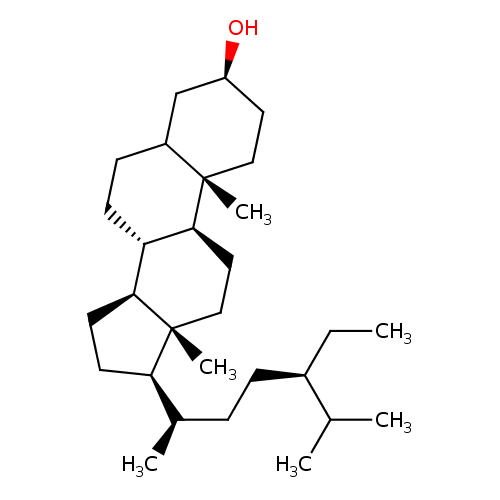
DescriptionStigmastanol, also known as sitostanol or (3b)-stigmastan-3-ol, belongs to stigmastanes and derivatives class of compounds. Those are sterol lipids with a structure based on the stigmastane skeleton, which consists of a cholestane moiety bearing an ethyl group at the carbon atom C24. Stigmastanol is practically insoluble (in water) and an extremely weak acidic compound (based on its pKa). Stigmastanol can be found primarily in blood and feces, as well as in human skeletal muscle tissue. Stigmastanol can be found anywhere throughout the human cell, such as in in the peroxisome, in the cytoplasm, in the Golgi apparatus, and in the membrane (predicted from logP). It can also be found in the extracellular space. Moreover, stigmastanol is found to be associated with sitosterolemia, an inborn error of metabolism. Stigmastanol (sitostanol) is a phytosterol found in a variety of plant sources. Similar to sterol esters and stanol esters, stigmastanol inhibits the absorption of cholesterol from the diet. Animal studies suggest that it also inhibits biosynthesis of cholesterol in the liver (Wikipedia). Stigmastanol is plant stanol. It can decrease the circulating LDL-cholesterol level by reducing intestinal cholesterol absorption (PMID 16910223).
Contaminant Sources
  • FooDB Chemicals
Contaminant TypeNot Available
Chemical Structure
Thumb
Synonyms
ValueSource
DihydrositosterolMeSH
24 alpha-Ethyl-5 beta-cholestan-3 alpha-olMeSH
beta-SitostanolMeSH
SitostanolMeSH
Stigmastanol, (3beta,5beta,24S)-isomerMeSH
24 alpha-Ethyl-5 alpha-cholestan-3 beta-olMeSH
(3b)-Stigmastan-3-olHMDB
(3beta)-Stigmastan-3-olHMDB
(3beta,5alpha)-Stigmastan-3-olHMDB
24-alpha-EthylcholestanolHMDB
24a-EthylcholestanolHMDB
4a-Methyl-5a,14a-lumistan-3b-olHMDB
4a-MethylcampestanolHMDB
5,6-dihydro-b-SitosterolHMDB
5,6-dihydro-beta-SitosterolHMDB
5a-Stigmastan-3b-olHMDB
5alpha-Stigmastan-3beta-olHMDB
b-SitostanolHMDB
beta-dihydro-SitosterolHMDB
dihydro-b-SitosterolHMDB
dihydro-beta-SitosterolHMDB
DihydrositosterinHMDB
FucostanolHMDB
SpinastanolHMDB
Stigmastan-3-olHMDB
Stigmastane-3-beta-olHMDB
StigmastanolMeSH
Chemical FormulaC29H52O
Average Molecular Mass416.723 g/mol
Monoisotopic Mass416.402 g/mol
CAS Registry Number83-45-4
IUPAC Name(1S,2S,5S,10R,11S,14R,15R)-14-[(2R,5R)-5-ethyl-6-methylheptan-2-yl]-2,15-dimethyltetracyclo[8.7.0.0²,⁷.0¹¹,¹⁵]heptadecan-5-ol
Traditional Namestigmastane-3-β-ol
SMILESCCC(CCC(C)C1CCC2C3CCC4CC(O)CCC4(C)C3CCC12C)C(C)C
InChI IdentifierInChI=1S/C29H52O/c1-7-21(19(2)3)9-8-20(4)25-12-13-26-24-11-10-22-18-23(30)14-16-28(22,5)27(24)15-17-29(25,26)6/h19-27,30H,7-18H2,1-6H3
InChI KeyLGJMUZUPVCAVPU-UHFFFAOYSA-N
Chemical Taxonomy
Description belongs to the class of organic compounds known as stigmastanes and derivatives. These are sterol lipids with a structure based on the stigmastane skeleton, which consists of a cholestane moiety bearing an ethyl group at the carbon atom C24.
KingdomOrganic compounds
Super ClassLipids and lipid-like molecules
ClassSteroids and steroid derivatives
Sub ClassStigmastanes and derivatives
Direct ParentStigmastanes and derivatives
Alternative Parents
Substituents
  • Triterpenoid
  • Stigmastane-skeleton
  • C24-propyl-sterol-skeleton
  • 3-beta-hydroxysteroid
  • Hydroxysteroid
  • 3-hydroxysteroid
  • Cyclic alcohol
  • Secondary alcohol
  • Organic oxygen compound
  • Hydrocarbon derivative
  • Organooxygen compound
  • Alcohol
  • Aliphatic homopolycyclic compound
Molecular FrameworkAliphatic homopolycyclic compounds
External DescriptorsNot Available
Biological Properties
StatusDetected and Not Quantified
OriginNot Available
Cellular LocationsNot Available
Biofluid LocationsNot Available
Tissue LocationsNot Available
PathwaysNot Available
ApplicationsNot Available
Biological RolesNot Available
Chemical RolesNot Available
Physical Properties
StateNot Available
AppearanceNot Available
Experimental Properties
PropertyValue
Melting PointNot Available
Boiling PointNot Available
SolubilityNot Available
Predicted Properties
PropertyValueSource
Water Solubility1.1e-05 g/LALOGPS
logP7.23ALOGPS
logP8.25ChemAxon
logS-7.6ALOGPS
pKa (Strongest Acidic)18.3ChemAxon
pKa (Strongest Basic)-1.4ChemAxon
Physiological Charge0ChemAxon
Hydrogen Acceptor Count1ChemAxon
Hydrogen Donor Count1ChemAxon
Polar Surface Area20.23 ŲChemAxon
Rotatable Bond Count6ChemAxon
Refractivity128.92 m³·mol⁻¹ChemAxon
Polarizability54.93 ųChemAxon
Number of Rings4ChemAxon
Bioavailability1ChemAxon
Rule of FiveNoChemAxon
Ghose FilterNoChemAxon
Veber's RuleYesChemAxon
MDDR-like RuleYesChemAxon
Spectra
Spectra
Spectrum TypeDescriptionSplash KeyView
GC-MSGC-MS Spectrum - GC-MS (1 TMS)splash10-066u-4942100000-604c3357e69c5eff6d37Spectrum
GC-MSGC-MS Spectrum - GC-MS (Non-derivatized)splash10-066u-4942100000-604c3357e69c5eff6d37Spectrum
Predicted GC-MSPredicted GC-MS Spectrum - GC-MS (Non-derivatized) - 70eV, Positivesplash10-0f79-2109200000-a86730d94764ca5efe85Spectrum
Predicted GC-MSPredicted GC-MS Spectrum - GC-MS (1 TMS) - 70eV, Positivesplash10-00di-3103900000-2af97f9cf8a2adff3196Spectrum
Predicted GC-MSPredicted GC-MS Spectrum - GC-MS (Non-derivatized) - 70eV, PositiveNot AvailableSpectrum
Predicted GC-MSPredicted GC-MS Spectrum - GC-MS (TBDMS_1_1) - 70eV, PositiveNot AvailableSpectrum
Predicted LC-MS/MSPredicted LC-MS/MS Spectrum - 10V, Positivesplash10-00kb-0019600000-d66897ecdbe2fe845508Spectrum
Predicted LC-MS/MSPredicted LC-MS/MS Spectrum - 20V, Positivesplash10-0002-4149200000-b304e7e4678a4df85f02Spectrum
Predicted LC-MS/MSPredicted LC-MS/MS Spectrum - 40V, Positivesplash10-0002-8089100000-404a21c90ecdfcc88b6bSpectrum
Predicted LC-MS/MSPredicted LC-MS/MS Spectrum - 10V, Negativesplash10-014i-0002900000-5b14a67727dfd30debe9Spectrum
Predicted LC-MS/MSPredicted LC-MS/MS Spectrum - 20V, Negativesplash10-014i-0004900000-af8991b83701d4b9f081Spectrum
Predicted LC-MS/MSPredicted LC-MS/MS Spectrum - 40V, Negativesplash10-0012-1009000000-eebc7b9b36cf260dbcebSpectrum
Predicted LC-MS/MSPredicted LC-MS/MS Spectrum - 10V, Negativesplash10-014i-0000900000-b5f23f2410b0642246b1Spectrum
Predicted LC-MS/MSPredicted LC-MS/MS Spectrum - 20V, Negativesplash10-014i-0000900000-bb6fb31d418e3fc0bd50Spectrum
Predicted LC-MS/MSPredicted LC-MS/MS Spectrum - 40V, Negativesplash10-02ta-0004900000-0b0cca9041a827eb2238Spectrum
Predicted LC-MS/MSPredicted LC-MS/MS Spectrum - 10V, Positivesplash10-014i-2125900000-88705afd06ff3d3ec277Spectrum
Predicted LC-MS/MSPredicted LC-MS/MS Spectrum - 20V, Positivesplash10-014i-9022300000-71d6fc93ae624cc61e6cSpectrum
Predicted LC-MS/MSPredicted LC-MS/MS Spectrum - 40V, Positivesplash10-0a4i-9610000000-0304da0e562e0b20612fSpectrum
1D NMR13C NMR SpectrumNot AvailableSpectrum
1D NMR1H NMR SpectrumNot AvailableSpectrum
1D NMR13C NMR SpectrumNot AvailableSpectrum
1D NMR1H NMR SpectrumNot AvailableSpectrum
1D NMR13C NMR SpectrumNot AvailableSpectrum
1D NMR1H NMR SpectrumNot AvailableSpectrum
1D NMR13C NMR SpectrumNot AvailableSpectrum
1D NMR1H NMR SpectrumNot AvailableSpectrum
1D NMR13C NMR SpectrumNot AvailableSpectrum
1D NMR1H NMR SpectrumNot AvailableSpectrum
1D NMR13C NMR SpectrumNot AvailableSpectrum
1D NMR1H NMR SpectrumNot AvailableSpectrum
1D NMR13C NMR SpectrumNot AvailableSpectrum
1D NMR1H NMR SpectrumNot AvailableSpectrum
1D NMR13C NMR SpectrumNot AvailableSpectrum
1D NMR1H NMR SpectrumNot AvailableSpectrum
1D NMR13C NMR SpectrumNot AvailableSpectrum
1D NMR1H NMR SpectrumNot AvailableSpectrum
1D NMR13C NMR SpectrumNot AvailableSpectrum
1D NMR1H NMR SpectrumNot AvailableSpectrum
Toxicity Profile
Route of ExposureNot Available
Mechanism of ToxicityNot Available
MetabolismNot Available
Toxicity ValuesNot Available
Lethal DoseNot Available
Carcinogenicity (IARC Classification)Not Available
Uses/SourcesNot Available
Minimum Risk LevelNot Available
Health EffectsNot Available
SymptomsNot Available
TreatmentNot Available
Concentrations
Not Available
DrugBank IDNot Available
HMDB IDHMDB0000494
FooDB IDNot Available
Phenol Explorer IDNot Available
KNApSAcK IDC00025214
BiGG IDNot Available
BioCyc IDNot Available
METLIN IDNot Available
PDB IDNot Available
Wikipedia LinkStigmastanol
Chemspider IDNot Available
ChEBI ID9479
PubChem Compound ID72340
Kegg Compound IDC11682
YMDB IDNot Available
ECMDB IDNot Available
References
Synthesis ReferenceNot Available
MSDSNot Available
General References
1. Bengtsson, B. E. A comparison between sitostanol and stigmastanol. Z. physiol. Chem. (1935), 237 46-51.
2. Miller TR, Anderson RJ, Linas SL, Henrich WL, Berns AS, Gabow PA, Schrier RW: Urinary diagnostic indices in acute renal failure: a prospective study. Ann Intern Med. 1978 Jul;89(1):47-50.
3. Connor WE, Lin DS, Pappu AS, Frohlich J, Gerhard G: Dietary sitostanol and campestanol: accumulation in the blood of humans with sitosterolemia and xanthomatosis and in rat tissues. Lipids. 2005 Sep;40(9):919-23.
4. Skrede B, Bjorkhem I, Bergesen O, Kayden HJ, Skrede S: The presence of 5 alpha-sitostanol in the serum of a patient with phytosterolemia, and its biosynthesis from plant steroids in rats with bile fistula. Biochim Biophys Acta. 1985 Oct 2;836(3):368-75.
5. Devaraj S, Jialal I: The role of dietary supplementation with plant sterols and stanols in the prevention of cardiovascular disease. Nutr Rev. 2006 Jul;64(7 Pt 1):348-54.
6. Phillips KM, Ruggio DM, Bailey JA: Precise quantitative determination of phytosterols, stanols, and cholesterol metabolites in human serum by capillary gas-liquid chromatography. J Chromatogr B Biomed Sci Appl. 1999 Sep 10;732(1):17-29.
7. Trump DL: Serious hyponatremia in patients with cancer: management with demeclocycline. Cancer. 1981 Jun 15;47(12):2908-12.
8. Ostlund RE Jr, Spilburg CA, Stenson WF: Sitostanol administered in lecithin micelles potently reduces cholesterol absorption in humans. Am J Clin Nutr. 1999 Nov;70(5):826-31.
9. Bengtsson, B. E. A comparison between sitostanol and stigmastanol. Z. physiol. Chem. (1935), 237 46-51.