Record Information
Version1.0
Creation Date2016-05-25 18:56:12 UTC
Update Date2026-04-06 12:55:12 UTC
Accession NumberCHEM022840
Identification
Common NameEpi-coprostanol
ClassSmall Molecule
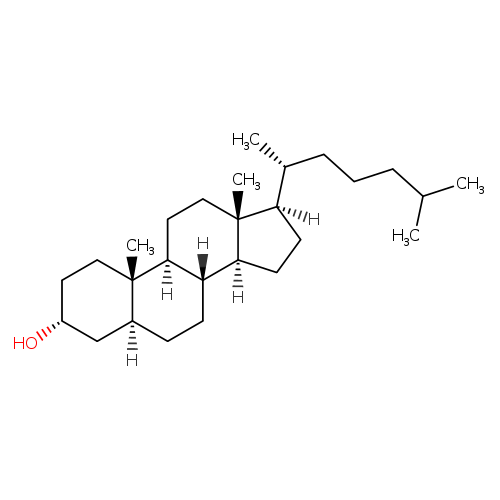
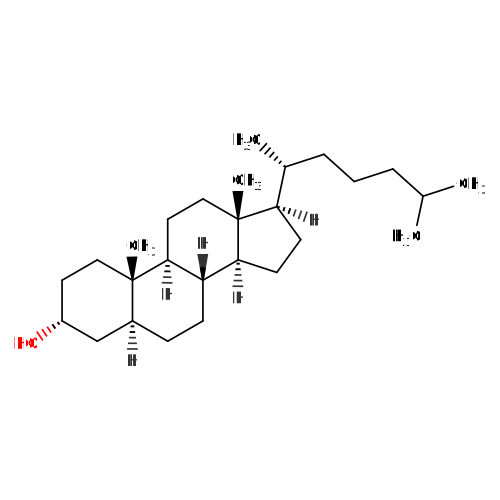
DescriptionA 5alpha-chloestane compound having a 3alpha-hydroxy substituent.
Contaminant Sources
  • FooDB Chemicals
  • HMDB Contaminants - Feces
  • STOFF IDENT Compounds
Contaminant TypeNot Available
Chemical Structure
Thumb
Synonyms
ValueSource
(3-alpha,5-alpha)-Cholestan-3-olChEBI
3alpha-Hydroxy-5alpha-cholestaneChEBI
5alpha-Cholestan-3alpha-olChEBI
Epi-cholestanolChEBI
EpicholestanolChEBI
EpidehydrocholesterinChEBI
PresteronChEBI
DihydrinKegg
(3-a,5-a)-Cholestan-3-olGenerator
(3-Α,5-α)-cholestan-3-olGenerator
3a-Hydroxy-5a-cholestaneGenerator
3Α-hydroxy-5α-cholestaneGenerator
5a-Cholestan-3a-olGenerator
5Α-cholestan-3α-olGenerator
5b-Cholestan-3a-olHMDB
5b-Cholestane-3a-olHMDB
5b-CholestanolHMDB
5beta-Cholestan-3alpha-olHMDB
5beta-Cholestane-3alpha-olHMDB
5beta-CholestanolHMDB
a-CoprostanolHMDB
alpha-CoprostanolHMDB
Epi-coprosterolHMDB
EpicoprostanolHMDB
EpicoprosterolHMDB
Chemical FormulaC27H48O
Average Molecular Mass388.669 g/mol
Monoisotopic Mass388.371 g/mol
CAS Registry Number516-95-0
IUPAC Name(1S,2S,5R,7S,10R,11S,14R,15R)-2,15-dimethyl-14-[(2R)-6-methylheptan-2-yl]tetracyclo[8.7.0.0^{2,7}.0^{11,15}]heptadecan-5-ol
Traditional Name(1S,2S,5R,7S,10R,11S,14R,15R)-2,15-dimethyl-14-[(2R)-6-methylheptan-2-yl]tetracyclo[8.7.0.0^{2,7}.0^{11,15}]heptadecan-5-ol
SMILES[H][C@@]1(CC[C@@]2([H])[C@]3([H])CC[C@@]4([H])C[C@H](O)CC[C@]4(C)[C@@]3([H])CC[C@]12C)[C@H](C)CCCC(C)C
InChI IdentifierInChI=1S/C27H48O/c1-18(2)7-6-8-19(3)23-11-12-24-22-10-9-20-17-21(28)13-15-26(20,4)25(22)14-16-27(23,24)5/h18-25,28H,6-17H2,1-5H3/t19-,20+,21-,22+,23-,24+,25+,26+,27-/m1/s1
InChI KeyQYIXCDOBOSTCEI-FBVYSKEZSA-N
Chemical Taxonomy
Description belongs to the class of organic compounds known as cholesterols and derivatives. Cholesterols and derivatives are compounds containing a 3-hydroxylated cholestane core.
KingdomOrganic compounds
Super ClassLipids and lipid-like molecules
ClassSteroids and steroid derivatives
Sub ClassCholestane steroids
Direct ParentCholesterols and derivatives
Alternative Parents
Substituents
  • Cholesterol-skeleton
  • Cholesterol
  • 3-alpha-hydroxysteroid
  • Hydroxysteroid
  • 3-hydroxysteroid
  • Cyclic alcohol
  • Secondary alcohol
  • Organic oxygen compound
  • Hydrocarbon derivative
  • Organooxygen compound
  • Alcohol
  • Aliphatic homopolycyclic compound
Molecular FrameworkAliphatic homopolycyclic compounds
External Descriptors
Biological Properties
StatusDetected and Not Quantified
OriginNot Available
Cellular LocationsNot Available
Biofluid LocationsNot Available
Tissue LocationsNot Available
PathwaysNot Available
ApplicationsNot Available
Biological RolesNot Available
Chemical RolesNot Available
Physical Properties
StateNot Available
AppearanceNot Available
Experimental Properties
PropertyValue
Melting PointNot Available
Boiling PointNot Available
SolubilityNot Available
Predicted Properties
PropertyValueSource
Water Solubility1.5e-05 g/LALOGPS
logP7.02ALOGPS
logP7.52ChemAxon
logS-7.4ALOGPS
pKa (Strongest Acidic)18.3ChemAxon
pKa (Strongest Basic)-1.4ChemAxon
Physiological Charge0ChemAxon
Hydrogen Acceptor Count1ChemAxon
Hydrogen Donor Count1ChemAxon
Polar Surface Area20.23 ŲChemAxon
Rotatable Bond Count5ChemAxon
Refractivity119.77 m³·mol⁻¹ChemAxon
Polarizability51.12 ųChemAxon
Number of Rings4ChemAxon
Bioavailability1ChemAxon
Rule of FiveNoChemAxon
Ghose FilterNoChemAxon
Veber's RuleYesChemAxon
MDDR-like RuleNoChemAxon
Spectra
Spectra
Spectrum TypeDescriptionSplash KeyView
Predicted GC-MSPredicted GC-MS Spectrum - GC-MS (Non-derivatized) - 70eV, Positivesplash10-05i0-0109000000-761dcf3fe040f44fa80eSpectrum
Predicted GC-MSPredicted GC-MS Spectrum - GC-MS (1 TMS) - 70eV, Positivesplash10-0002-3104900000-654dcbe9dd07b5a589f2Spectrum
Predicted GC-MSPredicted GC-MS Spectrum - GC-MS (Non-derivatized) - 70eV, PositiveNot AvailableSpectrum
Predicted LC-MS/MSPredicted LC-MS/MS Spectrum - 10V, Positivesplash10-0079-0009000000-48703a10acd86b4a9369Spectrum
Predicted LC-MS/MSPredicted LC-MS/MS Spectrum - 20V, Positivesplash10-00dr-3149000000-3dac80dba8a7c194a9a6Spectrum
Predicted LC-MS/MSPredicted LC-MS/MS Spectrum - 40V, Positivesplash10-0a4i-4169000000-067270e2b2860f462b88Spectrum
Predicted LC-MS/MSPredicted LC-MS/MS Spectrum - 10V, Negativesplash10-000i-0009000000-5db181960ec36b693dc5Spectrum
Predicted LC-MS/MSPredicted LC-MS/MS Spectrum - 20V, Negativesplash10-000i-0009000000-21dc22a0a9fa3809f268Spectrum
Predicted LC-MS/MSPredicted LC-MS/MS Spectrum - 40V, Negativesplash10-0ab9-1009000000-c90e4e689bf7be60948cSpectrum
Predicted LC-MS/MSPredicted LC-MS/MS Spectrum - 10V, Negativesplash10-000i-0009000000-34ef429285e58bb4b314Spectrum
Predicted LC-MS/MSPredicted LC-MS/MS Spectrum - 20V, Negativesplash10-000i-0009000000-780ac33d63315f658159Spectrum
Predicted LC-MS/MSPredicted LC-MS/MS Spectrum - 40V, Negativesplash10-000i-0009000000-2b8e0e9916832dc47876Spectrum
Predicted LC-MS/MSPredicted LC-MS/MS Spectrum - 10V, Positivesplash10-000i-0009000000-44afea742dee80d0734eSpectrum
Predicted LC-MS/MSPredicted LC-MS/MS Spectrum - 20V, Positivesplash10-0a4i-9032000000-166905331dad000292e6Spectrum
Predicted LC-MS/MSPredicted LC-MS/MS Spectrum - 40V, Positivesplash10-0a4j-9820000000-f066461902c4fe39e2d4Spectrum
1D NMR1H NMR SpectrumNot AvailableSpectrum
2D NMR[1H,13C] 2D NMR SpectrumNot AvailableSpectrum
Toxicity Profile
Route of ExposureNot Available
Mechanism of ToxicityNot Available
MetabolismNot Available
Toxicity ValuesNot Available
Lethal DoseNot Available
Carcinogenicity (IARC Classification)Not Available
Uses/SourcesNot Available
Minimum Risk LevelNot Available
Health EffectsNot Available
SymptomsNot Available
TreatmentNot Available
Concentrations
Not Available
DrugBank IDNot Available
HMDB IDHMDB0001569
FooDB IDFDB022694
Phenol Explorer IDNot Available
KNApSAcK IDNot Available
BiGG IDNot Available
BioCyc IDNot Available
METLIN ID6329
PDB IDNot Available
Wikipedia LinkNot Available
Chemspider ID59456
ChEBI ID31542
PubChem Compound ID66066
Kegg Compound IDC12978
YMDB IDNot Available
ECMDB IDNot Available
References
Synthesis ReferenceNot Available
MSDSNot Available
General References
1. https://www.ncbi.nlm.nih.gov/pubmed/?term=10901139
2. https://www.ncbi.nlm.nih.gov/pubmed/?term=4381999
3. Ruzicka, L.; Brungger, H.; Eichenberger, E.; Meyer, Jules. Polyterpenes and polyterpenoids. XCI. Preparation of coprosterol, epicoprosterol and epihydrocholesterol. Spatial position of the hydroxyl group in the sterols. Helvetica Chimica Acta (1934), 17 1407-16.
4. Ruzicka, L.; Brungger, H.; Eichenberger, E.; Meyer, Jules. Polyterpenes and polyterpenoids. XCI. Preparation of coprosterol, epicoprosterol and epihydrocholesterol. Spatial position of the hydroxyl group in the sterols. Helvetica Chimica Acta (1934), 17 1407-16.
5. Derrien M, Jarde E, Gruau G, Pierson-Wickmann AC: Extreme variability of steroid profiles in cow feces and pig slurries at the regional scale: implications for the use of steroids to specify fecal pollution sources in waters. J Agric Food Chem. 2011 Jul 13;59(13):7294-302. doi: 10.1021/jf201040v. Epub 2011 Jun 7.
6. Derrien M, Jarde E, Gruau G, Pourcher AM, Gourmelon M, Jadas-Hecart A, Pierson Wickmann AC: Origin of fecal contamination in waters from contrasted areas: stanols as Microbial Source Tracking markers. Water Res. 2012 Sep 1;46(13):4009-16. doi: 10.1016/j.watres.2012.05.003. Epub 2012 May 18.
7. Montone RC, Martins CC, Bicego MC, Taniguchi S, da Silva DA, Campos LS, Weber RR: Distribution of sewage input in marine sediments around a maritime Antarctic research station indicated by molecular geochemical indicators. Sci Total Environ. 2010 Sep 15;408(20):4665-71. doi: 10.1016/j.scitotenv.2010.07.012. Epub 2010 Jul 24.
8. Wu J, Hu R, Yue J, Yang Z, Zhang L: Determination of fecal sterols by gas chromatography-mass spectrometry with solid-phase extraction and injection-port derivatization. J Chromatogr A. 2009 Feb 13;1216(7):1053-8. doi: 10.1016/j.chroma.2008.12.054. Epub 2008 Dec 25.
9. D'Anjou RM, Bradley RS, Balascio NL, Finkelstein DB: Climate impacts on human settlement and agricultural activities in northern Norway revealed through sediment biogeochemistry. Proc Natl Acad Sci U S A. 2012 Dec 11;109(50):20332-7. doi: 10.1073/pnas.1212730109. Epub 2012 Nov 26.
10. Froehner S, Martins RF, Errera MR: Assessment of fecal sterols in Barigui River sediments in Curitiba, Brazil. Environ Monit Assess. 2009 Oct;157(1-4):591-600. doi: 10.1007/s10661-008-0559-0. Epub 2008 Oct 8.
11. Bukiya AN, Belani JD, Rychnovsky S, Dopico AM: Specificity of cholesterol and analogs to modulate BK channels points to direct sterol-channel protein interactions. J Gen Physiol. 2011 Jan;137(1):93-110. doi: 10.1085/jgp.201010519. Epub 2010 Dec 13.
12. Huang J, Sun L, Wang X, Wang Y, Huang T: Ecosystem evolution of seal colony and the influencing factors in the 20th century on Fildes Peninsula, West Antarctica. J Environ Sci (China). 2011;23(9):1431-6.
13. Zgheib S, Gromaire MC, Lorgeoux C, Saad M, Chebbo G: Sterols: a tracer of organic matter in combined sewers. Water Sci Technol. 2008;57(11):1705-12. doi: 10.2166/wst.2008.285.
14. Vane CH, Kim AW, McGowan S, Leng MJ, Heaton TH, Kendrick CP, Coombs P, Yang H, Swann GE: Sedimentary records of sewage pollution using faecal markers in contrasting peri-urban shallow lakes. Sci Total Environ. 2010 Dec 15;409(2):345-56. doi: 10.1016/j.scitotenv.2010.09.033. Epub 2010 Nov 9.
15. Shah VG, Dunstan RH, Geary PM, Coombes P, Roberts TK, Von Nagy-Felsobuki E: Evaluating potential applications of faecal sterols in distinguishing sources of faecal contamination from mixed faecal samples. Water Res. 2007 Aug;41(16):3691-700. Epub 2007 Jul 5.
16. Froehner S, Maceno M, Martins RF: Sediments as a potential tool for assessment of sewage pollution in Barigui River, Brazil. Environ Monit Assess. 2010 Nov;170(1-4):261-72. doi: 10.1007/s10661-009-1230-0. Epub 2009 Nov 14.
17. Martins CC, Bicego MC, Figueira RC, Angelli JL, Combi T, Gallice WC, Mansur AV, Nardes E, Rocha ML, Wisnieski E, Ceschim LM, Ribeiro AP: Multi-molecular markers and metals as tracers of organic matter inputs and contamination status from an Environmental Protection Area in the SW Atlantic (Laranjeiras Bay, Brazil). Sci Total Environ. 2012 Feb 15;417-418:158-68. doi: 10.1016/j.scitotenv.2011.11.086. Epub 2012 Jan 13.
18. Black LE, Brion GM, Freitas SJ: Multivariate logistic regression for predicting total culturable virus presence at the intake of a potable-water treatment plant: novel application of the atypical coliform/total coliform ratio. Appl Environ Microbiol. 2007 Jun;73(12):3965-74. Epub 2007 Apr 27.
19. Chari BP, Halden RU: Predicting the concentration range of unmonitored chemicals in wastewater-dominated streams and in run-off from biosolids-amended soils. Sci Total Environ. 2012 Dec 1;440:314-20. doi: 10.1016/j.scitotenv.2012.05.042. Epub 2012 Jun 7.
20. Tyagi P, Edwards DR, Coyne MS: Use of selected chemical markers in combination with a multiple regression model to assess the contribution of domesticated animal sources of fecal pollution in the environment. Chemosphere. 2007 Nov;69(10):1617-24. Epub 2007 Jun 27.
21. Romanenko VG, Roser KS, Melvin JE, Begenisich T: The role of cell cholesterol and the cytoskeleton in the interaction between IK1 and maxi-K channels. Am J Physiol Cell Physiol. 2009 Apr;296(4):C878-88. doi: 10.1152/ajpcell.00438.2008. Epub 2009 Jan 28.
22. Khallou J, Riottot M, Parquet M, Verneau C, Lutton C: Antilithiasic and hypocholesterolemic effects of diets containing autoclaved amylomaize starch in hamster. Dig Dis Sci. 1995 Dec;40(12):2540-8.
23. Shah VG, Hugh Dunstan R, Geary PM, Coombes P, Roberts TK, Rothkirch T: Bacterial source tracking from diverse land use catchments by sterol ratios. Water Res. 2007 Aug;41(16):3667-74. Epub 2007 Apr 11.