Record Information
Version1.0
Creation Date2016-05-25 18:50:30 UTC
Update Date2026-04-06 12:11:53 UTC
Accession NumberCHEM022742
Identification
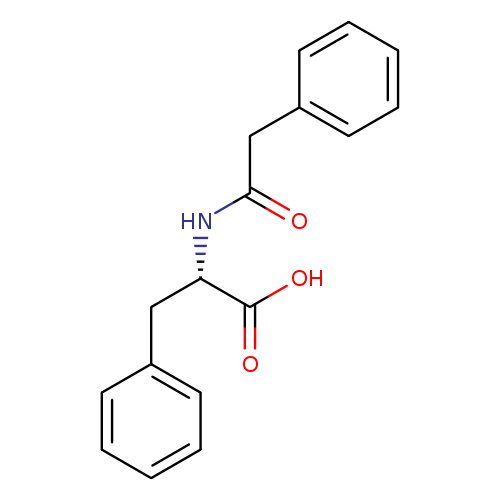
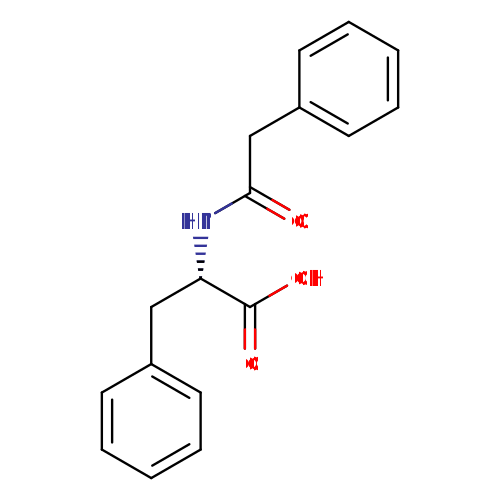
Common NameN-Phenylacetylphenylalanine
ClassSmall Molecule
Description
Contaminant Sources
  • FooDB Chemicals
  • HMDB Contaminants - Urine
Contaminant TypeNot Available
Chemical Structure
Thumb
Synonyms
ValueSource
3-Phenyl-N-(phenylacetyl)-alanineHMDB
L-3-Phenyl-N-(phenylacetyl)-alanineHMDB
N-(Phenylacetyl)-L-phenylalanineHMDB
N-Phenylacetyl-L-phenylalanineHMDB, MeSH
N-Phenylacetylphenylalanine, (D)-isomerMeSH, HMDB
(2S)-2-[(1-Hydroxy-2-phenylethylidene)amino]-3-phenylpropanoateGenerator, HMDB
N-PhenylacetylphenylalanineMeSH
Chemical FormulaC17H17NO3
Average Molecular Mass283.322 g/mol
Monoisotopic Mass283.121 g/mol
CAS Registry Number738-75-0
IUPAC Name(2S)-3-phenyl-2-(2-phenylacetamido)propanoic acid
Traditional NameN-phenylacetyl-L-phenylalanine
SMILESOC(=O)[C@H](CC1=CC=CC=C1)NC(=O)CC1=CC=CC=C1
InChI IdentifierInChI=1S/C17H17NO3/c19-16(12-14-9-5-2-6-10-14)18-15(17(20)21)11-13-7-3-1-4-8-13/h1-10,15H,11-12H2,(H,18,19)(H,20,21)/t15-/m0/s1
InChI KeyLIIPHJDKZNTNII-HNNXBMFYSA-N
Chemical Taxonomy
Description belongs to the class of organic compounds known as phenylalanine and derivatives. Phenylalanine and derivatives are compounds containing phenylalanine or a derivative thereof resulting from reaction of phenylalanine at the amino group or the carboxy group, or from the replacement of any hydrogen of glycine by a heteroatom.
KingdomOrganic compounds
Super ClassOrganic acids and derivatives
ClassCarboxylic acids and derivatives
Sub ClassAmino acids, peptides, and analogues
Direct ParentPhenylalanine and derivatives
Alternative Parents
Substituents
  • Phenylalanine or derivatives
  • N-acyl-alpha-amino acid
  • N-acyl-alpha amino acid or derivatives
  • N-acyl-l-alpha-amino acid
  • 3-phenylpropanoic-acid
  • Amphetamine or derivatives
  • Phenylacetamide
  • Monocyclic benzene moiety
  • Benzenoid
  • Carboxamide group
  • Secondary carboxylic acid amide
  • Carboxylic acid
  • Monocarboxylic acid or derivatives
  • Hydrocarbon derivative
  • Organic oxide
  • Organic nitrogen compound
  • Organopnictogen compound
  • Carbonyl group
  • Organic oxygen compound
  • Organonitrogen compound
  • Organooxygen compound
  • Aromatic homomonocyclic compound
Molecular FrameworkAromatic homomonocyclic compounds
External DescriptorsNot Available
Biological Properties
StatusDetected and Not Quantified
OriginNot Available
Cellular LocationsNot Available
Biofluid LocationsNot Available
Tissue LocationsNot Available
PathwaysNot Available
ApplicationsNot Available
Biological RolesNot Available
Chemical RolesNot Available
Physical Properties
StateNot Available
AppearanceNot Available
Experimental Properties
PropertyValue
Melting PointNot Available
Boiling PointNot Available
SolubilityNot Available
Predicted Properties
PropertyValueSource
Water Solubility0.027 g/LALOGPS
logP2.39ALOGPS
logP2.73ChemAxon
logS-4ALOGPS
pKa (Strongest Acidic)4.08ChemAxon
pKa (Strongest Basic)-2.6ChemAxon
Physiological Charge-1ChemAxon
Hydrogen Acceptor Count3ChemAxon
Hydrogen Donor Count2ChemAxon
Polar Surface Area66.4 ŲChemAxon
Rotatable Bond Count6ChemAxon
Refractivity79.28 m³·mol⁻¹ChemAxon
Polarizability29.97 ųChemAxon
Number of Rings2ChemAxon
Bioavailability1ChemAxon
Rule of FiveYesChemAxon
Ghose FilterYesChemAxon
Veber's RuleNoChemAxon
MDDR-like RuleNoChemAxon
Spectra
Spectra
Spectrum TypeDescriptionSplash KeyView
Predicted GC-MSPredicted GC-MS Spectrum - GC-MS (Non-derivatized) - 70eV, Positivesplash10-0006-7920000000-414527b0d8767edb022aSpectrum
Predicted GC-MSPredicted GC-MS Spectrum - GC-MS (1 TMS) - 70eV, Positivesplash10-006x-9301000000-6bba534fc811e446dd42Spectrum
Predicted GC-MSPredicted GC-MS Spectrum - GC-MS (Non-derivatized) - 70eV, PositiveNot AvailableSpectrum
Predicted LC-MS/MSPredicted LC-MS/MS Spectrum - 10V, Positivesplash10-02ai-2890000000-731f005addd7e44b2d79Spectrum
Predicted LC-MS/MSPredicted LC-MS/MS Spectrum - 20V, Positivesplash10-014i-1920000000-1a43b8b4de97159d1462Spectrum
Predicted LC-MS/MSPredicted LC-MS/MS Spectrum - 40V, Positivesplash10-0006-9300000000-3ae402042e506b3eac68Spectrum
Predicted LC-MS/MSPredicted LC-MS/MS Spectrum - 10V, Negativesplash10-001i-0490000000-47fac515ba1e5c7e08a2Spectrum
Predicted LC-MS/MSPredicted LC-MS/MS Spectrum - 20V, Negativesplash10-00m3-1940000000-4ac1507005c25d36f8b4Spectrum
Predicted LC-MS/MSPredicted LC-MS/MS Spectrum - 40V, Negativesplash10-014l-9700000000-2bb6f7f95d0c2306716fSpectrum
Predicted LC-MS/MSPredicted LC-MS/MS Spectrum - 10V, Positivesplash10-00lr-0590000000-c540ae154f5783eaed2cSpectrum
Predicted LC-MS/MSPredicted LC-MS/MS Spectrum - 20V, Positivesplash10-00di-1900000000-f83c0d5eac6e34453864Spectrum
Predicted LC-MS/MSPredicted LC-MS/MS Spectrum - 40V, Positivesplash10-0006-9600000000-6e9bb33785266131fff2Spectrum
Predicted LC-MS/MSPredicted LC-MS/MS Spectrum - 10V, Negativesplash10-03xr-1910000000-f164e21280a47480c5ddSpectrum
Predicted LC-MS/MSPredicted LC-MS/MS Spectrum - 20V, Negativesplash10-044m-4910000000-948f26d129049ea5276fSpectrum
Predicted LC-MS/MSPredicted LC-MS/MS Spectrum - 40V, Negativesplash10-00r7-7900000000-454ec737db24b4710cddSpectrum
Toxicity Profile
Route of ExposureNot Available
Mechanism of ToxicityNot Available
MetabolismNot Available
Toxicity ValuesNot Available
Lethal DoseNot Available
Carcinogenicity (IARC Classification)Not Available
Uses/SourcesNot Available
Minimum Risk LevelNot Available
Health EffectsNot Available
SymptomsNot Available
TreatmentNot Available
Concentrations
Not Available
DrugBank IDNot Available
HMDB IDHMDB0002372
FooDB IDFDB022983
Phenol Explorer IDNot Available
KNApSAcK IDNot Available
BiGG IDNot Available
BioCyc IDNot Available
METLIN IDNot Available
PDB IDNot Available
Wikipedia LinkNot Available
Chemspider ID43287
ChEBI ID975589
PubChem Compound ID47579
Kegg Compound IDNot Available
YMDB IDNot Available
ECMDB IDNot Available
References
Synthesis ReferenceNot Available
MSDSNot Available
General References
1. Burley SK, Wang AH, Votano JR, Rich A: Antigelling and antisickling bisphenyl oligopeptides and peptide analogues have similar structural features. Biochemistry. 1987 Aug 11;26(16):5091-9.
2. Votano JR, Altman J, Wilchek M, Gorecki M, Rich A: Potential use of biaromatic L-phenylalanyl derivatives as therapeutic agents in the treatment of sickle cell disease. Proc Natl Acad Sci U S A. 1984 May;81(10):3190-4.