Toggle navigation
ContaminantDB
Browse
Browse Contaminants
Browse By Sources
Search
ChemQuery Structure Search
Molecular Weight Search
Text Query
Advanced Search
LC-MS Search
LC-MS/MS Search
GC-MS Search
1D NMR Search
2D NMR Search
Downloads
About
About ContaminantDB
Other Databases
Documentation
Data Sources
Statistics
Wishart Research Group
TMIC Wishart Node
Contact Us
Search
Quantitative metabolomics services for biomarker discovery and validation.
Specializing in ready to use metabolomics kits.
Your source for quantitative metabolomics technologies and bioinformatics.
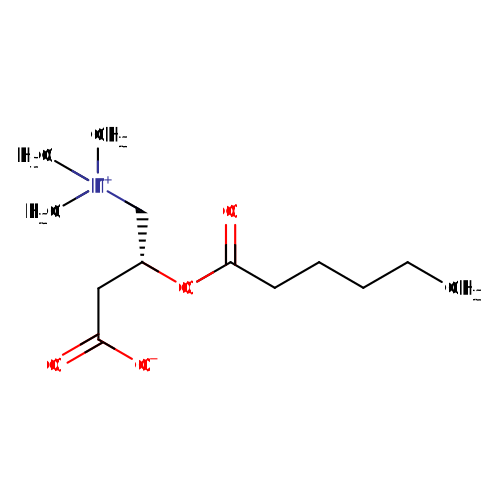
L-Hexanoylcarnitine (CHEM022388)
Identification
Taxonomy
Biological Properties
Physical Properties
Toxicity Profile
Spectra
Concentrations
Links
References
XML
Record Information
Version
1.0
Creation Date
2016-05-25 18:30:51 UTC
Update Date
2016-11-09 01:17:29 UTC
Accession Number
CHEM022388
Identification
Common Name
L-Hexanoylcarnitine
Class
Small Molecule
Description
An O-hexanoylcarnitine that has L configuration.
Contaminant Sources
FooDB Chemicals
HMDB Contaminants - Urine
Contaminant Type
Not Available
Chemical Structure
MOL
SDF
PDB
SMILES
InChI
×
Structure for CHEM022388: L-Hexanoylcarnitine
Synonyms
Value
Source
(R)-Caproylcarnitine
ChEBI
(R)-Hexanoylcarnitine
ChEBI
Hexanoyl-L-carnitine
ChEBI
L-Hexanoylcarnitine
ChEBI
O-Hexanoyl-(R)-carnitine
ChEBI
(R)-3-Carboxy-N,N,N-trimethyl-2-[(1-oxohexyl)oxy]-1-propanaminium inner salt
HMDB
Hexanoate
HMDB
Hexanoic acid
HMDB
Hexanoic acid ester with L-(3-carboxy-2-hydroxypropyl)trimethylammonium hydroxide inner salt
HMDB
L-Carnitine hexanoyl ester
HMDB
L-Hexanoate
HMDB
L-Hexanoic acid
HMDB
L-Hexanoic acid ester with (3-carboxy-2-hydroxypropyl)trimethylammonium hydroxide inner salt
HMDB
C6 Carnitine
HMDB
Hexanoylcarnitine
HMDB
Chemical Formula
C
13
H
25
NO
4
Average Molecular Mass
259.342 g/mol
Monoisotopic Mass
259.178 g/mol
CAS Registry Number
22671-29-0
IUPAC Name
(3R)-3-(hexanoyloxy)-4-(trimethylazaniumyl)butanoate
Traditional Name
L-carnitine hexanoyl ester
SMILES
CCCCCC(=O)O[C@H](CC([O-])=O)C[N+](C)(C)C
InChI Identifier
InChI=1S/C13H25NO4/c1-5-6-7-8-13(17)18-11(9-12(15)16)10-14(2,3)4/h11H,5-10H2,1-4H3/t11-/m1/s1
InChI Key
VVPRQWTYSNDTEA-LLVKDONJSA-N
Chemical Taxonomy
Description
belongs to the class of organic compounds known as acyl carnitines. These are organic compounds containing a fatty acid with the carboxylic acid attached to carnitine through an ester bond.
Kingdom
Organic compounds
Super Class
Lipids and lipid-like molecules
Class
Fatty Acyls
Sub Class
Fatty acid esters
Direct Parent
Acyl carnitines
Alternative Parents
Dicarboxylic acids and derivatives
Tetraalkylammonium salts
Carboxylic acid salts
Carboxylic acid esters
Carboxylic acids
Organopnictogen compounds
Organic salts
Organic oxides
Hydrocarbon derivatives
Carbonyl compounds
Amines
Substituents
Acyl-carnitine
Dicarboxylic acid or derivatives
Tetraalkylammonium salt
Quaternary ammonium salt
Carboxylic acid ester
Carboxylic acid salt
Carboxylic acid derivative
Carboxylic acid
Organic nitrogen compound
Organooxygen compound
Organonitrogen compound
Organic salt
Hydrocarbon derivative
Organic oxide
Organopnictogen compound
Organic oxygen compound
Carbonyl group
Amine
Aliphatic acyclic compound
Molecular Framework
Aliphatic acyclic compounds
External Descriptors
O-acyl-L-carnitine (
CHEBI:84834
)
Fatty acyl carnitines (
LMFA07070001
)
Biological Properties
Status
Detected and Not Quantified
Origin
Not Available
Cellular Locations
Not Available
Biofluid Locations
Not Available
Tissue Locations
Not Available
Pathways
Not Available
Applications
Not Available
Biological Roles
Not Available
Chemical Roles
Not Available
Physical Properties
State
Not Available
Appearance
Not Available
Experimental Properties
Property
Value
Melting Point
Not Available
Boiling Point
Not Available
Solubility
Not Available
Predicted Properties
Property
Value
Source
Water Solubility
0.0043 g/L
ALOGPS
logP
-1.7
ALOGPS
logP
-2.4
ChemAxon
logS
-4.9
ALOGPS
pKa (Strongest Acidic)
4.22
ChemAxon
pKa (Strongest Basic)
-7.1
ChemAxon
Physiological Charge
0
ChemAxon
Hydrogen Acceptor Count
3
ChemAxon
Hydrogen Donor Count
0
ChemAxon
Polar Surface Area
66.43 Ų
ChemAxon
Rotatable Bond Count
10
ChemAxon
Refractivity
91.07 m³·mol⁻¹
ChemAxon
Polarizability
28.79 ų
ChemAxon
Number of Rings
0
ChemAxon
Bioavailability
1
ChemAxon
Rule of Five
Yes
ChemAxon
Ghose Filter
No
ChemAxon
Veber's Rule
No
ChemAxon
MDDR-like Rule
No
ChemAxon
Spectra
Spectra
Spectrum Type
Description
Splash Key
View
Predicted GC-MS
Predicted GC-MS Spectrum - GC-MS (Non-derivatized) - 70eV, Positive
Not Available
Spectrum
Predicted GC-MS
Predicted GC-MS Spectrum - GC-MS (TMS_1_1) - 70eV, Positive
Not Available
Spectrum
Predicted GC-MS
Predicted GC-MS Spectrum - GC-MS (TBDMS_1_1) - 70eV, Positive
Not Available
Spectrum
LC-MS/MS
LC-MS/MS Spectrum - Quattro_QQQ 10V, Positive (Annotated)
splash10-03dr-6090000000-c19afe5acca5a4b0f82f
Spectrum
LC-MS/MS
LC-MS/MS Spectrum - Quattro_QQQ 25V, Positive (Annotated)
splash10-000i-9000000000-8d30a3ad5fce9bf004f7
Spectrum
LC-MS/MS
LC-MS/MS Spectrum - Quattro_QQQ 40V, Positive (Annotated)
splash10-000i-9000000000-a38bcb0bb25abdcaaa7c
Spectrum
Predicted LC-MS/MS
Predicted LC-MS/MS Spectrum - 10V, Positive
splash10-03di-0090000000-5c4e7ecd71d0ed800ae6
Spectrum
Predicted LC-MS/MS
Predicted LC-MS/MS Spectrum - 20V, Positive
splash10-01p9-9050000000-f92580b9643caf52768e
Spectrum
Predicted LC-MS/MS
Predicted LC-MS/MS Spectrum - 40V, Positive
splash10-000i-9000000000-e9262cbaff8cb4ad0ba6
Spectrum
1D NMR
1H NMR Spectrum
Not Available
Spectrum
1D NMR
1H NMR Spectrum
Not Available
Spectrum
1D NMR
13C NMR Spectrum
Not Available
Spectrum
1D NMR
1H NMR Spectrum
Not Available
Spectrum
1D NMR
13C NMR Spectrum
Not Available
Spectrum
1D NMR
1H NMR Spectrum
Not Available
Spectrum
1D NMR
13C NMR Spectrum
Not Available
Spectrum
1D NMR
1H NMR Spectrum
Not Available
Spectrum
1D NMR
13C NMR Spectrum
Not Available
Spectrum
1D NMR
1H NMR Spectrum
Not Available
Spectrum
1D NMR
13C NMR Spectrum
Not Available
Spectrum
1D NMR
1H NMR Spectrum
Not Available
Spectrum
1D NMR
13C NMR Spectrum
Not Available
Spectrum
1D NMR
1H NMR Spectrum
Not Available
Spectrum
1D NMR
13C NMR Spectrum
Not Available
Spectrum
1D NMR
1H NMR Spectrum
Not Available
Spectrum
1D NMR
13C NMR Spectrum
Not Available
Spectrum
1D NMR
1H NMR Spectrum
Not Available
Spectrum
1D NMR
13C NMR Spectrum
Not Available
Spectrum
1D NMR
1H NMR Spectrum
Not Available
Spectrum
1D NMR
13C NMR Spectrum
Not Available
Spectrum
2D NMR
[1H,13C] 2D NMR Spectrum
Not Available
Spectrum
Toxicity Profile
Route of Exposure
Not Available
Mechanism of Toxicity
Not Available
Metabolism
Not Available
Toxicity Values
Not Available
Lethal Dose
Not Available
Carcinogenicity (
IARC Classification
)
Not Available
Uses/Sources
Not Available
Minimum Risk Level
Not Available
Health Effects
Not Available
Symptoms
Not Available
Treatment
Not Available
Concentrations
Not Available
External Links
DrugBank ID
Not Available
HMDB ID
HMDB0000756
FooDB ID
FDB022226
Phenol Explorer ID
Not Available
KNApSAcK ID
C00052313
BiGG ID
Not Available
BioCyc ID
Not Available
METLIN ID
3548
PDB ID
Not Available
Wikipedia Link
Not Available
Chemspider ID
2497478
ChEBI ID
84834
PubChem Compound ID
3246938
Kegg Compound ID
Not Available
YMDB ID
Not Available
ECMDB ID
Not Available
References
Synthesis Reference
Not Available
MSDS
Not Available
General References
1
.
https://www.ncbi.nlm.nih.gov/pubmed/?term=23485643
2
.
Nakanishi, Toyofumi; Shimizu, Akira; Arimoto, Masao; Kanai, Michiko. Synthesis of acylcarnitines for differential diagnosis of metabolic disorders. Nippon Iyo Masu Supekutoru Gakkai Koenshu (1993), 18 129-32.
3
.
Ziadeh R, Hoffman EP, Finegold DN, Hoop RC, Brackett JC, Strauss AW, Naylor EW: Medium chain acyl-CoA dehydrogenase deficiency in Pennsylvania: neonatal screening shows high incidence and unexpected mutation frequencies. Pediatr Res. 1995 May;37(5):675-8.
4
.
Tyni T, Pourfarzam M, Turnbull DM: Analysis of mitochondrial fatty acid oxidation intermediates by tandem mass spectrometry from intact mitochondria prepared from homogenates of cultured fibroblasts, skeletal muscle cells, and fresh muscle. Pediatr Res. 2002 Jul;52(1):64-70.
5
.
Caksen H, Tuncer O, Kirimi E, Fryns JP, Uner A, Unal O, Cinal A, Odabas D: Report of two Turkish infants with Norman-Roberts syndrome. Genet Couns. 2004;15(1):9-17.
6
.
Lee PJ, Harrison EL, Jones MG, Jones S, Leonard JV, Chalmers RA: L-carnitine and exercise tolerance in medium-chain acyl-coenzyme A dehydrogenase (MCAD) deficiency: a pilot study. J Inherit Metab Dis. 2005;28(2):141-52.
7
.
Chalmers RA, Roe CR, Stacey TE, Hoppel CL: Urinary excretion of l-carnitine and acylcarnitines by patients with disorders of organic acid metabolism: evidence for secondary insufficiency of l-carnitine. Pediatr Res. 1984 Dec;18(12):1325-8.
8
.
Shigematsu Y, Hata I, Nakai A, Kikawa Y, Sudo M, Tanaka Y, Yamaguchi S, Jakobs C: Prenatal diagnosis of organic acidemias based on amniotic fluid levels of acylcarnitines. Pediatr Res. 1996 Apr;39(4 Pt 1):680-4.
9
.
Schmidt-Sommerfeld E, Penn D, Duran M, Bennett MJ, Santer R, Stanley CA: Detection of inborn errors of fatty acid oxidation from acylcarnitine analysis of plasma and blood spots with the radioisotopic exchange-high-performance liquid chromatographic method. J Pediatr. 1993 May;122(5 Pt 1):708-14.
10
.
Bene J, Komlosi K, Gasztonyi B, Juhasz M, Tulassay Z, Melegh B: Plasma carnitine ester profile in adult celiac disease patients maintained on long-term gluten free diet. World J Gastroenterol. 2005 Nov 14;11(42):6671-5.
11
.
Minkler PE, Hoppel CL: Quantification of free carnitine, individual short- and medium-chain acylcarnitines, and total carnitine in plasma by high-performance liquid chromatography. Anal Biochem. 1993 Aug 1;212(2):510-8.
12
.
Bennett MJ, Coates PM, Hale DE, Millington DS, Pollitt RJ, Rinaldo P, Roe CR, Tanaka K: Analysis of abnormal urinary metabolites in the newborn period in medium-chain acyl-CoA dehydrogenase deficiency. J Inherit Metab Dis. 1990;13(5):707-15.
13
.
Vallee L, Fontaine M, Nuyts JP, Ricart G, Krivosic I, Divry P, Vianey-Saban C, Lhermitte M, Vamecq J: Stroke, hemiparesis and deficient mitochondrial beta-oxidation. Eur J Pediatr. 1994 Aug;153(8):598-603.
14
.
Fontaine M, Briand G, Vallee L, Ricart G, Degand P, Divry P, Vianey-Saban C, Vamecq J: Acylcarnitine removal in a patient with acyl-CoA beta-oxidation deficiency disorder: effect of L-carnitine therapy and starvation. Clin Chim Acta. 1996 Aug 30;252(2):109-22.
15
.
Sreekumar A, Poisson LM, Rajendiran TM, Khan AP, Cao Q, Yu J, Laxman B, Mehra R, Lonigro RJ, Li Y, Nyati MK, Ahsan A, Kalyana-Sundaram S, Han B, Cao X, Byun J, Omenn GS, Ghosh D, Pennathur S, Alexander DC, Berger A, Shuster JR, Wei JT, Varambally S, Beecher C, Chinnaiyan AM: Metabolomic profiles delineate potential role for sarcosine in prostate cancer progression. Nature. 2009 Feb 12;457(7231):910-4. doi: 10.1038/nature07762.
16
.
Schmidt-Sommerfeld E, Penn D, Kerner J, Bieber LL, Rossi TM, Lebenthal E: Quantitation of urinary carnitine esters in a patient with medium-chain acyl-coenzyme A dehydrogenase deficiency: effect of metabolic state and L-carnitine therapy. J Pediatr. 1989 Oct;115(4):577-82.
17
.
Minkler PE, Hoppel CL: Quantification of carnitine and specific acylcarnitines by high-performance liquid chromatography: application to normal human urine and urine from patients with methylmalonic aciduria, isovaleric acidemia or medium-chain acyl-CoA dehydrogenase deficiency. J Chromatogr. 1993 Apr 2;613(2):203-21.
18
.
Pierre G, Macdonald A, Gray G, Hendriksz C, Preece MA, Chakrapani A: Prospective treatment in carnitine-acylcarnitine translocase deficiency. J Inherit Metab Dis. 2007 Oct;30(5):815. Epub 2007 May 12.
19
.
Brunk E, Sahoo S, Zielinski DC, Altunkaya A, Drager A, Mih N, Gatto F, Nilsson A, Preciat Gonzalez GA, Aurich MK, Prlic A, Sastry A, Danielsdottir AD, Heinken A, Noronha A, Rose PW, Burley SK, Fleming RMT, Nielsen J, Thiele I, Palsson BO: Recon3D enables a three-dimensional view of gene variation in human metabolism. Nat Biotechnol. 2018 Mar;36(3):272-281. doi: 10.1038/nbt.4072. Epub 2018 Feb 19.
20
.
Schmidt-Sommerfeld E, Penn D, Rinaldo P, Kossak D, Li BU, Huang ZH, Gage DA: Urinary medium-chain acylcarnitines in medium-chain acyl-CoA dehydrogenase deficiency, medium-chain triglyceride feeding and valproic acid therapy: sensitivity and specificity of the radioisotopic exchange/high performance liquid chromatography method. Pediatr Res. 1992 Jun;31(6):545-51.
21
.
Elshenawy S, Pinney SE, Stuart T, Doulias PT, Zura G, Parry S, Elovitz MA, Bennett MJ, Bansal A, Strauss JF 3rd, Ischiropoulos H, Simmons RA: The Metabolomic Signature of the Placenta in Spontaneous Preterm Birth. Int J Mol Sci. 2020 Feb 4;21(3). pii: ijms21031043. doi: 10.3390/ijms21031043.