Toggle navigation
ContaminantDB
Browse
Browse Contaminants
Browse By Sources
Search
ChemQuery Structure Search
Molecular Weight Search
Text Query
Advanced Search
LC-MS Search
LC-MS/MS Search
GC-MS Search
1D NMR Search
2D NMR Search
Downloads
About
About ContaminantDB
Other Databases
Documentation
Data Sources
Statistics
Wishart Research Group
TMIC Wishart Node
Contact Us
Search
Quantitative metabolomics services for biomarker discovery and validation.
Specializing in ready to use metabolomics kits.
Your source for quantitative metabolomics technologies and bioinformatics.
Dodecanoylcarnitine (CHEM022383)
Identification
Taxonomy
Biological Properties
Physical Properties
Toxicity Profile
Spectra
Concentrations
Links
References
XML
Record Information
Version
1.0
Creation Date
2016-05-25 18:30:39 UTC
Update Date
2026-04-05 14:31:05 UTC
Accession Number
CHEM022383
Identification
Common Name
Dodecanoylcarnitine
Class
Small Molecule
Description
An O-acyl-L-carnitine in which the acyl group is specified as lauroyl (dodecanoyl).
Contaminant Sources
FooDB Chemicals
HMDB Contaminants - Urine
Contaminant Type
Not Available
Chemical Structure
MOL
SDF
PDB
SMILES
InChI
×
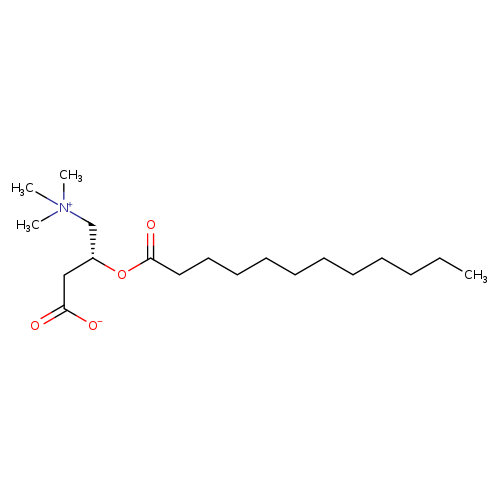
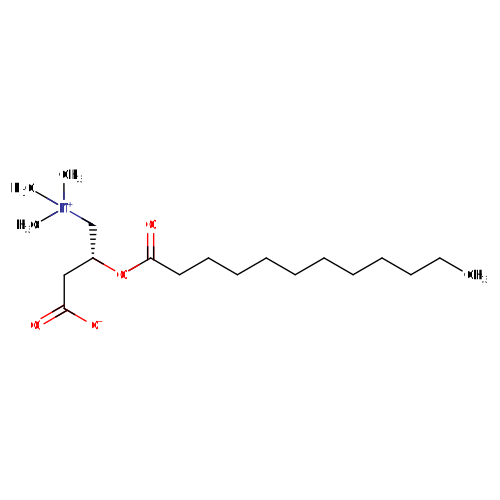
Structure for CHEM022383: Dodecanoylcarnitine
Synonyms
Value
Source
(-)-Lauroylcarnitine
ChEBI
(3R)-3-(Dodecanoyloxy)-4-(trimethylammonio)butanoate
ChEBI
(R)-Dodecanoylcarnitine
ChEBI
Dodecanoyl-L-carnitine
ChEBI
L-Carnitine dodecanoyl ester
ChEBI
Lauroyl-L(-)-carnitin
ChEBI
Lauroyl-L-carnitine
ChEBI
Lauroylcarnitine
ChEBI
Laurylcarnitine
ChEBI
O-C12:0-L-Carnitine
ChEBI
O-Dodecanoyl-R-carnitine
ChEBI
(3R)-3-(Dodecanoyloxy)-4-(trimethylammonio)butanoic acid
Generator
C12 Carnitine
HMDB
L-Lauroylcarnitine
HMDB
Lauroyl-L(-)-carnitine
HMDB
Dodecanoylcarnitine
HMDB
O-Dodecanoylcarnitine
ChEBI, HMDB
O-Lauroylcarnitine
ChEBI, HMDB
O-Lauroyl-L-carnitine
ChEBI, HMDB
Chemical Formula
C
19
H
37
NO
4
Average Molecular Mass
343.501 g/mol
Monoisotopic Mass
343.272 g/mol
CAS Registry Number
25518-54-1
IUPAC Name
(3R)-3-(dodecanoyloxy)-4-(trimethylazaniumyl)butanoate
Traditional Name
lauroyl-L(-)-carnitin
SMILES
CCCCCCCCCCCC(=O)O[C@H](CC([O-])=O)C[N+](C)(C)C
InChI Identifier
InChI=1S/C19H37NO4/c1-5-6-7-8-9-10-11-12-13-14-19(23)24-17(15-18(21)22)16-20(2,3)4/h17H,5-16H2,1-4H3/t17-/m1/s1
InChI Key
FUJLYHJROOYKRA-QGZVFWFLSA-N
Chemical Taxonomy
Description
belongs to the class of organic compounds known as acyl carnitines. These are organic compounds containing a fatty acid with the carboxylic acid attached to carnitine through an ester bond.
Kingdom
Organic compounds
Super Class
Lipids and lipid-like molecules
Class
Fatty Acyls
Sub Class
Fatty acid esters
Direct Parent
Acyl carnitines
Alternative Parents
Dicarboxylic acids and derivatives
Tetraalkylammonium salts
Carboxylic acid salts
Carboxylic acid esters
Carboxylic acids
Organopnictogen compounds
Organic salts
Organic oxides
Hydrocarbon derivatives
Carbonyl compounds
Amines
Substituents
Acyl-carnitine
Dicarboxylic acid or derivatives
Tetraalkylammonium salt
Quaternary ammonium salt
Carboxylic acid ester
Carboxylic acid salt
Carboxylic acid derivative
Carboxylic acid
Organic nitrogen compound
Organooxygen compound
Organonitrogen compound
Organic salt
Hydrocarbon derivative
Organic oxide
Organopnictogen compound
Organic oxygen compound
Carbonyl group
Amine
Aliphatic acyclic compound
Molecular Framework
Aliphatic acyclic compounds
External Descriptors
O-acyl-L-carnitine (
CHEBI:77086
)
O-dodecanoylcarnitine (
CHEBI:77086
)
laurate ester (
CHEBI:77086
)
Biological Properties
Status
Detected and Not Quantified
Origin
Not Available
Cellular Locations
Not Available
Biofluid Locations
Not Available
Tissue Locations
Not Available
Pathways
Not Available
Applications
Not Available
Biological Roles
Not Available
Chemical Roles
Not Available
Physical Properties
State
Not Available
Appearance
Not Available
Experimental Properties
Property
Value
Melting Point
Not Available
Boiling Point
Not Available
Solubility
Not Available
Predicted Properties
Property
Value
Source
Water Solubility
3.8e-05 g/L
ALOGPS
logP
0.03
ALOGPS
logP
0.26
ChemAxon
logS
-7
ALOGPS
pKa (Strongest Acidic)
4.22
ChemAxon
pKa (Strongest Basic)
-7.1
ChemAxon
Physiological Charge
0
ChemAxon
Hydrogen Acceptor Count
3
ChemAxon
Hydrogen Donor Count
0
ChemAxon
Polar Surface Area
66.43 Ų
ChemAxon
Rotatable Bond Count
16
ChemAxon
Refractivity
118.67 m³·mol⁻¹
ChemAxon
Polarizability
41.85 ų
ChemAxon
Number of Rings
0
ChemAxon
Bioavailability
1
ChemAxon
Rule of Five
Yes
ChemAxon
Ghose Filter
Yes
ChemAxon
Veber's Rule
No
ChemAxon
MDDR-like Rule
No
ChemAxon
Spectra
Spectra
Spectrum Type
Description
Splash Key
View
Predicted GC-MS
Predicted GC-MS Spectrum - GC-MS (Non-derivatized) - 70eV, Positive
splash10-00di-9300000000-0cd49618a50984aad982
Spectrum
Predicted GC-MS
Predicted GC-MS Spectrum - GC-MS (Non-derivatized) - 70eV, Positive
Not Available
Spectrum
LC-MS/MS
LC-MS/MS Spectrum - , negative
splash10-0002-0900000000-1c57ff1372236d823d80
Spectrum
LC-MS/MS
LC-MS/MS Spectrum - , positive
splash10-000i-9000000000-ef35ea7a4d61bac8cb20
Spectrum
Predicted LC-MS/MS
Predicted LC-MS/MS Spectrum - 10V, Positive
splash10-0006-0009000000-ce07549e40447c69729f
Spectrum
Predicted LC-MS/MS
Predicted LC-MS/MS Spectrum - 20V, Positive
splash10-000l-9005000000-ce18984499544d19b739
Spectrum
Predicted LC-MS/MS
Predicted LC-MS/MS Spectrum - 40V, Positive
splash10-000i-9000000000-e9262cbaff8cb4ad0ba6
Spectrum
Toxicity Profile
Route of Exposure
Not Available
Mechanism of Toxicity
Not Available
Metabolism
Not Available
Toxicity Values
Not Available
Lethal Dose
Not Available
Carcinogenicity (
IARC Classification
)
Not Available
Uses/Sources
Not Available
Minimum Risk Level
Not Available
Health Effects
Not Available
Symptoms
Not Available
Treatment
Not Available
Concentrations
Not Available
External Links
DrugBank ID
Not Available
HMDB ID
HMDB0002250
FooDB ID
FDB022928
Phenol Explorer ID
Not Available
KNApSAcK ID
C00052268
BiGG ID
Not Available
BioCyc ID
Not Available
METLIN ID
6573
PDB ID
Not Available
Wikipedia Link
Not Available
Chemspider ID
147288
ChEBI ID
77086
PubChem Compound ID
168381
Kegg Compound ID
Not Available
YMDB ID
YMDB01529
ECMDB ID
Not Available
References
Synthesis Reference
Not Available
MSDS
Not Available
General References
1
.
A. Foroutan et al. The Chemical Composition of Commercial Cow's Milk (in preparation)
2
.
Moder M, Kiessling A, Loster H, Bruggemann L: The pattern of urinary acylcarnitines determined by electrospray mass spectrometry: a new tool in the diagnosis of diabetes mellitus. Anal Bioanal Chem. 2003 Jan;375(2):200-10. Epub 2003 Jan 4.
3
.
Shigematsu Y, Hirano S, Hata I, Tanaka Y, Sudo M, Tajima T, Sakura N, Yamaguchi S, Takayanagi M: Selective screening for fatty acid oxidation disorders by tandem mass spectrometry: difficulties in practical discrimination. J Chromatogr B Analyt Technol Biomed Life Sci. 2003 Jul 15;792(1):63-72.
4
.
Vianey-Saban C, Divry P, Brivet M, Nada M, Zabot MT, Mathieu M, Roe C: Mitochondrial very-long-chain acyl-coenzyme A dehydrogenase deficiency: clinical characteristics and diagnostic considerations in 30 patients. Clin Chim Acta. 1998 Jan 12;269(1):43-62.
5
.
Morrow RJ, Rose ME: Isolation of acylcarnitines from urine: a comparison of methods and application to long-chain acyl-CoA dehydrogenase deficiency. Clin Chim Acta. 1992 Oct 15;211(1-2):73-81.
6
.
Elshenawy S, Pinney SE, Stuart T, Doulias PT, Zura G, Parry S, Elovitz MA, Bennett MJ, Bansal A, Strauss JF 3rd, Ischiropoulos H, Simmons RA: The Metabolomic Signature of the Placenta in Spontaneous Preterm Birth. Int J Mol Sci. 2020 Feb 4;21(3). pii: ijms21031043. doi: 10.3390/ijms21031043.
7
.
FRITZ IB: Action of carnitine on long chain fatty acid oxidation by liver. Am J Physiol. 1959 Aug;197:297-304. doi: 10.1152/ajplegacy.1959.197.2.297.
8
.
Violante S, Achetib N, van Roermund CWT, Hagen J, Dodatko T, Vaz FM, Waterham HR, Chen H, Baes M, Yu C, Argmann CA, Houten SM: Peroxisomes can oxidize medium- and long-chain fatty acids through a pathway involving ABCD3 and HSD17B4. FASEB J. 2019 Mar;33(3):4355-4364. doi: 10.1096/fj.201801498R. Epub 2018 Dec 12.
9
.
Costa CG, Struys EA, Bootsma A, ten Brink HJ, Dorland L, Tavares de Almeida I, Duran M, Jakobs C: Quantitative analysis of plasma acylcarnitines using gas chromatography chemical ionization mass fragmentography. J Lipid Res. 1997 Jan;38(1):173-82.
10
.
Yi WJ, Chen J, Li ZB, Jiang TT, Bi DQ, Liu CM, Yang S, Hu YT, Gan L, Tu HH, Huang H, Li JC: Screening of potential biomarkers for Yin-deficiency-heat syndrome based on UHPLC-MS method and the mechanism of Zhibai Dihuang granule therapeutic effect. Anat Rec (Hoboken). 2020 Aug;303(8):2095-2108. doi: 10.1002/ar.24352. Epub 2020 Jan 7.
11
.
Saral NY, Aksungar FB, Aktuglu-Zeybek C, Coskun J, Demirelce O, Serteser M: Glutaric acidemia type II patient with thalassemia minor and novel electron transfer flavoprotein-A gene mutations: A case report and review of literature. World J Clin Cases. 2018 Nov 26;6(14):786-790. doi: 10.12998/wjcc.v6.i14.786.
12
.
Zhao S, Feng XF, Huang T, Luo HH, Chen JX, Zeng J, Gu M, Li J, Sun XY, Sun D, Yang X, Fang ZZ, Cao YF: The Association Between Acylcarnitine Metabolites and Cardiovascular Disease in Chinese Patients With Type 2 Diabetes Mellitus. Front Endocrinol (Lausanne). 2020 May 5;11:212. doi: 10.3389/fendo.2020.00212. eCollection 2020.
13
.
Zordoky BN, Sung MM, Ezekowitz J, Mandal R, Han B, Bjorndahl TC, Bouatra S, Anderson T, Oudit GY, Wishart DS, Dyck JR: Metabolomic fingerprint of heart failure with preserved ejection fraction. PLoS One. 2015 May 26;10(5):e0124844. doi: 10.1371/journal.pone.0124844. eCollection 2015.
14
.
Bene J, Komlosi K, Gasztonyi B, Juhasz M, Tulassay Z, Melegh B: Plasma carnitine ester profile in adult celiac disease patients maintained on long-term gluten free diet. World J Gastroenterol. 2005 Nov 14;11(42):6671-5.
15
.
Ottas A, Fishman D, Okas TL, Kingo K, Soomets U: The metabolic analysis of psoriasis identifies the associated metabolites while providing computational models for the monitoring of the disease. Arch Dermatol Res. 2017 Sep;309(7):519-528. doi: 10.1007/s00403-017-1760-1. Epub 2017 Jul 10.
16
.
Zhang X, Li Y, Liang Y, Sun P, Wu X, Song J, Sun X, Hong M, Gao P, Deng D: Distinguishing Intracerebral Hemorrhage from Acute Cerebral Infarction through Metabolomics. Rev Invest Clin. 2017 Nov-Dec;69(6):319-328. doi: 10.24875/RIC.17002348.
17
.
Bahado-Singh RO, Ertl R, Mandal R, Bjorndahl TC, Syngelaki A, Han B, Dong E, Liu PB, Alpay-Savasan Z, Wishart DS, Nicolaides KH: Metabolomic prediction of fetal congenital heart defect in the first trimester. Am J Obstet Gynecol. 2014 Sep;211(3):240.e1-240.e14. doi: 10.1016/j.ajog.2014.03.056. Epub 2014 Apr 1.
18
.
Niziol J, Bonifay V, Ossolinski K, Ossolinski T, Ossolinska A, Sunner J, Beech I, Arendowski A, Ruman T: Metabolomic study of human tissue and urine in clear cell renal carcinoma by LC-HRMS and PLS-DA. Anal Bioanal Chem. 2018 Jun;410(16):3859-3869. doi: 10.1007/s00216-018-1059-x. Epub 2018 Apr 16.
19
.
Ferdinandusse S, Mulders J, IJlst L, Denis S, Dacremont G, Waterham HR, Wanders RJ: Molecular cloning and expression of human carnitine octanoyltransferase: evidence for its role in the peroxisomal beta-oxidation of branched-chain fatty acids. Biochem Biophys Res Commun. 1999 Sep 16;263(1):213-8.