Record Information
Version1.0
Creation Date2016-05-25 18:26:55 UTC
Update Date2016-11-09 01:17:27 UTC
Accession NumberCHEM022288
Identification
Common NameForasartan
ClassSmall Molecule
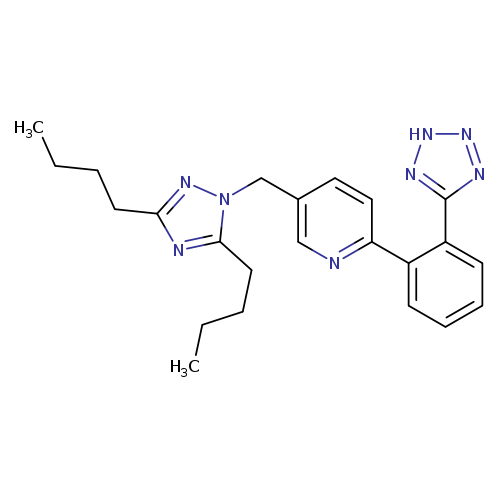
DescriptionForasartan, a specific angiotensin II antagonist, is used alone or with other antihypertensive agents to treat hypertension. Forasartan competes with angiotensin II for binding at the AT1 receptor subtype. As angiotensin II is a vasoconstrictor which also stimulates the synthesis and release of aldosterone, blockage of its effects results in a decreases in systemic vascular resistance.
Contaminant Sources
  • HMDB Contaminants - Urine
Contaminant TypeNot Available
Chemical Structure
Thumb
Synonyms
ValueSource
ForasartanumChEBI
SC 52458ChEBI
SC-52458ChEBI
5-((3,5-Dibutyl-1H-1,2,4-triazol-1-yl)methyl)-2-(2-(1H-tetrazol-5-ylphenyl))pyridineHMDB
Fora-sartanHMDB
Chemical FormulaC23H28N8
Average Molecular Mass416.522 g/mol
Monoisotopic Mass416.244 g/mol
CAS Registry Number145216-43-9
IUPAC Name5-[(dibutyl-1H-1,2,4-triazol-1-yl)methyl]-2-[2-(2H-1,2,3,4-tetrazol-5-yl)phenyl]pyridine
Traditional Nameforasartan
SMILESCCCCC1=NN(CC2=CN=C(C=C2)C2=CC=CC=C2C2=NNN=N2)C(CCCC)=N1
InChI IdentifierInChI=1S/C23H28N8/c1-3-5-11-21-25-22(12-6-4-2)31(28-21)16-17-13-14-20(24-15-17)18-9-7-8-10-19(18)23-26-29-30-27-23/h7-10,13-15H,3-6,11-12,16H2,1-2H3,(H,26,27,29,30)
InChI KeyYONOBYIBNBCDSJ-UHFFFAOYSA-N
Chemical Taxonomy
Description belongs to the class of organic compounds known as phenylpyridines. These are polycyclic aromatic compounds containing a benzene ring linked to a pyridine ring through a CC or CN bond.
KingdomOrganic compounds
Super ClassOrganoheterocyclic compounds
ClassPyridines and derivatives
Sub ClassPhenylpyridines
Direct ParentPhenylpyridines
Alternative Parents
Substituents
  • 2-phenylpyridine
  • Phenyltetrazole
  • Benzenoid
  • Monocyclic benzene moiety
  • Heteroaromatic compound
  • 1,2,4-triazole
  • Tetrazole
  • Azole
  • Azacycle
  • Organic nitrogen compound
  • Organopnictogen compound
  • Hydrocarbon derivative
  • Organonitrogen compound
  • Aromatic heteromonocyclic compound
Molecular FrameworkAromatic heteromonocyclic compounds
External DescriptorsNot Available
Biological Properties
StatusDetected and Not Quantified
OriginNot Available
Cellular LocationsNot Available
Biofluid LocationsNot Available
Tissue LocationsNot Available
PathwaysNot Available
ApplicationsNot Available
Biological RolesNot Available
Chemical RolesNot Available
Physical Properties
StateNot Available
AppearanceNot Available
Experimental Properties
PropertyValue
Melting PointNot Available
Boiling PointNot Available
SolubilityNot Available
Predicted Properties
PropertyValueSource
Water Solubility0.0067 g/LALOGPS
logP4.51ALOGPS
logP5.89ChemAxon
logS-4.8ALOGPS
pKa (Strongest Acidic)7.35ChemAxon
pKa (Strongest Basic)3.99ChemAxon
Physiological Charge0ChemAxon
Hydrogen Acceptor Count6ChemAxon
Hydrogen Donor Count1ChemAxon
Polar Surface Area98.06 ŲChemAxon
Rotatable Bond Count10ChemAxon
Refractivity145.44 m³·mol⁻¹ChemAxon
Polarizability46.79 ųChemAxon
Number of Rings4ChemAxon
Bioavailability1ChemAxon
Rule of FiveNoChemAxon
Ghose FilterNoChemAxon
Veber's RuleNoChemAxon
MDDR-like RuleYesChemAxon
Spectra
Spectra
Spectrum TypeDescriptionSplash KeyView
Predicted GC-MSPredicted GC-MS Spectrum - GC-MS (Non-derivatized) - 70eV, Positivesplash10-00dr-2119100000-e04b6124d350613840caSpectrum
Predicted GC-MSPredicted GC-MS Spectrum - GC-MS (Non-derivatized) - 70eV, PositiveNot AvailableSpectrum
Predicted LC-MS/MSPredicted LC-MS/MS Spectrum - 10V, Positivesplash10-014i-0011900000-82f2b8054d8a70abdd4bSpectrum
Predicted LC-MS/MSPredicted LC-MS/MS Spectrum - 20V, Positivesplash10-00kr-0239300000-c761990a428a03b7d031Spectrum
Predicted LC-MS/MSPredicted LC-MS/MS Spectrum - 40V, Positivesplash10-0a4r-3492000000-1caaf1e75870b4c29d8aSpectrum
Predicted LC-MS/MSPredicted LC-MS/MS Spectrum - 10V, Negativesplash10-00lr-0900500000-3aed9e02ff522163c56eSpectrum
Predicted LC-MS/MSPredicted LC-MS/MS Spectrum - 20V, Negativesplash10-00lr-0932400000-34fac54d64efb89db092Spectrum
Predicted LC-MS/MSPredicted LC-MS/MS Spectrum - 40V, Negativesplash10-001i-9610000000-e6e63055f5e11a58ec4aSpectrum
Predicted LC-MS/MSPredicted LC-MS/MS Spectrum - 10V, Positivesplash10-014i-0000900000-e582bd677f5dc3d1574cSpectrum
Predicted LC-MS/MSPredicted LC-MS/MS Spectrum - 20V, Positivesplash10-014i-0014900000-15e9aca84c5d255c5adfSpectrum
Predicted LC-MS/MSPredicted LC-MS/MS Spectrum - 40V, Positivesplash10-052r-2493000000-2306fba8af7044bc7838Spectrum
Predicted LC-MS/MSPredicted LC-MS/MS Spectrum - 10V, Negativesplash10-014i-0000900000-d5987697aba0ae95495cSpectrum
Predicted LC-MS/MSPredicted LC-MS/MS Spectrum - 20V, Negativesplash10-014i-0029800000-6bb80664ce7eeee384d3Spectrum
Predicted LC-MS/MSPredicted LC-MS/MS Spectrum - 40V, Negativesplash10-00xr-2964000000-2e9a6c661f210ddd8343Spectrum
Toxicity Profile
Route of ExposureNot Available
Mechanism of ToxicityNot Available
MetabolismNot Available
Toxicity ValuesNot Available
Lethal DoseNot Available
Carcinogenicity (IARC Classification)Not Available
Uses/SourcesNot Available
Minimum Risk LevelNot Available
Health EffectsNot Available
SymptomsNot Available
TreatmentNot Available
Concentrations
Not Available
DrugBank IDDB01342
HMDB IDHMDB0015434
FooDB IDNot Available
Phenol Explorer IDNot Available
KNApSAcK IDNot Available
BiGG IDNot Available
BioCyc IDNot Available
METLIN IDNot Available
PDB IDNot Available
Wikipedia LinkForasartan
Chemspider ID117146
ChEBI ID141552
PubChem Compound ID132706
Kegg Compound IDNot Available
YMDB IDNot Available
ECMDB IDNot Available
References
Synthesis ReferenceNot Available
MSDSNot Available
General References
1. https://www.ncbi.nlm.nih.gov/pubmed/?term=7505365
2. https://www.ncbi.nlm.nih.gov/pubmed/?term=8981065
3. https://www.ncbi.nlm.nih.gov/pubmed/?term=9156352
4. https://www.ncbi.nlm.nih.gov/pubmed/?term=9194514