Record Information
Version1.0
Creation Date2016-05-25 18:21:01 UTC
Update Date2026-03-26 21:46:41 UTC
Accession NumberCHEM022128
Identification
Common NameBentiromide
ClassSmall Molecule
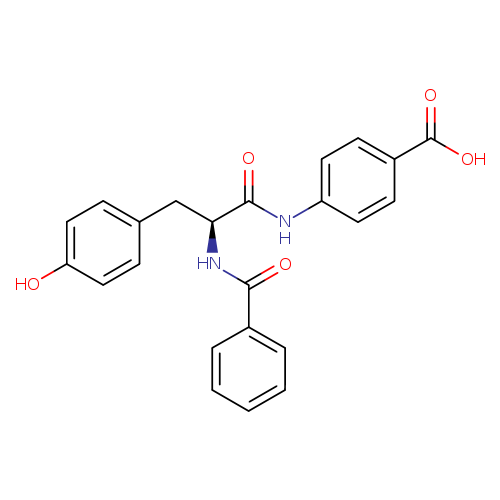
DescriptionThe dipeptide obtained by condensation of N-benzoyl-L-tyrosine with 4-aminobenzoic acid. Used as a noninvasive screening test for exocrine pancreatic insufficiency and to monitor the adequacy of supplemental pancreatic therapy, it is given by mouth: the amount of 4-aminobenzoic acid and its metabolites excreted in the urine is taken as a measure of the chymotrypsin-secreting activity of the pancreas.
Contaminant Sources
  • HMDB Contaminants - Urine
  • STOFF IDENT Compounds
Contaminant TypeNot Available
Chemical Structure
Thumb
Synonyms
ValueSource
(S)-4-((2-(Benzoylamino)-3-(4-hydroxyphenyl)-1-oxopropyl)amino)benzoic acidChEBI
(S)-p-(alpha-Benzamido-p-hydroxyhydrocinnamamido)benzoic acidChEBI
4-(N-Benzoyl-L-tyrosylamino)benzoic acidChEBI
BentiromidoChEBI
BentiromidumChEBI
Benzoyltyrosyl-p-aminobenzoic acidChEBI
BT-PABAChEBI
BTPABAChEBI
N-Benzoyl-L-tyrosyl-p-aminobenzoateChEBI
N-Benzoyl-L-tyrosyl-p-aminobenzoic acidChEBI
PFDChEBI
PFTChEBI
(S)-4-((2-(Benzoylamino)-3-(4-hydroxyphenyl)-1-oxopropyl)amino)benzoateGenerator
(S)-p-(a-Benzamido-p-hydroxyhydrocinnamamido)benzoateGenerator
(S)-p-(a-Benzamido-p-hydroxyhydrocinnamamido)benzoic acidGenerator
(S)-p-(alpha-Benzamido-p-hydroxyhydrocinnamamido)benzoateGenerator
(S)-p-(Α-benzamido-p-hydroxyhydrocinnamamido)benzoateGenerator
(S)-p-(Α-benzamido-p-hydroxyhydrocinnamamido)benzoic acidGenerator
4-(N-Benzoyl-L-tyrosylamino)benzoateGenerator
Benzoyltyrosyl-p-aminobenzoateGenerator
N-Benzoyl-L-tyrosyl-pabaHMDB
PABA-peptideHMDB
Benzoyl-tyrosyl-pabaHMDB
Chemical FormulaC23H20N2O5
Average Molecular Mass404.415 g/mol
Monoisotopic Mass404.137 g/mol
CAS Registry Number37106-97-1
IUPAC Name4-[(2S)-3-(4-hydroxyphenyl)-2-(phenylformamido)propanamido]benzoic acid
Traditional Namebentiromide
SMILESOC(=O)C1=CC=C(NC(=O)[C@H](CC2=CC=C(O)C=C2)NC(=O)C2=CC=CC=C2)C=C1
InChI IdentifierInChI=1S/C23H20N2O5/c26-19-12-6-15(7-13-19)14-20(25-21(27)16-4-2-1-3-5-16)22(28)24-18-10-8-17(9-11-18)23(29)30/h1-13,20,26H,14H2,(H,24,28)(H,25,27)(H,29,30)/t20-/m0/s1
InChI KeySPPTWHFVYKCNNK-FQEVSTJZSA-N
Chemical Taxonomy
Description belongs to the class of organic compounds known as tyrosine and derivatives. Tyrosine and derivatives are compounds containing tyrosine or a derivative thereof resulting from reaction of tyrosine at the amino group or the carboxy group, or from the replacement of any hydrogen of glycine by a heteroatom.
KingdomOrganic compounds
Super ClassOrganic acids and derivatives
ClassCarboxylic acids and derivatives
Sub ClassAmino acids, peptides, and analogues
Direct ParentTyrosine and derivatives
Alternative Parents
Substituents
  • Tyrosine or derivatives
  • Phenylalanine or derivatives
  • Hippuric acid or derivatives
  • N-acyl-alpha amino acid or derivatives
  • Acylaminobenzoic acid or derivatives
  • Alpha-amino acid amide
  • Amphetamine or derivatives
  • Benzoic acid or derivatives
  • Anilide
  • Benzoic acid
  • Benzamide
  • N-arylamide
  • Benzoyl
  • 1-hydroxy-2-unsubstituted benzenoid
  • Phenol
  • Monocyclic benzene moiety
  • Fatty acyl
  • Benzenoid
  • Fatty amide
  • Secondary carboxylic acid amide
  • Carboxamide group
  • Monocarboxylic acid or derivatives
  • Carboxylic acid
  • Organic nitrogen compound
  • Carbonyl group
  • Organonitrogen compound
  • Organooxygen compound
  • Hydrocarbon derivative
  • Organic oxide
  • Organopnictogen compound
  • Organic oxygen compound
  • Aromatic homomonocyclic compound
Molecular FrameworkAromatic homomonocyclic compounds
External Descriptors
Biological Properties
StatusDetected and Not Quantified
OriginNot Available
Cellular LocationsNot Available
Biofluid LocationsNot Available
Tissue LocationsNot Available
PathwaysNot Available
ApplicationsNot Available
Biological RolesNot Available
Chemical RolesNot Available
Physical Properties
StateNot Available
AppearanceNot Available
Experimental Properties
PropertyValue
Melting PointNot Available
Boiling PointNot Available
SolubilityNot Available
Predicted Properties
PropertyValueSource
Water Solubility0.0041 g/LALOGPS
logP2.99ALOGPS
logP3.54ChemAxon
logS-5ALOGPS
pKa (Strongest Acidic)4.16ChemAxon
pKa (Strongest Basic)-1.3ChemAxon
Physiological Charge-1ChemAxon
Hydrogen Acceptor Count5ChemAxon
Hydrogen Donor Count4ChemAxon
Polar Surface Area115.73 ŲChemAxon
Rotatable Bond Count7ChemAxon
Refractivity112.74 m³·mol⁻¹ChemAxon
Polarizability42.16 ųChemAxon
Number of Rings3ChemAxon
Bioavailability1ChemAxon
Rule of FiveYesChemAxon
Ghose FilterYesChemAxon
Veber's RuleNoChemAxon
MDDR-like RuleYesChemAxon
Spectra
Spectra
Spectrum TypeDescriptionSplash KeyView
Predicted GC-MSPredicted GC-MS Spectrum - GC-MS (Non-derivatized) - 70eV, Positivesplash10-0a4l-0951000000-3408813d239b684fcca1Spectrum
Predicted GC-MSPredicted GC-MS Spectrum - GC-MS (2 TMS) - 70eV, Positivesplash10-0a59-0902130000-2e52e28c1a3b2bc381ceSpectrum
Predicted GC-MSPredicted GC-MS Spectrum - GC-MS (Non-derivatized) - 70eV, PositiveNot AvailableSpectrum
Predicted LC-MS/MSPredicted LC-MS/MS Spectrum - 10V, Positivesplash10-0a4r-0479500000-9b7d3992e6800b7ec069Spectrum
Predicted LC-MS/MSPredicted LC-MS/MS Spectrum - 20V, Positivesplash10-0a4l-0951000000-0e8e632e5411e48e747eSpectrum
Predicted LC-MS/MSPredicted LC-MS/MS Spectrum - 40V, Positivesplash10-0a4i-2920000000-786eb7e2b52e3322399dSpectrum
Predicted LC-MS/MSPredicted LC-MS/MS Spectrum - 10V, Negativesplash10-0udi-0254900000-a07141fcfe2759e41e1bSpectrum
Predicted LC-MS/MSPredicted LC-MS/MS Spectrum - 20V, Negativesplash10-0zg3-3694200000-da9c1e7b3b855e5436e0Spectrum
Predicted LC-MS/MSPredicted LC-MS/MS Spectrum - 40V, Negativesplash10-0006-6900000000-d9bd094cd00bd79ca2a7Spectrum
Predicted LC-MS/MSPredicted LC-MS/MS Spectrum - 10V, Positivesplash10-0a4i-0020900000-491ed190ebed6003bc34Spectrum
Predicted LC-MS/MSPredicted LC-MS/MS Spectrum - 20V, Positivesplash10-0a59-0970200000-bd7f9a2db2ad1e6443f6Spectrum
Predicted LC-MS/MSPredicted LC-MS/MS Spectrum - 40V, Positivesplash10-056r-5921000000-a21fe0aa532ec26db20fSpectrum
Predicted LC-MS/MSPredicted LC-MS/MS Spectrum - 10V, Negativesplash10-0udi-0000900000-6c33d64e035c215f9b55Spectrum
Predicted LC-MS/MSPredicted LC-MS/MS Spectrum - 20V, Negativesplash10-00to-6972100000-fd8354cac47979662cabSpectrum
Predicted LC-MS/MSPredicted LC-MS/MS Spectrum - 40V, Negativesplash10-00l6-6900000000-655dee2f28414fdf2f97Spectrum
Toxicity Profile
Route of ExposureNot Available
Mechanism of ToxicityNot Available
MetabolismNot Available
Toxicity ValuesNot Available
Lethal DoseNot Available
Carcinogenicity (IARC Classification)Not Available
Uses/SourcesNot Available
Minimum Risk LevelNot Available
Health EffectsNot Available
SymptomsNot Available
TreatmentNot Available
Concentrations
Not Available
DrugBank IDDB00522
HMDB IDHMDB0014663
FooDB IDNot Available
Phenol Explorer IDNot Available
KNApSAcK IDNot Available
BiGG IDNot Available
BioCyc IDNot Available
METLIN IDNot Available
PDB IDNot Available
Wikipedia LinkBentiromide
Chemspider ID5329364
ChEBI ID31263
PubChem Compound ID6957673
Kegg Compound IDNot Available
YMDB IDNot Available
ECMDB IDNot Available
References
Synthesis ReferenceNot Available
MSDSNot Available
General References
1. Toskes PP: The bentiromide test for pancreatic exocrine insufficiency. Pharmacotherapy. 1984 Mar-Apr;4(2):74-80.