Record Information
Version1.0
Creation Date2016-05-25 18:18:15 UTC
Update Date2016-11-09 01:17:24 UTC
Accession NumberCHEM022032
Identification
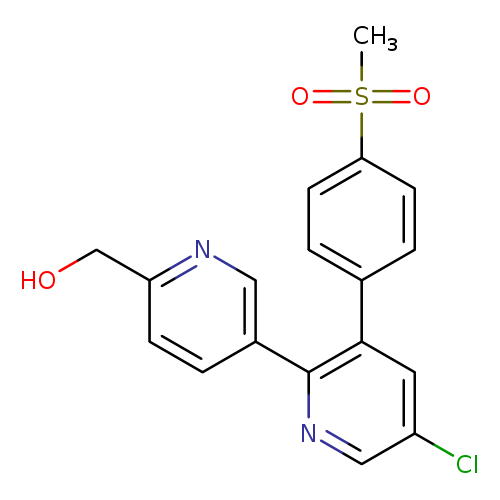
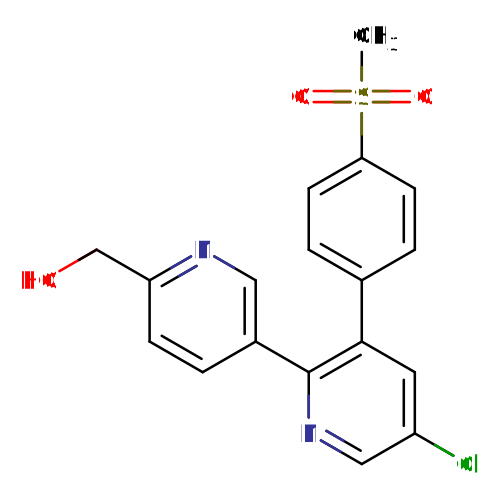
Common Name6-Hydroxymethyletoricoxib
ClassSmall Molecule
Description6-Hydroxymethyletoricoxib is only found in individuals that have used or taken Etoricoxib. 6-Hydroxymethyletoricoxib is a metabolite of Etoricoxib. 6-hydroxymethyletoricoxib belongs to the family of Bipyridines. These are organic compounds containing two pyridine rings linked to each other.
Contaminant Sources
  • HMDB Contaminants - Urine
Contaminant TypeNot Available
Chemical Structure
Thumb
Synonyms
ValueSource
[5-Chloro-3-(4-methanesulphonylphenyl)-[2,3'-bipyridine]-6'-yl]methanolGenerator
Chemical FormulaC18H15ClN2O3S
Average Molecular Mass374.841 g/mol
Monoisotopic Mass374.049 g/mol
CAS Registry NumberNot Available
IUPAC Name{5-[5-chloro-3-(4-methanesulfonylphenyl)pyridin-2-yl]pyridin-2-yl}methanol
Traditional Name{5-[5-chloro-3-(4-methanesulfonylphenyl)pyridin-2-yl]pyridin-2-yl}methanol
SMILESCS(=O)(=O)C1=CC=C(C=C1)C1=C(N=CC(Cl)=C1)C1=CN=C(CO)C=C1
InChI IdentifierInChI=1S/C18H15ClN2O3S/c1-25(23,24)16-6-3-12(4-7-16)17-8-14(19)10-21-18(17)13-2-5-15(11-22)20-9-13/h2-10,22H,11H2,1H3
InChI KeySCVWZQQMIZJGJY-UHFFFAOYSA-N
Chemical Taxonomy
Description belongs to the class of organic compounds known as bipyridines and oligopyridines. These are organic compounds containing two pyridine rings linked to each other.
KingdomOrganic compounds
Super ClassOrganoheterocyclic compounds
ClassPyridines and derivatives
Sub ClassBipyridines and oligopyridines
Direct ParentBipyridines and oligopyridines
Alternative Parents
Substituents
  • Bipyridine
  • 3-phenylpyridine
  • Benzenesulfonyl group
  • Aryl chloride
  • Aryl halide
  • Monocyclic benzene moiety
  • Benzenoid
  • Heteroaromatic compound
  • Sulfone
  • Sulfonyl
  • Azacycle
  • Alcohol
  • Aromatic alcohol
  • Primary alcohol
  • Hydrocarbon derivative
  • Organosulfur compound
  • Organooxygen compound
  • Organonitrogen compound
  • Organochloride
  • Organohalogen compound
  • Organic oxide
  • Organopnictogen compound
  • Organic oxygen compound
  • Organic nitrogen compound
  • Aromatic heteromonocyclic compound
Molecular FrameworkAromatic heteromonocyclic compounds
External DescriptorsNot Available
Biological Properties
StatusDetected and Not Quantified
OriginNot Available
Cellular LocationsNot Available
Biofluid LocationsNot Available
Tissue LocationsNot Available
PathwaysNot Available
ApplicationsNot Available
Biological RolesNot Available
Chemical RolesNot Available
Physical Properties
StateNot Available
AppearanceNot Available
Experimental Properties
PropertyValue
Melting PointNot Available
Boiling PointNot Available
SolubilityNot Available
Predicted Properties
PropertyValueSource
Water Solubility0.02 g/LALOGPS
logP2.58ALOGPS
logP1.98ChemAxon
logS-4.3ALOGPS
pKa (Strongest Acidic)14.17ChemAxon
pKa (Strongest Basic)3.82ChemAxon
Physiological Charge0ChemAxon
Hydrogen Acceptor Count5ChemAxon
Hydrogen Donor Count1ChemAxon
Polar Surface Area80.15 ŲChemAxon
Rotatable Bond Count4ChemAxon
Refractivity96.75 m³·mol⁻¹ChemAxon
Polarizability37.44 ųChemAxon
Number of Rings3ChemAxon
Bioavailability1ChemAxon
Rule of FiveYesChemAxon
Ghose FilterYesChemAxon
Veber's RuleNoChemAxon
MDDR-like RuleNoChemAxon
Spectra
Spectra
Spectrum TypeDescriptionSplash KeyView
Predicted GC-MSPredicted GC-MS Spectrum - GC-MS (Non-derivatized) - 70eV, Positivesplash10-0005-0097000000-6d9201694b0957932cdbSpectrum
Predicted GC-MSPredicted GC-MS Spectrum - GC-MS (1 TMS) - 70eV, Positivesplash10-0fl0-9018500000-5316067caa26d10e2054Spectrum
Predicted GC-MSPredicted GC-MS Spectrum - GC-MS (Non-derivatized) - 70eV, PositiveNot AvailableSpectrum
Predicted LC-MS/MSPredicted LC-MS/MS Spectrum - 10V, Positivesplash10-004i-0009000000-5241a5f2f85d782ffd8dSpectrum
Predicted LC-MS/MSPredicted LC-MS/MS Spectrum - 20V, Positivesplash10-004j-0049000000-303f6f6f687b8c913185Spectrum
Predicted LC-MS/MSPredicted LC-MS/MS Spectrum - 40V, Positivesplash10-0kyj-1191000000-860082fd0fcb353ab6a6Spectrum
Predicted LC-MS/MSPredicted LC-MS/MS Spectrum - 10V, Negativesplash10-00di-1009000000-fb5104bf1255d89bfadbSpectrum
Predicted LC-MS/MSPredicted LC-MS/MS Spectrum - 20V, Negativesplash10-00fu-4019000000-30c989ba9441ea988e86Spectrum
Predicted LC-MS/MSPredicted LC-MS/MS Spectrum - 40V, Negativesplash10-004i-9021000000-4a2200e03904bfa09028Spectrum
Predicted LC-MS/MSPredicted LC-MS/MS Spectrum - 10V, Negativesplash10-00di-0009000000-238e13a9692d91134858Spectrum
Predicted LC-MS/MSPredicted LC-MS/MS Spectrum - 20V, Negativesplash10-001i-9005000000-775f4a2f9818bf4fa04fSpectrum
Predicted LC-MS/MSPredicted LC-MS/MS Spectrum - 40V, Negativesplash10-0059-9000000000-d87c93edc50dc6cacf88Spectrum
Predicted LC-MS/MSPredicted LC-MS/MS Spectrum - 10V, Positivesplash10-004i-0009000000-f238e5857569fe9f4e65Spectrum
Predicted LC-MS/MSPredicted LC-MS/MS Spectrum - 20V, Positivesplash10-004i-0009000000-2f9603e7fae611396479Spectrum
Predicted LC-MS/MSPredicted LC-MS/MS Spectrum - 40V, Positivesplash10-014l-0095000000-b326af6659371b96b646Spectrum
Toxicity Profile
Route of ExposureNot Available
Mechanism of ToxicityNot Available
MetabolismNot Available
Toxicity ValuesNot Available
Lethal DoseNot Available
Carcinogenicity (IARC Classification)Not Available
Uses/SourcesNot Available
Minimum Risk LevelNot Available
Health EffectsNot Available
SymptomsNot Available
TreatmentNot Available
Concentrations
Not Available
DrugBank IDNot Available
HMDB IDHMDB0013997
FooDB IDNot Available
Phenol Explorer IDNot Available
KNApSAcK IDNot Available
BiGG IDNot Available
BioCyc IDNot Available
METLIN IDNot Available
PDB IDNot Available
Wikipedia LinkNot Available
Chemspider ID23110102
ChEBI ID106712
PubChem Compound ID44266438
Kegg Compound IDNot Available
YMDB IDNot Available
ECMDB IDNot Available
References
Synthesis ReferenceNot Available
MSDSNot Available
General ReferencesNot Available