Record Information
Version1.0
Creation Date2016-05-25 18:17:56 UTC
Update Date2016-11-09 01:17:24 UTC
Accession NumberCHEM022015
Identification
Common Name1-Hydroxycarvedilol
ClassSmall Molecule
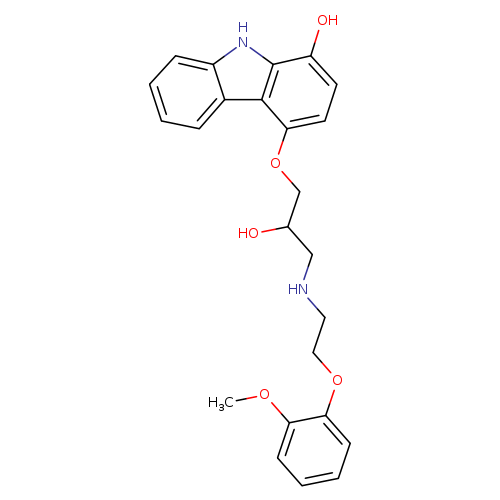
Description1-Hydroxycarvedilol is only found in individuals that have used or taken Carvedilol. 1-Hydroxycarvedilol is a metabolite of Carvedilol. 1-hydroxycarvedilol belongs to the family of Carbazoles. These are compounds containing a three ring system containing a pyrrole ring fused on either side to a benzene ring.
Contaminant Sources
  • HMDB Contaminants - Urine
Contaminant TypeNot Available
Chemical Structure
Thumb
SynonymsNot Available
Chemical FormulaC24H26N2O5
Average Molecular Mass422.474 g/mol
Monoisotopic Mass422.184 g/mol
CAS Registry NumberNot Available
IUPAC Name4-(2-hydroxy-3-{[2-(2-methoxyphenoxy)ethyl]amino}propoxy)-9H-carbazol-1-ol
Traditional Name4-(2-hydroxy-3-{[2-(2-methoxyphenoxy)ethyl]amino}propoxy)-9H-carbazol-1-ol
SMILESCOC1=CC=CC=C1OCCNCC(O)COC1=CC=C(O)C2=C1C1=CC=CC=C1N2
InChI IdentifierInChI=1S/C24H26N2O5/c1-29-20-8-4-5-9-21(20)30-13-12-25-14-16(27)15-31-22-11-10-19(28)24-23(22)17-6-2-3-7-18(17)26-24/h2-11,16,25-28H,12-15H2,1H3
InChI KeyUQJJKVKQRTUYJW-UHFFFAOYSA-N
Chemical Taxonomy
Description belongs to the class of organic compounds known as carbazoles. Carbazoles are compounds containing a three ring system containing a pyrrole ring fused on either side to a benzene ring.
KingdomOrganic compounds
Super ClassOrganoheterocyclic compounds
ClassIndoles and derivatives
Sub ClassCarbazoles
Direct ParentCarbazoles
Alternative Parents
Substituents
  • Carbazole
  • Hydroxyindole
  • Indole
  • Phenoxy compound
  • Anisole
  • Phenol ether
  • Methoxybenzene
  • Alkyl aryl ether
  • 1-hydroxy-2-unsubstituted benzenoid
  • Monocyclic benzene moiety
  • Benzenoid
  • Heteroaromatic compound
  • Pyrrole
  • 1,2-aminoalcohol
  • Secondary alcohol
  • Azacycle
  • Ether
  • Secondary aliphatic amine
  • Secondary amine
  • Alcohol
  • Organooxygen compound
  • Organonitrogen compound
  • Hydrocarbon derivative
  • Organopnictogen compound
  • Organic oxygen compound
  • Amine
  • Organic nitrogen compound
  • Aromatic heteropolycyclic compound
Molecular FrameworkAromatic heteropolycyclic compounds
External DescriptorsNot Available
Biological Properties
StatusDetected and Not Quantified
OriginNot Available
Cellular LocationsNot Available
Biofluid LocationsNot Available
Tissue LocationsNot Available
PathwaysNot Available
ApplicationsNot Available
Biological RolesNot Available
Chemical RolesNot Available
Physical Properties
StateNot Available
AppearanceNot Available
Experimental Properties
PropertyValue
Melting PointNot Available
Boiling PointNot Available
SolubilityNot Available
Predicted Properties
PropertyValueSource
Water Solubility0.015 g/LALOGPS
logP3.02ALOGPS
logP2.7ChemAxon
logS-4.5ALOGPS
pKa (Strongest Acidic)9.27ChemAxon
pKa (Strongest Basic)8.59ChemAxon
Physiological Charge1ChemAxon
Hydrogen Acceptor Count6ChemAxon
Hydrogen Donor Count4ChemAxon
Polar Surface Area95.97 ŲChemAxon
Rotatable Bond Count10ChemAxon
Refractivity117.62 m³·mol⁻¹ChemAxon
Polarizability46.08 ųChemAxon
Number of Rings4ChemAxon
Bioavailability1ChemAxon
Rule of FiveYesChemAxon
Ghose FilterYesChemAxon
Veber's RuleNoChemAxon
MDDR-like RuleYesChemAxon
Spectra
Spectra
Spectrum TypeDescriptionSplash KeyView
Predicted GC-MSPredicted GC-MS Spectrum - GC-MS (Non-derivatized) - 70eV, Positivesplash10-01ow-4980100000-0f085b396ba5027b565bSpectrum
Predicted GC-MSPredicted GC-MS Spectrum - GC-MS (2 TMS) - 70eV, Positivesplash10-0h4o-6749230000-477de223418b01332de4Spectrum
Predicted GC-MSPredicted GC-MS Spectrum - GC-MS (Non-derivatized) - 70eV, PositiveNot AvailableSpectrum
Predicted LC-MS/MSPredicted LC-MS/MS Spectrum - 10V, Positivesplash10-00di-0450900000-43573af89a3f0d449681Spectrum
Predicted LC-MS/MSPredicted LC-MS/MS Spectrum - 20V, Positivesplash10-0kh9-2790200000-ad21a57051c80de149afSpectrum
Predicted LC-MS/MSPredicted LC-MS/MS Spectrum - 40V, Positivesplash10-0pc0-6910000000-edc898aac4d6becbf464Spectrum
Predicted LC-MS/MSPredicted LC-MS/MS Spectrum - 10V, Negativesplash10-00di-0920700000-3c5b71809f9df898c375Spectrum
Predicted LC-MS/MSPredicted LC-MS/MS Spectrum - 20V, Negativesplash10-0002-0900000000-f455a88c65200e1f8a5eSpectrum
Predicted LC-MS/MSPredicted LC-MS/MS Spectrum - 40V, Negativesplash10-00kb-1900000000-8ec7bbfd36df031366dcSpectrum
Predicted LC-MS/MSPredicted LC-MS/MS Spectrum - 10V, Positivesplash10-00dj-0290700000-79a5f467ecda4672c85aSpectrum
Predicted LC-MS/MSPredicted LC-MS/MS Spectrum - 20V, Positivesplash10-0udi-0590200000-321aeaa9277b604e4f6bSpectrum
Predicted LC-MS/MSPredicted LC-MS/MS Spectrum - 40V, Positivesplash10-0udi-3930000000-5b3e1586bbedfc0c6a19Spectrum
Predicted LC-MS/MSPredicted LC-MS/MS Spectrum - 10V, Negativesplash10-00di-0500900000-caf55dd3329c3d657a91Spectrum
Predicted LC-MS/MSPredicted LC-MS/MS Spectrum - 20V, Negativesplash10-00kb-2941400000-13f364c85c0127a3e39eSpectrum
Predicted LC-MS/MSPredicted LC-MS/MS Spectrum - 40V, Negativesplash10-00kb-1900000000-1de11fb882390516b6eeSpectrum
Toxicity Profile
Route of ExposureNot Available
Mechanism of ToxicityNot Available
MetabolismNot Available
Toxicity ValuesNot Available
Lethal DoseNot Available
Carcinogenicity (IARC Classification)Not Available
Uses/SourcesNot Available
Minimum Risk LevelNot Available
Health EffectsNot Available
SymptomsNot Available
TreatmentNot Available
Concentrations
Not Available
DrugBank IDNot Available
HMDB IDHMDB0013950
FooDB IDNot Available
Phenol Explorer IDNot Available
KNApSAcK IDNot Available
BiGG IDNot Available
BioCyc IDNot Available
METLIN IDNot Available
PDB IDNot Available
Wikipedia LinkNot Available
Chemspider ID158745
ChEBI ID175370
PubChem Compound ID182523
Kegg Compound IDNot Available
YMDB IDNot Available
ECMDB IDNot Available
References
Synthesis ReferenceNot Available
MSDSNot Available
General ReferencesNot Available