Record Information
Version1.0
Creation Date2016-05-25 18:14:31 UTC
Update Date2026-04-06 16:53:29 UTC
Accession NumberCHEM021873
Identification
Common NameDityrosine
ClassSmall Molecule
Description
Contaminant Sources
  • FooDB Chemicals
  • HMDB Contaminants - Urine
Contaminant TypeNot Available
Chemical Structure
Thumb
Synonyms
ValueSource
BityrosineHMDB
O,O'-dityrosineHMDB
O,O-DityrosineHMDB
2-Amino-3-[4'-(2-amino-2-carboxyethyl)-2,2'-dihydroxy-[1,1'-biphenyl]-4-yl]propanoateGenerator, HMDB
Chemical FormulaC18H20N2O6
Average Molecular Mass360.361 g/mol
Monoisotopic Mass360.132 g/mol
CAS Registry Number980-21-2
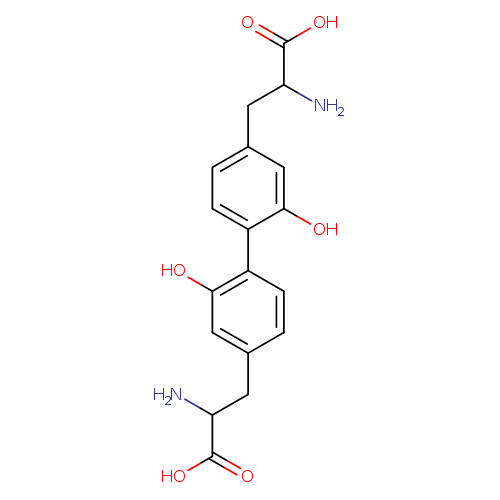
IUPAC Name2-amino-3-{4-[4-(2-amino-2-carboxyethyl)-2-hydroxyphenyl]-3-hydroxyphenyl}propanoic acid
Traditional Name2-amino-3-{4-[4-(2-amino-2-carboxyethyl)-2-hydroxyphenyl]-3-hydroxyphenyl}propanoic acid
SMILESNC(CC1=CC(O)=C(C=C1)C1=CC=C(CC(N)C(O)=O)C=C1O)C(O)=O
InChI IdentifierInChI=1S/C18H20N2O6/c19-13(17(23)24)5-9-1-3-11(15(21)7-9)12-4-2-10(8-16(12)22)6-14(20)18(25)26/h1-4,7-8,13-14,21-22H,5-6,19-20H2,(H,23,24)(H,25,26)
InChI KeyFHOZGLMQYMAREG-UHFFFAOYSA-N
Chemical Taxonomy
Description belongs to the class of organic compounds known as lignans, neolignans and related compounds. These are plant products of low molecular weight formed primarily from oxidative coupling of two p-propylphenol moieties. They can also be described as micromolecules with two phenylpropanoid units coupled together. They can be attached in various manners, like C5-C5', C8-C8'. Most known natural lignans are oxidized at C9 and C9´ and, based upon the way in which oxygen is incorporated into the skeleton and on the cyclization patterns, a wide range of lignans of very different structural types can be formed.
KingdomOrganic compounds
Super ClassLignans, neolignans and related compounds
ClassNot Available
Sub ClassNot Available
Direct ParentLignans, neolignans and related compounds
Alternative Parents
Substituents
  • Phenylalanine or derivatives
  • Neolignan skeleton
  • Biphenyl
  • 3-phenylpropanoic-acid
  • Alpha-amino acid
  • Alpha-amino acid or derivatives
  • Amphetamine or derivatives
  • 1-hydroxy-4-unsubstituted benzenoid
  • 1-hydroxy-2-unsubstituted benzenoid
  • Aralkylamine
  • Phenol
  • Monocyclic benzene moiety
  • Dicarboxylic acid or derivatives
  • Benzenoid
  • Amino acid or derivatives
  • Amino acid
  • Carboxylic acid
  • Carboxylic acid derivative
  • Primary aliphatic amine
  • Primary amine
  • Hydrocarbon derivative
  • Carbonyl group
  • Organic oxygen compound
  • Organic oxide
  • Organopnictogen compound
  • Organic nitrogen compound
  • Amine
  • Organonitrogen compound
  • Organooxygen compound
  • Aromatic homomonocyclic compound
Molecular FrameworkAromatic homomonocyclic compounds
External DescriptorsNot Available
Biological Properties
StatusDetected and Not Quantified
OriginNot Available
Cellular LocationsNot Available
Biofluid LocationsNot Available
Tissue LocationsNot Available
PathwaysNot Available
ApplicationsNot Available
Biological RolesNot Available
Chemical RolesNot Available
Physical Properties
StateNot Available
AppearanceNot Available
Experimental Properties
PropertyValue
Melting PointNot Available
Boiling PointNot Available
SolubilityNot Available
Predicted Properties
PropertyValueSource
Water Solubility0.052 g/LALOGPS
logP-2.8ALOGPS
logP-3.3ChemAxon
logS-3.8ALOGPS
pKa (Strongest Acidic)1.56ChemAxon
pKa (Strongest Basic)9.94ChemAxon
Physiological Charge0ChemAxon
Hydrogen Acceptor Count8ChemAxon
Hydrogen Donor Count6ChemAxon
Polar Surface Area167.1 ŲChemAxon
Rotatable Bond Count7ChemAxon
Refractivity93.27 m³·mol⁻¹ChemAxon
Polarizability37.15 ųChemAxon
Number of Rings2ChemAxon
Bioavailability1ChemAxon
Rule of FiveNoChemAxon
Ghose FilterNoChemAxon
Veber's RuleNoChemAxon
MDDR-like RuleNoChemAxon
Spectra
Spectra
Spectrum TypeDescriptionSplash KeyView
Predicted GC-MSPredicted GC-MS Spectrum - GC-MS (Non-derivatized) - 70eV, Positivesplash10-00r6-4094000000-69cfcedbb99c8bb8cb22Spectrum
Predicted GC-MSPredicted GC-MS Spectrum - GC-MS (4 TMS) - 70eV, Positivesplash10-0ff0-5100039000-cb3449936fc7a3cc50b3Spectrum
Predicted GC-MSPredicted GC-MS Spectrum - GC-MS (Non-derivatized) - 70eV, PositiveNot AvailableSpectrum
Predicted LC-MS/MSPredicted LC-MS/MS Spectrum - 10V, Positivesplash10-02t9-0039000000-ec7ae91410eca2c163aeSpectrum
Predicted LC-MS/MSPredicted LC-MS/MS Spectrum - 20V, Positivesplash10-014i-0094000000-70dc4b0fd9a69a9afbb7Spectrum
Predicted LC-MS/MSPredicted LC-MS/MS Spectrum - 40V, Positivesplash10-0006-0090000000-6bfa163a49d5227bf160Spectrum
Predicted LC-MS/MSPredicted LC-MS/MS Spectrum - 10V, Negativesplash10-0a4i-0009000000-baf07a29301dbcc652a9Spectrum
Predicted LC-MS/MSPredicted LC-MS/MS Spectrum - 20V, Negativesplash10-0a59-2529000000-229b9b59e584d12c9814Spectrum
Predicted LC-MS/MSPredicted LC-MS/MS Spectrum - 40V, Negativesplash10-00e9-9811000000-f784f768398cc5e8fa4eSpectrum
Predicted LC-MS/MSPredicted LC-MS/MS Spectrum - 10V, Negativesplash10-0a4i-1029000000-99c9c87678bcb9643b95Spectrum
Predicted LC-MS/MSPredicted LC-MS/MS Spectrum - 20V, Negativesplash10-05tb-2096000000-157a4b079267ef2d7e78Spectrum
Predicted LC-MS/MSPredicted LC-MS/MS Spectrum - 40V, Negativesplash10-00vj-2191000000-ad98ef86b3ce473d2199Spectrum
Predicted LC-MS/MSPredicted LC-MS/MS Spectrum - 10V, Positivesplash10-01b9-0097000000-e6e5f8d807ad7ccd91a9Spectrum
Predicted LC-MS/MSPredicted LC-MS/MS Spectrum - 20V, Positivesplash10-01ba-0092000000-1f404f5753c0ce803beaSpectrum
Predicted LC-MS/MSPredicted LC-MS/MS Spectrum - 40V, Positivesplash10-002g-2290000000-9895fb1cf10a8122083bSpectrum
1D NMR13C NMR SpectrumNot AvailableSpectrum
1D NMR1H NMR SpectrumNot AvailableSpectrum
1D NMR13C NMR SpectrumNot AvailableSpectrum
1D NMR1H NMR SpectrumNot AvailableSpectrum
1D NMR13C NMR SpectrumNot AvailableSpectrum
1D NMR1H NMR SpectrumNot AvailableSpectrum
1D NMR13C NMR SpectrumNot AvailableSpectrum
1D NMR1H NMR SpectrumNot AvailableSpectrum
1D NMR13C NMR SpectrumNot AvailableSpectrum
1D NMR1H NMR SpectrumNot AvailableSpectrum
1D NMR13C NMR SpectrumNot AvailableSpectrum
1D NMR1H NMR SpectrumNot AvailableSpectrum
1D NMR13C NMR SpectrumNot AvailableSpectrum
1D NMR1H NMR SpectrumNot AvailableSpectrum
1D NMR13C NMR SpectrumNot AvailableSpectrum
1D NMR1H NMR SpectrumNot AvailableSpectrum
1D NMR13C NMR SpectrumNot AvailableSpectrum
1D NMR1H NMR SpectrumNot AvailableSpectrum
1D NMR13C NMR SpectrumNot AvailableSpectrum
1D NMR1H NMR SpectrumNot AvailableSpectrum
Toxicity Profile
Route of ExposureNot Available
Mechanism of ToxicityNot Available
MetabolismNot Available
Toxicity ValuesNot Available
Lethal DoseNot Available
Carcinogenicity (IARC Classification)Not Available
Uses/SourcesNot Available
Minimum Risk LevelNot Available
Health EffectsNot Available
SymptomsNot Available
TreatmentNot Available
Concentrations
Not Available
DrugBank IDNot Available
HMDB IDHMDB0006045
FooDB IDFDB023818
Phenol Explorer IDNot Available
KNApSAcK IDC00054519
BiGG IDNot Available
BioCyc IDNot Available
METLIN IDNot Available
PDB IDNot Available
Wikipedia LinkNot Available
Chemspider ID21233943
ChEBI IDNot Available
PubChem Compound ID53477799
Kegg Compound IDNot Available
YMDB IDNot Available
ECMDB IDNot Available
References
Synthesis ReferenceNot Available
MSDSNot Available
General References
1. Abdelrahim M, Morris E, Carver J, Facchina S, White A, Verma A: Liquid chromatographic assay of dityrosine in human cerebrospinal fluid. J Chromatogr B Biomed Sci Appl. 1997 Aug 29;696(2):175-82.
2. Galeazzi L, Ronchi P, Franceschi C, Giunta S: In vitro peroxidase oxidation induces stable dimers of beta-amyloid (1-42) through dityrosine bridge formation. Amyloid. 1999 Mar;6(1):7-13.
3. DiMarco T, Giulivi C: Current analytical methods for the detection of dityrosine, a biomarker of oxidative stress, in biological samples. Mass Spectrom Rev. 2007 Jan-Feb;26(1):108-20.