Record Information
Version1.0
Creation Date2016-05-25 02:49:15 UTC
Update Date2016-10-28 10:01:46 UTC
Accession NumberCHEM020983
Identification
Common NameArachidonic acid
ClassSmall Molecule
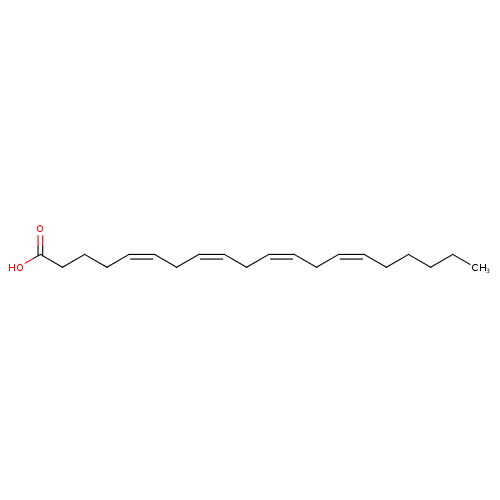
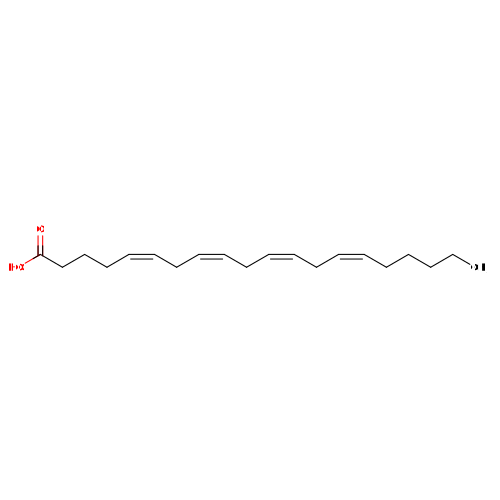
DescriptionArachidonic acid is a polyunsaturated, essential fatty acid that has a 20-carbon chain as a backbone and four cis-double bonds at the C5, C8, C11, and C14 positions. It is found in animal and human fat as well as in the liver, brain, and glandular organs, and is a constituent of animal phosphatides. It is synthesized from dietary linoleic acid. Arachidonic acid mediates inflammation and the functioning of several organs and systems either directly or upon its conversion into eicosanoids. Arachidonic acid in cell membrane phospholipids is the substrate for the synthesis of a range of biologically active compounds (eicosanoids) including prostaglandins, thromboxanes, and leukotrienes. These compounds can act as mediators in their own right and can also act as regulators of other processes, such as platelet aggregation, blood clotting, smooth muscle contraction, leukocyte chemotaxis, inflammatory cytokine production, and immune function. Arachidonic acid can be metabolized by cytochrome p450 (CYP450) enzymes into 5,6-, 8,9-, 11,12-, and 14,15-epoxyeicosatrienoic acids (EETs), their corresponding dihydroxyeicosatrienoic acids (DHETs), and 20-hydroxyeicosatetraenoic acid (20-HETE). The production of kidney CYP450 arachidonic acid metabolites is altered in diabetes, pregnancy, hepatorenal syndrome, and in various models of hypertension, and it is likely that changes in this system contribute to the abnormalities in renal function that are associated with many of these conditions. Phospholipase A2 (PLA2) catalyzes the hydrolysis of the sn-2 position of membrane glycerophospholipids to liberate arachidonic acid (PMID: 12736897, 12736897, 12700820, 12570747, 12432908). The beneficial effects of omega-3 fatty acids are believed to be due in part to selective alteration of arachidonate metabolism that involves cyclooxygenase (COX) enzymes (PMID: 23371504). 9-Oxononanoic acid (9-ONA), one of the major products of peroxidized fatty acids, was found to stimulate the activity of phospholipase A2 (PLA2), the key enzyme to initiate the arachidonate cascade and eicosanoid production (PMID: 23704812). Arachidonate lipoxygenase (ALOX) enzymes metabolize arachidonic acid to generate potent inflammatory mediators and play an important role in inflammation-associated diseases (PMID: 23404351).
Contaminant Sources
  • Cosmetic Chemicals
  • FooDB Chemicals
  • HMDB Contaminants - Urine
Contaminant TypeNot Available
Chemical Structure
Thumb
Synonyms
ValueSource
(5Z,8Z,11Z,14Z)-5,8,11,14-Icosatetraenoic acidChEBI
(5Z,8Z,11Z,14Z)-Icosatetraenoic acidChEBI
AAChEBI
all-cis-5,8,11,14-Eicosatetraenoic acidChEBI
ARAChEBI
ArachidonateChEBI
ArachidonsaeureChEBI
cis-5,8,11,14-Eicosatetraenoic acidChEBI
cis-Delta(5,8,11,14)-Eicosatetraenoic acidChEBI
5Z,8Z,11Z,14Z-Eicosatetraenoic acidKegg
(5Z,8Z,11Z,14Z)-Icosa-5,8,11,14-tetraenoic acidKegg
(5Z,8Z,11Z,14Z)-5,8,11,14-IcosatetraenoateGenerator
(5Z,8Z,11Z,14Z)-IcosatetraenoateGenerator
all-cis-5,8,11,14-EicosatetraenoateGenerator
cis-5,8,11,14-EicosatetraenoateGenerator
cis-delta(5,8,11,14)-EicosatetraenoateGenerator
cis-Δ(5,8,11,14)-eicosatetraenoateGenerator
cis-Δ(5,8,11,14)-eicosatetraenoic acidGenerator
5Z,8Z,11Z,14Z-EicosatetraenoateGenerator
(5Z,8Z,11Z,14Z)-Icosa-5,8,11,14-tetraenoateGenerator
Arachidonic acid, (all-Z)-isomer, 1-(14)C-labeledMeSH
Arachidonic acid, zinc salt, (all-Z)-isomerMeSH
Sodium arachidonateMeSH
Arachidonate, sodiumMeSH
Arachidonic acid, (all-Z)-isomer, 3H-labeledMeSH
Arachidonic acid, ammonium salt, (all-Z)-isomerMeSH
Arachidonic acid, cerium salt, (all-Z)-isomerMeSH
Arachidonic acid, sodium saltMeSH
Arachidonic acid, sodium salt, (all-Z)-isomerMeSH
Vitamin FMeSH
Arachidonic acid, cesium salt, (all-Z)-isomerMeSH
Arachidonic acid, lithium salt, (all-Z)-isomerMeSH
(all-Z)-5,8,11,14-Eicosatetraenoic acidMeSH
Arachidonic acid, potassium salt, (all-Z)-isomerMeSH
(all-Z)-5,8,11,14-EicosatetraenoateHMDB
5,8,11,14-all-cis-EicosatetraenoateHMDB
5,8,11,14-all-cis-Eicosatetraenoic acidHMDB
5,8,11,14-EicosatetraenoateHMDB
5,8,11,14-Eicosatetraenoic acidHMDB
5-cis,8-cis,11-cis,14-cis-EicosatetraenoateHMDB
5-cis,8-cis,11-cis,14-cis-Eicosatetraenoic acidHMDB
cis-D5,8,11,14-EicosatetraenoateHMDB
cis-D5,8,11,14-Eicosatetraenoic acidHMDB
ImmunocytophyteHMDB
FA(20:4(5Z,8Z,11Z,14Z))HMDB
FA(20:4n6)HMDB
Chemical FormulaC20H32O2
Average Molecular Mass304.467 g/mol
Monoisotopic Mass304.240 g/mol
CAS Registry NumberNot Available
IUPAC Name(5Z,8Z,11Z,14Z)-icosa-5,8,11,14-tetraenoic acid
Traditional Namearachidonic acid
SMILESCCCCC\C=C/C\C=C/C\C=C/C\C=C/CCCC(O)=O
InChI IdentifierInChI=1S/C20H32O2/c1-2-3-4-5-6-7-8-9-10-11-12-13-14-15-16-17-18-19-20(21)22/h6-7,9-10,12-13,15-16H,2-5,8,11,14,17-19H2,1H3,(H,21,22)/b7-6-,10-9-,13-12-,16-15-
InChI KeyYZXBAPSDXZZRGB-DOFZRALJSA-N
Chemical Taxonomy
Description belongs to the class of organic compounds known as long-chain fatty acids. These are fatty acids with an aliphatic tail that contains between 13 and 21 carbon atoms.
KingdomOrganic compounds
Super ClassLipids and lipid-like molecules
ClassFatty Acyls
Sub ClassFatty acids and conjugates
Direct ParentLong-chain fatty acids
Alternative Parents
Substituents
  • Long-chain fatty acid
  • Unsaturated fatty acid
  • Straight chain fatty acid
  • Monocarboxylic acid or derivatives
  • Carboxylic acid
  • Carboxylic acid derivative
  • Organic oxygen compound
  • Organic oxide
  • Hydrocarbon derivative
  • Organooxygen compound
  • Carbonyl group
  • Aliphatic acyclic compound
Molecular FrameworkAliphatic acyclic compounds
External Descriptors
Biological Properties
StatusDetected and Not Quantified
OriginNot Available
Cellular LocationsNot Available
Biofluid LocationsNot Available
Tissue LocationsNot Available
PathwaysNot Available
ApplicationsNot Available
Biological RolesNot Available
Chemical RolesNot Available
Physical Properties
StateNot Available
AppearanceNot Available
Experimental Properties
PropertyValue
Melting PointNot Available
Boiling PointNot Available
SolubilityNot Available
Predicted Properties
PropertyValueSource
Water Solubility0.00015 g/LALOGPS
logP6.8ALOGPS
logP6.59ChemAxon
logS-6.3ALOGPS
pKa (Strongest Acidic)4.82ChemAxon
Physiological Charge-1ChemAxon
Hydrogen Acceptor Count2ChemAxon
Hydrogen Donor Count1ChemAxon
Polar Surface Area37.3 ŲChemAxon
Rotatable Bond Count14ChemAxon
Refractivity99.95 m³·mol⁻¹ChemAxon
Polarizability37.2 ųChemAxon
Number of Rings0ChemAxon
Bioavailability0ChemAxon
Rule of FiveNoChemAxon
Ghose FilterNoChemAxon
Veber's RuleNoChemAxon
MDDR-like RuleNoChemAxon
Spectra
Spectra
Spectrum TypeDescriptionSplash KeyView
GC-MSGC-MS Spectrum - GC-MS (1 TMS)splash10-005c-9800000000-87c290971fc8a628fb23Spectrum
GC-MSGC-MS Spectrum - GC-MS (Non-derivatized)splash10-005c-9800000000-87c290971fc8a628fb23Spectrum
GC-MSGC-MS Spectrum - GC-EI-TOF (Non-derivatized)splash10-0006-6900000000-6870df266b6c73f2a4a1Spectrum
Predicted GC-MSPredicted GC-MS Spectrum - GC-MS (Non-derivatized) - 70eV, Positivesplash10-0006-7390000000-7004b9cd28a9b3d9c991Spectrum
Predicted GC-MSPredicted GC-MS Spectrum - GC-MS (1 TMS) - 70eV, Positivesplash10-05i9-9252000000-475d13959ee8ce889646Spectrum
Predicted GC-MSPredicted GC-MS Spectrum - GC-MS (Non-derivatized) - 70eV, PositiveNot AvailableSpectrum
LC-MS/MSLC-MS/MS Spectrum - LC-ESI-QTOF (UPLC Q-Tof Premier, Waters) , Negativesplash10-0nmi-0913000000-95846e8d5e8afd29664bSpectrum
LC-MS/MSLC-MS/MS Spectrum - ESI-TOF 10V, Negativesplash10-005l-0902100000-6fc8730bd28daa779b66Spectrum
LC-MS/MSLC-MS/MS Spectrum - ESI-TOF 20V, Negativesplash10-005l-0902100000-6fc8730bd28daa779b66Spectrum
LC-MS/MSLC-MS/MS Spectrum - ESI-TOF , Negativesplash10-005l-0902100000-6fc8730bd28daa779b66Spectrum
LC-MS/MSLC-MS/MS Spectrum - ESI-TOF 10V, Negativesplash10-0udi-0009000000-4dd23c77f8e48c0ab9ecSpectrum
LC-MS/MSLC-MS/MS Spectrum - ESI-TOF 30V, Negativesplash10-0udi-0009000000-4dd23c77f8e48c0ab9ecSpectrum
LC-MS/MSLC-MS/MS Spectrum - ESI-TOF 10V, Negativesplash10-0udi-0009000000-6bd9d0477c122d3eed94Spectrum
LC-MS/MSLC-MS/MS Spectrum - ESI-TOF 20V, Negativesplash10-0udi-0009000000-510ea33e558fa238a1d2Spectrum
LC-MS/MSLC-MS/MS Spectrum - ESI-TOF , Negativesplash10-0udi-0009000000-73a6b21464acba15463cSpectrum
LC-MS/MSLC-MS/MS Spectrum - ESI-TOF 10V, Negativesplash10-0udi-0009000000-4dd23c77f8e48c0ab9ecSpectrum
LC-MS/MSLC-MS/MS Spectrum - ESI-TOF 30V, Negativesplash10-0udi-0049000000-102d050109d3c78b1a25Spectrum
LC-MS/MSLC-MS/MS Spectrum - LC-ESI-IT , negativesplash10-0a4i-0090000000-2fb9003e782ec3d05e20Spectrum
LC-MS/MSLC-MS/MS Spectrum - LC-ESI-QTOF , negativesplash10-0nmi-0913000000-95846e8d5e8afd29664bSpectrum
LC-MS/MSLC-MS/MS Spectrum - LC-ESI-TOF , negativesplash10-0udi-0009000000-6bd9d0477c122d3eed94Spectrum
LC-MS/MSLC-MS/MS Spectrum - LC-ESI-TOF , negativesplash10-0udi-0009000000-510ea33e558fa238a1d2Spectrum
LC-MS/MSLC-MS/MS Spectrum - LC-ESI-TOF , negativesplash10-0udi-0049000000-102d050109d3c78b1a25Spectrum
LC-MS/MSLC-MS/MS Spectrum - 10V, Positivesplash10-0udi-0009000000-6bd9d0477c122d3eed94Spectrum
LC-MS/MSLC-MS/MS Spectrum - 20V, Positivesplash10-0udi-0009000000-510ea33e558fa238a1d2Spectrum
LC-MS/MSLC-MS/MS Spectrum - 6V, Positivesplash10-0a4i-1934000000-3fb5938d1b4795217a97Spectrum
Predicted LC-MS/MSPredicted LC-MS/MS Spectrum - 10V, Positivesplash10-0a4r-1196000000-a42ea66033eb9771d36dSpectrum
Predicted LC-MS/MSPredicted LC-MS/MS Spectrum - 20V, Positivesplash10-0a4j-5691000000-2bc7b1ae5487233dfce8Spectrum
Predicted LC-MS/MSPredicted LC-MS/MS Spectrum - 40V, Positivesplash10-0007-7950000000-b15a8d382a4b3ad62d08Spectrum
Predicted LC-MS/MSPredicted LC-MS/MS Spectrum - 10V, Negativesplash10-0udi-0029000000-28a9bbfed5fabd10c0c2Spectrum
Predicted LC-MS/MSPredicted LC-MS/MS Spectrum - 20V, Negativesplash10-0zfr-2079000000-3f6e64ef7522a793e9a9Spectrum
Predicted LC-MS/MSPredicted LC-MS/MS Spectrum - 40V, Negativesplash10-0a4i-9130000000-9c0c8bb5fc8e30bf53c7Spectrum
1D NMR13C NMR SpectrumNot AvailableSpectrum
1D NMR1H NMR SpectrumNot AvailableSpectrum
1D NMR13C NMR SpectrumNot AvailableSpectrum
1D NMR1H NMR SpectrumNot AvailableSpectrum
1D NMR13C NMR SpectrumNot AvailableSpectrum
1D NMR1H NMR SpectrumNot AvailableSpectrum
1D NMR13C NMR SpectrumNot AvailableSpectrum
1D NMR1H NMR SpectrumNot AvailableSpectrum
1D NMR13C NMR SpectrumNot AvailableSpectrum
1D NMR1H NMR SpectrumNot AvailableSpectrum
1D NMR13C NMR SpectrumNot AvailableSpectrum
1D NMR1H NMR SpectrumNot AvailableSpectrum
1D NMR13C NMR SpectrumNot AvailableSpectrum
1D NMR1H NMR SpectrumNot AvailableSpectrum
1D NMR13C NMR SpectrumNot AvailableSpectrum
1D NMR1H NMR SpectrumNot AvailableSpectrum
1D NMR13C NMR SpectrumNot AvailableSpectrum
1D NMR1H NMR SpectrumNot AvailableSpectrum
1D NMR13C NMR SpectrumNot AvailableSpectrum
1D NMR1H NMR SpectrumNot AvailableSpectrum
Toxicity Profile
Route of ExposureNot Available
Mechanism of ToxicityNot Available
MetabolismNot Available
Toxicity ValuesNot Available
Lethal DoseNot Available
Carcinogenicity (IARC Classification)Not Available
Uses/SourcesNot Available
Minimum Risk LevelNot Available
Health EffectsNot Available
SymptomsNot Available
TreatmentNot Available
Concentrations
Not Available
DrugBank IDDB04557
HMDB IDHMDB0001043
FooDB IDFDB011872
Phenol Explorer IDNot Available
KNApSAcK IDC00000388
BiGG ID1586189
BioCyc IDARACHIDONIC_ACID
METLIN ID193
PDB IDNot Available
Wikipedia LinkArachidonic_acid
Chemspider ID392692
ChEBI ID15843
PubChem Compound ID444899
Kegg Compound IDC00219
YMDB IDNot Available
ECMDB IDM2MDB004816
References
Synthesis ReferenceNot Available
MSDSNot Available
General References
1. Dai, Chuanchao; Yuan, Zhilin; Wang, Anqi. Production of arachidonic acid and eicosapentaenoic acid with organic wastewater of soybean products. Zhongguo Youzhi (2004), 29(5), 31-33.
2. Sreekumar A, Poisson LM, Rajendiran TM, Khan AP, Cao Q, Yu J, Laxman B, Mehra R, Lonigro RJ, Li Y, Nyati MK, Ahsan A, Kalyana-Sundaram S, Han B, Cao X, Byun J, Omenn GS, Ghosh D, Pennathur S, Alexander DC, Berger A, Shuster JR, Wei JT, Varambally S, Beecher C, Chinnaiyan AM: Metabolomic profiles delineate potential role for sarcosine in prostate cancer progression. Nature. 2009 Feb 12;457(7231):910-4. doi: 10.1038/nature07762.
3. Markuszewski L, Rosiak M, Golanski J, Rysz J, Spychalska M, Watala C: Reduced blood platelet sensitivity to aspirin in coronary artery disease: are dyslipidaemia and inflammatory states possible factors predisposing to sub-optimal platelet response to aspirin? Basic Clin Pharmacol Toxicol. 2006 May;98(5):503-9.
4. Frelinger AL 3rd, Furman MI, Linden MD, Li Y, Fox ML, Barnard MR, Michelson AD: Residual arachidonic acid-induced platelet activation via an adenosine diphosphate-dependent but cyclooxygenase-1- and cyclooxygenase-2-independent pathway: a 700-patient study of aspirin resistance. Circulation. 2006 Jun 27;113(25):2888-96. Epub 2006 Jun 19.
5. Daskalou T, Karamouzis M, Liaros G: [Metabolites of arachidonic acid in activating platelets and their estimation by radionuclide techniques]. Hell J Nucl Med. 2006 Jan-Apr;9(1):49-52.
6. Sacerdoti D, Gatta A, McGiff JC: Role of cytochrome P450-dependent arachidonic acid metabolites in liver physiology and pathophysiology. Prostaglandins Other Lipid Mediat. 2003 Oct;72(1-2):51-71.
7. Claria J, Arroyo V: Prostaglandins and other cyclooxygenase-dependent arachidonic acid metabolites and the kidney in liver disease. Prostaglandins Other Lipid Mediat. 2003 Oct;72(1-2):19-33.
8. Pantaleo P, Marra F, Vizzutti F, Spadoni S, Ciabattoni G, Galli C, La Villa G, Gentilini P, Laffi G: Effects of dietary supplementation with arachidonic acid on platelet and renal function in patients with cirrhosis. Clin Sci (Lond). 2004 Jan;106(1):27-34.
9. Hughes-Fulford M, Tjandrawinata RR, Li CF, Sayyah S: Arachidonic acid, an omega-6 fatty acid, induces cytoplasmic phospholipase A2 in prostate carcinoma cells. Carcinogenesis. 2005 Sep;26(9):1520-6. Epub 2005 May 5.
10. Kudolo GB, Wang W, Barrientos J, Elrod R, Blodgett J: The ingestion of Ginkgo biloba extract (EGb 761) inhibits arachidonic acid-mediated platelet aggregation and thromboxane B2 production in healthy volunteers. J Herb Pharmacother. 2004;4(4):13-26.
11. Burke J, Kraft WK, Greenberg HE, Gleave M, Pitari GM, VanBuren S, Wagner JA, Waldman SA: Relationship of arachidonic acid concentration to cyclooxygenase-dependent human platelet aggregation. J Clin Pharmacol. 2003 Sep;43(9):983-9.
12. Carroll RC, Craft RM, Chavez JJ, Snider CC, Bresee SJ, Cohen E: A Thrombelastograph whole blood assay for clinical monitoring of NSAID-insensitive transcellular platelet activation by arachidonic acid. J Lab Clin Med. 2005 Jul;146(1):30-5.
13. Cuisset T, Frere C, Quilici J, Barbou F, Morange PE, Hovasse T, Bonnet JL, Alessi MC: High post-treatment platelet reactivity identified low-responders to dual antiplatelet therapy at increased risk of recurrent cardiovascular events after stenting for acute coronary syndrome. J Thromb Haemost. 2006 Mar;4(3):542-9. Epub 2005 Dec 22.
14. Arruzazabala ML, Mas R, Molina V, Carbajal D, Fernandez L, Illnait J, Castano G, Fernandez J, Mendoza S: Effects of d-003, a new substance purified from sugar cane wax, on platelet aggregation and plasma levels of arachidonic acid metabolites in healthy volunteers. Int J Clin Pharmacol Res. 2004;24(2-3):55-63.
15. Sinzinger H: Metabolites of arachidonic acid in activating platelets and their estimation by radionuclide techniques. Hell J Nucl Med. 2006 May-Aug;9(2):111; author reply 111-2.
16. Bringmann A, Schopf S, Faude F, Reichenbach A: Arachidonic acid-induced inhibition of Ca2+ channel currents in retinal glial (Muller) cells. Graefes Arch Clin Exp Ophthalmol. 2001 Nov;239(11):859-64.
17. Eikelboom JW, Hankey GJ, Thom J, Claxton A, Yi Q, Gilmore G, Staton J, Barden A, Norman PE: Enhanced antiplatelet effect of clopidogrel in patients whose platelets are least inhibited by aspirin: a randomized crossover trial. J Thromb Haemost. 2005 Dec;3(12):2649-55.
18. Cox D, Maree AO, Dooley M, Conroy R, Byrne MF, Fitzgerald DJ: Effect of enteric coating on antiplatelet activity of low-dose aspirin in healthy volunteers. Stroke. 2006 Aug;37(8):2153-8. Epub 2006 Jun 22.
19. Yamada N, Miyamoto M, Isogaya M, Suzuki M, Ikezawa S, Ohno M, Otake A, Umemura K: TRA-418, a novel compound having both thromboxane A(2) receptor antagonistic and prostaglandin I(2) receptor agonistic activities: its antiplatelet effects in human and animal platelets. J Thromb Haemost. 2003 Aug;1(8):1813-9.
20. Payne DA, Jones CI, Hayes PD, Webster SE, Ross Naylor A, Goodall AH: Platelet inhibition by aspirin is diminished in patients during carotid surgery: a form of transient aspirin resistance? Thromb Haemost. 2004 Jul;92(1):89-96.
21. Kroetz DL, Xu F: Regulation and inhibition of arachidonic acid omega-hydroxylases and 20-HETE formation. Annu Rev Pharmacol Toxicol. 2005;45:413-38.
22. Thiele I, Swainston N, Fleming RM, Hoppe A, Sahoo S, Aurich MK, Haraldsdottir H, Mo ML, Rolfsson O, Stobbe MD, Thorleifsson SG, Agren R, Bolling C, Bordel S, Chavali AK, Dobson P, Dunn WB, Endler L, Hala D, Hucka M, Hull D, Jameson D, Jamshidi N, Jonsson JJ, Juty N, Keating S, Nookaew I, Le Novere N, Malys N, Mazein A, Papin JA, Price ND, Selkov E Sr, Sigurdsson MI, Simeonidis E, Sonnenschein N, Smallbone K, Sorokin A, van Beek JH, Weichart D, Goryanin I, Nielsen J, Westerhoff HV, Kell DB, Mendes P, Palsson BO: A community-driven global reconstruction of human metabolism. Nat Biotechnol. 2013 May;31(5):419-25. doi: 10.1038/nbt.2488. Epub 2013 Mar 3.
23. Pompeia C, Lima T, Curi R: Arachidonic acid cytotoxicity: can arachidonic acid be a physiological mediator of cell death? Cell Biochem Funct. 2003 Jun;21(2):97-104.
24. Calder PC: Long-chain n-3 fatty acids and inflammation: potential application in surgical and trauma patients. Braz J Med Biol Res. 2003 Apr;36(4):433-46. Epub 2003 Apr 8.
25. Zhao X, Imig JD: Kidney CYP450 enzymes: biological actions beyond drug metabolism. Curr Drug Metab. 2003 Feb;4(1):73-84.
26. Kudo I, Murakami M: Phospholipase A2 enzymes. Prostaglandins Other Lipid Mediat. 2002 Aug;68-69:3-58.
27. Yang P, Cartwright C, Chan D, Ding J, Felix E, Pan Y, Pang J, Rhea P, Block K, Fischer SM, Newman RA: Anticancer activity of fish oils against human lung cancer is associated with changes in formation of PGE2 and PGE3 and alteration of Akt phosphorylation. Mol Carcinog. 2014 Jul;53(7):566-77. doi: 10.1002/mc.22008. Epub 2013 Jan 31.
28. Ren R, Hashimoto T, Mizuno M, Takigawa H, Yoshida M, Azuma T, Kanazawa K: A lipid peroxidation product 9-oxononanoic acid induces phospholipase A2 activity and thromboxane A2 production in human blood. J Clin Biochem Nutr. 2013 May;52(3):228-33. doi: 10.3164/jcbn.12-110. Epub 2013 May 1.
29. Kleinstein SE, Heath L, Makar KW, Poole EM, Seufert BL, Slattery ML, Xiao L, Duggan DJ, Hsu L, Curtin K, Koepl L, Muehling J, Taverna D, Caan BJ, Carlson CS, Potter JD, Ulrich CM: Genetic variation in the lipoxygenase pathway and risk of colorectal neoplasia. Genes Chromosomes Cancer. 2013 May;52(5):437-49. doi: 10.1002/gcc.22042. Epub 2013 Feb 12.
30. Simons K, Toomre D: Lipid rafts and signal transduction. Nat Rev Mol Cell Biol. 2000 Oct;1(1):31-9.
31. Watson AD: Thematic review series: systems biology approaches to metabolic and cardiovascular disorders. Lipidomics: a global approach to lipid analysis in biological systems. J Lipid Res. 2006 Oct;47(10):2101-11. Epub 2006 Aug 10.
32. Sethi JK, Vidal-Puig AJ: Thematic review series: adipocyte biology. Adipose tissue function and plasticity orchestrate nutritional adaptation. J Lipid Res. 2007 Jun;48(6):1253-62. Epub 2007 Mar 20.
33. Lingwood D, Simons K: Lipid rafts as a membrane-organizing principle. Science. 2010 Jan 1;327(5961):46-50. doi: 10.1126/science.1174621.
34. Elshenawy S, Pinney SE, Stuart T, Doulias PT, Zura G, Parry S, Elovitz MA, Bennett MJ, Bansal A, Strauss JF 3rd, Ischiropoulos H, Simmons RA: The Metabolomic Signature of the Placenta in Spontaneous Preterm Birth. Int J Mol Sci. 2020 Feb 4;21(3). pii: ijms21031043. doi: 10.3390/ijms21031043.
35. The lipid handbook with CD-ROM
36. Dai, Chuanchao; Yuan, Zhilin; Wang, Anqi. Production of arachidonic acid and eicosapentaenoic acid with organic wastewater of soybean products. Zhongguo Youzhi (2004), 29(5), 31-33.
37. Jensen RG: The composition of bovine milk lipids: January 1995 to December 2000. J Dairy Sci. 2002 Feb;85(2):295-350. doi: 10.3168/jds.S0022-0302(02)74079-4.
38. van Gastelen S, Antunes-Fernandes EC, Hettinga KA, Dijkstra J: Relationships between methane emission of Holstein Friesian dairy cows and fatty acids, volatile metabolites and non-volatile metabolites in milk. Animal. 2017 Sep;11(9):1539-1548. doi: 10.1017/S1751731117000295. Epub 2017 Feb 21.
39. Kurt J. Boudonck, Matthew W. Mitchell, Jacob Wulff and John A. Ryals. Characterization of the biochemical variability of bovine milk using metabolomics. Metabolomics (2009) 5:375?386
40. M. Ferrand et al. Determination of fatty acid profile in cow's milk using mid-infrared spectrometry: Interest of applying a variable selection by genetic algorithms before a PLS regression. Chemometrics and Intelligent Laboratory Systems 106 (2011) 183?189
41. M.J. Abarghuei, Y. Rouzbehan, A.Z.M Salem, M.J. Zamiri. Nitrogen balance, blood metabolites and milk fatty acid composition of dairy cows fed pomegranate-peel extract. Livestock Science (2014) 164:72-80 doi: 10.1016/j.livsci.2014.03.021
42. https://www.ncbi.nlm.nih.gov/pubmed/?term=15129302
43. https://www.ncbi.nlm.nih.gov/pubmed/?term=18931599
44. https://www.ncbi.nlm.nih.gov/pubmed/?term=18973997
45. https://www.ncbi.nlm.nih.gov/pubmed/?term=25584012
46. https://www.ncbi.nlm.nih.gov/pubmed/?term=2820055