Record Information
Version1.0
Creation Date2016-05-22 07:24:14 UTC
Update Date2026-04-04 19:34:06 UTC
Accession NumberCHEM020766
Identification
Common NameEthyl biscoumacetate
ClassSmall Molecule
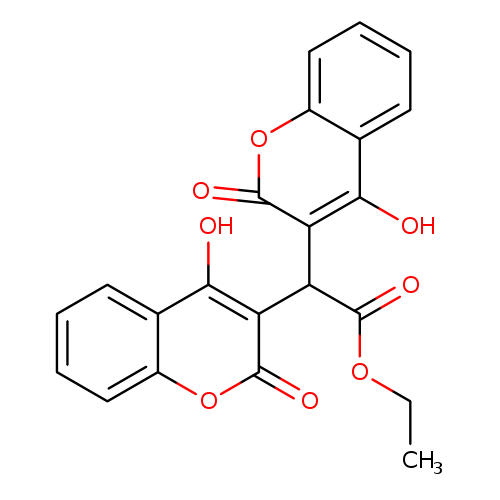
DescriptionEthyl biscoumacetate is a courmarin that is used as an anticoagulant. It has actions similar to those of Warfarin. (From Martindale, The Extra Pharmacopoeia, 30th ed, p226)
Contaminant Sources
  • STOFF IDENT Compounds
  • ToxCast & Tox21 Chemicals
Contaminant TypeNot Available
Chemical Structure
Thumb
Synonyms
ValueSource
Ethyl biscoumacetic acidGenerator
Biscoumacetate, ethylMeSH
PelentanMeSH
CarbethoxydicoumarolMeSH
Ethyl biscoumacetateMeSH
EthyldicoumarolMeSH
TromexanMeSH
Ethyl 2,2-bis(4-hydroxy-2-oxo-2H-chromen-3-yl)acetic acidGenerator
Chemical FormulaC22H16O8
Average Molecular Mass408.362 g/mol
Monoisotopic Mass408.085 g/mol
CAS Registry Number548-00-5
IUPAC Nameethyl 2,2-bis(4-hydroxy-2-oxo-2H-chromen-3-yl)acetate
Traditional Nameethyl biscoumacetate
SMILESCCOC(=O)C(C1=C(O)C2=CC=CC=C2OC1=O)C1=C(O)C2=CC=CC=C2OC1=O
InChI IdentifierInChI=1S/C22H16O8/c1-2-28-20(25)15(16-18(23)11-7-3-5-9-13(11)29-21(16)26)17-19(24)12-8-4-6-10-14(12)30-22(17)27/h3-10,15,23-24H,2H2,1H3
InChI KeyJCLHQFUTFHUXNN-UHFFFAOYSA-N
Chemical Taxonomy
Description belongs to the class of organic compounds known as 4-hydroxycoumarins. These are coumarins that contain one or more hydroxyl groups attached to C4-position the coumarin skeleton.
KingdomOrganic compounds
Super ClassPhenylpropanoids and polyketides
ClassCoumarins and derivatives
Sub ClassHydroxycoumarins
Direct Parent4-hydroxycoumarins
Alternative Parents
Substituents
  • 4-hydroxycoumarin
  • Benzopyran
  • 1-benzopyran
  • Pyranone
  • Pyran
  • Benzenoid
  • Heteroaromatic compound
  • Vinylogous acid
  • Carboxylic acid ester
  • Lactone
  • Monocarboxylic acid or derivatives
  • Carboxylic acid derivative
  • Oxacycle
  • Organoheterocyclic compound
  • Hydrocarbon derivative
  • Organooxygen compound
  • Organic oxygen compound
  • Carbonyl group
  • Organic oxide
  • Aromatic heteropolycyclic compound
Molecular FrameworkAromatic heteropolycyclic compounds
External DescriptorsNot Available
Biological Properties
StatusDetected and Not Quantified
OriginNot Available
Cellular LocationsNot Available
Biofluid LocationsNot Available
Tissue LocationsNot Available
PathwaysNot Available
ApplicationsNot Available
Biological RolesNot Available
Chemical RolesNot Available
Physical Properties
StateNot Available
AppearanceNot Available
Experimental Properties
PropertyValue
Melting PointNot Available
Boiling PointNot Available
SolubilityNot Available
Predicted Properties
PropertyValueSource
Water Solubility0.068 g/LALOGPS
logP2.18ALOGPS
logP1.67ChemAxon
logS-3.8ALOGPS
pKa (Strongest Acidic)4.82ChemAxon
pKa (Strongest Basic)-6.7ChemAxon
Physiological Charge-2ChemAxon
Hydrogen Acceptor Count5ChemAxon
Hydrogen Donor Count2ChemAxon
Polar Surface Area119.36 ŲChemAxon
Rotatable Bond Count5ChemAxon
Refractivity104.95 m³·mol⁻¹ChemAxon
Polarizability39.98 ųChemAxon
Number of Rings4ChemAxon
Bioavailability1ChemAxon
Rule of FiveYesChemAxon
Ghose FilterYesChemAxon
Veber's RuleNoChemAxon
MDDR-like RuleNoChemAxon
Spectra
Spectra
Spectrum TypeDescriptionSplash KeyView
Predicted GC-MSPredicted GC-MS Spectrum - GC-MS (Non-derivatized) - 70eV, Positivesplash10-000i-1009000000-fa618d1c7e0f4833c3b9Spectrum
Predicted GC-MSPredicted GC-MS Spectrum - GC-MS (Non-derivatized) - 70eV, PositiveNot AvailableSpectrum
Predicted GC-MSPredicted GC-MS Spectrum - GC-MS (TMS_1_1) - 70eV, PositiveNot AvailableSpectrum
Predicted GC-MSPredicted GC-MS Spectrum - GC-MS (TMS_2_1) - 70eV, PositiveNot AvailableSpectrum
Predicted GC-MSPredicted GC-MS Spectrum - GC-MS (TBDMS_1_1) - 70eV, PositiveNot AvailableSpectrum
Predicted GC-MSPredicted GC-MS Spectrum - GC-MS (TBDMS_2_1) - 70eV, PositiveNot AvailableSpectrum
Predicted LC-MS/MSPredicted LC-MS/MS Spectrum - 10V, Positivesplash10-0a4i-0017900000-a20dad80b109a421d82bSpectrum
Predicted LC-MS/MSPredicted LC-MS/MS Spectrum - 20V, Positivesplash10-0ly2-1198200000-addc37b735b37137667fSpectrum
Predicted LC-MS/MSPredicted LC-MS/MS Spectrum - 40V, Positivesplash10-0h90-1849000000-15211ebcc8b3025281d5Spectrum
Predicted LC-MS/MSPredicted LC-MS/MS Spectrum - 10V, Negativesplash10-0a4i-1006900000-5cb63ec8d9a0572eb515Spectrum
Predicted LC-MS/MSPredicted LC-MS/MS Spectrum - 20V, Negativesplash10-03di-1519400000-ce50f9dda1d51b832014Spectrum
Predicted LC-MS/MSPredicted LC-MS/MS Spectrum - 40V, Negativesplash10-01ox-6923000000-00340b9b9979788a491dSpectrum
Predicted LC-MS/MSPredicted LC-MS/MS Spectrum - 10V, Positivesplash10-03di-0009300000-42a8e6556c968bcd7af7Spectrum
Predicted LC-MS/MSPredicted LC-MS/MS Spectrum - 20V, Positivesplash10-0229-0915100000-60e31b5e348096774950Spectrum
Predicted LC-MS/MSPredicted LC-MS/MS Spectrum - 40V, Positivesplash10-00fr-3904000000-e4c228cf4365b0a35d2eSpectrum
Predicted LC-MS/MSPredicted LC-MS/MS Spectrum - 10V, Negativesplash10-0a4i-0200900000-2f3725fdc22514d0e46bSpectrum
Predicted LC-MS/MSPredicted LC-MS/MS Spectrum - 20V, Negativesplash10-0a4i-0306900000-e53490706acb381d4bb0Spectrum
Predicted LC-MS/MSPredicted LC-MS/MS Spectrum - 40V, Negativesplash10-05fr-2944000000-840e4e1252cc5088358aSpectrum
Toxicity Profile
Route of ExposureNot Available
Mechanism of ToxicityNot Available
MetabolismNot Available
Toxicity ValuesNot Available
Lethal DoseNot Available
Carcinogenicity (IARC Classification)Not Available
Uses/SourcesNot Available
Minimum Risk LevelNot Available
Health EffectsNot Available
SymptomsNot Available
TreatmentNot Available
Concentrations
Not Available
DrugBank IDDB08794
HMDB IDNot Available
FooDB IDNot Available
Phenol Explorer IDNot Available
KNApSAcK IDNot Available
BiGG IDNot Available
BioCyc IDNot Available
METLIN IDNot Available
PDB IDNot Available
Wikipedia LinkEthyl biscoumacetate
Chemspider IDNot Available
ChEBI IDNot Available
PubChem Compound ID54685524
Kegg Compound IDNot Available
YMDB IDNot Available
ECMDB IDNot Available
References
Synthesis ReferenceNot Available
MSDSNot Available
General ReferencesNot Available