Record Information
Version1.0
Creation Date2016-05-22 06:00:41 UTC
Update Date2026-05-14 16:49:08 UTC
Accession NumberCHEM019314
Identification
Common NameHaloprogin
ClassSmall Molecule
DescriptionHaloprogin is used as a topical ointment or cream in the treatment of Tinea infections. Tinea infections are superficial fungal infections caused by three species of fungi collectively known as dermatophytes (Trichophyton, Microsporum and Epidermophyton). Commonly these infections are named for the body part affected, including tinea corporis (general skin), tinea cruris (groin), and tinea pedis (feet). Haloprogin is a halogenated phenolic ether administered topically for dermotaphytic infections. The mechanism of action is unknown, but it is thought to be via inhibition of oxygen uptake and disruption of yeast membrane structure and function. Haloprogin is no longer available in the United States and has been discontinued.
Contaminant Sources
  • HMDB Contaminants - Urine
  • STOFF IDENT Compounds
  • ToxCast & Tox21 Chemicals
Contaminant TypeNot Available
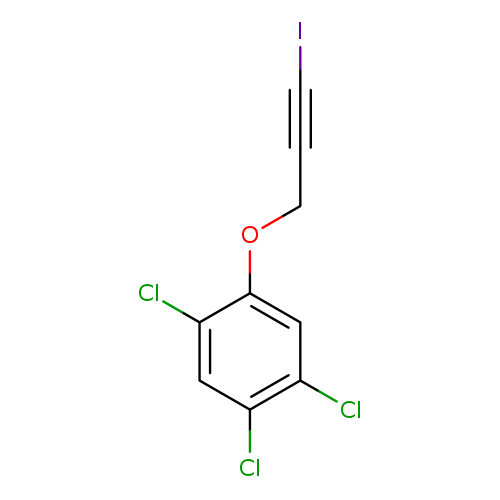
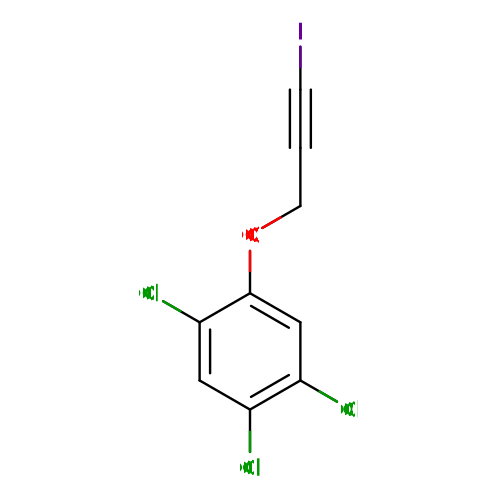
Chemical Structure
Thumb
Synonyms
ValueSource
HalotexKegg
Théraplix brand OF haloproginHMDB
MycilanHMDB
Westwood squibb brand OF haloproginHMDB
3-Iodo-2-propynyl 2,4,5-trichlorophenyl etherHMDB
Chemical FormulaC9H4Cl3IO
Average Molecular Mass361.391 g/mol
Monoisotopic Mass359.837 g/mol
CAS Registry Number777-11-7
IUPAC Name1,2,4-trichloro-5-[(3-iodoprop-2-yn-1-yl)oxy]benzene
Traditional Namehaloprogin
SMILESClC1=CC(Cl)=C(Cl)C=C1OCC#CI
InChI IdentifierInChI=1S/C9H4Cl3IO/c10-6-4-8(12)9(5-7(6)11)14-3-1-2-13/h4-5H,3H2
InChI KeyCTETYYAZBPJBHE-UHFFFAOYSA-N
Chemical Taxonomy
Description belongs to the class of organic compounds known as phenol ethers. These are aromatic compounds containing an ether group substituted with a benzene ring.
KingdomOrganic compounds
Super ClassBenzenoids
ClassPhenol ethers
Sub ClassNot Available
Direct ParentPhenol ethers
Alternative Parents
Substituents
  • Phenoxy compound
  • Phenol ether
  • Alkyl aryl ether
  • Chlorobenzene
  • Halobenzene
  • Aryl chloride
  • Aryl halide
  • Monocyclic benzene moiety
  • Ether
  • Haloacetylene or derivatives
  • Organohalogen compound
  • Hydrocarbon derivative
  • Organic oxygen compound
  • Organochloride
  • Organoiodide
  • Organooxygen compound
  • Aromatic homomonocyclic compound
Molecular FrameworkAromatic homomonocyclic compounds
External DescriptorsNot Available
Biological Properties
StatusDetected and Not Quantified
OriginNot Available
Cellular LocationsNot Available
Biofluid LocationsNot Available
Tissue LocationsNot Available
PathwaysNot Available
ApplicationsNot Available
Biological RolesNot Available
Chemical RolesNot Available
Physical Properties
StateNot Available
AppearanceNot Available
Experimental Properties
PropertyValue
Melting PointNot Available
Boiling PointNot Available
SolubilityNot Available
Predicted Properties
PropertyValueSource
Water Solubility0.006 g/LALOGPS
logP4.69ALOGPS
logP4.85ChemAxon
logS-4.8ALOGPS
pKa (Strongest Basic)-5ChemAxon
Physiological Charge0ChemAxon
Hydrogen Acceptor Count1ChemAxon
Hydrogen Donor Count0ChemAxon
Polar Surface Area9.23 ŲChemAxon
Rotatable Bond Count3ChemAxon
Refractivity66.88 m³·mol⁻¹ChemAxon
Polarizability26.82 ųChemAxon
Number of Rings1ChemAxon
Bioavailability1ChemAxon
Rule of FiveYesChemAxon
Ghose FilterNoChemAxon
Veber's RuleYesChemAxon
MDDR-like RuleNoChemAxon
Spectra
Spectra
Spectrum TypeDescriptionSplash KeyView
Predicted GC-MSPredicted GC-MS Spectrum - GC-MS (Non-derivatized) - 70eV, Positivesplash10-0nvi-2937000000-e0fbc50dec2df8a7392cSpectrum
Predicted GC-MSPredicted GC-MS Spectrum - GC-MS (Non-derivatized) - 70eV, PositiveNot AvailableSpectrum
Predicted LC-MS/MSPredicted LC-MS/MS Spectrum - 10V, Positivesplash10-03di-0009000000-205241bf6f19269ac44fSpectrum
Predicted LC-MS/MSPredicted LC-MS/MS Spectrum - 20V, Positivesplash10-03di-0009000000-685736b870ca3a5b7396Spectrum
Predicted LC-MS/MSPredicted LC-MS/MS Spectrum - 40V, Positivesplash10-01q9-0904000000-0fa7f51cc65c247bc53eSpectrum
Predicted LC-MS/MSPredicted LC-MS/MS Spectrum - 10V, Negativesplash10-0a4i-0009000000-613da8314566eab0ea09Spectrum
Predicted LC-MS/MSPredicted LC-MS/MS Spectrum - 20V, Negativesplash10-0a4i-0009000000-5526c9d6e567956ca1c8Spectrum
Predicted LC-MS/MSPredicted LC-MS/MS Spectrum - 40V, Negativesplash10-0a6r-0639000000-48169dabf0e58c7b946cSpectrum
Predicted LC-MS/MSPredicted LC-MS/MS Spectrum - 10V, Positivesplash10-03di-0009000000-13123a05c84264f3a263Spectrum
Predicted LC-MS/MSPredicted LC-MS/MS Spectrum - 20V, Positivesplash10-03di-0029000000-82363b16547174d03783Spectrum
Predicted LC-MS/MSPredicted LC-MS/MS Spectrum - 40V, Positivesplash10-06w9-4296000000-43a5c95da82f2b836304Spectrum
Predicted LC-MS/MSPredicted LC-MS/MS Spectrum - 10V, Negativesplash10-0a4i-0009000000-c2d55deaed82c6582a92Spectrum
Predicted LC-MS/MSPredicted LC-MS/MS Spectrum - 20V, Negativesplash10-0a4i-0009000000-c2d55deaed82c6582a92Spectrum
Predicted LC-MS/MSPredicted LC-MS/MS Spectrum - 40V, Negativesplash10-0a4i-2249000000-3d6d4d91ac564a883d2bSpectrum
Toxicity Profile
Route of ExposureNot Available
Mechanism of ToxicityNot Available
MetabolismNot Available
Toxicity ValuesNot Available
Lethal DoseNot Available
Carcinogenicity (IARC Classification)Not Available
Uses/SourcesNot Available
Minimum Risk LevelNot Available
Health EffectsNot Available
SymptomsNot Available
TreatmentNot Available
Concentrations
Not Available
DrugBank IDDB00793
HMDB IDHMDB0014931
FooDB IDNot Available
Phenol Explorer IDNot Available
KNApSAcK IDNot Available
BiGG IDNot Available
BioCyc IDNot Available
METLIN IDNot Available
PDB IDNot Available
Wikipedia LinkHaloprogin
Chemspider ID3440
ChEBI ID353862
PubChem Compound ID3561
Kegg Compound IDNot Available
YMDB IDNot Available
ECMDB IDNot Available
References
Synthesis ReferenceNot Available
MSDSNot Available
General References
1. Harrison EF, Zygmunt WA: Haloprogin: mode of action studies in Candida albicans. Can J Microbiol. 1974 Sep;20(9):1241-5.
2. Harrison EF, Zwadyk P Jr, Bequette RJ, Hamlow EE, Tavormina PA, Zygmunt WA: Haloprogin: a topical antifungal agent. Appl Microbiol. 1970 May;19(5):746-50.