Record Information
Version1.0
Creation Date2016-05-22 05:15:52 UTC
Update Date2026-04-13 20:33:13 UTC
Accession NumberCHEM018457
Identification
Common NameDesoximetasone
ClassSmall Molecule
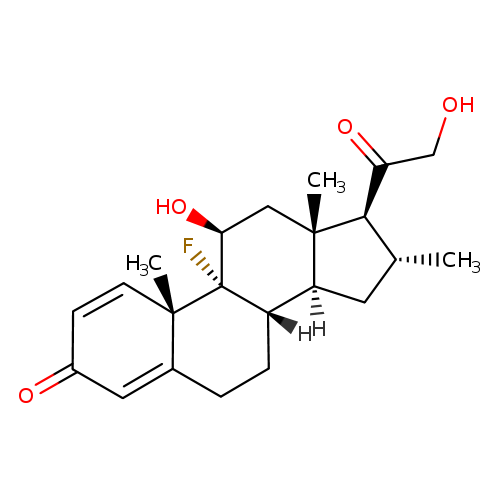
DescriptionDexamethasone in which the hydroxy group at the 17alpha position is substituted by hydrogen. A synthetic corticosteroid with glucocorticoid activity, it is used as an anti-inflammatory and anti-pruritic in the treatment of various skin disorders, including skin allergies and psoriasis.
Contaminant Sources
  • HMDB Contaminants - Urine
  • STOFF IDENT Compounds
  • ToxCast & Tox21 Chemicals
Contaminant TypeNot Available
Chemical Structure
Thumb
Synonyms
ValueSource
(11beta,16alpha)-9-Fluoro-11,21-dihydroxy-16-methylpregna-1,4-diene-3,20-dioneChEBI
9alpha-Fluoro-16alpha-methyl-Delta(1)-corticosteroneChEBI
DesoximetasonaChEBI
DesoximetasonumChEBI
DesoxymethasoneChEBI
TopicortKegg
(11b,16a)-9-Fluoro-11,21-dihydroxy-16-methylpregna-1,4-diene-3,20-dioneGenerator
(11Β,16α)-9-fluoro-11,21-dihydroxy-16-methylpregna-1,4-diene-3,20-dioneGenerator
9a-Fluoro-16a-methyl-delta(1)-corticosteroneGenerator
9Α-fluoro-16α-methyl-δ(1)-corticosteroneGenerator
9a-Fluoro-16a-methyl-δ(1)-corticosteroneHMDB
DesoxiHMDB
Hoechst brand OF desoximetasoneHMDB
IbarilHMDB
Optipharma brand OF desoximetasoneHMDB
TopicorteHMDB
TopisolonHMDB
17-DesoxymethasoneHMDB
Abbott brand OF desoximetasoneHMDB
Medicis brand OF desoximetasoneHMDB
StiedexHMDB
17 DesoxymethasoneHMDB
DeoxydexamethasoneHMDB
Dermik brand OF desoximetasoneHMDB
Stiefel brand OF desoximetasoneHMDB
Aventis brand OF desoximetasoneHMDB
Bipharma brand OF desoximetasoneHMDB
FlubasonHMDB
Chemical FormulaC22H29FO4
Average Molecular Mass376.462 g/mol
Monoisotopic Mass376.205 g/mol
CAS Registry Number382-67-2
IUPAC Name(1R,2S,10S,11S,13R,14S,15S,17S)-1-fluoro-17-hydroxy-14-(2-hydroxyacetyl)-2,13,15-trimethyltetracyclo[8.7.0.0²,⁷.0¹¹,¹⁵]heptadeca-3,6-dien-5-one
Traditional Namedesoximetasone
SMILES[H][C@@]12C[C@@H](C)[C@H](C(=O)CO)[C@@]1(C)C[C@H](O)[C@@]1(F)[C@@]2([H])CCC2=CC(=O)C=C[C@]12C
InChI IdentifierInChI=1S/C22H29FO4/c1-12-8-16-15-5-4-13-9-14(25)6-7-21(13,3)22(15,23)18(27)10-20(16,2)19(12)17(26)11-24/h6-7,9,12,15-16,18-19,24,27H,4-5,8,10-11H2,1-3H3/t12-,15+,16+,18+,19-,20+,21+,22+/m1/s1
InChI KeyVWVSBHGCDBMOOT-IIEHVVJPSA-N
Chemical Taxonomy
Description belongs to the class of organic compounds known as 21-hydroxysteroids. These are steroids carrying a hydroxyl group at the 21-position of the steroid backbone.
KingdomOrganic compounds
Super ClassLipids and lipid-like molecules
ClassSteroids and steroid derivatives
Sub ClassHydroxysteroids
Direct Parent21-hydroxysteroids
Alternative Parents
Substituents
  • 21-hydroxysteroid
  • Progestogin-skeleton
  • 20-oxosteroid
  • Pregnane-skeleton
  • 9-halo-steroid
  • Halo-steroid
  • 3-oxo-delta-1,4-steroid
  • 3-oxosteroid
  • Oxosteroid
  • 11-beta-hydroxysteroid
  • 11-hydroxysteroid
  • Delta-1,4-steroid
  • Alpha-hydroxy ketone
  • Cyclic alcohol
  • Ketone
  • Secondary alcohol
  • Halohydrin
  • Fluorohydrin
  • Cyclic ketone
  • Organic oxygen compound
  • Organohalogen compound
  • Organofluoride
  • Organooxygen compound
  • Primary alcohol
  • Carbonyl group
  • Hydrocarbon derivative
  • Alkyl halide
  • Alkyl fluoride
  • Alcohol
  • Organic oxide
  • Aliphatic homopolycyclic compound
Molecular FrameworkAliphatic homopolycyclic compounds
External Descriptors
Biological Properties
StatusDetected and Not Quantified
OriginNot Available
Cellular LocationsNot Available
Biofluid LocationsNot Available
Tissue LocationsNot Available
PathwaysNot Available
ApplicationsNot Available
Biological RolesNot Available
Chemical RolesNot Available
Physical Properties
StateNot Available
AppearanceNot Available
Experimental Properties
PropertyValue
Melting PointNot Available
Boiling PointNot Available
SolubilityNot Available
Predicted Properties
PropertyValueSource
Water Solubility0.031 g/LALOGPS
logP2.13ALOGPS
logP2.35ChemAxon
logS-4.1ALOGPS
pKa (Strongest Acidic)13.44ChemAxon
pKa (Strongest Basic)-3.3ChemAxon
Physiological Charge0ChemAxon
Hydrogen Acceptor Count4ChemAxon
Hydrogen Donor Count2ChemAxon
Polar Surface Area74.6 ŲChemAxon
Rotatable Bond Count2ChemAxon
Refractivity101.17 m³·mol⁻¹ChemAxon
Polarizability40.09 ųChemAxon
Number of Rings4ChemAxon
Bioavailability1ChemAxon
Rule of FiveYesChemAxon
Ghose FilterYesChemAxon
Veber's RuleNoChemAxon
MDDR-like RuleNoChemAxon
Spectra
Spectra
Spectrum TypeDescriptionSplash KeyView
Predicted GC-MSPredicted GC-MS Spectrum - GC-MS (Non-derivatized) - 70eV, Positivesplash10-05o0-0912000000-a19399cef0d27c3594e6Spectrum
Predicted GC-MSPredicted GC-MS Spectrum - GC-MS (2 TMS) - 70eV, Positivesplash10-0a4i-2943160000-a934ab87ed20665cae69Spectrum
Predicted GC-MSPredicted GC-MS Spectrum - GC-MS (Non-derivatized) - 70eV, PositiveNot AvailableSpectrum
LC-MS/MSLC-MS/MS Spectrum - LC-ESI-qTof , Positivesplash10-000i-0859000000-a10700f328db7dc715b5Spectrum
LC-MS/MSLC-MS/MS Spectrum - LC-ESI-qTof , Positivesplash10-00di-2940000000-d3344c1ae6eb70791755Spectrum
LC-MS/MSLC-MS/MS Spectrum - , positivesplash10-000i-0859000000-a10700f328db7dc715b5Spectrum
LC-MS/MSLC-MS/MS Spectrum - , positivesplash10-00di-2940000000-d3344c1ae6eb70791755Spectrum
LC-MS/MSLC-MS/MS Spectrum - 35V, Positivesplash10-007a-0943000000-d694148b80e27bf50378Spectrum
LC-MS/MSLC-MS/MS Spectrum - 35V, Negativesplash10-056r-0097000000-b71d36aa7a284e10054eSpectrum
Predicted LC-MS/MSPredicted LC-MS/MS Spectrum - 10V, Positivesplash10-056r-0009000000-d0e87553c50e0a0145c1Spectrum
Predicted LC-MS/MSPredicted LC-MS/MS Spectrum - 20V, Positivesplash10-0a6s-0109000000-07696481bbb48e48679fSpectrum
Predicted LC-MS/MSPredicted LC-MS/MS Spectrum - 40V, Positivesplash10-0kft-3498000000-c406362cf63dd705c638Spectrum
Predicted LC-MS/MSPredicted LC-MS/MS Spectrum - 10V, Negativesplash10-004i-0009000000-518050b225f1b7caa912Spectrum
Predicted LC-MS/MSPredicted LC-MS/MS Spectrum - 20V, Negativesplash10-0a6r-1009000000-bb5c7b442c44ba33b8cdSpectrum
Predicted LC-MS/MSPredicted LC-MS/MS Spectrum - 40V, Negativesplash10-0pba-4149000000-be3ea39b760207659651Spectrum
Predicted LC-MS/MSPredicted LC-MS/MS Spectrum - 10V, Negativesplash10-004i-0009000000-ae9873238f7091a31d62Spectrum
Predicted LC-MS/MSPredicted LC-MS/MS Spectrum - 20V, Negativesplash10-014j-0009000000-ac020326894ee4a95c54Spectrum
Predicted LC-MS/MSPredicted LC-MS/MS Spectrum - 40V, Negativesplash10-016s-0019000000-1ae4ef032615d49ca33aSpectrum
Predicted LC-MS/MSPredicted LC-MS/MS Spectrum - 10V, Positivesplash10-004i-0009000000-ccab12f64a156f1a5595Spectrum
Predicted LC-MS/MSPredicted LC-MS/MS Spectrum - 20V, Positivesplash10-06fr-0329000000-c25e09b1c9425ea3a7faSpectrum
Predicted LC-MS/MSPredicted LC-MS/MS Spectrum - 40V, Positivesplash10-05g0-0794000000-aa7e0b33c97c418bc479Spectrum
Toxicity Profile
Route of ExposureNot Available
Mechanism of ToxicityNot Available
MetabolismNot Available
Toxicity ValuesNot Available
Lethal DoseNot Available
Carcinogenicity (IARC Classification)Not Available
Uses/SourcesNot Available
Minimum Risk LevelNot Available
Health EffectsNot Available
SymptomsNot Available
TreatmentNot Available
Concentrations
Not Available
DrugBank IDDB00547
HMDB IDHMDB0014687
FooDB IDNot Available
Phenol Explorer IDNot Available
KNApSAcK IDNot Available
BiGG IDNot Available
BioCyc IDNot Available
METLIN IDNot Available
PDB IDNot Available
Wikipedia LinkDesoximetasone
Chemspider ID4470604
ChEBI ID691037
PubChem Compound ID5311067
Kegg Compound IDNot Available
YMDB IDNot Available
ECMDB IDNot Available
References
Synthesis ReferenceNot Available
MSDSNot Available
General References
1. Simons K, Toomre D: Lipid rafts and signal transduction. Nat Rev Mol Cell Biol. 2000 Oct;1(1):31-9.
2. Watson AD: Thematic review series: systems biology approaches to metabolic and cardiovascular disorders. Lipidomics: a global approach to lipid analysis in biological systems. J Lipid Res. 2006 Oct;47(10):2101-11. Epub 2006 Aug 10.
3. Sethi JK, Vidal-Puig AJ: Thematic review series: adipocyte biology. Adipose tissue function and plasticity orchestrate nutritional adaptation. J Lipid Res. 2007 Jun;48(6):1253-62. Epub 2007 Mar 20.
4. Lingwood D, Simons K: Lipid rafts as a membrane-organizing principle. Science. 2010 Jan 1;327(5961):46-50. doi: 10.1126/science.1174621.
5. The lipid handbook with CD-ROM