Record Information
Version1.0
Creation Date2016-05-22 05:04:40 UTC
Update Date2016-11-09 01:15:45 UTC
Accession NumberCHEM018227
Identification
Common NameAzacyclonol
ClassSmall Molecule
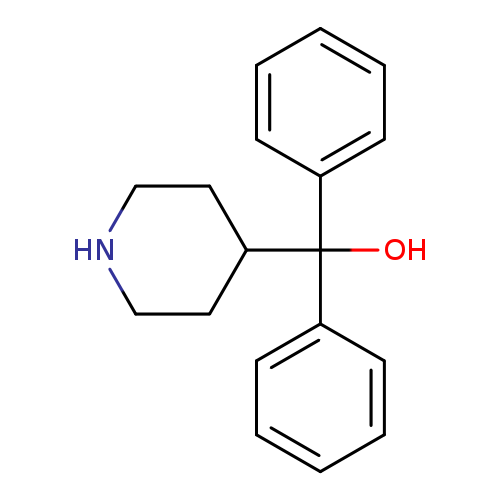
DescriptionAzacyclonol (trade names Ataractan, Calmeran, Frenoton, Frenquel, Psychosan), also known as γ-pipradrol, is a drug which is an ataractive; an agent which diminishes hallucinations in psychotic individuals. It has also been called a tranquilizer and antipsychotic, though these definitions are not accurate as it does not actually possess such properties. Despite being a positional isomer of pipradrol, it is not a psychostimulant, and instead has mild depressant effects.The drug was introduced in Europe in the mid-1950s for the treatment of schizophrenia likely because it was found to attenuate the subjective psychedelic effects of LSD and mescaline in humans. However, due to poor and mixed clinical effectiveness it never gained widespread acceptance and was eventually discontinued. Azacyclonol is also known as diphenylmethanolpiperidine and is the parent structure of the antihistamines fexofenadine and terfenadine. Terfenadine produces azacyclonol as a major active metabolite.It is made by the organometallic addition of 4-bromopyridine to benzophenone, followed by catalytic hydrogenation of the pyridine heteroaromatic ring system to the corresponding piperidine.
Contaminant Sources
  • STOFF IDENT Compounds
  • ToxCast & Tox21 Chemicals
Contaminant TypeNot Available
Chemical Structure
Thumb
Synonyms
ValueSource
Azacyclonol hydrochlorideMeSH
PsychosanChEMBL
CalmeranChEMBL
AtaractanChEMBL
FrenquelChEMBL
FrenotonChEMBL
gamma-PipradolChEMBL
g-PipradolGenerator
γ-pipradolGenerator
AzacyclonolMeSH
Chemical FormulaC18H21NO
Average Molecular Mass267.372 g/mol
Monoisotopic Mass267.162 g/mol
CAS Registry Number115-46-8
IUPAC Namediphenyl(piperidin-4-yl)methanol
Traditional Nameazacyclonol
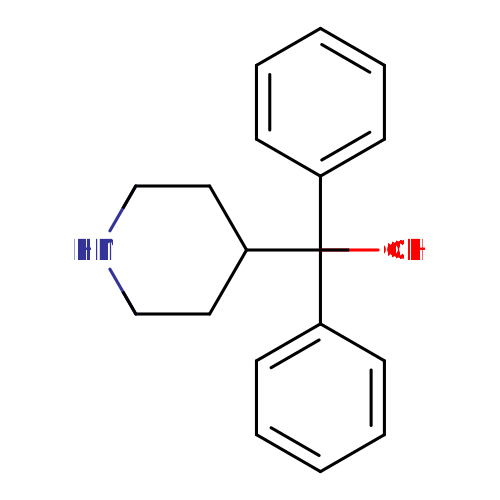
SMILESOC(C1CCNCC1)(C1=CC=CC=C1)C1=CC=CC=C1
InChI IdentifierInChI=1S/C18H21NO/c20-18(15-7-3-1-4-8-15,16-9-5-2-6-10-16)17-11-13-19-14-12-17/h1-10,17,19-20H,11-14H2
InChI KeyZMISODWVFHHWNR-UHFFFAOYSA-N
Chemical Taxonomy
Description belongs to the class of organic compounds known as diphenylmethanes. Diphenylmethanes are compounds containing a diphenylmethane moiety, which consists of a methane wherein two hydrogen atoms are replaced by two phenyl groups.
KingdomOrganic compounds
Super ClassBenzenoids
ClassBenzene and substituted derivatives
Sub ClassDiphenylmethanes
Direct ParentDiphenylmethanes
Alternative Parents
Substituents
  • Diphenylmethane
  • Aralkylamine
  • Piperidine
  • Tertiary alcohol
  • Azacycle
  • Organoheterocyclic compound
  • Secondary amine
  • Secondary aliphatic amine
  • Organopnictogen compound
  • Aromatic alcohol
  • Alcohol
  • Organic oxygen compound
  • Organooxygen compound
  • Organonitrogen compound
  • Organic nitrogen compound
  • Amine
  • Hydrocarbon derivative
  • Aromatic heteromonocyclic compound
Molecular FrameworkAromatic heteromonocyclic compounds
External DescriptorsNot Available
Biological Properties
StatusDetected and Not Quantified
OriginNot Available
Cellular LocationsNot Available
Biofluid LocationsNot Available
Tissue LocationsNot Available
PathwaysNot Available
ApplicationsNot Available
Biological RolesNot Available
Chemical RolesNot Available
Physical Properties
StateNot Available
AppearanceNot Available
Experimental Properties
PropertyValue
Melting PointNot Available
Boiling PointNot Available
SolubilityNot Available
Predicted Properties
PropertyValueSource
Water Solubility0.024 g/LALOGPS
logP3.36ALOGPS
logP2.88ChemAxon
logS-4ALOGPS
pKa (Strongest Acidic)13.22ChemAxon
pKa (Strongest Basic)10.04ChemAxon
Physiological Charge1ChemAxon
Hydrogen Acceptor Count2ChemAxon
Hydrogen Donor Count2ChemAxon
Polar Surface Area32.26 ŲChemAxon
Rotatable Bond Count3ChemAxon
Refractivity82.22 m³·mol⁻¹ChemAxon
Polarizability30.59 ųChemAxon
Number of Rings3ChemAxon
Bioavailability1ChemAxon
Rule of FiveYesChemAxon
Ghose FilterYesChemAxon
Veber's RuleYesChemAxon
MDDR-like RuleNoChemAxon
Spectra
Spectra
Spectrum TypeDescriptionSplash KeyView
Predicted GC-MSPredicted GC-MS Spectrum - GC-MS (Non-derivatized) - 70eV, Positivesplash10-0a59-4900000000-685d0996e1bcf6e3c6a1Spectrum
Predicted GC-MSPredicted GC-MS Spectrum - GC-MS (Non-derivatized) - 70eV, PositiveNot AvailableSpectrum
Predicted GC-MSPredicted GC-MS Spectrum - GC-MS (TMS_1_1) - 70eV, PositiveNot AvailableSpectrum
Predicted GC-MSPredicted GC-MS Spectrum - GC-MS (TMS_1_2) - 70eV, PositiveNot AvailableSpectrum
Predicted GC-MSPredicted GC-MS Spectrum - GC-MS (TBDMS_1_1) - 70eV, PositiveNot AvailableSpectrum
Predicted GC-MSPredicted GC-MS Spectrum - GC-MS (TBDMS_1_2) - 70eV, PositiveNot AvailableSpectrum
Predicted LC-MS/MSPredicted LC-MS/MS Spectrum - 10V, Positivesplash10-014i-0090000000-254a7394747d59214935Spectrum
Predicted LC-MS/MSPredicted LC-MS/MS Spectrum - 20V, Positivesplash10-014i-2190000000-51b009d60985aed2c044Spectrum
Predicted LC-MS/MSPredicted LC-MS/MS Spectrum - 40V, Positivesplash10-05o3-9110000000-ff6a52a8481077ba6266Spectrum
Predicted LC-MS/MSPredicted LC-MS/MS Spectrum - 10V, Negativesplash10-014i-0190000000-4f6e6ea8d6f232b7219cSpectrum
Predicted LC-MS/MSPredicted LC-MS/MS Spectrum - 20V, Negativesplash10-017i-9270000000-64a85c5a292ddb24e48dSpectrum
Predicted LC-MS/MSPredicted LC-MS/MS Spectrum - 40V, Negativesplash10-0059-9110000000-ed9ab57f7be366b2755bSpectrum
Predicted LC-MS/MSPredicted LC-MS/MS Spectrum - 10V, Positivesplash10-0uxr-0090000000-ab92cce1c56cfd2c8790Spectrum
Predicted LC-MS/MSPredicted LC-MS/MS Spectrum - 20V, Positivesplash10-0udi-0090000000-c380283f47f31f0937b2Spectrum
Predicted LC-MS/MSPredicted LC-MS/MS Spectrum - 40V, Positivesplash10-001i-9520000000-af663b1d51ba4af24fa9Spectrum
Predicted LC-MS/MSPredicted LC-MS/MS Spectrum - 10V, Negativesplash10-014i-0390000000-4a0bb722f3f05bd9893fSpectrum
Predicted LC-MS/MSPredicted LC-MS/MS Spectrum - 20V, Negativesplash10-000i-1930000000-f32c0b27e86aa9c5e50fSpectrum
Predicted LC-MS/MSPredicted LC-MS/MS Spectrum - 40V, Negativesplash10-03di-0090000000-1f4e1c77bccde6d52d61Spectrum
Toxicity Profile
Route of ExposureNot Available
Mechanism of ToxicityNot Available
MetabolismNot Available
Toxicity ValuesNot Available
Lethal DoseNot Available
Carcinogenicity (IARC Classification)Not Available
Uses/SourcesNot Available
Minimum Risk LevelNot Available
Health EffectsNot Available
SymptomsNot Available
TreatmentNot Available
Concentrations
Not Available
DrugBank IDNot Available
HMDB IDNot Available
FooDB IDNot Available
Phenol Explorer IDNot Available
KNApSAcK IDNot Available
BiGG IDNot Available
BioCyc IDNot Available
METLIN IDNot Available
PDB IDNot Available
Wikipedia LinkAzacyclonol
Chemspider IDNot Available
ChEBI IDNot Available
PubChem Compound ID15723
Kegg Compound IDNot Available
YMDB IDNot Available
ECMDB IDNot Available
References
Synthesis ReferenceNot Available
MSDSNot Available
General ReferencesNot Available