Record Information
Version1.0
Creation Date2016-05-22 04:20:55 UTC
Update Date2016-11-09 01:15:35 UTC
Accession NumberCHEM017439
Identification
Common NameNicarbazin
ClassSmall Molecule
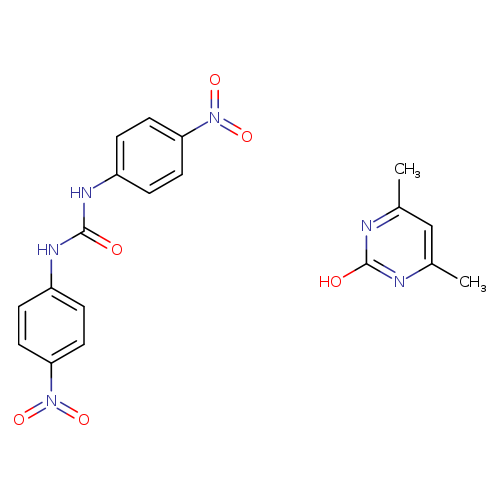
DescriptionNicarbazin is a coccidiostat used on meat chickens. It is also used as a contraceptive for population control of Canada geese and feral pigeons.It is also a wide-spectrum anti-parasitic drug approved for veterinary use, effective on Toxocara canis, Toxascaris leonina, Ancylostoma caninum, Uncinaria stenocephala, Trichuris vulpis, Dipylidium caninum, and Taenia sp. and Mesocestoides sp.. Known brand names for specific countries include: Carbigran (the United States) Ceva Nicarbazin (South Africa) Cycarb (New Zealand) Keymix (Australia) Koffogran (South Africa) Kofozin (Israel) Nicarb 25% (the United States) Nicarbazin (Israel) Nicarbazin Elanco (the United States) Nicarbmax 100% (New Zealand) Nicarmix (the United States) Ovistop (Costa Rica and Italy) OvoControl (the United States) PhiCarb (Australia) R-12 (Belgium)From the chemical point of view, nicarbazin is an equimolar complex formed by 1,3 - bis (4- nitrophenyl) urea and 4-6 dimethyl-2- (1H) - pyrimidinone also called 4,4'-dinitrocarbanilide (DNC) and 2-hydroxy - 4,6 dimethylpyrimidine (HDP). The DNC represents the biologically active part of the complex, but to be absorbed it must be bound to the HDP. Because of its hydrophobic nature, the DNC alone is poorly absorbed and has a limited "biological availability" so, following oral administration, it would be eliminated without being absorbed. The DNC therefore requires HDP to be absorbed and to reach a plasma level that allows an effect in the target species. Following oral administration, nicarbazin rapidly dissociates in vivo into its two HDP and DNC components, which follow different routes of excretion: 95% of HDP is rapidly eliminated with urine, while DNC remains longer and is eliminated predominantly with feces. Metabolism and depletion of the two components have been studied extensively with the use of carbon-14-labeled nicarbazin. Following oral administration, nicarbazin rapidly dissociates in vivo into its two components HDP and DNC, which are absorbed through the intestine, then passing into the blood, and following different routes of excretion. The HDP is excreted more rapidly than the DNC, mainly through the kidneys via the urine, while the DNC is absorbed more rapidly than the HDP and is excreted more slowly than the latter through the liver, via the faeces. No significant residue of either component is noticeable in any fabric after 7 days. DNC accumulates in eggs and normally the concentration of DNC in eggs is less than 5 ppm. The two components HDP and DNC do not undergo metabolism in vivo and in vitro, except for the formation of derivatives structurally similar to nitroaniline. However, this possibility appears extremely remote, achievable only in the laboratory, in particular chemical-physical conditions (high temperature in a strongly acid environment).Of the two components of the nicarbazin molecule, the DNC takes on a significance from a toxicological point of view as it remains longer in the body. The DNC molecule was therefore considered as a marker compound in residue studies.
Contaminant Sources
  • ToxCast & Tox21 Chemicals
Contaminant TypeNot Available
Chemical Structure
Thumb
Synonyms
ValueSource
NicarbazineMeSH
NicarbazinMeSH
Chemical FormulaC19H18N6O6
Average Molecular Mass426.389 g/mol
Monoisotopic Mass426.129 g/mol
CAS Registry Number330-95-0
IUPAC Name1,3-bis(4-nitrophenyl)urea; 4,6-dimethylpyrimidin-2-ol
Traditional Name4,6-dimethylpyrimidin-2-ol; urea, N,N'-bis(4-nitrophenyl)-
SMILESCC1=CC(C)=NC(O)=N1.O=C(NC1=CC=C(C=C1)N(=O)=O)NC1=CC=C(C=C1)N(=O)=O
InChI IdentifierInChI=1S/C13H10N4O5.C6H8N2O/c18-13(14-9-1-5-11(6-2-9)16(19)20)15-10-3-7-12(8-4-10)17(21)22;1-4-3-5(2)8-6(9)7-4/h1-8H,(H2,14,15,18);3H,1-2H3,(H,7,8,9)
InChI KeyUKHWDRMMMYWSFL-UHFFFAOYSA-N
Chemical Taxonomy
Description belongs to the class of organic compounds known as n-phenylureas. N-phenylureas are compounds containing a N-phenylurea moiety, which is structurally characterized by a phenyl group linked to one nitrogen atom of a urea group.
KingdomOrganic compounds
Super ClassBenzenoids
ClassBenzene and substituted derivatives
Sub ClassN-phenylureas
Direct ParentN-phenylureas
Alternative Parents
Substituents
  • N-phenylurea
  • Nitrobenzene
  • Nitroaromatic compound
  • Pyrimidone
  • Hydropyrimidine
  • Pyrimidine
  • Heteroaromatic compound
  • C-nitro compound
  • Carbonic acid derivative
  • Urea
  • Organic nitro compound
  • Propargyl-type 1,3-dipolar organic compound
  • Allyl-type 1,3-dipolar organic compound
  • Organic oxoazanium
  • Organic 1,3-dipolar compound
  • Organoheterocyclic compound
  • Azacycle
  • Organic nitrogen compound
  • Hydrocarbon derivative
  • Organic oxide
  • Organooxygen compound
  • Organonitrogen compound
  • Carbonyl group
  • Organopnictogen compound
  • Organic oxygen compound
  • Aromatic heteromonocyclic compound
Molecular FrameworkNot Available
External Descriptors
Biological Properties
StatusDetected and Not Quantified
OriginNot Available
Cellular LocationsNot Available
Biofluid LocationsNot Available
Tissue LocationsNot Available
PathwaysNot Available
ApplicationsNot Available
Biological RolesNot Available
Chemical RolesNot Available
Physical Properties
StateNot Available
AppearanceNot Available
Experimental Properties
PropertyValue
Melting PointNot Available
Boiling PointNot Available
SolubilityNot Available
Predicted Properties
PropertyValueSource
Water Solubility0.012 g/LALOGPS
logP2.48ALOGPS
logP3ChemAxon
logS-4.4ALOGPS
pKa (Strongest Acidic)10.99ChemAxon
pKa (Strongest Basic)-4.9ChemAxon
Physiological Charge0ChemAxon
Hydrogen Acceptor Count5ChemAxon
Hydrogen Donor Count2ChemAxon
Polar Surface Area132.77 ŲChemAxon
Rotatable Bond Count4ChemAxon
Refractivity80.7 m³·mol⁻¹ChemAxon
Polarizability28.24 ųChemAxon
Number of Rings3ChemAxon
Bioavailability1ChemAxon
Rule of FiveYesChemAxon
Ghose FilterYesChemAxon
Veber's RuleNoChemAxon
MDDR-like RuleNoChemAxon
Spectra
Spectra
Spectrum TypeDescriptionSplash KeyView
Predicted LC-MS/MSPredicted LC-MS/MS Spectrum - 10V, Positivesplash10-004i-0000900000-8fa76670dc5fb60b5f10Spectrum
Predicted LC-MS/MSPredicted LC-MS/MS Spectrum - 20V, Positivesplash10-004i-0000900000-8fa76670dc5fb60b5f10Spectrum
Predicted LC-MS/MSPredicted LC-MS/MS Spectrum - 40V, Positivesplash10-004i-0000900000-8fa76670dc5fb60b5f10Spectrum
Predicted LC-MS/MSPredicted LC-MS/MS Spectrum - 10V, Negativesplash10-004i-0000900000-f67e2e8250e49e5542f7Spectrum
Predicted LC-MS/MSPredicted LC-MS/MS Spectrum - 20V, Negativesplash10-004i-0000900000-f67e2e8250e49e5542f7Spectrum
Predicted LC-MS/MSPredicted LC-MS/MS Spectrum - 40V, Negativesplash10-004i-0000900000-f67e2e8250e49e5542f7Spectrum
Toxicity Profile
Route of ExposureNot Available
Mechanism of ToxicityNot Available
MetabolismNot Available
Toxicity ValuesNot Available
Lethal DoseNot Available
Carcinogenicity (IARC Classification)Not Available
Uses/SourcesNot Available
Minimum Risk LevelNot Available
Health EffectsNot Available
SymptomsNot Available
TreatmentNot Available
Concentrations
Not Available
DrugBank IDDB11434
HMDB IDNot Available
FooDB IDNot Available
Phenol Explorer IDNot Available
KNApSAcK IDNot Available
BiGG IDNot Available
BioCyc IDNot Available
METLIN IDNot Available
PDB IDNot Available
Wikipedia LinkNicarbazin
Chemspider IDNot Available
ChEBI IDNot Available
PubChem Compound ID9507
Kegg Compound IDC18389
YMDB IDNot Available
ECMDB IDNot Available
References
Synthesis ReferenceNot Available
MSDSNot Available
General ReferencesNot Available