Record Information
Version1.0
Creation Date2016-05-22 03:41:23 UTC
Update Date2026-04-06 04:10:39 UTC
Accession NumberCHEM016719
Identification
Common NameGestrinone
ClassSmall Molecule
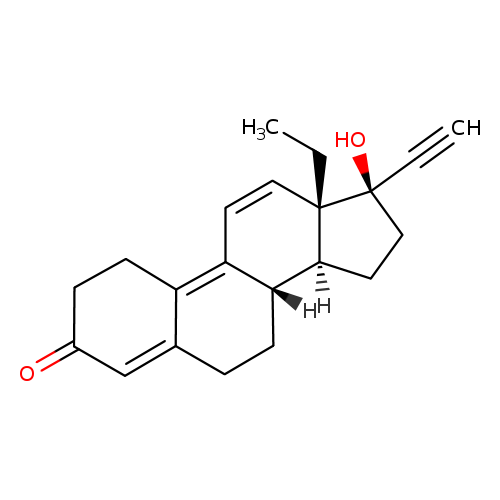
DescriptionGestrinone, also known as ethylnorgestrienone, is a synthetic steroid of the 19-nortestosterone group that is marketed in Europe, Australia, and Latin America, though not the United States or Canada, and is used primarily in the treatment of endometriosis. Gestrinone was developed in the early 1970s and was tested clinically as a weekly oral contraceptive in Europe and North America. Without significant advantages over other oral contraceptives and with its high cost, gestrinone was no longer used after the Stage II clinical trials. However, from 1982 this drug attracted increased interest due to significant therapeutic effects in the treatment endometriosis. Under different endocrine conditions, gestrinone possesses estrogenic, progestational, androgenic, antiestrogenic and antiprogesterone actions [L1696].
Contaminant Sources
  • FooDB Chemicals
  • ToxCast & Tox21 Chemicals
Contaminant TypeNot Available
Chemical Structure
Thumb
Synonyms
ValueSource
R-2323a-46745RU-2323gestrinoneChEMBL, HMDB
(17a)-13-Ethyl-17-hydroxy-18,19-dinorpregna-4,9,11-trien-20-yn-3-oneHMDB
13-Ethyl-17-hydroxy-18,19-dinor-17a-pregna-4,9,11-trien-20-yn-3-oneHMDB
13-Ethyl-17a-ethynyl-17b-hydroxygona-4,9,11-trien-3-oneHMDB
DimetrioseHMDB, MeSH
EthylnorgestrienoneHMDB
GestrigoneHMDB
GestrinonaHMDB
NemestranHMDB, MeSH
TridomoseHMDB
Aventis brand OF gestrinoneMeSH, HMDB
Florizel brand OF gestrinoneMeSH, HMDB
Hoechst brand OF gestrinoneMeSH, HMDB
Chemical FormulaC21H24O2
Average Molecular Mass308.414 g/mol
Monoisotopic Mass308.178 g/mol
CAS Registry Number16320-04-0
IUPAC Name(10S,11S,14R,15S)-15-ethyl-14-ethynyl-14-hydroxytetracyclo[8.7.0.0²,⁷.0¹¹,¹⁵]heptadeca-1,6,16-trien-5-one
Traditional Namegestrinone
SMILES[H][C@@]12CC[C@@](O)(C#C)[C@@]1(CC)C=CC1=C3CCC(=O)C=C3CC[C@@]21[H]
InChI IdentifierInChI=1S/C21H24O2/c1-3-20-11-9-17-16-8-6-15(22)13-14(16)5-7-18(17)19(20)10-12-21(20,23)4-2/h2,9,11,13,18-19,23H,3,5-8,10,12H2,1H3/t18-,19+,20+,21+/m1/s1
InChI KeyBJJXHLWLUDYTGC-ANULTFPQSA-N
Chemical Taxonomy
Description belongs to the class of organic compounds known as estrogens and derivatives. These are steroids with a structure containing a 3-hydroxylated estrane.
KingdomOrganic compounds
Super ClassLipids and lipid-like molecules
ClassSteroids and steroid derivatives
Sub ClassEstrane steroids
Direct ParentEstrogens and derivatives
Alternative Parents
Substituents
  • Estrogen-skeleton
  • 3-oxosteroid
  • Hydroxysteroid
  • Oxosteroid
  • 17-hydroxysteroid
  • Cyclohexenone
  • Ynone
  • Cyclic alcohol
  • Tertiary alcohol
  • Ketone
  • Cyclic ketone
  • Acetylide
  • Hydrocarbon derivative
  • Organooxygen compound
  • Organic oxide
  • Organic oxygen compound
  • Carbonyl group
  • Alcohol
  • Aliphatic homopolycyclic compound
Molecular FrameworkAliphatic homopolycyclic compounds
External DescriptorsNot Available
Biological Properties
StatusDetected and Not Quantified
OriginNot Available
Cellular LocationsNot Available
Biofluid LocationsNot Available
Tissue LocationsNot Available
PathwaysNot Available
ApplicationsNot Available
Biological RolesNot Available
Chemical RolesNot Available
Physical Properties
StateNot Available
AppearanceNot Available
Experimental Properties
PropertyValue
Melting PointNot Available
Boiling PointNot Available
SolubilityNot Available
Predicted Properties
PropertyValueSource
Water Solubility0.0097 g/LALOGPS
logP3.39ALOGPS
logP2.85ChemAxon
logS-4.5ALOGPS
pKa (Strongest Acidic)17.88ChemAxon
pKa (Strongest Basic)-1.5ChemAxon
Physiological Charge0ChemAxon
Hydrogen Acceptor Count2ChemAxon
Hydrogen Donor Count1ChemAxon
Polar Surface Area37.3 ŲChemAxon
Rotatable Bond Count1ChemAxon
Refractivity93.73 m³·mol⁻¹ChemAxon
Polarizability35.65 ųChemAxon
Number of Rings4ChemAxon
Bioavailability1ChemAxon
Rule of FiveYesChemAxon
Ghose FilterYesChemAxon
Veber's RuleYesChemAxon
MDDR-like RuleNoChemAxon
Spectra
Spectra
Spectrum TypeDescriptionSplash KeyView
Predicted GC-MSPredicted GC-MS Spectrum - GC-MS (Non-derivatized) - 70eV, Positivesplash10-00c0-0290000000-57f6504d7337bb8212b2Spectrum
Predicted GC-MSPredicted GC-MS Spectrum - GC-MS (1 TMS) - 70eV, Positivesplash10-0udi-1195000000-3d70a23e3b190bc2c4baSpectrum
Predicted GC-MSPredicted GC-MS Spectrum - GC-MS (Non-derivatized) - 70eV, PositiveNot AvailableSpectrum
Predicted LC-MS/MSPredicted LC-MS/MS Spectrum - 10V, Positivesplash10-0a4i-0179000000-21d04af47d81a0fa64beSpectrum
Predicted LC-MS/MSPredicted LC-MS/MS Spectrum - 20V, Positivesplash10-0k96-0191000000-7e714cca35d7cb88f55dSpectrum
Predicted LC-MS/MSPredicted LC-MS/MS Spectrum - 40V, Positivesplash10-0006-4690000000-928c7b0605ff8c862697Spectrum
Predicted LC-MS/MSPredicted LC-MS/MS Spectrum - 10V, Negativesplash10-0a4i-0019000000-70685a39fcdb6f5ed3f1Spectrum
Predicted LC-MS/MSPredicted LC-MS/MS Spectrum - 20V, Negativesplash10-0a4i-0059000000-1b56e1ac6f7e8a82d18eSpectrum
Predicted LC-MS/MSPredicted LC-MS/MS Spectrum - 40V, Negativesplash10-0fbc-0090000000-3d1289b1e39792631887Spectrum
Predicted LC-MS/MSPredicted LC-MS/MS Spectrum - 10V, Positivesplash10-052f-0093000000-28e45ca153b50cd99ae5Spectrum
Predicted LC-MS/MSPredicted LC-MS/MS Spectrum - 20V, Positivesplash10-082c-0692000000-d130e39fa98ada46dd8cSpectrum
Predicted LC-MS/MSPredicted LC-MS/MS Spectrum - 40V, Positivesplash10-0c01-1920000000-0448c973bb48e978f873Spectrum
Predicted LC-MS/MSPredicted LC-MS/MS Spectrum - 10V, Negativesplash10-0a4i-0009000000-118e3792b0dbc604ba7fSpectrum
Predicted LC-MS/MSPredicted LC-MS/MS Spectrum - 20V, Negativesplash10-0a4i-0039000000-fce3cccda83afb194305Spectrum
Predicted LC-MS/MSPredicted LC-MS/MS Spectrum - 40V, Negativesplash10-08i0-0091000000-8c310ce9b41e0da60f93Spectrum
Toxicity Profile
Route of ExposureNot Available
Mechanism of ToxicityNot Available
MetabolismNot Available
Toxicity ValuesNot Available
Lethal DoseNot Available
Carcinogenicity (IARC Classification)Not Available
Uses/SourcesNot Available
Minimum Risk LevelNot Available
Health EffectsNot Available
SymptomsNot Available
TreatmentNot Available
Concentrations
Not Available
DrugBank IDDB11619
HMDB IDHMDB0002720
FooDB IDFDB023052
Phenol Explorer IDNot Available
KNApSAcK IDNot Available
BiGG IDNot Available
BioCyc IDNot Available
METLIN IDNot Available
PDB IDNot Available
Wikipedia LinkGestrinone
Chemspider ID25877
ChEBI ID1309273
PubChem Compound ID27812
Kegg Compound IDNot Available
YMDB IDNot Available
ECMDB IDNot Available
References
Synthesis ReferenceNot Available
MSDSNot Available
General References
1. Lenna, Roberto. Process for the synthesis of (17a)-13-ethyl-17-hydroxy-18,19-dinorpregna-4,9,11-trien-20-yn-3-one (Gestrinone). Ital. Appl. (2003), 23pp.
2. Lenna, Roberto. Process for the synthesis of (17a)-13-ethyl-17-hydroxy-18,19-dinorpregna-4,9,11-trien-20-yn-3-one (Gestrinone). Ital. Appl. (2003), 23pp.
3. Thevis M, Geyer H, Mareck U, Schanzer W: Screening for unknown synthetic steroids in human urine by liquid chromatography-tandem mass spectrometry. J Mass Spectrom. 2005 Jul;40(7):955-62.
4. Gao X, Wu E, Chen G: Mechanism of emergency contraception with gestrinone: a preliminary investigation. Contraception. 2007 Sep;76(3):221-7. Epub 2007 Jul 26.