Record Information
Version1.0
Creation Date2016-05-22 03:39:49 UTC
Update Date2026-04-14 19:21:28 UTC
Accession NumberCHEM016665
Identification
Common NameDibekacin
ClassSmall Molecule
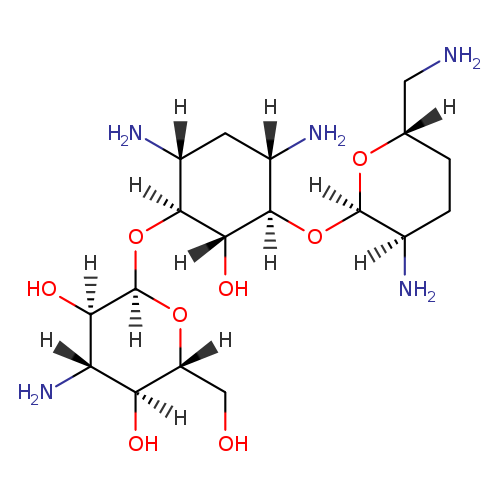
DescriptionA kanamycin that is kanamycin B lacking the 3- and 4-hydroxy groups on the 2,6-diaminosugar ring.
Contaminant Sources
  • ToxCast & Tox21 Chemicals
Contaminant TypeNot Available
Chemical Structure
Thumb
Synonyms
ValueSource
3',4'-Dideoxykanamycin bChEBI
DKMChEBI
O-3-Amino-3-deoxy-alpha-D-glucopyranosyl-(1-4)-O-(2,6-diamino-2,3,4,6-tetradeoxy-alpha-D-erythro-hexopyranosyl-(1-6))-2-deoxy-L-streptamineChEBI
PanamicinChEBI
O-3-Amino-3-deoxy-a-D-glucopyranosyl-(1-4)-O-(2,6-diamino-2,3,4,6-tetradeoxy-a-D-erythro-hexopyranosyl-(1-6))-2-deoxy-L-streptamineGenerator
O-3-Amino-3-deoxy-α-D-glucopyranosyl-(1-4)-O-(2,6-diamino-2,3,4,6-tetradeoxy-α-D-erythro-hexopyranosyl-(1-6))-2-deoxy-L-streptamineGenerator
DibekacinMeSH
Dibekacin sulfateMeSH
Sulfate, dibekacinMeSH
b, 3',4'-DideoxykanamycinMeSH
Dideoxykanamycin bMeSH
OrbicinMeSH
3',4' Dideoxykanamycin bMeSH
DideoxykanamycineMeSH
Sulphate, dibekacinMeSH
Dibekacin sulphateMeSH
Chemical FormulaC18H37N5O8
Average Molecular Mass451.521 g/mol
Monoisotopic Mass451.264 g/mol
CAS Registry Number34493-98-6
IUPAC Name(2S,3R,4S,5S,6R)-4-amino-2-{[(1S,2S,3R,4S,6R)-4,6-diamino-3-{[(2R,3R,6S)-3-amino-6-(aminomethyl)oxan-2-yl]oxy}-2-hydroxycyclohexyl]oxy}-6-(hydroxymethyl)oxane-3,5-diol
Traditional Namedibekacin
SMILES[H][C@@]1(N)CC[C@@]([H])(CN)O[C@]1([H])O[C@]1([H])[C@@]([H])(N)C[C@@]([H])(N)[C@]([H])(O[C@@]2([H])O[C@]([H])(CO)[C@@]([H])(O)[C@]([H])(N)[C@@]2([H])O)[C@@]1([H])O
InChI IdentifierInChI=1S/C18H37N5O8/c19-4-6-1-2-7(20)17(28-6)30-15-8(21)3-9(22)16(14(15)27)31-18-13(26)11(23)12(25)10(5-24)29-18/h6-18,24-27H,1-5,19-23H2/t6-,7+,8-,9+,10+,11-,12+,13+,14-,15+,16-,17+,18+/m0/s1
InChI KeyJJCQSGDBDPYCEO-XVZSLQNASA-N
Chemical Taxonomy
Description belongs to the class of organic compounds known as 4,6-disubstituted 2-deoxystreptamines. These are 2-deoxystreptamine aminoglycosides that are glycosidically linked to a pyranose of furanose unit at the C4- and C6-positions.
KingdomOrganic compounds
Super ClassOrganic oxygen compounds
ClassOrganooxygen compounds
Sub ClassCarbohydrates and carbohydrate conjugates
Direct Parent4,6-disubstituted 2-deoxystreptamines
Alternative Parents
Substituents
  • 4,6-disubstituted 2-deoxystreptamine
  • Glycosyl compound
  • O-glycosyl compound
  • Aminocyclitol or derivatives
  • Cyclohexanol
  • Cyclohexylamine
  • Cyclitol or derivatives
  • Monosaccharide
  • Oxane
  • Cyclic alcohol
  • 1,2-aminoalcohol
  • Secondary alcohol
  • Organoheterocyclic compound
  • Acetal
  • Oxacycle
  • Alcohol
  • Organonitrogen compound
  • Primary aliphatic amine
  • Hydrocarbon derivative
  • Organopnictogen compound
  • Organic nitrogen compound
  • Amine
  • Primary alcohol
  • Primary amine
  • Aliphatic heteromonocyclic compound
Molecular FrameworkAliphatic heteromonocyclic compounds
External Descriptors
Biological Properties
StatusDetected and Not Quantified
OriginNot Available
Cellular LocationsNot Available
Biofluid LocationsNot Available
Tissue LocationsNot Available
PathwaysNot Available
ApplicationsNot Available
Biological RolesNot Available
Chemical RolesNot Available
Physical Properties
StateNot Available
AppearanceNot Available
Experimental Properties
PropertyValue
Melting PointNot Available
Boiling PointNot Available
SolubilityNot Available
Predicted Properties
PropertyValueSource
Water Solubility33.9 g/LALOGPS
logP-2.6ALOGPS
logP-5.3ChemAxon
logS-1.1ALOGPS
pKa (Strongest Acidic)12.54ChemAxon
pKa (Strongest Basic)9.96ChemAxon
Physiological Charge5ChemAxon
Hydrogen Acceptor Count13ChemAxon
Hydrogen Donor Count9ChemAxon
Polar Surface Area247.94 ŲChemAxon
Rotatable Bond Count6ChemAxon
Refractivity105.38 m³·mol⁻¹ChemAxon
Polarizability45.98 ųChemAxon
Number of Rings3ChemAxon
Bioavailability0ChemAxon
Rule of FiveNoChemAxon
Ghose FilterNoChemAxon
Veber's RuleNoChemAxon
MDDR-like RuleYesChemAxon
Spectra
Spectra
Spectrum TypeDescriptionSplash KeyView
Predicted LC-MS/MSPredicted LC-MS/MS Spectrum - 10V, Positivesplash10-0fdx-0291800000-2298c26f134352267e2dSpectrum
Predicted LC-MS/MSPredicted LC-MS/MS Spectrum - 20V, Positivesplash10-03di-0952100000-7831a35039d295e6c20eSpectrum
Predicted LC-MS/MSPredicted LC-MS/MS Spectrum - 40V, Positivesplash10-006t-6920000000-1c089042350f7a0b4fd8Spectrum
Predicted LC-MS/MSPredicted LC-MS/MS Spectrum - 10V, Negativesplash10-0ul9-3493800000-bc35ebfd33bbff9564c4Spectrum
Predicted LC-MS/MSPredicted LC-MS/MS Spectrum - 20V, Negativesplash10-00li-1492400000-2c9d2e4592a0f5f14bd6Spectrum
Predicted LC-MS/MSPredicted LC-MS/MS Spectrum - 40V, Negativesplash10-0udi-1590000000-d9f55f434a9f0851d744Spectrum
Toxicity Profile
Route of ExposureNot Available
Mechanism of ToxicityNot Available
MetabolismNot Available
Toxicity ValuesNot Available
Lethal DoseNot Available
Carcinogenicity (IARC Classification)Not Available
Uses/SourcesNot Available
Minimum Risk LevelNot Available
Health EffectsNot Available
SymptomsNot Available
TreatmentNot Available
Concentrations
Not Available
DrugBank IDDB13270
HMDB IDNot Available
FooDB IDNot Available
Phenol Explorer IDNot Available
KNApSAcK IDNot Available
BiGG IDNot Available
BioCyc IDNot Available
METLIN IDNot Available
PDB IDNot Available
Wikipedia LinkDibekacin
Chemspider IDNot Available
ChEBI ID37945
PubChem Compound ID470999
Kegg Compound IDNot Available
YMDB IDNot Available
ECMDB IDNot Available
References
Synthesis ReferenceNot Available
MSDSNot Available
General References
1. https://www.ncbi.nlm.nih.gov/pubmed/?term=20922036
2. https://www.ncbi.nlm.nih.gov/pubmed/?term=20936279