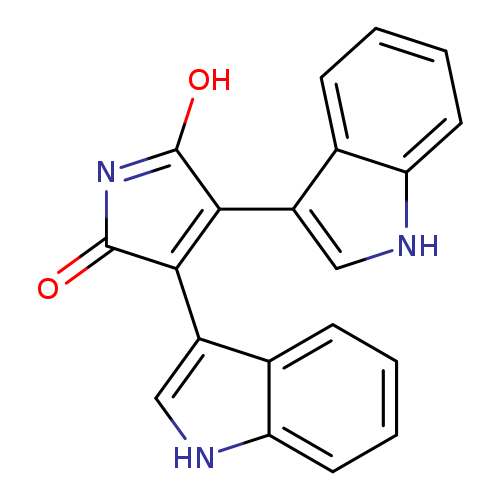
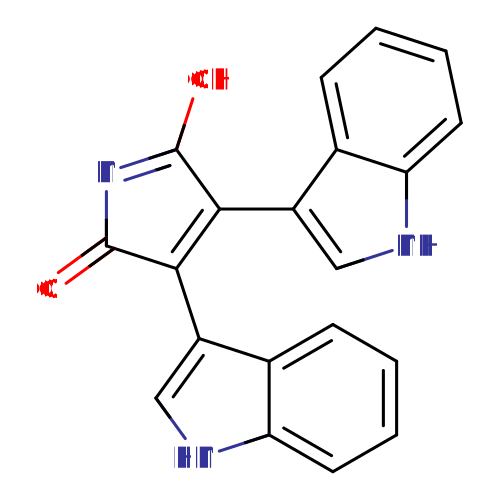
Record Information
Version1.0
Creation Date2016-05-19 04:23:31 UTC
Update Date2016-11-09 01:14:55 UTC
Accession NumberCHEM014083
Identification
Common NameFuel gases, C6-8 catalytic reformer
ClassSmall Molecule
Description
Contaminant Sources
  • HPV EPA Chemicals
Contaminant TypeNot Available
Chemical Structure
Thumb
Synonyms
ValueSource
Bis-indolylmaleimideHMDB
BisindolylmaleimideHMDB
Bis(indolyl)maleimideHMDB
Bisindolylmaleimide IVMeSH
Chemical FormulaC20H13N3O2
Average Molecular Mass327.343 g/mol
Monoisotopic Mass327.101 g/mol
CAS Registry Number68476-28-8
IUPAC Name3,4-bis(1H-indol-3-yl)-2,5-dihydro-1H-pyrrole-2,5-dione
Traditional Name3,4-bis(1H-indol-3-yl)-1H-pyrrole-2,5-dione
SMILESO=C1NC(=O)C(C2=CNC3=CC=CC=C23)=C1C1=CNC2=CC=CC=C12
InChI IdentifierInChI=1S/C20H13N3O2/c24-19-17(13-9-21-15-7-3-1-5-11(13)15)18(20(25)23-19)14-10-22-16-8-4-2-6-12(14)16/h1-10,21-22H,(H,23,24,25)
InChI KeyDQYBRTASHMYDJG-UHFFFAOYSA-N
Chemical Taxonomy
Description belongs to the class of organic compounds known as indoles. Indoles are compounds containing an indole moiety, which consists of pyrrole ring fused to benzene to form 2,3-benzopyrrole.
KingdomOrganic compounds
Super ClassOrganoheterocyclic compounds
ClassIndoles and derivatives
Sub ClassIndoles
Direct ParentIndoles
Alternative Parents
Substituents
  • Indole
  • Maleimide
  • Substituted pyrrole
  • Benzenoid
  • Carboxylic acid imide
  • Dicarboximide
  • Carboxylic acid imide, n-unsubstituted
  • Pyrrole
  • Pyrroline
  • Heteroaromatic compound
  • Carboxylic acid derivative
  • Azacycle
  • Carbonyl group
  • Organooxygen compound
  • Organonitrogen compound
  • Organic oxygen compound
  • Organopnictogen compound
  • Organic oxide
  • Organic nitrogen compound
  • Hydrocarbon derivative
  • Aromatic heteropolycyclic compound
Molecular FrameworkAromatic heteropolycyclic compounds
External DescriptorsNot Available
Biological Properties
StatusDetected and Not Quantified
OriginNot Available
Cellular LocationsNot Available
Biofluid LocationsNot Available
Tissue LocationsNot Available
PathwaysNot Available
ApplicationsNot Available
Biological RolesNot Available
Chemical RolesNot Available
Physical Properties
StateNot Available
AppearanceNot Available
Experimental Properties
PropertyValue
Melting PointNot Available
Boiling PointNot Available
SolubilityNot Available
Predicted Properties
PropertyValueSource
Water Solubility0.0065 g/LALOGPS
logP3.6ALOGPS
logP2.9ChemAxon
logS-4.7ALOGPS
pKa (Strongest Acidic)9.71ChemAxon
pKa (Strongest Basic)-4.9ChemAxon
Physiological Charge0ChemAxon
Hydrogen Acceptor Count2ChemAxon
Hydrogen Donor Count3ChemAxon
Polar Surface Area77.75 ŲChemAxon
Rotatable Bond Count2ChemAxon
Refractivity94.43 m³·mol⁻¹ChemAxon
Polarizability34.21 ųChemAxon
Number of Rings5ChemAxon
Bioavailability1ChemAxon
Rule of FiveYesChemAxon
Ghose FilterYesChemAxon
Veber's RuleNoChemAxon
MDDR-like RuleNoChemAxon
Spectra
Spectra
Spectrum TypeDescriptionSplash KeyView
Predicted GC-MSPredicted GC-MS Spectrum - GC-MS (Non-derivatized) - 70eV, Positivesplash10-056r-0198000000-c8874e77b6ae7a9cc850Spectrum
Predicted GC-MSPredicted GC-MS Spectrum - GC-MS (Non-derivatized) - 70eV, PositiveNot AvailableSpectrum
Predicted LC-MS/MSPredicted LC-MS/MS Spectrum - 10V, Positivesplash10-004i-0009000000-8bd5f768a14c0d76cb9cSpectrum
Predicted LC-MS/MSPredicted LC-MS/MS Spectrum - 20V, Positivesplash10-004i-0229000000-78eb45fc03fd7c9a60ecSpectrum
Predicted LC-MS/MSPredicted LC-MS/MS Spectrum - 40V, Positivesplash10-053u-0970000000-8dd89bf863ee1350fbd7Spectrum
Predicted LC-MS/MSPredicted LC-MS/MS Spectrum - 10V, Negativesplash10-004i-0019000000-f13e1f363cf7c472a337Spectrum
Predicted LC-MS/MSPredicted LC-MS/MS Spectrum - 20V, Negativesplash10-004i-0139000000-8aea76dd613941de4b5aSpectrum
Predicted LC-MS/MSPredicted LC-MS/MS Spectrum - 40V, Negativesplash10-0006-9640000000-37fbf1313cf449a35accSpectrum
Predicted LC-MS/MSPredicted LC-MS/MS Spectrum - 10V, Positivesplash10-004i-0009000000-985c7095db66138081b0Spectrum
Predicted LC-MS/MSPredicted LC-MS/MS Spectrum - 20V, Positivesplash10-004i-0009000000-ea8b88dfee46814342b3Spectrum
Predicted LC-MS/MSPredicted LC-MS/MS Spectrum - 40V, Positivesplash10-0a6r-0095000000-fde290effbc8bf374ad8Spectrum
Predicted LC-MS/MSPredicted LC-MS/MS Spectrum - 10V, Negativesplash10-004i-0009000000-2b36f92d28317783c3e5Spectrum
Predicted LC-MS/MSPredicted LC-MS/MS Spectrum - 20V, Negativesplash10-004i-0019000000-50ac964a726d152d2f2eSpectrum
Predicted LC-MS/MSPredicted LC-MS/MS Spectrum - 40V, Negativesplash10-0a4l-2091000000-c86459bae4a4471ddb9cSpectrum
Toxicity Profile
Route of ExposureNot Available
Mechanism of ToxicityNot Available
MetabolismNot Available
Toxicity ValuesNot Available
Lethal DoseNot Available
Carcinogenicity (IARC Classification)Not Available
Uses/SourcesNot Available
Minimum Risk LevelNot Available
Health EffectsNot Available
SymptomsNot Available
TreatmentNot Available
Concentrations
Not Available
DrugBank IDNot Available
HMDB IDHMDB0244435
FooDB IDNot Available
Phenol Explorer IDNot Available
KNApSAcK IDC00027940
BiGG IDNot Available
BioCyc IDNot Available
METLIN IDNot Available
PDB IDNot Available
Wikipedia LinkNot Available
Chemspider ID2306
ChEBI IDNot Available
PubChem Compound ID2399
Kegg Compound IDNot Available
YMDB IDNot Available
ECMDB IDNot Available
References
Synthesis ReferenceNot Available
MSDSNot Available
General References
1. Barupal DK, Fiehn O: Generating the Blood Exposome Database Using a Comprehensive Text Mining and Database Fusion Approach. Environ Health Perspect. 2019 Sep;127(9):97008. doi: 10.1289/EHP4713. Epub 2019 Sep 26.