| Record Information |
|---|
| Version | 1.0 |
|---|
| Creation Date | 2016-05-19 03:56:16 UTC |
|---|
| Update Date | 2016-11-09 01:14:35 UTC |
|---|
| Accession Number | CHEM012469 |
|---|
| Identification |
|---|
| Common Name | Indigo |
|---|
| Class | Small Molecule |
|---|
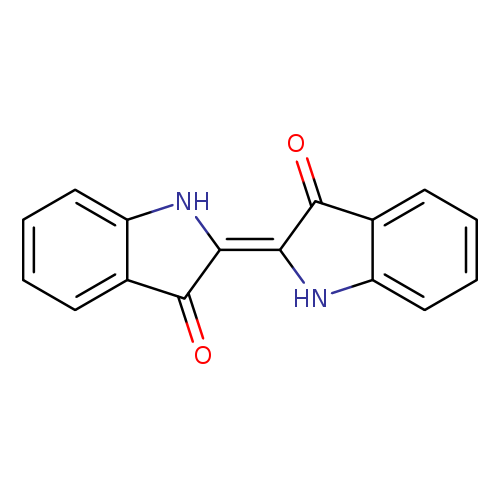
| Description | Indigo (indigo dye or indigotin) is an organic compound with a distinctive blue color. It is an oxindole dimer consisting of two fused oxindole rings. Indoles are compounds which consist of a pyrrole ring fused to benzene to form 2,3-benzopyrrole. Indigo is found in both plants and animals and has been detected in human urine and human tissues (PMID: 11076521; PMID: 8667928). The natural precursor to indigo is indican, a colorless, water-soluble derivative of the amino acid tryptophan. Indican readily hydrolyzes to release β-D-glucose and indoxyl. Oxidation of indoxyl by CYP450 enzymes in the liver or kidneys can convert indoxyl to indigo (PMID: 11076521). Likewise, exposure to air can convert indoxyl to indigo. In addition to the mammalian production of minute amounts of indigo, this chemical can also be recovered in far larger amounts from plants. Historically, indigo has been extracted from the leaves of certain plants of the Indigofera genus, in particular Indigofera tinctoria. Indigofera plants were commonly grown and used throughout the world for the production of indigo dyestuff. This was economically important due to the previous rarity of some blue dyestuffs historically. India was the primary supplier of indigo to Europe as early as the Greco-Roman era. The association of India with indigo is reflected in the Greek word for the dye, indikón. The Romans latinized the term to indicum, which passed into Italian dialect and eventually into English as the word indigo. Most indigo dye produced today is synthetic, constituting several thousand tons each year. It is most commonly associated with the production of denim cloth and blue jeans. |
|---|
| Contaminant Sources | - HPV EPA Chemicals
- OECD HPV Chemicals
- STOFF IDENT Compounds
- ToxCast & Tox21 Chemicals
|
|---|
| Contaminant Type | Not Available |
|---|
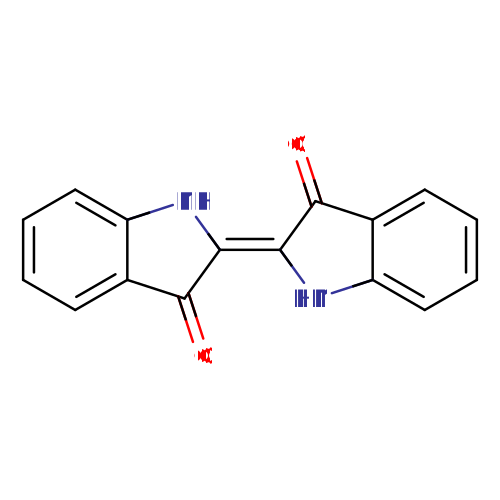
| Chemical Structure | |
|---|
| Synonyms | | Value | Source |
|---|
| Indigotin | HMDB | | Cystoceva | HMDB | | Diindogen | HMDB | | Vulcafix blue R | HMDB | | Indigotindisulfonic acid | HMDB | | Indigo carmine | HMDB | | Indigotindisulfonate | HMDB | | Soluble indigo blue | HMDB | | Disulfonate, indigo | HMDB | | 2-(1,3-Dihydro-3-oxo-5-sulphO-2H-indol-2-ylidene)-3- oxoindoline-5-sulphonic acid | HMDB | | FD And C blue no. 2 | HMDB | | Indigo blue, soluble | HMDB | | (delta-2,2'-Biindole)-3,3'-dione | HMDB | | D And C blue no. 6 | HMDB | | Carmine, indigo | HMDB | | Indigo disulfonate | HMDB | | Indigo blue | HMDB | | Indigotindisulfonate sodium | HMDB | | Indigo | MeSH |
|
|---|
| Chemical Formula | C16H10N2O2 |
|---|
| Average Molecular Mass | 262.268 g/mol |
|---|
| Monoisotopic Mass | 262.074 g/mol |
|---|
| CAS Registry Number | 482-89-3 |
|---|
| IUPAC Name | (E)-1H,1'H,3H,3'H-[2,2'-biindolylidene]-3,3'-dione |
|---|
| Traditional Name | (E)-1H,1'H-[2,2'-biindolylidene]-3,3'-dione |
|---|
| SMILES | O=C1\C(NC2=CC=CC=C12)=C1/NC2=CC=CC=C2C1=O |
|---|
| InChI Identifier | InChI=1S/C16H10N2O2/c19-15-9-5-1-3-7-11(9)17-13(15)14-16(20)10-6-2-4-8-12(10)18-14/h1-8,17-18H/b14-13+ |
|---|
| InChI Key | COHYTHOBJLSHDF-BUHFOSPRSA-N |
|---|
| Chemical Taxonomy |
|---|
| Description | belongs to the class of organic compounds known as indolines. Indolines are compounds containing an indole moiety, which consists of pyrrolidine ring fused to benzene to form 2,3-dihydroindole. |
|---|
| Kingdom | Organic compounds |
|---|
| Super Class | Organoheterocyclic compounds |
|---|
| Class | Indoles and derivatives |
|---|
| Sub Class | Indolines |
|---|
| Direct Parent | Indolines |
|---|
| Alternative Parents | |
|---|
| Substituents | - Dihydroindole
- Aryl ketone
- Secondary aliphatic/aromatic amine
- Benzenoid
- Vinylogous amide
- Ketone
- Secondary amine
- Enamine
- Azacycle
- Hydrocarbon derivative
- Organic oxide
- Organopnictogen compound
- Organic oxygen compound
- Organooxygen compound
- Organonitrogen compound
- Amine
- Organic nitrogen compound
- Aromatic heteropolycyclic compound
|
|---|
| Molecular Framework | Aromatic heteropolycyclic compounds |
|---|
| External Descriptors | Not Available |
|---|
| Biological Properties |
|---|
| Status | Detected and Not Quantified |
|---|
| Origin | Not Available |
|---|
| Cellular Locations | Not Available |
|---|
| Biofluid Locations | Not Available |
|---|
| Tissue Locations | Not Available |
|---|
| Pathways | Not Available |
|---|
| Applications | Not Available |
|---|
| Biological Roles | Not Available |
|---|
| Chemical Roles | Not Available |
|---|
| Physical Properties |
|---|
| State | Not Available |
|---|
| Appearance | Not Available |
|---|
| Experimental Properties | | Property | Value |
|---|
| Melting Point | Not Available | | Boiling Point | Not Available | | Solubility | Not Available |
|
|---|
| Predicted Properties | |
|---|
| Spectra |
|---|
| Spectra | | Spectrum Type | Description | Splash Key | View |
|---|
| Predicted GC-MS | Predicted GC-MS Spectrum - GC-MS (Non-derivatized) - 70eV, Positive | Not Available | Spectrum | | Predicted LC-MS/MS | Predicted LC-MS/MS Spectrum - 10V, Positive | splash10-03di-0090000000-790509310d3a9b1089dc | Spectrum | | Predicted LC-MS/MS | Predicted LC-MS/MS Spectrum - 20V, Positive | splash10-03di-0290000000-b87193ec33d05c5972bc | Spectrum | | Predicted LC-MS/MS | Predicted LC-MS/MS Spectrum - 40V, Positive | splash10-0006-1920000000-06f522bb3b9294630d21 | Spectrum | | Predicted LC-MS/MS | Predicted LC-MS/MS Spectrum - 10V, Negative | splash10-03di-0090000000-7b4ca08a5827f92042b5 | Spectrum | | Predicted LC-MS/MS | Predicted LC-MS/MS Spectrum - 20V, Negative | splash10-03di-0290000000-8e31bd790d0c838bafde | Spectrum | | Predicted LC-MS/MS | Predicted LC-MS/MS Spectrum - 40V, Negative | splash10-001i-0590000000-1d3c68663ee4df12a0e2 | Spectrum | | Predicted LC-MS/MS | Predicted LC-MS/MS Spectrum - 10V, Negative | splash10-03di-0090000000-fc429704171183f86ba8 | Spectrum | | Predicted LC-MS/MS | Predicted LC-MS/MS Spectrum - 20V, Negative | splash10-03di-0290000000-8d486152aa8dcd21f192 | Spectrum | | Predicted LC-MS/MS | Predicted LC-MS/MS Spectrum - 40V, Negative | splash10-001i-0920000000-4c6f54d2c5462973f105 | Spectrum | | Predicted LC-MS/MS | Predicted LC-MS/MS Spectrum - 10V, Positive | splash10-03di-0090000000-d2ff69a7f2ebf2ad3717 | Spectrum | | Predicted LC-MS/MS | Predicted LC-MS/MS Spectrum - 20V, Positive | splash10-03e9-0690000000-024cece7c516595caa9f | Spectrum | | Predicted LC-MS/MS | Predicted LC-MS/MS Spectrum - 40V, Positive | splash10-0w30-0960000000-2d6f1d15e9a51ab8b9f5 | Spectrum |
|
|---|
| Toxicity Profile |
|---|
| Route of Exposure | Not Available |
|---|
| Mechanism of Toxicity | Not Available |
|---|
| Metabolism | Not Available |
|---|
| Toxicity Values | Not Available |
|---|
| Lethal Dose | Not Available |
|---|
| Carcinogenicity (IARC Classification) | Not Available |
|---|
| Uses/Sources | Not Available |
|---|
| Minimum Risk Level | Not Available |
|---|
| Health Effects | Not Available |
|---|
| Symptoms | Not Available |
|---|
| Treatment | Not Available |
|---|
| Concentrations |
|---|
| Not Available |
|---|
| External Links |
|---|
| DrugBank ID | Not Available |
|---|
| HMDB ID | HMDB0240742 |
|---|
| FooDB ID | Not Available |
|---|
| Phenol Explorer ID | Not Available |
|---|
| KNApSAcK ID | C00000126 |
|---|
| BiGG ID | Not Available |
|---|
| BioCyc ID | Not Available |
|---|
| METLIN ID | Not Available |
|---|
| PDB ID | Not Available |
|---|
| Wikipedia Link | Indigo |
|---|
| Chemspider ID | 4477009 |
|---|
| ChEBI ID | Not Available |
|---|
| PubChem Compound ID | 5318432 |
|---|
| Kegg Compound ID | Not Available |
|---|
| YMDB ID | Not Available |
|---|
| ECMDB ID | Not Available |
|---|
| References |
|---|
| Synthesis Reference | Not Available |
|---|
| MSDS | Not Available |
|---|
| General References | |
|---|