It is used in freezing of foods
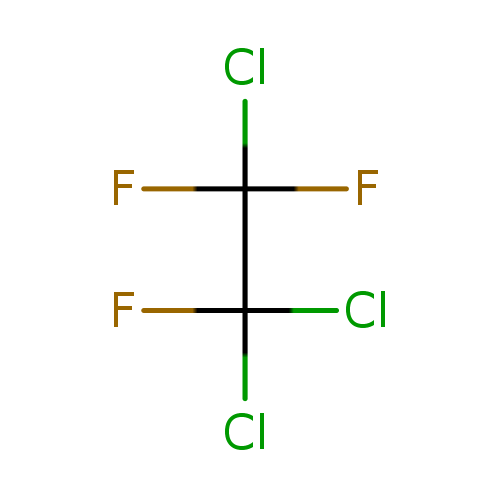
CFC-113 is a very unreactive chlorofluorocarbon, that will stay in the atmosphere for a great deal of time if it is released. CFC-113 will stay in the atmosphere long enough that it will cycle out of the troposphere and into the stratosphere. In the stratosphere, CFC-113 can be broken up by ultraviolet radiation, creating chlorine radicals, which can in turn react with ozone molecules to form molecular oxygen (O2), leading to the overall depletion of stratospheric ozone. The amount of CFC-113 in the atmosphere has stayed relatively stable, at about 80 parts per trillion, since the early 1990s.; CFC-113 was one of the many forms of CFCs that were made to eliminate toxic and flammable substances in the areas that they were used. It has been used as a cooling agent in refrigerants and air conditioners, aerosol propellant, and a cleansing agent for electrical and electronic components. CFC-113 is one of the three most popular CFCs, along with CFC-11 and CFC-12 and saw much use in its time. CFC-113 has a unique property that makes it perfect for cooling systems. When it is in a gas form and compressed, it heats up, when it is expanded, it cools. This makes them ideal for the vapor compression cycle systems. They were also very desirable because of their low toxicity, non-flammability, thermophysical properties, and normal boiling point. CFC-113 also has a flexible form so it was used in the production of plastics, packaging material, insulation, foams for cushioning, and things like the soles of your shoes. CFC-113 has such a low flammability and low toxicity that it was also used as a cleaner for delicate electrical equipment, fabrics, and even metals. Because it would not warm the product it was cleaning, catch fire with a spark or react to and other chemicals it was ideal for this purpose. CFC-113 in laboratory analytics has been replaced by other solvents.; Trichlorotrifluoroethane, also called 1,1,2-Trichloro-1,2,2-trifluoroethane or CFC-113 is a chlorofluorocarbon. It has the formula Cl2FC-CClF2.
Structure for CHEM004031: Ethane, 1,1,2-trichloro-1,2,2,-trifluoro-
Synonyms
Value
Source
1,1,2-Trichloro-1,2,2-trifluoro-ethane
HMDB
1,1,2-Trichloro-1,2,2-trifluoroethane (CFC-113)
HMDB
1,1,2-Trichloro-trifluoroethane
HMDB
1,1,2-Trichlorotrifluoroethane
HMDB
1,1,2-Trichlorotrifluoroethane (freon 113)
HMDB
1,1,2-Trifluoro-1,2,2-trichloroethane
HMDB
1,1,2-Trifluorotrichloroethane
HMDB
1,2,2-Trichlorotrifluoroethane
HMDB
1,2,2-Trifluorotrichloroethane
HMDB
Arcton 113
HMDB
Arcton 63
HMDB
Arklone
HMDB
Arklone p
HMDB
Asahifron 113
HMDB
CFC 113
HMDB
CFCL2cf2CL
HMDB
Chlorinated fluorocarbon
HMDB
Chlorofluorocarbon 113
HMDB
Daiflon S 3
HMDB
Diflon S-3
HMDB
Distillex DS5
HMDB
Eskimon 113
HMDB
Flugene 113
HMDB
Forane
HMDB
Forane 113
HMDB
Freon 113
HMDB
Freon 113 TR-T
HMDB
Freon 113TR-T
HMDB
Freon F113
HMDB
Freon R 113
HMDB
Freon TF
HMDB
Freon TF (113)
HMDB
Fridohna
HMDB
Frigen 113
HMDB
Frigen 113 TR
HMDB
Frigen 113 TR-a
HMDB
Frigen 113 TR-N
HMDB
Frigen 113 TR-T
HMDB
Frigen 113a
HMDB
Frigen 113TR
HMDB
Frigen 113TR-N
HMDB
Frigen 113TR-T
HMDB
Fron 113
HMDB
Fronsolve 113
HMDB
Genesolv D
HMDB
Genesolv D sslvent
HMDB
Genetron 113
HMDB
Genetron(R) 113
HMDB
Halocarbon 113
HMDB
Isceon 113
HMDB
Kaiser chemicals 11
HMDB
Kaltron 113MDR
HMDB
Khladon 113
HMDB
LEDON 113
HMDB
MS-180 Freon TF solv
HMDB
Propellant 113
HMDB
R 113 (Halocarbon)
HMDB
R 113(Halocarbon)
HMDB
Racon 113
HMDB
Refrigerant 113
HMDB
Refrigerant R 113
HMDB
Trichloro 1,2,2-trifluoroethane
HMDB
Trichlorotrifluoroethane
HMDB
Ucon 113/halocarbon 113
HMDB
Ucon fluorocarbon 113
HMDB
Chemical Formula
C2Cl3F3
Average Molecular Mass
187.376 g/mol
Monoisotopic Mass
185.902 g/mol
CAS Registry Number
76-13-1
IUPAC Name
1,1,2-trichloro-1,2,2-trifluoroethane
Traditional Name
1,1,2-trichlorotrifluoroethane
SMILES
FC(F)(Cl)C(F)(Cl)Cl
InChI Identifier
InChI=1S/C2Cl3F3/c3-1(4,6)2(5,7)8
InChI Key
AJDIZQLSFPQPEY-UHFFFAOYSA-N
Chemical Taxonomy
Description
belongs to the class of organic compounds known as chlorofluorocarbons. These are alkyhalide compounds that are composed only of chlorine, fluorine, and carbon atoms.