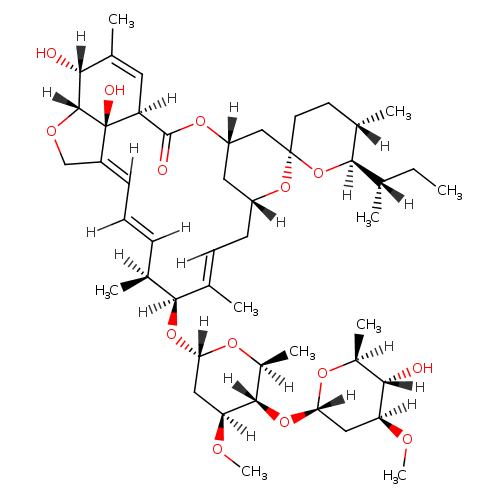
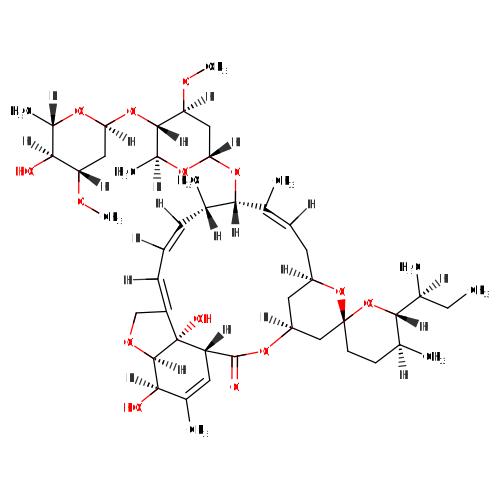
22,23-dihydroavermectin b1a is a component of Ivermectin, a broad-spectrum antiparasitic avermectin medicine. It is sold under brand names Sklice and Stromectol in the United States, Ivomec in Europe by Merial Animal Health, Mectizan in Canada by Merck and Ivexterm in Mexico by Valeant Pharmaceuticals International. In southeast Asian countries like Bangladesh, it is marketed by Delta Pharma Ltd. under the trade name Scabo 6. While in development, it was assigned the code MK-933 by Merck. It was first used against worms (except tapeworms), but in 2012 it was approved for the topical treatment of head lice infestations in patients 6 months of age and older. Ivermectin is mainly used in humans in the treatment of onchocerciasis, but is also effective against other worm infestations (such as strongyloidiasis, ascariasis, trichuriasis and enterobiasis).
belongs to the class of organic compounds known as milbemycins. These are a group of macrolides with a structure containing a 16-membered lactone ring fused to a 1,7-dioxaspiroundecane ring system and to either a benzofuran (or hydrogenated derivative thereof). In some cases (e.g. Milbemycin E), the tetrahydrofuranyl ring is missing. Milbemycins can be o-glycosylated at C13 to form Avermectins. Milbemycins are produced by Streptomyces species.
Ivermectin is moderately well absorbed. Improved absorption with high fat meal.
Mechanism of Toxicity
Ivermectin binds selectively and with high affinity to glutamate-gated chloride ion channels in invertebrate muscle and nerve cells of the microfilaria. This binding causes an increase in the permeability of the cell membrane to chloride ions and results in hyperpolarization of the cell, leading to paralysis and death of the parasite. Ivermectin also is believed to act as an agonist of the neurotransmitter gamma-aminobutyric acid (GABA), thereby disrupting GABA-mediated central nervous system (CNS) neurosynaptic transmission. Ivermectin may also impair normal intrauterine development of O. volvulus microfilariae and may inhibit their release from the uteri of gravid female worms. It has low solubility in water and extensive non-specific binding. It opens GABA-insensitive chloride channels, reducing membrane resistance and increasing conductance inward. (3)
Metabolism
Primarily hepatic. Ivermectin and/or its metabolites are excreted almost exclusively in the feces over an estimated 12 days, with less than 1 % of the administered dose excreted in the urine. Route of Elimination: Ivermectin is metabolized in the liver, and ivermectin and/or its metabolites are excreted almost exclusively in the feces over an estimated 12 days, with less than 1% of the administered dose excreted in the urine. Half Life: 16 hours (also reported at 22-28 hours)
For the treatment of intestinal (i.e., nondisseminated) strongyloidiasis due to the nematode parasite Strongyloides stercoralis. Also for the treatment of onchocerciasis (river blindness) due to the nematode parasite Onchocerca volvulus. Can be used to treat scabies caused by Sarcoptes scabiei. Active ingredient in some commercial ant bait traps. (1)
Minimum Risk Level
Not Available
Health Effects
Avermectins are neurotoxic and have reproductive and developmental effects. (2)
Symptoms
Avermectins cause irritation of skin and eyes, central nervous system depression (incoordination, tremors, lethargy, excitation, pupil dilation, coma), vomiting, convulsions and/or tremors, and respiratory failure at high doses. (2) Adverse effects include muscle or joint pain, dizziness, fever, headache, skin rash, fast heartbeat.
Shuet-Hing L. Chiu, Josephine R. Carlin, Rae Taub, “Ivermectin derivative compounds and process for preparing the same.” U.S. Patent US4963667, issued June, 1982.