Record Information
Version1.0
Creation Date2014-10-14 21:19:36 UTC
Update Date2026-03-31 19:18:56 UTC
Accession NumberCHEM003938
Identification
Common NameAniline
ClassSmall Molecule
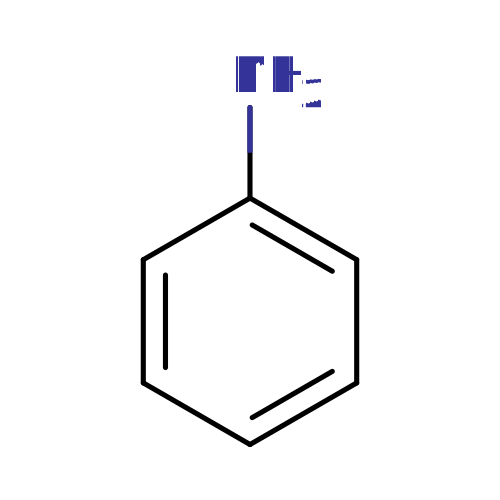
DescriptionAniline is an organic chemical compound, specifically a primary aromatic amine. It consists of a benzene ring attached to an amino group. Aniline is oily and, although colorless, it can be slowly oxidized and resinified in air to form impurities which can give it a red-brown tint. Its boiling point is 184 degree centigrade and its melting point is -6 degree centegrade. It is a liquid at room temperature. Like most volatile amines, it possesses a somewhat unpleasant odour of rotten fish, and also has a burning aromatic taste; it is a highly acrid poison. It ignites readily, burning with a large smoky flame. Aniline reacts with strong acids to form salts containing the anilinium (or phenylammonium) ion (C6H5-NH3+), and reacts with acyl halides (such as acetyl chloride (ethanoyl chloride), CH3COCl) to form amides. The amides formed from aniline are sometimes called anilides, for example CH3-CO-NH-C6H5 is acetanilide, for which the modern name is N-phenyl ethanamide. Like phenols, aniline derivatives are highly reactive in electrophilic substitution reactions. For example, sulfonation of aniline produces sulfanilic acid, which can be converted to sulfanilamide. Sulfanilamide is one of the sulfa drugs which were widely used as antibacterial in the early 20th century. Aniline was first isolated from the destructive distillation of indigo in 1826 by Otto Unverdorben. In 1834, Friedrich Runge isolated from coal tar a substance which produced a beautiful blue color on treatment with chloride of lime; this he named kyanol or cyanol. In 1841, C. J. Fritzsche showed that by treating indigo with caustic potash it yielded an oil, which he named aniline, from the specific name of one of the indigo-yielding plants, Indigofera anil, anil being derived from the Sanskrit, dark-blue.
Contaminant Sources
  • Clean Air Act Chemicals
  • FooDB Chemicals
  • HMDB Contaminants - Urine
  • HPV EPA Chemicals
  • IARC Carcinogens Group 3
  • My Exposome Chemicals
  • OECD HPV Chemicals
  • STOFF IDENT Compounds
  • T3DB toxins
  • ToxCast & Tox21 Chemicals
Contaminant Type
  • Carcinogen
  • Dye
  • Industrial/Workplace Toxin
  • Metabolite
  • Synthetic Compound
Chemical Structure
Thumb
Synonyms
ValueSource
AminobenzeneChEBI
AminophenChEBI
AnilinChEBI
BenzenamineChEBI
BenzeneamineChEBI
KyanolChEBI
PhenylamineChEBI
ArylamineKegg
Aniline aluminium saltMeSH
Aniline dihydrofluorideMeSH
Aniline diphosphate (1:1)MeSH
Aniline diphosphate (3:1)MeSH
Aniline diphosphate (4:1)MeSH
Aniline hydrobromideMeSH
Aniline hydrochlorideMeSH
Aniline hydrochloride-(14)C-labeled CPDMeSH
Aniline hydrochloride-(15)N-labeled CPDMeSH
Aniline hydrofluorideMeSH
Aniline hydrogen iodideMeSH
Aniline monosulfateMeSH
Aniline nitrateMeSH
Aniline perchlorateMeSH
Aniline phosphate (1:1)MeSH
Aniline phosphate (1:2)MeSH
Aniline phosphate (2:1)MeSH
Aniline phosphonate (1:1)MeSH
Aniline sulfateMeSH
Aniline sulfate (2:1)MeSH
Aniline sulfate (2:1), (14)C-labeled CPDMeSH
Aniline, (13)C-labeled CPDMeSH
Aniline, (14)C-labeled CPDMeSH
Aniline, 15N-labeled CPDMeSH
Aniline, 2-(13)C-labeled CPDMeSH
Aniline, 3-(13)C-labeled CPDMeSH
Aniline, 3H-labeled CPDMeSH
Aniline, 4-(13)C-labeled CPDMeSH
Aniline, conjugate acidMeSH
Aniline, ion(1+)MeSH
Aniline, magnesium (1:1) saltMeSH
Aniline, monolithium saltMeSH
Aniline, sodium saltMeSH
AnilinaHMDB
Aniline reagentHMDB
AnyvimHMDB
BenzidamHMDB
CyanolHMDB
D'AnilineHMDB
KrystallinHMDB
Chemical FormulaC6H7N
Average Molecular Mass93.127 g/mol
Monoisotopic Mass93.058 g/mol
CAS Registry Number62-53-3
IUPAC Nameaniline
Traditional Nameaniline
SMILESNC1=CC=CC=C1
InChI IdentifierInChI=1S/C6H7N/c7-6-4-2-1-3-5-6/h1-5H,7H2
InChI KeyPAYRUJLWNCNPSJ-UHFFFAOYSA-N
Chemical Taxonomy
Description belongs to the class of organic compounds known as aniline and substituted anilines. These are organic compounds containing an aminobenzene moiety.
KingdomOrganic compounds
Super ClassBenzenoids
ClassBenzene and substituted derivatives
Sub ClassAniline and substituted anilines
Direct ParentAniline and substituted anilines
Alternative Parents
Substituents
  • Aniline or substituted anilines
  • Organic nitrogen compound
  • Organopnictogen compound
  • Hydrocarbon derivative
  • Primary amine
  • Organonitrogen compound
  • Amine
  • Aromatic homomonocyclic compound
Molecular FrameworkAromatic homomonocyclic compounds
External Descriptors
Biological Properties
StatusDetected and Not Quantified
OriginEndogenous
Cellular LocationsNot Available
Biofluid LocationsNot Available
Tissue Locations
  • Bladder
  • Epidermis
  • Prostate
  • Spleen
PathwaysNot Available
ApplicationsNot Available
Biological RolesNot Available
Chemical RolesNot Available
Physical Properties
StateLiquid
AppearanceNot Available
Experimental Properties
PropertyValue
Melting Point-6 °C
Boiling Point245 C
Solubility36 mg/mL at 25 °C
Predicted Properties
PropertyValueSource
Water Solubility18 g/LALOGPS
logP0.89ALOGPS
logP1.14ChemAxon
logS-0.71ALOGPS
pKa (Strongest Basic)4.64ChemAxon
Physiological Charge0ChemAxon
Hydrogen Acceptor Count1ChemAxon
Hydrogen Donor Count1ChemAxon
Polar Surface Area26.02 ŲChemAxon
Rotatable Bond Count0ChemAxon
Refractivity30.76 m³·mol⁻¹ChemAxon
Polarizability10.29 ųChemAxon
Number of Rings1ChemAxon
Bioavailability1ChemAxon
Rule of FiveYesChemAxon
Ghose FilterNoChemAxon
Veber's RuleYesChemAxon
MDDR-like RuleNoChemAxon
Spectra
Spectra
Spectrum TypeDescriptionSplash KeyView
GC-MSGC-MS Spectrum - EI-B (Non-derivatized)splash10-00kf-9000000000-9a543eee5081cc927e82Spectrum
GC-MSGC-MS Spectrum - EI-B (Non-derivatized)splash10-0006-9000000000-e04550d3cafee77e6192Spectrum
GC-MSGC-MS Spectrum - EI-B (Non-derivatized)splash10-0006-9000000000-b4213ef5f8ee4a3df612Spectrum
GC-MSGC-MS Spectrum - GC-EI-TOF (Non-derivatized)splash10-0udi-1900000000-b5d970641bbe63fdb366Spectrum
GC-MSGC-MS Spectrum - EI-B (Non-derivatized)splash10-00kf-9000000000-9a543eee5081cc927e82Spectrum
GC-MSGC-MS Spectrum - EI-B (Non-derivatized)splash10-0006-9000000000-e04550d3cafee77e6192Spectrum
GC-MSGC-MS Spectrum - EI-B (Non-derivatized)splash10-0006-9000000000-b4213ef5f8ee4a3df612Spectrum
GC-MSGC-MS Spectrum - GC-EI-TOF (Non-derivatized)splash10-0udi-1900000000-b5d970641bbe63fdb366Spectrum
Predicted GC-MSPredicted GC-MS Spectrum - GC-MS (Non-derivatized) - 70eV, Positivesplash10-0006-9000000000-62eb000567821fbe8a22Spectrum
Predicted GC-MSPredicted GC-MS Spectrum - GC-MS (Non-derivatized) - 70eV, PositiveNot AvailableSpectrum
LC-MS/MSLC-MS/MS Spectrum - Quattro_QQQ 10V, Positive (Annotated)splash10-0006-9000000000-a23bad3a5415210b8e58Spectrum
LC-MS/MSLC-MS/MS Spectrum - Quattro_QQQ 25V, Positive (Annotated)splash10-004i-9000000000-129ed2147aba87164399Spectrum
LC-MS/MSLC-MS/MS Spectrum - Quattro_QQQ 40V, Positive (Annotated)splash10-0udi-9000000000-9e60a29bae11a3beb396Spectrum
LC-MS/MSLC-MS/MS Spectrum - EI-B (HITACHI RMU-7M) , Positivesplash10-00kf-9000000000-8e5e6fec72fd720bd3bbSpectrum
LC-MS/MSLC-MS/MS Spectrum - EI-B (HITACHI RMU-6L) , Positivesplash10-0006-9000000000-e04550d3cafee77e6192Spectrum
LC-MS/MSLC-MS/MS Spectrum - LC-ESI-QQ (API3000, Applied Biosystems) 10V, Positivesplash10-0006-9000000000-4a2ea8998eab06e3b7faSpectrum
LC-MS/MSLC-MS/MS Spectrum - LC-ESI-QQ (API3000, Applied Biosystems) 20V, Positivesplash10-002f-9000000000-041fc0d729e6308b36ecSpectrum
LC-MS/MSLC-MS/MS Spectrum - LC-ESI-QQ (API3000, Applied Biosystems) 30V, Positivesplash10-004i-9000000000-c0f67277e0af76d5d6e1Spectrum
LC-MS/MSLC-MS/MS Spectrum - LC-ESI-QQ (API3000, Applied Biosystems) 40V, Positivesplash10-0fb9-9000000000-35b2093eb2c81ba07d17Spectrum
LC-MS/MSLC-MS/MS Spectrum - LC-ESI-QQ (API3000, Applied Biosystems) 50V, Positivesplash10-004i-9000000000-15d86b7cf94658003a7cSpectrum
LC-MS/MSLC-MS/MS Spectrum - LC-ESI-QQ (API3000, Applied Biosystems) 10V, Positivesplash10-03di-9000000000-fc34fd188d386065c4f5Spectrum
LC-MS/MSLC-MS/MS Spectrum - LC-ESI-QQ (API3000, Applied Biosystems) 20V, Positivesplash10-03dl-9000000000-fbed3991af3afeea3a79Spectrum
LC-MS/MSLC-MS/MS Spectrum - LC-ESI-QQ (API3000, Applied Biosystems) 30V, Positivesplash10-0006-9000000000-0bea53746f5bc30ab770Spectrum
LC-MS/MSLC-MS/MS Spectrum - LC-ESI-QQ (API3000, Applied Biosystems) 40V, Positivesplash10-0007-9000000000-971619ea8bd73637ba14Spectrum
LC-MS/MSLC-MS/MS Spectrum - LC-ESI-QQ (API3000, Applied Biosystems) 50V, Positivesplash10-0006-9000000000-2001822055db683e8999Spectrum
LC-MS/MSLC-MS/MS Spectrum - LC-ESI-QTOF (UPLC Q-Tof Premier, Waters) , Positivesplash10-0006-9000000000-a5bc25b5010f2044b435Spectrum
LC-MS/MSLC-MS/MS Spectrum - LC-ESI-QTOF (UPLC Q-Tof Premier, Waters) 30V, Positivesplash10-0006-9000000000-8ab282b725391b0d9923Spectrum
LC-MS/MSLC-MS/MS Spectrum - , negativesplash10-00di-0900000000-ed34a4f0bafc3ce06174Spectrum
LC-MS/MSLC-MS/MS Spectrum - LC-ESI-QQ , positivesplash10-0006-9000000000-4a2ea8998eab06e3b7faSpectrum
Predicted LC-MS/MSPredicted LC-MS/MS Spectrum - 10V, Positivesplash10-0006-9000000000-c4c7adf426e20a85b18eSpectrum
Predicted LC-MS/MSPredicted LC-MS/MS Spectrum - 20V, Positivesplash10-0006-9000000000-cbf324483014cd812600Spectrum
Predicted LC-MS/MSPredicted LC-MS/MS Spectrum - 40V, Positivesplash10-014i-9000000000-4ef27c104c8c073fccb4Spectrum
Predicted LC-MS/MSPredicted LC-MS/MS Spectrum - 10V, Negativesplash10-0006-9000000000-9b2f125fc5146ad77329Spectrum
Predicted LC-MS/MSPredicted LC-MS/MS Spectrum - 20V, Negativesplash10-0006-9000000000-9b2f125fc5146ad77329Spectrum
Predicted LC-MS/MSPredicted LC-MS/MS Spectrum - 40V, Negativesplash10-0006-9000000000-e7badc7e20ab7cd59fd5Spectrum
MSMass Spectrum (Electron Ionization)splash10-00kf-9000000000-4ba5d22a406245826ca0Spectrum
1D NMR1H NMR SpectrumNot AvailableSpectrum
1D NMR13C NMR SpectrumNot AvailableSpectrum
1D NMR1H NMR SpectrumNot AvailableSpectrum
1D NMR13C NMR SpectrumNot AvailableSpectrum
1D NMR1H NMR SpectrumNot AvailableSpectrum
1D NMR13C NMR SpectrumNot AvailableSpectrum
1D NMR1H NMR SpectrumNot AvailableSpectrum
1D NMR13C NMR SpectrumNot AvailableSpectrum
1D NMR1H NMR SpectrumNot AvailableSpectrum
1D NMR13C NMR SpectrumNot AvailableSpectrum
1D NMR1H NMR SpectrumNot AvailableSpectrum
1D NMR13C NMR SpectrumNot AvailableSpectrum
1D NMR1H NMR SpectrumNot AvailableSpectrum
1D NMR13C NMR SpectrumNot AvailableSpectrum
1D NMR1H NMR SpectrumNot AvailableSpectrum
1D NMR13C NMR SpectrumNot AvailableSpectrum
1D NMR1H NMR SpectrumNot AvailableSpectrum
1D NMR13C NMR SpectrumNot AvailableSpectrum
1D NMR1H NMR SpectrumNot AvailableSpectrum
1D NMR13C NMR SpectrumNot AvailableSpectrum
1D NMR1H NMR SpectrumNot AvailableSpectrum
2D NMR[1H,13C] 2D NMR SpectrumNot AvailableSpectrum
Toxicity Profile
Route of ExposureToxic by ingestion and a skin and eye irritant.
Mechanism of ToxicityAniline induces lipid peroxidation and protein oxidation in the spleen and that oxidative stress plays a role in the splenic toxicity of aniline. The hematopoietic system is the primary target of aniline insult in rats which is characterized by methemoglobinemia, hemolysis, and hemolytic anemia and by the development of splenic hyperplasia, siderosis, fibrosis, a variety of sarcomas, and, most commonly, fibrosarcomas on prolonged exposure. Many of the characteristics of splenotoxicity in rats, such as hyperplasia, hyperpigmentation, and/or formation of highly malignant tumors such as fibrosarcomas, are not restricted to aniline exposure, but also occur when animals are exposed to substituted anilines such as chloroaniline. Studies with aniline hydrochloride in rats indicate an association between erythrocyte damage and the severity of the splenotoxicity. Since one of the major functions of the spleen is to remove damaged erythrocytes, aniline-damaged erythrocytes would be expected to be scavenged by the spleen, especially by phagocytes. The deposition and subsequent breakdown of damaged erythrocytes will not only release aniline and/or its metabolites, but, most importantly, will also result in accumulation of iron in the spleen which may catalyze the generation of tissue-damaging oxygen radicals which can subsequently cause oxidation of biomolecules and result in lipid peroxidation and protein oxidation. It is also possible that during the scavenging of damaged erythrocytes, the splenic phagocytes, especially macrophages themselves, can become activated and release reactive oxygen species (ROS) which could further contribute to the oxidation of biomolecules leading to tissue injury. (14)
MetabolismNot Available
Toxicity ValuesNot Available
Lethal DoseNot Available
Carcinogenicity (IARC Classification)3, not classifiable as to its carcinogenicity to humans. (15)
Uses/SourcesNot Available
Minimum Risk LevelNot Available
Health EffectsNot Available
SymptomsAniline-induced splenic toxicity is characterized by hemorrhage, capsular hyperplasia, fibrosis, and a variety of sarcomas in rats.
TreatmentNot Available
Concentrations
Not Available
DrugBank IDDB06728
HMDB IDHMDB0003012
FooDB IDFDB003571
Phenol Explorer IDNot Available
KNApSAcK IDC00048294
BiGG IDNot Available
BioCyc IDANILINE
METLIN ID489
PDB IDNot Available
Wikipedia LinkAniline
Chemspider ID5889
ChEBI ID17296
PubChem Compound ID6115
Kegg Compound IDC00292
YMDB IDNot Available
ECMDB IDM2MDB004895
References
Synthesis Reference

Michel Dury, “Method for preparing 2-trifluoro-methoxy-aniline.” U.S. Patent US6121492, issued 0000.

MSDSNot Available
General References
1. https://www.ncbi.nlm.nih.gov/pubmed/?term=11304127
2. https://www.ncbi.nlm.nih.gov/pubmed/?term=17135213
3. https://www.ncbi.nlm.nih.gov/pubmed/?term=23821252
4. https://www.ncbi.nlm.nih.gov/pubmed/?term=3779628
5. https://www.ncbi.nlm.nih.gov/pubmed/?term=6205897
6. Mung D, Li L: Development of Chemical Isotope Labeling LC-MS for Milk Metabolomics: Comprehensive and Quantitative Profiling of the Amine/Phenol Submetabolome. Anal Chem. 2017 Apr 18;89(8):4435-4443. doi: 10.1021/acs.analchem.6b03737. Epub 2017 Mar 28.
7. Weiss T, Angerer J: Simultaneous determination of various aromatic amines and metabolites of aromatic nitro compounds in urine for low level exposure using gas chromatography-mass spectrometry. J Chromatogr B Analyt Technol Biomed Life Sci. 2002 Oct 5;778(1-2):179-92.
8. Hein DW, Doll MA, Xiao GH, Feng Y: Prostate expression of N-acetyltransferase 1 (NAT1) and 2 (NAT2) in rapid and slow acetylator congenic Syrian hamster. Pharmacogenetics. 2003 Mar;13(3):159-67.
9. Kuo HM, Ho HJ, Chao PD, Chung JG: Quercetin glucuronides inhibited 2-aminofluorene acetylation in human acute myeloid HL-60 leukemia cells. Phytomedicine. 2002 Oct;9(7):625-31.
10. Faraglia B, Chen SY, Gammon MD, Zhang Y, Teitelbaum SL, Neugut AI, Ahsan H, Garbowski GC, Hibshoosh H, Lin D, Kadlubar FF, Santella RM: Evaluation of 4-aminobiphenyl-DNA adducts in human breast cancer: the influence of tobacco smoke. Carcinogenesis. 2003 Apr;24(4):719-25.
11. Peluso M, Airoldi L, Magagnotti C, Fiorini L, Munnia A, Hautefeuille A, Malaveille C, Vineis P: White blood cell DNA adducts and fruit and vegetable consumption in bladder cancer. Carcinogenesis. 2000 Feb;21(2):183-7.
12. el-Bayoumy K, Donahue JM, Hecht SS, Hoffmann D: Identification and quantitative determination of aniline and toluidines in human urine. Cancer Res. 1986 Dec;46(12 Pt 1):6064-7.
13. Mathews JM, De Costa KS: Absorption, metabolism, and disposition of 1,3-diphenyl-1-triazene in rats and mice after oral, i.v., and dermal administration. Drug Metab Dispos. 1999 Dec;27(12):1499-504.
14. Bomhard EM, Herbold BA: Genotoxic activities of aniline and its metabolites and their relationship to the carcinogenicity of aniline in the spleen of rats. Crit Rev Toxicol. 2005 Dec;35(10):783-835.
15. Iwersen-Bergmann S, Schmoldt A: Acute intoxication with aniline: detection of acetaminophen as aniline metabolite. Int J Legal Med. 2000;113(3):171-4.
16. Gan J, Skipper PL, Gago-Dominguez M, Arakawa K, Ross RK, Yu MC, Tannenbaum SR: Alkylaniline-hemoglobin adducts and risk of non-smoking-related bladder cancer. J Natl Cancer Inst. 2004 Oct 6;96(19):1425-31.
17. Nohynek GJ, Duche D, Garrigues A, Meunier PA, Toutain H, Leclaire J: Under the skin: Biotransformation of para-aminophenol and para-phenylenediamine in reconstructed human epidermis and human hepatocytes. Toxicol Lett. 2005 Sep 15;158(3):196-212.
18. Stanley LA, Coroneos E, Cuff R, Hickman D, Ward A, Sim E: Immunochemical detection of arylamine N-acetyltransferase in normal and neoplastic bladder. J Histochem Cytochem. 1996 Sep;44(9):1059-67.
19. Vaziri SA, Hughes NC, Sampson H, Darlington G, Jewett MA, Grant DM: Variation in enzymes of arylamine procarcinogen biotransformation among bladder cancer patients and control subjects. Pharmacogenetics. 2001 Feb;11(1):7-20.