Record Information
Version1.0
Creation Date2014-09-11 05:21:05 UTC
Update Date2026-04-17 18:00:21 UTC
Accession NumberCHEM003847
Identification
Common NameThiourea
ClassSmall Molecule
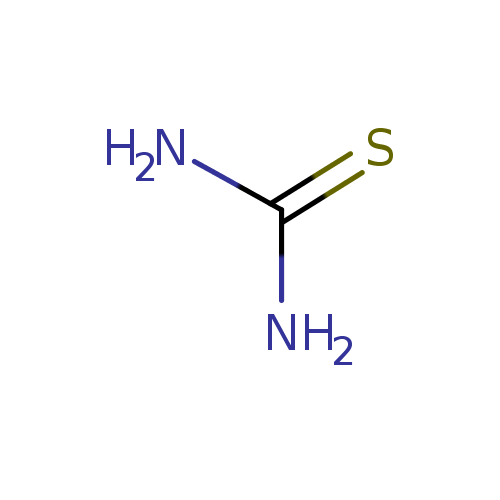
DescriptionThiourea is an organic compound of carbon, nitrogen, sulfur and hydrogen, with the formula CSN2H4 or (NH2)2CS. It is similar to urea, except that the oxygen atom is replaced by a sulfur atom. The properties of urea and thiourea differ significantly because of the relative electronegativities of sulfur and oxygen. Thiourea is a versatile reagent in organic synthesis. "Thioureas" refers to a broad class of compounds with the general structure (R1R2N)(R3R4N)C=S. Thioureas are related to thioamides, e.g. RC(S)NR2, where R is methyl, ethyl, etc. Thiourea is prohibited from use in food. Industrial uses of thiourea include production of flame retardant resins, and vulcanization accelerators. Thiourea is used as an auxiliary agent in diazo paper (light-sensitive photocopy paper) and almost all other types of copy paper. It is also used to tone silver-gelatin photographic prints. The liquid silver cleaning product TarnX is essentially a solution of thiourea. A leaching agent for gold leaching and silver leaching can be created by selectively oxidizing thiourea, bypassing the steps of cyanide use and smelting. Another common application for use of thiourea is a common sulfur source for making semiconductor cadmium sulfide nanoparticle. Thiourea is a planar molecule. The C=S bond distance is 1.60±0.1 for a wide range of derivatives. This narrow range indicates that the C=S bond is insensitive to the nature of the substitutent. Thus, the thioamide, which is similar to an amide group, is difficult to perturb. Thiourea reduces peroxides to the corresponding diols. The intermediate of the reaction is an unstable epidioxide which can only be identified at -100 °C. Epidioxide is similar to epoxide except with two oxygen atoms. This intermediate reduces to diol by thiourea. Thiourea has been shown to exhibit anti-viral, anti-fungal and radical scavenger functions (1, 2, 3).
Contaminant Sources
  • Clean Air Act Chemicals
  • EAFUS Chemicals
  • FooDB Chemicals
  • HPV EPA Chemicals
  • IARC Carcinogens Group 3
  • STOFF IDENT Compounds
  • T3DB toxins
  • ToxCast & Tox21 Chemicals
Contaminant Type
  • Amine
  • Food Toxin
  • Household Toxin
  • Indicator and Reagent
  • Industrial/Workplace Toxin
  • Metabolite
  • Organic Compound
  • Synthetic Compound
Chemical Structure
Thumb
Synonyms
ValueSource
2-ThioureaChEBI
AminothioamideChEBI
AminothiocarboxamideChEBI
Carbonothioic diamideChEBI
H2NC(S)NH2ChEBI
ThiocarbamidChEBI
ThiocarbamideChEBI
Thiocarbonic acid diamideChEBI
ThioharnstoffChEBI
ThiokarbamidChEBI
tuChEBI
Thiocarbonate diamideGenerator
(NH2)2CSHMDB
2-thio-PseudoureaHMDB
2-thio-UreaHMDB
2-ThiopseudoureaHMDB
beta -ThiopseudoureaHMDB
beta-ThiopseudoureaHMDB
IsothioureaHMDB
PseudothioureaHMDB
SulfocarbamideHMDB
SulfoureaHMDB
SulfourenHMDB
SuloureaHMDB
thio-UreaHMDB
Thiocarbonic diamideHMDB
ThiomocovinaHMDB
Thiourea, acsHMDB
ThiureaHMDB
ThiuroniumHMDB
THUHMDB
TOUHMDB
Tsizp 34HMDB
Urea, thio- (8ci)HMDB
Chemical FormulaCH4N2S
Average Molecular Mass76.121 g/mol
Monoisotopic Mass76.010 g/mol
CAS Registry Number62-56-6
IUPAC Namethiourea
Traditional Namethiourea
SMILESNC(N)=S
InChI IdentifierInChI=1S/CH4N2S/c2-1(3)4/h(H4,2,3,4)
InChI KeyUMGDCJDMYOKAJW-UHFFFAOYSA-N
Chemical Taxonomy
Description belongs to the class of organic compounds known as thioureas. These are organic compounds containing the thiourea functional group, a derivative of urea with the general structure (R1(N)R2C(=S)(R3)R4, R1-R4=H, alkyl, aryl), obtained by replacing the carbonyl group of urea with a thiocarbonyl group.
KingdomOrganic compounds
Super ClassOrganosulfur compounds
ClassThioureas
Sub ClassNot Available
Direct ParentThioureas
Alternative Parents
Substituents
  • Thiourea
  • Organic nitrogen compound
  • Organopnictogen compound
  • Hydrocarbon derivative
  • Organonitrogen compound
  • Aliphatic acyclic compound
Molecular FrameworkAliphatic acyclic compounds
External Descriptors
Biological Properties
StatusDetected and Not Quantified
OriginExogenous
Cellular Locations
  • Cytoplasm
  • Extracellular
Biofluid LocationsNot Available
Tissue LocationsNot Available
PathwaysNot Available
ApplicationsNot Available
Biological RolesNot Available
Chemical RolesNot Available
Physical Properties
StateSolid
AppearanceWhite powder.
Experimental Properties
PropertyValue
Melting Point180 °C
Boiling PointDecomposes. None
Solubility142 mg/mL at 25 °C
Predicted Properties
PropertyValueSource
Water Solubility21.2 g/LALOGPS
logP-1.1ALOGPS
logP-0.47ChemAxon
logS-0.55ALOGPS
pKa (Strongest Acidic)13.87ChemAxon
pKa (Strongest Basic)-3ChemAxon
Physiological Charge0ChemAxon
Hydrogen Acceptor Count0ChemAxon
Hydrogen Donor Count2ChemAxon
Polar Surface Area52.04 ŲChemAxon
Rotatable Bond Count0ChemAxon
Refractivity21.13 m³·mol⁻¹ChemAxon
Polarizability7.14 ųChemAxon
Number of Rings0ChemAxon
Bioavailability1ChemAxon
Rule of FiveYesChemAxon
Ghose FilterNoChemAxon
Veber's RuleNoChemAxon
MDDR-like RuleNoChemAxon
Spectra
Spectra
Spectrum TypeDescriptionSplash KeyView
Predicted GC-MSPredicted GC-MS Spectrum - GC-MS (Non-derivatized) - 70eV, Positivesplash10-056r-9000000000-8e5bcf535608a9c5c795Spectrum
Predicted GC-MSPredicted GC-MS Spectrum - GC-MS (Non-derivatized) - 70eV, PositiveNot AvailableSpectrum
LC-MS/MSLC-MS/MS Spectrum - 20V, Positivesplash10-0a4i-9000000000-fc85c4c4965deff19a4bSpectrum
LC-MS/MSLC-MS/MS Spectrum - 10V, Positivesplash10-0a4i-9000000000-9df13a5f6817f41fe8cfSpectrum
LC-MS/MSLC-MS/MS Spectrum - 10V, Positivesplash10-0a4i-9000000000-5e86038161f25d0f4820Spectrum
LC-MS/MSLC-MS/MS Spectrum - 40V, Positivesplash10-0a4i-9000000000-006549670e02390c97cbSpectrum
LC-MS/MSLC-MS/MS Spectrum - 20V, Positivesplash10-0a4i-9000000000-6c868e007f78c8b9e10eSpectrum
LC-MS/MSLC-MS/MS Spectrum - 40V, Positivesplash10-0a4i-9000000000-837112ddd5e6429124e7Spectrum
Predicted LC-MS/MSPredicted LC-MS/MS Spectrum - 10V, Positivesplash10-004i-9000000000-63a30c532af48a8e12b1Spectrum
Predicted LC-MS/MSPredicted LC-MS/MS Spectrum - 20V, Positivesplash10-004i-9000000000-1447f942ca93d2d6a2c7Spectrum
Predicted LC-MS/MSPredicted LC-MS/MS Spectrum - 40V, Positivesplash10-0a4i-9000000000-c202fd1bcbae71404d36Spectrum
Predicted LC-MS/MSPredicted LC-MS/MS Spectrum - 10V, Negativesplash10-004l-9000000000-47b3f247781166d2b51aSpectrum
Predicted LC-MS/MSPredicted LC-MS/MS Spectrum - 20V, Negativesplash10-056r-9000000000-f31b460d9dd139df11daSpectrum
Predicted LC-MS/MSPredicted LC-MS/MS Spectrum - 40V, Negativesplash10-052f-9000000000-6c446727638b12dd4262Spectrum
Predicted LC-MS/MSPredicted LC-MS/MS Spectrum - 10V, Negativesplash10-0a6u-9000000000-ca5a647850195cd117e7Spectrum
Predicted LC-MS/MSPredicted LC-MS/MS Spectrum - 20V, Negativesplash10-0a4i-9000000000-286b63d3516de7d14a12Spectrum
Predicted LC-MS/MSPredicted LC-MS/MS Spectrum - 40V, Negativesplash10-0a4i-9000000000-286b63d3516de7d14a12Spectrum
Predicted LC-MS/MSPredicted LC-MS/MS Spectrum - 10V, Positivesplash10-0a6r-9000000000-41ef030e882c2237b142Spectrum
Predicted LC-MS/MSPredicted LC-MS/MS Spectrum - 20V, Positivesplash10-0a4i-9000000000-921fd3a13e7c6371da15Spectrum
Predicted LC-MS/MSPredicted LC-MS/MS Spectrum - 40V, Positivesplash10-0a4i-9000000000-921fd3a13e7c6371da15Spectrum
MSMass Spectrum (Electron Ionization)splash10-004l-9000000000-266e84d73e3942345320Spectrum
Toxicity Profile
Route of ExposureNot Available
Mechanism of ToxicityNot Available
MetabolismNot Available
Toxicity ValuesNot Available
Lethal DoseNot Available
Carcinogenicity (IARC Classification)3, not classifiable as to its carcinogenicity to humans. (4)
Uses/SourcesNot Available
Minimum Risk LevelNot Available
Health EffectsNot Available
SymptomsNot Available
TreatmentNot Available
Concentrations
Not Available
DrugBank IDNot Available
HMDB IDHMDB0034155
FooDB IDFDB012439
Phenol Explorer IDNot Available
KNApSAcK IDC00013578
BiGG IDNot Available
BioCyc IDNot Available
METLIN IDNot Available
PDB IDNot Available
Wikipedia LinkThiourea
Chemspider ID2005981
ChEBI ID36946
PubChem Compound ID2723790
Kegg Compound IDC14415
YMDB IDNot Available
ECMDB IDNot Available
References
Synthesis ReferenceNot Available
MSDSLink
General References
1. https://www.ncbi.nlm.nih.gov/pubmed/?term=12102173
2. Chen MH, Chen Z, Song BA, Bhadury PS, Yang S, Cai XJ, Hu DY, Xue W, Zeng S: Synthesis and antiviral activities of chiral thiourea derivatives containing an alpha-aminophosphonate moiety. J Agric Food Chem. 2009 Feb 25;57(4):1383-8. doi: 10.1021/jf803215t.
3. Shankar V, Pandeya SN: Synthesis of a series of new N1-[4-(4-nitrophenylthio)phenyl]-N3-(H/alkyl/acyl/aryl) thioureas and their antifungal, insecticidal and larvicidal activities. Arzneimittelforschung. 1981;31(5):753-6.
4. Vogelpoel FR, van Kooij RJ, te Velde ER, Verhoef J: Influence of polymorphonuclear granulocytes on the zona-free hamster oocyte assay. Hum Reprod. 1991 Sep;6(8):1104-7.
5. Yannai, Shmuel. (2004) Dictionary of food compounds with CD-ROM: Additives, flavors, and ingredients. Boca Raton: Chapman & Hall/CRC.