Record Information
Version1.0
Creation Date2014-09-11 05:17:50 UTC
Update Date2026-05-14 16:53:20 UTC
Accession NumberCHEM003773
Identification
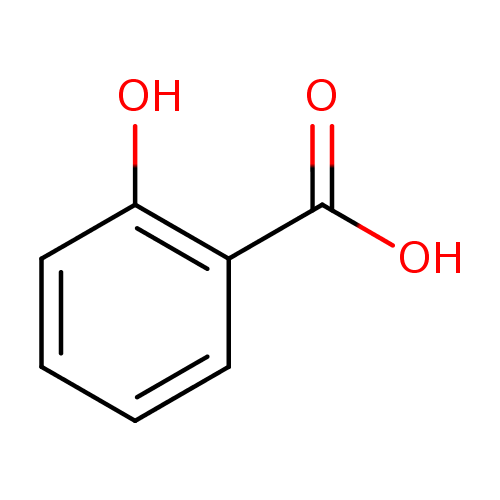
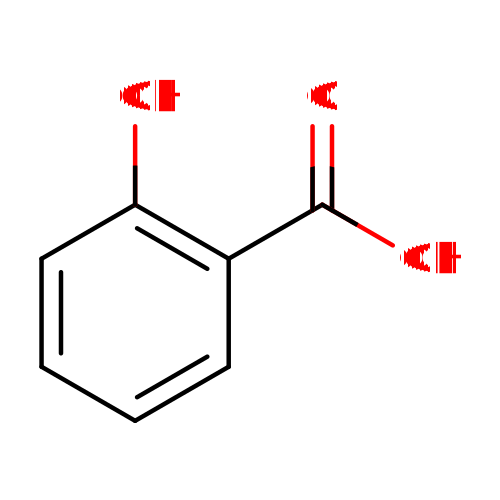
Common NameSalicylic acid
ClassSmall Molecule
DescriptionA compound obtained from the bark of the white willow and wintergreen leaves, and also prepared synthetically. It has bacteriostatic, fungicidal, and keratolytic actions. Its salts, the salicylates, are used as analgesics.
Contaminant Sources
  • Cosmetic Chemicals
  • EAFUS Chemicals
  • FooDB Chemicals
  • HMDB Contaminants - Feces
  • HMDB Contaminants - Urine
  • HPV EPA Chemicals
  • STOFF IDENT Compounds
  • Suspected Compounds
  • T3DB toxins
  • ToxCast & Tox21 Chemicals
Contaminant Type
  • Anti-Infective Agent
  • Antifungal Agent
  • Drug
  • Ester
  • Food Toxin
  • Household Toxin
  • Human Neurotoxin
  • Keratolytic Agent
  • Metabolite
  • Natural Compound
  • Organic Compound
  • Plant Toxin
  • Synthetic Compound
Chemical Structure
Thumb
Synonyms
ValueSource
2-CarboxyphenolChEBI
2-HYDROXYBENZOIC ACIDChEBI
O-CarboxyphenolChEBI
O-Hydroxybenzoic acidChEBI
2-HYDROXYBENZOateGenerator
O-HydroxybenzoateGenerator
SalicylateGenerator
2 Hydroxybenzoic acidMeSH
Acid, 2-hydroxybenzoicMeSH
Acid, salicylicMeSH
Acid, O-hydroxybenzoicMeSH
Acid, ortho-hydroxybenzoicMeSH
O Hydroxybenzoic acidMeSH
Ortho hydroxybenzoic acidMeSH
Ortho-hydroxybenzoic acidMeSH
2-HydroxybenzenecarboxylateHMDB
2-Hydroxybenzenecarboxylic acidHMDB
Advanced pain relief callus removersHMDB
Advanced pain relief corn removersHMDB
Clear away wart removerHMDB
Compound WHMDB
Dr. scholl's callus removersHMDB
Dr. scholl's corn removersHMDB
Dr. scholl's wart remover kitHMDB
Duofil wart removerHMDB
DuoplantHMDB
FreezoneHMDB
IonilHMDB
Ionil plusHMDB
K 537HMDB
K 557HMDB
Phenol-2-carboxylateHMDB
Phenol-2-carboxylic acidHMDB
Psoriacid-S-stiftHMDB
Retarder WHMDB
RutranexHMDB
Salicylic acid collodionHMDB
Salicylic acid soapHMDB
SaligelHMDB
SalonilHMDB
Stri-dexHMDB
trans-Ver-salHMDB
SAPhytoBank
Chemical FormulaC7H6O3
Average Molecular Mass138.122 g/mol
Monoisotopic Mass138.032 g/mol
CAS Registry Number69-72-7
IUPAC Name2-hydroxybenzoic acid
Traditional Namesalicylic
SMILESOC(=O)C1=CC=CC=C1O
InChI IdentifierInChI=1S/C7H6O3/c8-6-4-2-1-3-5(6)7(9)10/h1-4,8H,(H,9,10)
InChI KeyYGSDEFSMJLZEOE-UHFFFAOYSA-N
Chemical Taxonomy
Description belongs to the class of organic compounds known as salicylic acids. These are ortho-hydroxylated benzoic acids.
KingdomOrganic compounds
Super ClassBenzenoids
ClassBenzene and substituted derivatives
Sub ClassBenzoic acids and derivatives
Direct ParentSalicylic acids
Alternative Parents
Substituents
  • Salicylic acid
  • Benzoic acid
  • Benzoyl
  • 1-hydroxy-4-unsubstituted benzenoid
  • 1-hydroxy-2-unsubstituted benzenoid
  • Phenol
  • Vinylogous acid
  • Monocarboxylic acid or derivatives
  • Carboxylic acid
  • Carboxylic acid derivative
  • Organic oxygen compound
  • Organic oxide
  • Hydrocarbon derivative
  • Organooxygen compound
  • Aromatic homomonocyclic compound
Molecular FrameworkAromatic homomonocyclic compounds
External Descriptors
Biological Properties
StatusDetected and Not Quantified
OriginExogenous
Cellular Locations
  • Cytoplasm
  • Extracellular
Biofluid LocationsNot Available
Tissue Locations
  • Liver
  • Skin
PathwaysNot Available
ApplicationsNot Available
Biological RolesNot Available
Chemical RolesNot Available
Physical Properties
StateSolid
AppearanceWhite powder.
Experimental Properties
PropertyValue
Melting Point158°C
Boiling Point211°C at 2.00E+01 mm Hg
Solubility2240 mg/L (at 25°C)
Predicted Properties
PropertyValueSource
Water Solubility11.3 g/LALOGPS
logP1.96ALOGPS
logP1.98ChemAxon
logS-1.1ALOGPS
pKa (Strongest Acidic)2.79ChemAxon
pKa (Strongest Basic)-6.3ChemAxon
Physiological Charge-1ChemAxon
Hydrogen Acceptor Count3ChemAxon
Hydrogen Donor Count2ChemAxon
Polar Surface Area57.53 ŲChemAxon
Rotatable Bond Count1ChemAxon
Refractivity35.3 m³·mol⁻¹ChemAxon
Polarizability12.81 ųChemAxon
Number of Rings1ChemAxon
Bioavailability1ChemAxon
Rule of FiveYesChemAxon
Ghose FilterNoChemAxon
Veber's RuleNoChemAxon
MDDR-like RuleNoChemAxon
Spectra
Spectra
Spectrum TypeDescriptionSplash KeyView
GC-MSGC-MS Spectrum - GC-MS (2 TMS)splash10-014i-3890000000-62eae168a9d7ab3ada6fSpectrum
GC-MSGC-MS Spectrum - EI-B (Non-derivatized)splash10-00du-9700000000-e1e2ee6b61d86c596403Spectrum
GC-MSGC-MS Spectrum - GC-MS (Non-derivatized)splash10-014i-3890000000-62eae168a9d7ab3ada6fSpectrum
GC-MSGC-MS Spectrum - GC-EI-TOF (Non-derivatized)splash10-014i-2960000000-1b6b46cbb2b643b71448Spectrum
Predicted GC-MSPredicted GC-MS Spectrum - GC-MS (Non-derivatized) - 70eV, Positivesplash10-0079-8900000000-e8ee46d81fcc1ce3766eSpectrum
Predicted GC-MSPredicted GC-MS Spectrum - GC-MS (2 TMS) - 70eV, Positivesplash10-006x-8950000000-9ed3a56f2b2654ba281fSpectrum
Predicted GC-MSPredicted GC-MS Spectrum - GC-MS (Non-derivatized) - 70eV, PositiveNot AvailableSpectrum
LC-MS/MSLC-MS/MS Spectrum - Quattro_QQQ 10V, Negative (Annotated)splash10-059j-9600000000-54545731fceee84be340Spectrum
LC-MS/MSLC-MS/MS Spectrum - Quattro_QQQ 25V, Negative (Annotated)splash10-00xu-9500000000-2f1c989b672669aaf083Spectrum
LC-MS/MSLC-MS/MS Spectrum - Quattro_QQQ 40V, Negative (Annotated)splash10-0gb9-9000000000-a0049e982e8ecd7ab730Spectrum
LC-MS/MSLC-MS/MS Spectrum - LC-ESI-QQ (API3000, Applied Biosystems) 10V, Negativesplash10-000i-0900000000-f1e71df6894bcc8dda74Spectrum
LC-MS/MSLC-MS/MS Spectrum - LC-ESI-QQ (API3000, Applied Biosystems) 20V, Negativesplash10-0006-9200000000-f9fd317c182ec7ca90dcSpectrum
LC-MS/MSLC-MS/MS Spectrum - LC-ESI-QQ (API3000, Applied Biosystems) 30V, Negativesplash10-0006-9000000000-2b17aea4ee0ddd6321cfSpectrum
LC-MS/MSLC-MS/MS Spectrum - LC-ESI-QQ (API3000, Applied Biosystems) 40V, Negativesplash10-0006-9000000000-320b7cd879b61439cf42Spectrum
LC-MS/MSLC-MS/MS Spectrum - LC-ESI-QQ (API3000, Applied Biosystems) 50V, Negativesplash10-0006-9000000000-7d1b96d60026076a7eccSpectrum
LC-MS/MSLC-MS/MS Spectrum - ESI-TOF , Negativesplash10-002b-0496100000-97708001d2a6d031beffSpectrum
LC-MS/MSLC-MS/MS Spectrum - ESI-TOF 10V, Negativesplash10-002b-0496100000-97708001d2a6d031beffSpectrum
LC-MS/MSLC-MS/MS Spectrum - ESI-TOF , Negativesplash10-002b-0496100000-97708001d2a6d031beffSpectrum
LC-MS/MSLC-MS/MS Spectrum - ESI-TOF 10V, Negativesplash10-000i-0900000000-f88c693bac9b89416a52Spectrum
LC-MS/MSLC-MS/MS Spectrum - DI-ESI-qTof , Positivesplash10-00di-0900000000-2aeace8112266d938c2bSpectrum
LC-MS/MSLC-MS/MS Spectrum - LC-ESI-QFT , negativesplash10-0006-9400000000-b0fb5458dfa73429b976Spectrum
LC-MS/MSLC-MS/MS Spectrum - LC-ESI-QFT , negativesplash10-0006-9100000000-237ee14e8af5262c0dabSpectrum
LC-MS/MSLC-MS/MS Spectrum - LC-ESI-QFT , negativesplash10-0006-9000000000-3ec5d7a9114e37b8af2aSpectrum
LC-MS/MSLC-MS/MS Spectrum - LC-ESI-QFT , negativesplash10-0006-9000000000-d8fdab29114453b10280Spectrum
LC-MS/MSLC-MS/MS Spectrum - LC-ESI-QFT , negativesplash10-0006-9000000000-4a337e3639c9f42a9000Spectrum
Predicted LC-MS/MSPredicted LC-MS/MS Spectrum - 10V, Positivesplash10-000i-2900000000-23d1cf43d4dedc979389Spectrum
Predicted LC-MS/MSPredicted LC-MS/MS Spectrum - 20V, Positivesplash10-0076-8900000000-f8b39b175209523386d0Spectrum
Predicted LC-MS/MSPredicted LC-MS/MS Spectrum - 40V, Positivesplash10-0udi-9000000000-549ee40f4c3d2a965b2dSpectrum
Predicted LC-MS/MSPredicted LC-MS/MS Spectrum - 10V, Negativesplash10-000l-6900000000-06bd3bf75f92d507fd8dSpectrum
Predicted LC-MS/MSPredicted LC-MS/MS Spectrum - 20V, Negativesplash10-0006-9100000000-fd107d170618784f2f1fSpectrum
Predicted LC-MS/MSPredicted LC-MS/MS Spectrum - 40V, Negativesplash10-0006-9000000000-3fc7a3b941f5e3e4f7ddSpectrum
MSMass Spectrum (Electron Ionization)splash10-00du-9600000000-6d4a0ff2d48d814b5c54Spectrum
1D NMR1H NMR SpectrumNot AvailableSpectrum
1D NMR13C NMR SpectrumNot AvailableSpectrum
1D NMR1H NMR SpectrumNot AvailableSpectrum
1D NMR13C NMR SpectrumNot AvailableSpectrum
1D NMR1H NMR SpectrumNot AvailableSpectrum
1D NMR13C NMR SpectrumNot AvailableSpectrum
1D NMR1H NMR SpectrumNot AvailableSpectrum
1D NMR13C NMR SpectrumNot AvailableSpectrum
1D NMR1H NMR SpectrumNot AvailableSpectrum
1D NMR13C NMR SpectrumNot AvailableSpectrum
1D NMR1H NMR SpectrumNot AvailableSpectrum
1D NMR13C NMR SpectrumNot AvailableSpectrum
1D NMR1H NMR SpectrumNot AvailableSpectrum
1D NMR13C NMR SpectrumNot AvailableSpectrum
1D NMR1H NMR SpectrumNot AvailableSpectrum
1D NMR13C NMR SpectrumNot AvailableSpectrum
1D NMR1H NMR SpectrumNot AvailableSpectrum
1D NMR13C NMR SpectrumNot AvailableSpectrum
1D NMR1H NMR SpectrumNot AvailableSpectrum
1D NMR13C NMR SpectrumNot AvailableSpectrum
1D NMR1H NMR SpectrumNot AvailableSpectrum
1D NMR13C NMR SpectrumNot AvailableSpectrum
2D NMR[1H,1H] 2D NMR SpectrumNot AvailableSpectrum
2D NMR[1H,13C] 2D NMR SpectrumNot AvailableSpectrum
Toxicity Profile
Route of ExposureNot Available
Mechanism of ToxicitySalicylic acid directly and irreversibly inhibits the activity of both types of cyclo-oxygenases (COX-1 and COX-2) to decrease the formation of precursors of prostaglandins and thromboxanes from arachidonic acid. Salicylate may competitively inhibit prostaglandin formation. Salicylate's antirheumatic (nonsteroidal anti-inflammatory) actions are a result of its analgesic and anti-inflammatory mechanisms. Salicylic acid is a key ingredient in many skin-care products for the treatment of acne, psoriasis, calluses, corns, keratosis pilaris, and warts. It works by causing the cells of the epidermis to slough off more readily, preventing pores from clogging up, and allowing room for new cell growth. Because of its effect on skin cells, salicylic acid is used in several shampoos used to treat dandruff. Salicylic acid is also used as an active ingredient in gels which remove verrucas (plantar warts). Salicylic acid inhibits the oxidation of uridine-5-diphosphoglucose (UDPG) competitively with nicotinamide adenosine dinucleotide (NAD) and noncompetitively with UDPG. It also competitively inhibits the transferring of glucuronyl group of uridine-5-phosphoglucuronic acid (UDPGA) to the phenolic acceptor. The wound-healing retardation action of salicylates is probably due mainly to its inhibitory action on mucopolysaccharide synthesis.
MetabolismNot Available
Toxicity ValuesOral rat LD50: 891 mg/kg. Inhalation rat LC50: > 900 mg/m3/1hr. Irritation: skin rabbit: 500 mg/24H mild. Eye rabbit: 100 mg severe.
Lethal DoseNot Available
Carcinogenicity (IARC Classification)No indication of carcinogenicity to humans (not listed by IARC).
Uses/SourcesKey additive in many skin-care products for the treatment of acne, psoriasis, callouses, corns, keratosis pilaris and warts.
Minimum Risk LevelNot Available
Health EffectsInvestigated as a mutagen and reproductive effector.
SymptomsNot Available
TreatmentNot Available
Concentrations
Not Available
DrugBank IDDB00936
HMDB IDHMDB0001895
FooDB IDFDB000882
Phenol Explorer ID428
KNApSAcK IDC00000206
BiGG IDNot Available
BioCyc IDCPD-110
METLIN ID616
PDB IDNot Available
Wikipedia LinkSalicylic_Acid
Chemspider ID331
ChEBI ID16914
PubChem Compound ID338
Kegg Compound IDC00805
YMDB IDYMDB01322
ECMDB IDECMDB21437
References
Synthesis Reference

Howard Jones, Robert W. Houser, “Process for preparing 4-(2,4-difluorophenyl)-salicyclic acid.” U.S. Patent US4225730, issued August, 1972.

MSDSLink
General References
1. https://www.ncbi.nlm.nih.gov/pubmed/?term=11016405
2. https://www.ncbi.nlm.nih.gov/pubmed/?term=12865403
3. https://www.ncbi.nlm.nih.gov/pubmed/?term=1650428
4. https://www.ncbi.nlm.nih.gov/pubmed/?term=19400653
5. https://www.ncbi.nlm.nih.gov/pubmed/?term=19816125
6. https://www.ncbi.nlm.nih.gov/pubmed/?term=22770225
7. https://www.ncbi.nlm.nih.gov/pubmed/?term=29079364
8. https://www.ncbi.nlm.nih.gov/pubmed/?term=32807953
9. https://www.ncbi.nlm.nih.gov/pubmed/?term=3425858
10. Yin, Yingwu; Guo, Qingbin. Preparation of salicylic acid from phenol. Faming Zhuanli Shenqing Gongkai Shuomingshu (2005), 7pp.
11. Mung D, Li L: Development of Chemical Isotope Labeling LC-MS for Milk Metabolomics: Comprehensive and Quantitative Profiling of the Amine/Phenol Submetabolome. Anal Chem. 2017 Apr 18;89(8):4435-4443. doi: 10.1021/acs.analchem.6b03737. Epub 2017 Mar 28.
12. Mung D, Li L: Applying quantitative metabolomics based on chemical isotope labeling LC-MS for detecting potential milk adulterant in human milk. Anal Chim Acta. 2018 Feb 25;1001:78-85. doi: 10.1016/j.aca.2017.11.019. Epub 2017 Nov 14.
13. Yin, Yingwu; Guo, Qingbin. Preparation of salicylic acid from phenol. Faming Zhuanli Shenqing Gongkai Shuomingshu (2005), 7pp.
14. Khan AZ, Aarons L: A note on the use of salicylate saliva concentration in clinical pharmacokinetic studies. J Pharm Pharmacol. 1989 Oct;41(10):710-1.
15. Vila MM, Tubino M, de Oliveira Neto G: Determination of salicylate in blood serum by flow injection with immobilized salicylate hydroxylase. J AOAC Int. 2001 Sep-Oct;84(5):1363-9.
16. Zaugg S, Zhang X, Sweedler J, Thormann W: Determination of salicylate, gentisic acid and salicyluric acid in human urine by capillary electrophoresis with laser-induced fluorescence detection. J Chromatogr B Biomed Sci Appl. 2001 Mar 5;752(1):17-31.
17. Berkovitch M, Uziel Y, Greenberg R, Chen-Levy Z, Arcusin M, Marcus O, Pinto O, Evans S, Matias A, Lahat E: False-high blood salicylate levels in neonates with hyperbilirubinemia. Ther Drug Monit. 2000 Dec;22(6):757-61.
18. Rutner M, Fitzek J, Jahnel-Kracht H, Otto J, Krause W: [Therapy of rheumatic disease with a hydroxyethylsalicylate gel. Results of 2 clinical studies of effectiveness and bioavailability]. Fortschr Med. 1995 Mar 20;113(8):111-3.
19. Goussis OS, Theodoropoulos TJ: Dilantin and salicylate effects on hepatic thyroxine bio-availability and dialyzable thyroxine. Horm Metab Res. 1990 Jun;22(6):342-4.
20. Benfeldt E, Serup J, Menne T: Microdialysis vs. suction blister technique for in vivo sampling of pharmacokinetics in the human dermis. Acta Derm Venereol. 1999 Sep;79(5):338-42.
21. Ndovi TT, Choi L, Caffo B, Parsons T, Baker S, Zhao M, Rohde C, Hendrix CW: Quantitative assessment of seminal vesicle and prostate drug concentrations by use of a noninvasive method. Clin Pharmacol Ther. 2006 Aug;80(2):146-58.
22. Kocoshis SA, Wong CT: Sodium salicylate and bile acid-induced colonic secretion in the rat. Ann Clin Lab Sci. 1991 May-Jun;21(3):197-204.
23. Owen SG, Francis HW, Roberts MS: Disappearance kinetics of solutes from synovial fluid after intra-articular injection. Br J Clin Pharmacol. 1994 Oct;38(4):349-55.
24. Quaranta A, Portalatini P, Camporeale M, Sallustio V: Effects of salicylates on evoked otoacoustic emissions and remote masking in humans. Audiology. 1999 May-Jun;38(3):174-9.
25. Yoshida NH, Roberts MS: Prediction of cathodal iontophoretic transport of various anions across excised skin from different vehicles using conductivity measurements. J Pharm Pharmacol. 1995 Nov;47(11):883-90.
26. Alanko K, Stubb S, Salo OP, Reitamo S: Suction blister fluid histamine in fixed drug eruption. Acta Derm Venereol. 1992;72(2):89-91.
27. Singh P, Anliker M, Smith GA, Zavortink D, Maibach HI: Transdermal iontophoresis and solute penetration across excised human skin. J Pharm Sci. 1995 Nov;84(11):1342-6.
28. Hazouard E, Grimbert M, Jonville-Berra AP, De Toffol MC, Legras A: [Salicylism and glaucoma: reciprocal augmentation of the toxicity of acetazolamide and acetylsalicylic acid]. J Fr Ophtalmol. 1999 Feb;22(1):73-5.
29. Schmook FP, Meingassner JG, Billich A: Comparison of human skin or epidermis models with human and animal skin in in-vitro percutaneous absorption. Int J Pharm. 2001 Mar 14;215(1-2):51-6.
30. Pirola R, Bareggi SR, De Benedittis G: Determination of acetylsalicylic acid and salicylic acid in skin and plasma by high-performance liquid chromatography. J Chromatogr B Biomed Sci Appl. 1998 Feb 13;705(2):309-15.
31. Kunkel A, Watzig H: Pharmacokinetic investigations with direct injection of plasma samples: possible savings using capillary electrophoresis (CE). Arch Pharm (Weinheim). 1999 May;332(5):175-8.
32. Azaroual, Imbenotte M, Cartigny B, Lhermitte M, Vermeersch G: [Identification and quantification of exogenous metabolites in biological liquids with new development in NMR spectroscopy in one and two dimensions]. Acta Clin Belg. 1999;53 Suppl 1:97-100.
33. Baggott JE, Morgan SL, Ha T, Vaughn WH, Hine RJ: Inhibition of folate-dependent enzymes by non-steroidal anti-inflammatory drugs. Biochem J. 1992 Feb 15;282 ( Pt 1):197-202.
34. Flower R, Gryglewski R, Herbaczynska-Cedro K, Vane JR: Effects of anti-inflammatory drugs on prostaglandin biosynthesis. Nat New Biol. 1972 Jul 26;238(82):104-6.
35. Vane JR: Inhibition of prostaglandin synthesis as a mechanism of action for aspirin-like drugs. Nat New Biol. 1971 Jun 23;231(25):232-5.
36. Lonsane BK, Barua PK, Singh HD, Mathur RK, Baruah JN, Iyengar MS: Formation of salicylic acid from naphthalene by microorganisms: Part I. Studies on isolation, characterization & growth of bacterial isolates utilizing naphthalene. Indian J Exp Biol. 1974 Mar;12(2):158-61.
37. Elshenawy S, Pinney SE, Stuart T, Doulias PT, Zura G, Parry S, Elovitz MA, Bennett MJ, Bansal A, Strauss JF 3rd, Ischiropoulos H, Simmons RA: The Metabolomic Signature of the Placenta in Spontaneous Preterm Birth. Int J Mol Sci. 2020 Feb 4;21(3). pii: ijms21031043. doi: 10.3390/ijms21031043.