Record Information
Version1.0
Creation Date2014-09-11 05:17:23 UTC
Update Date2026-05-14 17:30:10 UTC
Accession NumberCHEM003762
Identification
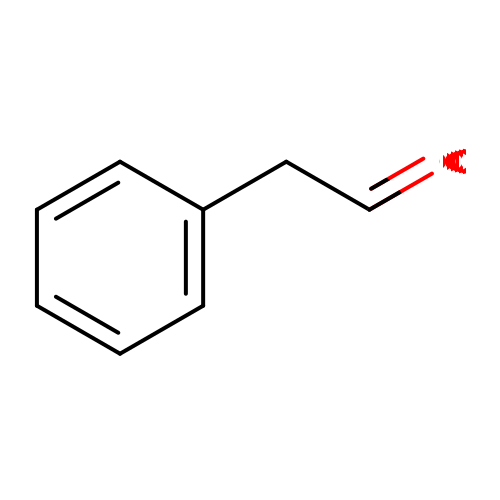
Common NamePhenylacetaldehyde
ClassSmall Molecule
DescriptionPhenylacetaldehyde is one important oxidation-related aldehyde. Exposure to styrene gives phenylacetaldehyde as a secondary metabolite. Styrene has been implicated as reproductive toxicant, neurotoxicant, or carcinogen in vivo or in vitro. Phenylacetaldehyde could be formed by diverse thermal reactions during the cooking process together with C8 compounds is identified as a major aroma- active compound in cooked pine mushroom. Phenylacetaldehyde is readily oxidized to phenylacetic acid. Therefore will eventually be hydrolyzed and oxidized to yield phenylacetic acid that will be excreted primarily in the urine in conjugated form. (1, 2, 3). Phenylacetaldehyde is an aromatic compound found in buckwheat, chocolate and many other foods and flowers. It is also responsible for the antibiotic activity of maggot therapy and it is also a compound that is added to cigarettes to improve their aroma.
Contaminant Sources
  • Disinfection Byproducts
  • EAFUS Chemicals
  • FooDB Chemicals
  • HMDB Contaminants - Feces
  • HPV EPA Chemicals
  • T3DB toxins
  • Tobacco Smoke Compounds
  • ToxCast & Tox21 Chemicals
Contaminant Type
  • Cigarette Toxin
  • Food Toxin
  • Metabolite
  • Natural Compound
  • Organic Compound
  • Plant Toxin
Chemical Structure
Thumb
Synonyms
ValueSource
1-oxo-2-PhenylethaneChEBI
2-PhenylacetaldehydeChEBI
2-PhenylethanalChEBI
alpha-PhenylacetaldehydeChEBI
alpha-TolualdehydeChEBI
alpha-Toluic aldehydeChEBI
BenzacetaldehydeChEBI
BenzeneacetaldehydeChEBI
HyacinthinChEBI
PhenacetaldehydeChEBI
Phenylacetic aldehydeChEBI
a-PhenylacetaldehydeGenerator
Α-phenylacetaldehydeGenerator
a-TolualdehydeGenerator
Α-tolualdehydeGenerator
a-Toluic aldehydeGenerator
Α-toluic aldehydeGenerator
.alpha.-toluic aldehydeHMDB
BenzenacetaldehydeHMDB
BenzylcarboxaldehydeHMDB
FEMA no. 2974HMDB
OxophenylethaneHMDB
Phenyl-acetaldehydeHMDB
PhenylethanalHMDB
Chemical FormulaC8H8O
Average Molecular Mass120.149 g/mol
Monoisotopic Mass120.058 g/mol
CAS Registry Number122-78-1
IUPAC Name2-phenylacetaldehyde
Traditional Namephenylacetaldehyde
SMILESO=CCC1=CC=CC=C1
InChI IdentifierInChI=1S/C8H8O/c9-7-6-8-4-2-1-3-5-8/h1-5,7H,6H2
InChI KeyDTUQWGWMVIHBKE-UHFFFAOYSA-N
Chemical Taxonomy
Description belongs to the class of organic compounds known as phenylacetaldehydes. Phenylacetaldehydes are compounds containing a phenylacetaldehyde moiety, which consists of a phenyl group substituted at the second position by an acetalydehyde.
KingdomOrganic compounds
Super ClassBenzenoids
ClassBenzene and substituted derivatives
Sub ClassPhenylacetaldehydes
Direct ParentPhenylacetaldehydes
Alternative Parents
Substituents
  • Phenylacetaldehyde
  • Alpha-hydrogen aldehyde
  • Organic oxygen compound
  • Organic oxide
  • Hydrocarbon derivative
  • Organooxygen compound
  • Carbonyl group
  • Aldehyde
  • Aromatic homomonocyclic compound
Molecular FrameworkAromatic homomonocyclic compounds
External Descriptors
Biological Properties
StatusDetected and Not Quantified
OriginEndogenous
Cellular Locations
  • Cytoplasm
  • Extracellular
Biofluid LocationsNot Available
Tissue LocationsNot Available
PathwaysNot Available
ApplicationsNot Available
Biological RolesNot Available
Chemical RolesNot Available
Physical Properties
StateSolid
AppearanceWhite powder.
Experimental Properties
PropertyValue
Melting Point33.5°C
Boiling Point195°C
SolubilityNot Available
Predicted Properties
PropertyValueSource
Water Solubility2.08 g/LALOGPS
logP1.75ALOGPS
logP1.45ChemAxon
logS-1.8ALOGPS
pKa (Strongest Acidic)14.98ChemAxon
pKa (Strongest Basic)-7ChemAxon
Physiological Charge0ChemAxon
Hydrogen Acceptor Count1ChemAxon
Hydrogen Donor Count0ChemAxon
Polar Surface Area17.07 ŲChemAxon
Rotatable Bond Count2ChemAxon
Refractivity36.44 m³·mol⁻¹ChemAxon
Polarizability12.91 ųChemAxon
Number of Rings1ChemAxon
Bioavailability1ChemAxon
Rule of FiveYesChemAxon
Ghose FilterNoChemAxon
Veber's RuleYesChemAxon
MDDR-like RuleNoChemAxon
Spectra
Spectra
Spectrum TypeDescriptionSplash KeyView
GC-MSGC-MS Spectrum - GC-MS (Non-derivatized)splash10-00kf-9400000000-bec6e42b47ad1306960fSpectrum
GC-MSGC-MS Spectrum - GC-MS (Non-derivatized)splash10-014l-9700000000-152bdd5b77d6af9657ecSpectrum
GC-MSGC-MS Spectrum - EI-B (Non-derivatized)splash10-0006-9000000000-d37cbef4100302e951deSpectrum
GC-MSGC-MS Spectrum - GC-MS (Non-derivatized)splash10-00kf-9400000000-bec6e42b47ad1306960fSpectrum
GC-MSGC-MS Spectrum - GC-MS (Non-derivatized)splash10-014l-9700000000-152bdd5b77d6af9657ecSpectrum
GC-MSGC-MS Spectrum - GC-EI-TOF (Non-derivatized)splash10-00kf-9400000000-e75d2f0bf82f16a80388Spectrum
GC-MSGC-MS Spectrum - GC-EI-TOF (Non-derivatized)splash10-00kf-9400000000-32573b7f6ab690a27e3eSpectrum
GC-MSGC-MS Spectrum - GC-EI-TOF (Non-derivatized)splash10-0006-5900000000-21e85148d15d190553c4Spectrum
GC-MSGC-MS Spectrum - GC-EI-TOF (Non-derivatized)splash10-0006-5900000000-4471e0916a32cf4df7acSpectrum
GC-MSGC-MS Spectrum - GC-EI-TOF (Non-derivatized)splash10-0006-5900000000-650012e69d0a89a2fd4aSpectrum
GC-MSGC-MS Spectrum - GC-EI-TOF (Non-derivatized)splash10-0006-5900000000-c80b65e383f833509e0fSpectrum
Predicted GC-MSPredicted GC-MS Spectrum - GC-MS (Non-derivatized) - 70eV, Positivesplash10-0006-9200000000-b3923f5fae42c664ac4aSpectrum
Predicted GC-MSPredicted GC-MS Spectrum - GC-MS (Non-derivatized) - 70eV, PositiveNot AvailableSpectrum
LC-MS/MSLC-MS/MS Spectrum - Quattro_QQQ 10V, Positive (Annotated)splash10-0udi-4900000000-5001b07cef2fed3caa2cSpectrum
LC-MS/MSLC-MS/MS Spectrum - Quattro_QQQ 25V, Positive (Annotated)splash10-004i-9100000000-048e2f1b42f7bd5104beSpectrum
LC-MS/MSLC-MS/MS Spectrum - Quattro_QQQ 40V, Positive (Annotated)splash10-0fb9-9000000000-fc1fbd4e7c49f44ba764Spectrum
LC-MS/MSLC-MS/MS Spectrum - EI-B (HITACHI M-80A) , Positivesplash10-0006-9000000000-bc0fa2967da6872f3a47Spectrum
LC-MS/MSLC-MS/MS Spectrum - 35V, Positivesplash10-0ufr-9700000000-507b63b585578b670628Spectrum
Predicted LC-MS/MSPredicted LC-MS/MS Spectrum - 10V, Positivesplash10-00di-0900000000-8c96fee71b311d751181Spectrum
Predicted LC-MS/MSPredicted LC-MS/MS Spectrum - 20V, Positivesplash10-0fk9-2900000000-4b405668c302f69a4bc7Spectrum
Predicted LC-MS/MSPredicted LC-MS/MS Spectrum - 40V, Positivesplash10-0ufr-9300000000-fe46a418a2f0124566c3Spectrum
Predicted LC-MS/MSPredicted LC-MS/MS Spectrum - 10V, Negativesplash10-014i-0900000000-4e064e0123dc18b6136aSpectrum
Predicted LC-MS/MSPredicted LC-MS/MS Spectrum - 20V, Negativesplash10-014i-1900000000-02fff0bd874e6e8616bbSpectrum
Predicted LC-MS/MSPredicted LC-MS/MS Spectrum - 40V, Negativesplash10-004l-9200000000-340c7a60a7708fa801f1Spectrum
Predicted LC-MS/MSPredicted LC-MS/MS Spectrum - 10V, Positivesplash10-002f-9000000000-e37fda57674e1a53ea10Spectrum
Predicted LC-MS/MSPredicted LC-MS/MS Spectrum - 20V, Positivesplash10-0006-9000000000-2071e5b3f45157a1da9cSpectrum
Predicted LC-MS/MSPredicted LC-MS/MS Spectrum - 40V, Positivesplash10-002f-9100000000-219bfc0a518871479977Spectrum
Predicted LC-MS/MSPredicted LC-MS/MS Spectrum - 10V, Negativesplash10-00kf-9300000000-3fb47a0274f5792b4bd1Spectrum
Predicted LC-MS/MSPredicted LC-MS/MS Spectrum - 20V, Negativesplash10-0006-9000000000-5671d4c535a6553aaf0dSpectrum
Predicted LC-MS/MSPredicted LC-MS/MS Spectrum - 40V, Negativesplash10-0006-9000000000-cc66f13f72898a397be6Spectrum
MSMass Spectrum (Electron Ionization)splash10-0006-9100000000-e7ef9a5c5a6cc5674cd1Spectrum
1D NMR1H NMR SpectrumNot AvailableSpectrum
1D NMR13C NMR SpectrumNot AvailableSpectrum
1D NMR1H NMR SpectrumNot AvailableSpectrum
1D NMR13C NMR SpectrumNot AvailableSpectrum
1D NMR1H NMR SpectrumNot AvailableSpectrum
1D NMR13C NMR SpectrumNot AvailableSpectrum
1D NMR1H NMR SpectrumNot AvailableSpectrum
1D NMR13C NMR SpectrumNot AvailableSpectrum
1D NMR1H NMR SpectrumNot AvailableSpectrum
1D NMR13C NMR SpectrumNot AvailableSpectrum
1D NMR1H NMR SpectrumNot AvailableSpectrum
1D NMR13C NMR SpectrumNot AvailableSpectrum
1D NMR1H NMR SpectrumNot AvailableSpectrum
1D NMR13C NMR SpectrumNot AvailableSpectrum
1D NMR1H NMR SpectrumNot AvailableSpectrum
1D NMR13C NMR SpectrumNot AvailableSpectrum
1D NMR1H NMR SpectrumNot AvailableSpectrum
1D NMR13C NMR SpectrumNot AvailableSpectrum
1D NMR1H NMR SpectrumNot AvailableSpectrum
1D NMR13C NMR SpectrumNot AvailableSpectrum
Toxicity Profile
Route of ExposureNot Available
Mechanism of ToxicityNot Available
MetabolismNot Available
Toxicity ValuesNot Available
Lethal DoseNot Available
Carcinogenicity (IARC Classification)Not listed by IARC.
Uses/SourcesThis is an endogenously produced metabolite found in the human body. It is used in metabolic reactions, catabolic reactions or waste generation.
Minimum Risk LevelNot Available
Health EffectsNot Available
SymptomsNot Available
TreatmentNot Available
Concentrations
Not Available
DrugBank IDDB02178
HMDB IDHMDB0006236
FooDB IDFDB012238
Phenol Explorer IDNot Available
KNApSAcK IDC00007535
BiGG ID35469
BioCyc IDPHENYLACETALDEHYDE
METLIN IDNot Available
PDB IDNot Available
Wikipedia LinkPhenylacetaldehyde
Chemspider ID13876539
ChEBI ID16424
PubChem Compound ID998
Kegg Compound IDC00601
YMDB IDYMDB00116
ECMDB IDECMDB06236
References
Synthesis ReferenceNot Available
MSDSLink
General References
1. Sun Zhirong; Hu Xiang; Zhou Ding Wastewater minimization in indirect electrochemical synthesis of phenylacetaldehyde. TheScientificWorldJournal (2002), 2 48-52.
2. Pan L, Yu J, Mi Z, Mo L, Jin H, Yao C, Ren D, Menghe B: A Metabolomics Approach Uncovers Differences between Traditional and Commercial Dairy Products in Buryatia (Russian Federation). Molecules. 2018 Mar 22;23(4). pii: molecules23040735. doi: 10.3390/molecules23040735.
3. Sun Zhirong; Hu Xiang; Zhou Ding Wastewater minimization in indirect electrochemical synthesis of phenylacetaldehyde. TheScientificWorldJournal (2002), 2 48-52.
4. Cho IH, Kim SY, Choi HK, Kim YS: Characterization of aroma-active compounds in raw and cooked pine-mushrooms (Tricholoma matsutake Sing.). J Agric Food Chem. 2006 Aug 23;54(17):6332-5.
5. Sumner SJ, Fennell TR: Review of the metabolic fate of styrene. Crit Rev Toxicol. 1994;24 Suppl:S11-33.
6. Watson WP, Munter T, Golding BT: A new role for glutathione: protection of vitamin B12 from depletion by xenobiotics. Chem Res Toxicol. 2004 Dec;17(12):1562-7.
7. https://www.ncbi.nlm.nih.gov/pubmed/?term=14698165
8. https://www.ncbi.nlm.nih.gov/pubmed/?term=16557466
9. https://www.ncbi.nlm.nih.gov/pubmed/?term=18954073
10. https://www.ncbi.nlm.nih.gov/pubmed/?term=21495722
11. https://www.ncbi.nlm.nih.gov/pubmed/?term=21627324