Record Information
Version1.0
Creation Date2014-09-11 05:17:21 UTC
Update Date2026-04-16 22:20:51 UTC
Accession NumberCHEM003761
Identification
Common Name2,4,6-Tribromophenol
ClassSmall Molecule
Description2,4,6-Tribromophenol is found in crustaceans. 2,4,6-Tribromophenol is isolated from molluscs and crustaceans. 2,4,6-Tribromophenol is a flavour component of seafood, imparts an intense shrimp-like flavour. 2,4,6-Tribromophenol belongs to the family of Bromobenzenes. These are organic compounds containing a chlorine atom attached to a benzene ring.
Contaminant Sources
  • Clean Air Act Chemicals
  • FooDB Chemicals
  • HPV EPA Chemicals
  • My Exposome Chemicals
  • OECD HPV Chemicals
  • STOFF IDENT Compounds
  • T3DB toxins
  • ToxCast & Tox21 Chemicals
Contaminant Type
  • Animal Toxin
  • Bromide Compound
  • Food Toxin
  • Marine Toxin
  • Metabolite
  • Natural Compound
  • Organic Compound
  • Organobromide
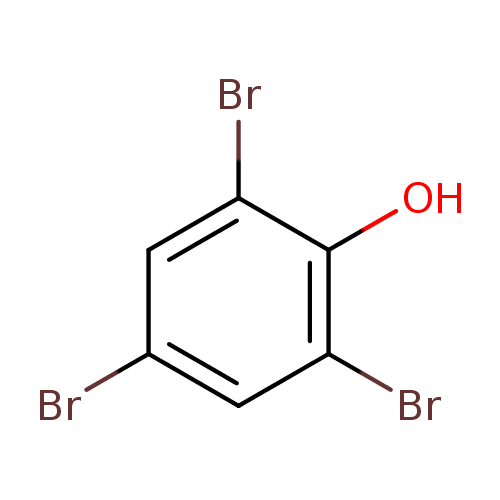
Chemical Structure
Thumb
Synonyms
ValueSource
2,4,6-TBPChEBI
BromolChEBI
TribromophenolChEBI
XeroformChEBI
2,4,6-Tribromo-3-methylphenolHMDB
2,4,6-Tribromo-m-cresolHMDB
2,4,6-Tribromo-phenolHMDB
2,4,6-Tribromophenol, bismuth (3+) saltHMDB
5175-83-7 (Bismuth(3+) salt)HMDB
Bismuth tribromophenateHMDB
Bromkal pur 3HMDB
C6H3BR3OHMDB
Flammex 3BPHMDB
Great lakes PH-73HMDB
MicatexHMDB
TBPHMDB
Chemical FormulaC6H3Br3O
Average Molecular Mass330.799 g/mol
Monoisotopic Mass327.773 g/mol
CAS Registry Number118-79-6
IUPAC Name2,4,6-tribromophenol
Traditional Name2,4,6-tribromophenol
SMILESOC1=C(Br)C=C(Br)C=C1Br
InChI IdentifierInChI=1S/C6H3Br3O/c7-3-1-4(8)6(10)5(9)2-3/h1-2,10H
InChI KeyBSWWXRFVMJHFBN-UHFFFAOYSA-N
Chemical Taxonomy
Description belongs to the class of organic compounds known as p-bromophenols. These are bromophenols carrying a iodine at the C4 position of the benzene ring.
KingdomOrganic compounds
Super ClassBenzenoids
ClassPhenols
Sub ClassHalophenols
Direct ParentP-bromophenols
Alternative Parents
Substituents
  • 4-bromophenol
  • 2-bromophenol
  • Halobenzene
  • Bromobenzene
  • Monocyclic benzene moiety
  • Aryl halide
  • Aryl bromide
  • Organic oxygen compound
  • Hydrocarbon derivative
  • Organooxygen compound
  • Organobromide
  • Organohalogen compound
  • Aromatic homomonocyclic compound
Molecular FrameworkAromatic homomonocyclic compounds
External Descriptors
Biological Properties
StatusDetected and Not Quantified
OriginEndogenous
Cellular Locations
  • Membrane
Biofluid LocationsNot Available
Tissue LocationsNot Available
PathwaysNot Available
ApplicationsNot Available
Biological RolesNot Available
Chemical RolesNot Available
Physical Properties
StateSolid
AppearanceWhite powder.
Experimental Properties
PropertyValue
Melting Point95.5°C
Boiling Point286°C
Solubility70 mg/L (at 15°C)
Predicted Properties
PropertyValueSource
Water Solubility0.054 g/LALOGPS
logP4.2ALOGPS
logP3.98ChemAxon
logS-3.8ALOGPS
pKa (Strongest Acidic)6.34ChemAxon
pKa (Strongest Basic)-7.7ChemAxon
Physiological Charge-1ChemAxon
Hydrogen Acceptor Count1ChemAxon
Hydrogen Donor Count1ChemAxon
Polar Surface Area20.23 ŲChemAxon
Rotatable Bond Count0ChemAxon
Refractivity50.91 m³·mol⁻¹ChemAxon
Polarizability19.92 ųChemAxon
Number of Rings1ChemAxon
Bioavailability1ChemAxon
Rule of FiveYesChemAxon
Ghose FilterNoChemAxon
Veber's RuleYesChemAxon
MDDR-like RuleNoChemAxon
Spectra
Spectra
Spectrum TypeDescriptionSplash KeyView
GC-MSGC-MS Spectrum - EI-B (Non-derivatized)splash10-0059-3329000000-8507237252f6c68a3e56Spectrum
Predicted GC-MSPredicted GC-MS Spectrum - GC-MS (Non-derivatized) - 70eV, Positivesplash10-0059-0119000000-1a9e2f72fef4a0ac8111Spectrum
Predicted GC-MSPredicted GC-MS Spectrum - GC-MS (1 TMS) - 70eV, Positivesplash10-00di-7109000000-97e2aa9549b71aa7b589Spectrum
Predicted GC-MSPredicted GC-MS Spectrum - GC-MS (Non-derivatized) - 70eV, PositiveNot AvailableSpectrum
LC-MS/MSLC-MS/MS Spectrum - LC-ESI-QFT , negativesplash10-004i-0009000000-d4bc5a4018393fbac0ddSpectrum
LC-MS/MSLC-MS/MS Spectrum - 15V, Negativesplash10-004i-0009000000-005521cf47da21fc692dSpectrum
LC-MS/MSLC-MS/MS Spectrum - 30V, Negativesplash10-004i-4009000000-1059d4513edc2f692cd9Spectrum
LC-MS/MSLC-MS/MS Spectrum - 60V, Negativesplash10-004i-9000000000-edf8868f71d375c66c8fSpectrum
LC-MS/MSLC-MS/MS Spectrum - 45V, Negativesplash10-004i-9001000000-2cb087e2b10227d4bc58Spectrum
LC-MS/MSLC-MS/MS Spectrum - 35V, Negativesplash10-004i-0009000000-c643b3283b22198481e0Spectrum
LC-MS/MSLC-MS/MS Spectrum - 75V, Negativesplash10-004i-9000000000-6b0acd4d149e1fb20f9aSpectrum
Predicted LC-MS/MSPredicted LC-MS/MS Spectrum - 10V, Positivesplash10-004i-0009000000-ac0c6cf1e753ce0f5f4cSpectrum
Predicted LC-MS/MSPredicted LC-MS/MS Spectrum - 20V, Positivesplash10-004i-0019000000-351eee795291f1b9df50Spectrum
Predicted LC-MS/MSPredicted LC-MS/MS Spectrum - 40V, Positivesplash10-0002-0093000000-428567fe0f8a5c215407Spectrum
Predicted LC-MS/MSPredicted LC-MS/MS Spectrum - 10V, Negativesplash10-004i-0009000000-5d313196ac3f5efd612bSpectrum
Predicted LC-MS/MSPredicted LC-MS/MS Spectrum - 20V, Negativesplash10-004i-0009000000-5d313196ac3f5efd612bSpectrum
Predicted LC-MS/MSPredicted LC-MS/MS Spectrum - 40V, Negativesplash10-004i-0009000000-bc986254cad6944c4f3fSpectrum
Predicted LC-MS/MSPredicted LC-MS/MS Spectrum - 10V, Negativesplash10-004i-0009000000-1c737efeb82cd2708038Spectrum
Predicted LC-MS/MSPredicted LC-MS/MS Spectrum - 20V, Negativesplash10-004i-0009000000-1c737efeb82cd2708038Spectrum
Predicted LC-MS/MSPredicted LC-MS/MS Spectrum - 40V, Negativesplash10-004i-2109000000-b82a427abd657f50a8b5Spectrum
Predicted LC-MS/MSPredicted LC-MS/MS Spectrum - 10V, Positivesplash10-004i-0009000000-0a0c5a8748582063dfc3Spectrum
Predicted LC-MS/MSPredicted LC-MS/MS Spectrum - 20V, Positivesplash10-004i-0009000000-0a0c5a8748582063dfc3Spectrum
Predicted LC-MS/MSPredicted LC-MS/MS Spectrum - 40V, Positivesplash10-002e-0945000000-f1ab499d0d7a288d2114Spectrum
MSMass Spectrum (Electron Ionization)splash10-01q9-9318000000-c2e1e322c2756de014c5Spectrum
1D NMR1H NMR SpectrumNot AvailableSpectrum
1D NMR13C NMR SpectrumNot AvailableSpectrum
Toxicity Profile
Route of ExposureNot Available
Mechanism of ToxicityNot Available
MetabolismNot Available
Toxicity ValuesNot Available
Lethal DoseNot Available
Carcinogenicity (IARC Classification)No indication of carcinogenicity to humans (not listed by IARC).
Uses/SourcesThis is an endogenously produced metabolite found in the human body. It is used in metabolic reactions, catabolic reactions or waste generation.
Minimum Risk LevelNot Available
Health EffectsNot Available
SymptomsNot Available
TreatmentNot Available
Concentrations
Not Available
DrugBank IDDB02417
HMDB IDHMDB0029642
FooDB IDFDB000813
Phenol Explorer IDNot Available
KNApSAcK IDC00033540
BiGG IDNot Available
BioCyc IDNot Available
METLIN IDNot Available
PDB IDTBP
Wikipedia Link2,4,6-tribromophenol
Chemspider ID1438
ChEBI ID47696
PubChem Compound ID1483
Kegg Compound IDC14454
YMDB IDNot Available
ECMDB IDNot Available
References
Synthesis ReferenceNot Available
MSDSNot Available
General References
1. https://www.ncbi.nlm.nih.gov/pubmed/?term=16134480
2. https://www.ncbi.nlm.nih.gov/pubmed/?term=18460800
3. https://www.ncbi.nlm.nih.gov/pubmed/?term=19701836
4. https://www.ncbi.nlm.nih.gov/pubmed/?term=19931292
5. https://www.ncbi.nlm.nih.gov/pubmed/?term=24263137
6. Oliveira AS, Silva VM, Veloso MC, Santos GV, Andrade JB: Bromophenol concentrations in fish from Salvador, BA, Brazil. An Acad Bras Cienc. 2009 Jun;81(2):165-72.
7. Yannai, Shmuel. (2004) Dictionary of food compounds with CD-ROM: Additives, flavors, and ingredients. Boca Raton: Chapman & Hall/CRC.