Record Information
Version1.0
Creation Date2014-09-11 05:16:14 UTC
Update Date2026-03-26 19:53:48 UTC
Accession NumberCHEM003736
Identification
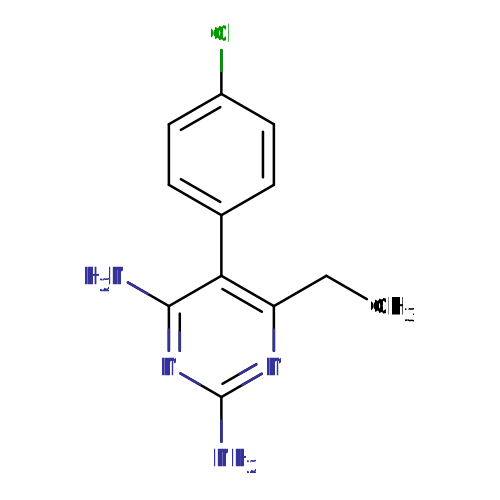
Common NamePyrimethamine
ClassSmall Molecule
DescriptionOne of the folic acid antagonists that is used as an antimalarial or with a sulfonamide to treat toxoplasmosis.
Contaminant Sources
  • HMDB Contaminants - Urine
  • IARC Carcinogens Group 3
  • STOFF IDENT Compounds
  • T3DB toxins
  • ToxCast & Tox21 Chemicals
Contaminant Type
  • Amine
  • Antimalarial
  • Antiprotozoal Agent
  • Drug
  • Folic Acid Antagonist
  • Metabolite
  • Organic Compound
  • Organochloride
  • Synthetic Compound
Chemical Structure
Thumb
Synonyms
ValueSource
2,4-Diamino-5-(4-chlorophenyl)-6-ethylpyrimidineChEBI
2,4-Diamino-5-(p-chlorophenyl)-6-ethylpyrimidineChEBI
2,4-Diamino-5-chlorophenyl-6-ethylpyrimidineChEBI
5-(4'-Chlorophenyl)-2,4-diamino-6-ethylpyrimidineChEBI
5-(4-Chlorophenyl)-6-ethyl-2,4-diaminopyrimidineChEBI
5-(4-Chlorophenyl)-6-ethyl-2,4-pyrimidinediamineChEBI
CDChEBI
ChloridineChEBI
ChloridynChEBI
DiaminopyritaminChEBI
EthylpyrimidineChEBI
PirimetaminaChEBI
PrimethamineChEBI
PyrimethaminumChEBI
DaraprimKegg
ChloridinHMDB
PirimetaminHMDB
PyremethamineHMDB
PyrimethaminHMDB
Glaxo wellcome brand OF pyrimethamineHMDB
GlaxoSmithKline brand OF pyrimethamineHMDB
TindurineHMDB
Aventis brand OF pyrimethamineHMDB
Wellcome brand OF pyrimethamineHMDB
MalocideHMDB
Chemical FormulaC12H13ClN4
Average Molecular Mass248.711 g/mol
Monoisotopic Mass248.083 g/mol
CAS Registry Number58-14-0
IUPAC Name5-(4-chlorophenyl)-6-ethylpyrimidine-2,4-diamine
Traditional Namepyrimethamine
SMILESCCC1=C(C(N)=NC(N)=N1)C1=CC=C(Cl)C=C1
InChI IdentifierInChI=1S/C12H13ClN4/c1-2-9-10(11(14)17-12(15)16-9)7-3-5-8(13)6-4-7/h3-6H,2H2,1H3,(H4,14,15,16,17)
InChI KeyWKSAUQYGYAYLPV-UHFFFAOYSA-N
Chemical Taxonomy
Description belongs to the class of organic compounds known as aminopyrimidines and derivatives. These are organic compounds containing an amino group attached to a pyrimidine ring. Pyrimidine is a 6-membered ring consisting of four carbon atoms and two nitrogen centers at the 1- and 3- ring positions.
KingdomOrganic compounds
Super ClassOrganoheterocyclic compounds
ClassDiazines
Sub ClassPyrimidines and pyrimidine derivatives
Direct ParentAminopyrimidines and derivatives
Alternative Parents
Substituents
  • Aminopyrimidine
  • Chlorobenzene
  • Halobenzene
  • Aryl chloride
  • Aryl halide
  • Monocyclic benzene moiety
  • Hydropyrimidine
  • Benzenoid
  • Heteroaromatic compound
  • Azacycle
  • Organochloride
  • Organohalogen compound
  • Amine
  • Hydrocarbon derivative
  • Organopnictogen compound
  • Organonitrogen compound
  • Primary amine
  • Organic nitrogen compound
  • Aromatic heteromonocyclic compound
Molecular FrameworkAromatic heteromonocyclic compounds
External Descriptors
Biological Properties
StatusDetected and Not Quantified
OriginExogenous
Cellular Locations
  • Cytoplasm
  • Extracellular
  • Membrane
Biofluid LocationsNot Available
Tissue LocationsNot Available
PathwaysNot Available
ApplicationsNot Available
Biological RolesNot Available
Chemical RolesNot Available
Physical Properties
StateSolid
AppearanceWhite powder.
Experimental Properties
PropertyValue
Melting Point233.5°C
Boiling PointNot Available
Solubility121 mg/L
Predicted Properties
PropertyValueSource
Water Solubility0.18 g/LALOGPS
logP2.62ALOGPS
logP2.75ChemAxon
logS-3.1ALOGPS
pKa (Strongest Acidic)17.22ChemAxon
pKa (Strongest Basic)7.77ChemAxon
Physiological Charge1ChemAxon
Hydrogen Acceptor Count4ChemAxon
Hydrogen Donor Count2ChemAxon
Polar Surface Area77.82 ŲChemAxon
Rotatable Bond Count2ChemAxon
Refractivity71.54 m³·mol⁻¹ChemAxon
Polarizability25.79 ųChemAxon
Number of Rings2ChemAxon
Bioavailability1ChemAxon
Rule of FiveYesChemAxon
Ghose FilterYesChemAxon
Veber's RuleNoChemAxon
MDDR-like RuleNoChemAxon
Spectra
Spectra
Spectrum TypeDescriptionSplash KeyView
GC-MSGC-MS Spectrum - CI-B (Non-derivatized)splash10-0002-0090000000-4e966bed391e234a23e3Spectrum
Predicted GC-MSPredicted GC-MS Spectrum - GC-MS (Non-derivatized) - 70eV, Positivesplash10-01pk-0290000000-f67f41257c448ad0d840Spectrum
Predicted GC-MSPredicted GC-MS Spectrum - GC-MS (Non-derivatized) - 70eV, PositiveNot AvailableSpectrum
LC-MS/MSLC-MS/MS Spectrum - LC-ESI-QTOF , positivesplash10-0002-0090000000-a146b85d59fc9835ed4cSpectrum
LC-MS/MSLC-MS/MS Spectrum - LC-ESI-QTOF , positivesplash10-0002-0090000000-84e4cea277c64351f21bSpectrum
LC-MS/MSLC-MS/MS Spectrum - LC-ESI-QTOF , positivesplash10-0002-0190000000-d931593de00f33f04587Spectrum
LC-MS/MSLC-MS/MS Spectrum - LC-ESI-QTOF , positivesplash10-0059-0980000000-a232e355dd50976aea07Spectrum
LC-MS/MSLC-MS/MS Spectrum - LC-ESI-QTOF , positivesplash10-005a-0920000000-7d48f7cfecbd7823803aSpectrum
LC-MS/MSLC-MS/MS Spectrum - , positivesplash10-0002-0290000000-b6d3f56ade24c0e6984cSpectrum
LC-MS/MSLC-MS/MS Spectrum - , positivesplash10-0002-0290000000-415b60a9caab352df184Spectrum
LC-MS/MSLC-MS/MS Spectrum - , positivesplash10-0032-2960000000-583d00b81182f34e5a94Spectrum
LC-MS/MSLC-MS/MS Spectrum - 20V, Positivesplash10-0002-0090000000-84e4cea277c64351f21bSpectrum
LC-MS/MSLC-MS/MS Spectrum - 10V, Positivesplash10-0002-0090000000-a146b85d59fc9835ed4cSpectrum
LC-MS/MSLC-MS/MS Spectrum - 40V, Positivesplash10-0059-0980000000-a232e355dd50976aea07Spectrum
LC-MS/MSLC-MS/MS Spectrum - 30V, Positivesplash10-0002-0190000000-d931593de00f33f04587Spectrum
LC-MS/MSLC-MS/MS Spectrum - 30V, Positivesplash10-0002-0090000000-a5bd8cb5be16b08fe352Spectrum
LC-MS/MSLC-MS/MS Spectrum - 45V, Positivesplash10-0002-0090000000-ec976a2cca417c4abd83Spectrum
LC-MS/MSLC-MS/MS Spectrum - 15V, Positivesplash10-0002-0090000000-142231cbd9fb9d4cd7caSpectrum
LC-MS/MSLC-MS/MS Spectrum - 50V, Positivesplash10-005a-0920000000-7d48f7cfecbd7823803aSpectrum
LC-MS/MSLC-MS/MS Spectrum - 90V, Positivesplash10-005a-0910000000-74228f82abe0906b09ddSpectrum
LC-MS/MSLC-MS/MS Spectrum - 30V, Positivesplash10-0002-0190000000-2277a786baa63a6f391cSpectrum
LC-MS/MSLC-MS/MS Spectrum - 50V, Positivesplash10-005a-0920000000-aacf5c362f2e7330e364Spectrum
Predicted LC-MS/MSPredicted LC-MS/MS Spectrum - 10V, Positivesplash10-0002-0090000000-cc03baac614916e188aeSpectrum
Predicted LC-MS/MSPredicted LC-MS/MS Spectrum - 20V, Positivesplash10-0002-0190000000-8c90fdad9d6f513cfdcfSpectrum
Predicted LC-MS/MSPredicted LC-MS/MS Spectrum - 40V, Positivesplash10-03ec-2940000000-ad7ab31613780bee7745Spectrum
Predicted LC-MS/MSPredicted LC-MS/MS Spectrum - 10V, Negativesplash10-0002-0090000000-7cec7981debaccce56c0Spectrum
Predicted LC-MS/MSPredicted LC-MS/MS Spectrum - 20V, Negativesplash10-0002-1190000000-3e6ac4ed3d9334756216Spectrum
Predicted LC-MS/MSPredicted LC-MS/MS Spectrum - 40V, Negativesplash10-0006-9740000000-b92682f3660029c1045dSpectrum
MSMass Spectrum (Electron Ionization)splash10-0002-2590000000-6434b6f0181741b3ca41Spectrum
Toxicity Profile
Route of ExposureWell absorbed with peak levels occurring between 2 to 6 hours following administration
Mechanism of ToxicityPyrimethamine inhibits the dihydrofolate reductase of plasmodia and thereby blocks the biosynthesis of purines and pyrimidines, which are essential for DNA synthesis and cell multiplication. This leads to failure of nuclear division at the time of schizont formation in erythrocytes and liver.
MetabolismHepatic Half Life: 96 hours
Toxicity ValuesNot Available
Lethal DoseNot Available
Carcinogenicity (IARC Classification)3, not classifiable as to its carcinogenicity to humans. (3)
Uses/SourcesFor the treatment of toxoplasmosis and acute malaria; For the prevention of malaria in areas non-resistant to pyrimethamine
Minimum Risk LevelNot Available
Health EffectsNot Available
SymptomsNot Available
TreatmentNot Available
Concentrations
Not Available
DrugBank IDDB00205
HMDB IDHMDB0014350
FooDB IDNot Available
Phenol Explorer IDNot Available
KNApSAcK IDNot Available
BiGG IDNot Available
BioCyc IDNot Available
METLIN IDNot Available
PDB IDCP6
Wikipedia LinkPyrimethamine
Chemspider ID4819
ChEBI ID8673
PubChem Compound ID4993
Kegg Compound IDC07391
YMDB IDNot Available
ECMDB IDNot Available
References
Synthesis Reference

DrugSyn.org

MSDSLink
General References
1. Sirichaiwat C, Intaraudom C, Kamchonwongpaisan S, Vanichtanankul J, Thebtaranonth Y, Yuthavong Y: Target guided synthesis of 5-benzyl-2,4-diamonopyrimidines: their antimalarial activities and binding affinities to wild type and mutant dihydrofolate reductases from Plasmodium falciparum. J Med Chem. 2004 Jan 15;47(2):345-54.
2. Gatton ML, Martin LB, Cheng Q: Evolution of resistance to sulfadoxine-pyrimethamine in Plasmodium falciparum. Antimicrob Agents Chemother. 2004 Jun;48(6):2116-23.
3. https://www.ncbi.nlm.nih.gov/pubmed/?term=11257045
4. https://www.ncbi.nlm.nih.gov/pubmed/?term=11313656
5. https://www.ncbi.nlm.nih.gov/pubmed/?term=12543697
6. https://www.ncbi.nlm.nih.gov/pubmed/?term=16157660
7. https://www.ncbi.nlm.nih.gov/pubmed/?term=19435820
8. https://www.ncbi.nlm.nih.gov/pubmed/?term=28166217
9. https://www.ncbi.nlm.nih.gov/pubmed/?term=3377143