Record Information
Version1.0
Creation Date2014-09-11 05:15:42 UTC
Update Date2026-04-16 22:35:38 UTC
Accession NumberCHEM003723
Identification
Common NameN-Decane
ClassSmall Molecule
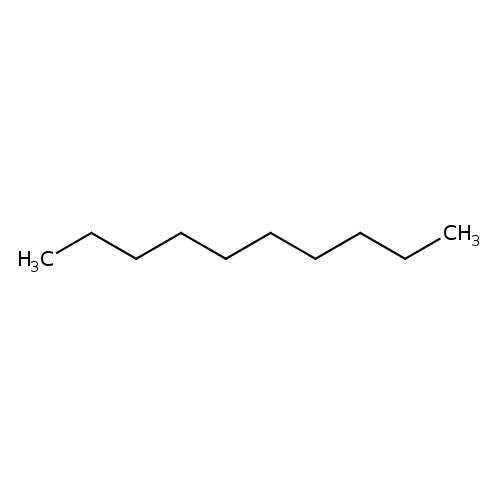
DescriptionN-Decane is found in common oregano. Decane is an alkane hydrocarbon with the chemical formula CH3(CH2)8CH3. 75 isomers of decane exist, all of which are flammable liquids. N-Decane belongs to the family of Acyclic Alkanes. These are acyclic hydrocarbons consisting only of n carbon atoms and m hydrogen atoms where m=2*n + 2.
Contaminant Sources
  • FooDB Chemicals
  • HMDB Contaminants - Feces
  • HPV EPA Chemicals
  • OECD HPV Chemicals
  • STOFF IDENT Compounds
  • Sludge Chemicals
  • T3DB toxins
  • ToxCast & Tox21 Chemicals
Contaminant Type
  • Food Toxin
  • Metabolite
  • Natural Compound
  • Organic Compound
  • Plant Toxin
Chemical Structure
Thumb
Synonyms
ValueSource
CH3-[CH2]8-CH3ChEBI
DekanChEBI
N-DekanChEBI
DecaneHMDB
N-DecaneChEBI
Chemical FormulaC10H22
Average Molecular Mass142.282 g/mol
Monoisotopic Mass142.172 g/mol
CAS Registry Number124-18-5
IUPAC Namedecane
Traditional Namedecane
SMILESCCCCCCCCCC
InChI IdentifierInChI=1S/C10H22/c1-3-5-7-9-10-8-6-4-2/h3-10H2,1-2H3
InChI KeyDIOQZVSQGTUSAI-UHFFFAOYSA-N
Chemical Taxonomy
Description belongs to the class of organic compounds known as alkanes. These are acyclic branched or unbranched hydrocarbons having the general formula CnH2n+2 , and therefore consisting entirely of hydrogen atoms and saturated carbon atoms.
KingdomOrganic compounds
Super ClassHydrocarbons
ClassSaturated hydrocarbons
Sub ClassAlkanes
Direct ParentAlkanes
Alternative ParentsNot Available
Substituents
  • Acyclic alkane
  • Alkane
  • Aliphatic acyclic compound
Molecular FrameworkAliphatic acyclic compounds
External Descriptors
Biological Properties
StatusDetected and Not Quantified
OriginExogenous
Cellular Locations
  • Membrane
Biofluid LocationsNot Available
Tissue LocationsNot Available
PathwaysNot Available
ApplicationsNot Available
Biological RolesNot Available
Chemical RolesNot Available
Physical Properties
StateLiquid
AppearanceNot Available
Experimental Properties
PropertyValue
Melting Point-29.7°C
Boiling Point174.1°C
Solubility0.052 mg/L (at 25°C)
Predicted Properties
PropertyValueSource
Water Solubility0.00071 g/LALOGPS
logP5.87ALOGPS
logP4.91ChemAxon
logS-5.3ALOGPS
Physiological Charge0ChemAxon
Hydrogen Acceptor Count0ChemAxon
Hydrogen Donor Count0ChemAxon
Polar Surface Area0 ŲChemAxon
Rotatable Bond Count7ChemAxon
Refractivity47.81 m³·mol⁻¹ChemAxon
Polarizability20.61 ųChemAxon
Number of Rings0ChemAxon
Bioavailability1ChemAxon
Rule of FiveYesChemAxon
Ghose FilterNoChemAxon
Veber's RuleYesChemAxon
MDDR-like RuleNoChemAxon
Spectra
Spectra
Spectrum TypeDescriptionSplash KeyView
GC-MSGC-MS Spectrum - GC-MS (Non-derivatized)splash10-00di-9000000000-9df97e31eebb5e71f4deSpectrum
GC-MSGC-MS Spectrum - CI-B (Non-derivatized)splash10-000i-9000000000-9f57f6bcf77f0eac8db3Spectrum
GC-MSGC-MS Spectrum - EI-B (Non-derivatized)splash10-052f-9000000000-eaff23c4d9aac623bf75Spectrum
GC-MSGC-MS Spectrum - EI-B (Non-derivatized)splash10-052f-9000000000-17ab8ba53e53f7df1609Spectrum
GC-MSGC-MS Spectrum - CI-B (Non-derivatized)splash10-0006-9800000000-315facd0cd21bf8a5979Spectrum
GC-MSGC-MS Spectrum - GC-MS (Non-derivatized)splash10-00di-9000000000-9df97e31eebb5e71f4deSpectrum
Predicted GC-MSPredicted GC-MS Spectrum - GC-MS (Non-derivatized) - 70eV, Positivesplash10-05bo-9100000000-2e88ad716e79e280d38dSpectrum
Predicted GC-MSPredicted GC-MS Spectrum - GC-MS (Non-derivatized) - 70eV, PositiveNot AvailableSpectrum
Predicted LC-MS/MSPredicted LC-MS/MS Spectrum - 10V, Positivesplash10-0006-0900000000-1b58045e319c12e35254Spectrum
Predicted LC-MS/MSPredicted LC-MS/MS Spectrum - 20V, Positivesplash10-0006-4900000000-1ffce5ce659fec4bafcbSpectrum
Predicted LC-MS/MSPredicted LC-MS/MS Spectrum - 40V, Positivesplash10-052f-9000000000-2922293d4fa6e4081579Spectrum
Predicted LC-MS/MSPredicted LC-MS/MS Spectrum - 10V, Negativesplash10-0006-0900000000-bdbad94f5bf0013e81c0Spectrum
Predicted LC-MS/MSPredicted LC-MS/MS Spectrum - 20V, Negativesplash10-0006-0900000000-b404a7c183315a3cde5bSpectrum
Predicted LC-MS/MSPredicted LC-MS/MS Spectrum - 40V, Negativesplash10-0006-9700000000-410e228da98c1128e07eSpectrum
Predicted LC-MS/MSPredicted LC-MS/MS Spectrum - 10V, Negativesplash10-0006-0900000000-13ee864c22c4eb290becSpectrum
Predicted LC-MS/MSPredicted LC-MS/MS Spectrum - 20V, Negativesplash10-0006-0900000000-13ee864c22c4eb290becSpectrum
Predicted LC-MS/MSPredicted LC-MS/MS Spectrum - 40V, Negativesplash10-0006-8900000000-ebadd46bfefd213471f0Spectrum
Predicted LC-MS/MSPredicted LC-MS/MS Spectrum - 10V, Positivesplash10-00di-9100000000-a4039cec7c3a7f05e150Spectrum
Predicted LC-MS/MSPredicted LC-MS/MS Spectrum - 20V, Positivesplash10-00di-9000000000-2a5c3432c5d2069e1abcSpectrum
Predicted LC-MS/MSPredicted LC-MS/MS Spectrum - 40V, Positivesplash10-052f-9000000000-9379596c5d6a79844be7Spectrum
MSMass Spectrum (Electron Ionization)splash10-052f-9000000000-04ad887815740c3910a5Spectrum
1D NMR1H NMR SpectrumNot AvailableSpectrum
1D NMR13C NMR SpectrumNot AvailableSpectrum
Toxicity Profile
Route of ExposureNot Available
Mechanism of ToxicityNot Available
MetabolismNot Available
Toxicity ValuesNot Available
Lethal DoseNot Available
Carcinogenicity (IARC Classification)No indication of carcinogenicity to humans (not listed by IARC).
Uses/SourcesN-Decane is found in common oregano.
Minimum Risk LevelNot Available
Health EffectsNot Available
SymptomsNot Available
TreatmentNot Available
Concentrations
Not Available
DrugBank IDNot Available
HMDB IDHMDB0031450
FooDB IDFDB005890
Phenol Explorer IDNot Available
KNApSAcK IDC00048375
BiGG IDNot Available
BioCyc IDCPD-9287
METLIN IDNot Available
PDB IDD10
Wikipedia LinkDecane
Chemspider ID14840
ChEBI ID41808
PubChem Compound ID15600
Kegg Compound IDNot Available
YMDB IDNot Available
ECMDB IDNot Available
References
Synthesis Reference

Takao Yoshida, “Methyl substituted oxobicyclo-4,4,0-decane derivatives, process for preparing same and organoleptic uses thereof.” U.S. Patent US4377714, issued October, 1944.

MSDSLink
General References
1. https://www.ncbi.nlm.nih.gov/pubmed/?term=11762597
2. Duke, James A. (1992) Handbook of phytochemical constituents of GRAS herbs and other economic plants. Boca Raton, FL. CRC Press.