Record Information
Version1.0
Creation Date2014-09-11 05:14:30 UTC
Update Date2026-03-31 17:31:01 UTC
Accession NumberCHEM003702
Identification
Common NameNorethindrone
ClassSmall Molecule
DescriptionA synthetic progestational hormone with actions similar to those of progesterone but functioning as a more potent inhibitor of ovulation. It has weak estrogenic and androgenic properties. The hormone has been used in treating amenorrhea, functional uterine bleeding, endometriosis, and for contraception.
Contaminant Sources
  • HMDB Contaminants - Urine
  • IARC Carcinogens Group 2B
  • STOFF IDENT Compounds
  • T3DB toxins
  • ToxCast & Tox21 Chemicals
Contaminant Type
  • Contraceptive, Oral, Synthetic
  • Drug
  • Ester
  • Metabolite
  • Organic Compound
  • Synthetic Compound
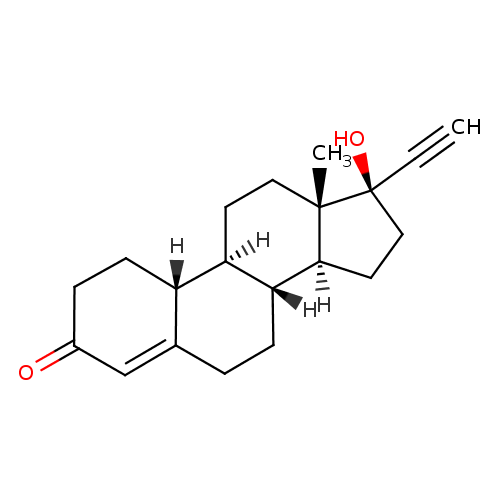
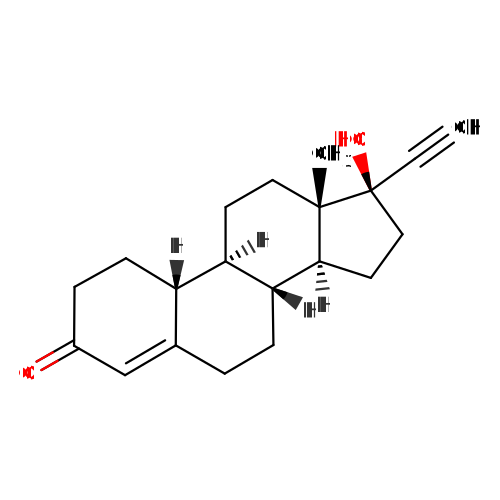
Chemical Structure
Thumb
Synonyms
ValueSource
(17alpha)-17-Ethynyl-17-hydroxyestra-4,8(14),9-trien-3-oneChEBI
17-alpha-Ethynyl-17-hydroxy-4-estren-3-oneChEBI
17-alpha-Ethynyl-19-norandrost-4-en-17-beta-ol-3-oneChEBI
17-alpha-Ethynyl-19-nortestosteroneChEBI
17-alpha-Ethynyl-4-estren-17-ol-3-oneChEBI
17-beta-Hydroxy-19-norpregn-4-en-20-yn-3-oneChEBI
17-Hydroxy-19-nor-17-alpha-pregn-4-en-20-yn-3-oneChEBI
17-Hydroxy-19-nor-17alpha-pregn-4-en-20-yn-3-oneChEBI
17alpha-Ethinyl-19-nortestosteroneChEBI
17alpha-Ethinylestra-4-en-17beta-ol-3-oneChEBI
17alpha-Ethynyl-17-hydroxy-4-estren-3-oneChEBI
17alpha-Ethynyl-17beta-hydroxy-19-norandrost-4-en-3-oneChEBI
17alpha-Ethynyl-19-nor-4-androsten-17beta-ol-3-oneChEBI
17alpha-Ethynyl-19-norandrost-4-en-17beta-ol-3-oneChEBI
17alpha-Ethynyl-19-nortestosteroneChEBI
17alpha-Ethynyl-4-estren-17-ol-3-oneChEBI
17beta-Hydroxy-19-norpregn-4-en-20-yn-3-oneChEBI
19-Nor-17-alpha-ethynyl-17-beta-hydroxy-4-androsten-3-oneChEBI
19-Nor-17-alpha-ethynylandrosten-17-beta-ol-3-oneChEBI
19-Nor-17-alpha-ethynyltestosteroneChEBI
19-Nor-17alpha-ethynyl-17beta-hydroxy-4-androsten-3-oneChEBI
19-Nor-17alpha-ethynylandrosten-17beta-ol-3-oneChEBI
19-Nor-17alpha-ethynyltestosteroneChEBI
19-Nor-ethindroneChEBI
19-NorethisteroneChEBI
4-Estren-17alpha-ethynyl-17beta-ol-3-oneChEBI
CamilaChEBI
ConludagChEBI
MicronorChEBI
MicronovumChEBI
Mini-peChEBI
Mini-pillChEBI
NorcolutChEBI
NorethisteronChEBI
NorethisteronumChEBI
NoretisteronaChEBI
NoridayChEBI
NorlutenChEBI
NorlutinChEBI
Primolut-NChEBI
UtovlanChEBI
NorethisteroneKegg
(17a)-17-Ethynyl-17-hydroxyestra-4,8(14),9-trien-3-oneGenerator
(17Α)-17-ethynyl-17-hydroxyestra-4,8(14),9-trien-3-oneGenerator
17-a-Ethynyl-17-hydroxy-4-estren-3-oneGenerator
17-Α-ethynyl-17-hydroxy-4-estren-3-oneGenerator
17-a-Ethynyl-19-norandrost-4-en-17-b-ol-3-oneGenerator
17-Α-ethynyl-19-norandrost-4-en-17-β-ol-3-oneGenerator
17-a-Ethynyl-19-nortestosteroneGenerator
17-Α-ethynyl-19-nortestosteroneGenerator
17-a-Ethynyl-4-estren-17-ol-3-oneGenerator
17-Α-ethynyl-4-estren-17-ol-3-oneGenerator
17-b-Hydroxy-19-norpregn-4-en-20-yn-3-oneGenerator
17-Β-hydroxy-19-norpregn-4-en-20-yn-3-oneGenerator
17-Hydroxy-19-nor-17-a-pregn-4-en-20-yn-3-oneGenerator
17-Hydroxy-19-nor-17-α-pregn-4-en-20-yn-3-oneGenerator
17-Hydroxy-19-nor-17a-pregn-4-en-20-yn-3-oneGenerator
17-Hydroxy-19-nor-17α-pregn-4-en-20-yn-3-oneGenerator
17a-Ethinyl-19-nortestosteroneGenerator
17Α-ethinyl-19-nortestosteroneGenerator
17a-Ethinylestra-4-en-17b-ol-3-oneGenerator
17Α-ethinylestra-4-en-17β-ol-3-oneGenerator
17a-Ethynyl-17-hydroxy-4-estren-3-oneGenerator
17Α-ethynyl-17-hydroxy-4-estren-3-oneGenerator
17a-Ethynyl-17b-hydroxy-19-norandrost-4-en-3-oneGenerator
17Α-ethynyl-17β-hydroxy-19-norandrost-4-en-3-oneGenerator
17a-Ethynyl-19-nor-4-androsten-17b-ol-3-oneGenerator
17Α-ethynyl-19-nor-4-androsten-17β-ol-3-oneGenerator
17a-Ethynyl-19-norandrost-4-en-17b-ol-3-oneGenerator
17Α-ethynyl-19-norandrost-4-en-17β-ol-3-oneGenerator
17a-Ethynyl-19-nortestosteroneGenerator
17Α-ethynyl-19-nortestosteroneGenerator
17a-Ethynyl-4-estren-17-ol-3-oneGenerator
17Α-ethynyl-4-estren-17-ol-3-oneGenerator
17b-Hydroxy-19-norpregn-4-en-20-yn-3-oneGenerator
17Β-hydroxy-19-norpregn-4-en-20-yn-3-oneGenerator
19-Nor-17-a-ethynyl-17-b-hydroxy-4-androsten-3-oneGenerator
19-Nor-17-α-ethynyl-17-β-hydroxy-4-androsten-3-oneGenerator
19-Nor-17-a-ethynylandrosten-17-b-ol-3-oneGenerator
19-Nor-17-α-ethynylandrosten-17-β-ol-3-oneGenerator
19-Nor-17-a-ethynyltestosteroneGenerator
19-Nor-17-α-ethynyltestosteroneGenerator
19-Nor-17a-ethynyl-17b-hydroxy-4-androsten-3-oneGenerator
19-Nor-17α-ethynyl-17β-hydroxy-4-androsten-3-oneGenerator
19-Nor-17a-ethynylandrosten-17b-ol-3-oneGenerator
19-Nor-17α-ethynylandrosten-17β-ol-3-oneGenerator
19-Nor-17a-ethynyltestosteroneGenerator
19-Nor-17α-ethynyltestosteroneGenerator
4-Estren-17a-ethynyl-17b-ol-3-oneGenerator
4-Estren-17α-ethynyl-17β-ol-3-oneGenerator
(17-alpha)-17-Hydroxy-19-norpregn-4-en-20-yn-3-oneHMDB
17-alpha-Ethynyl-17-beta-hydroxy-4-estren-3-oneHMDB
17-Ethinyl-19-nor-testosteroneHMDB
17-Ethynyl-17-hydroxyestr-4-en-3-one (acd/name 4.0)HMDB
17-Ethynyl-17beta-hydroxyestr-4-en-3-oneHMDB
17-Ethynyl-19-nortestosteroneHMDB
17-Hydroxy-(17alpha)-19-norpregn-4-en-20-yn-3-oneHMDB
17-Hydroxy-17-alpha-19-norpregn-4-en-20-yn-3-oneHMDB
17alpha-Ethinyl-17alpha-ethinyl-19-nortestosteroneHMDB
17alpha-Ethynyl-17-hydroxy-estr-4-en-3-oneHMDB
17alpha-Ethynyl-17-hydroxyest-4-en-3-oneHMDB
17alpha-Ethynyl-17beta-hydroxyestr-4-en-3-oneHMDB
17alpha-Ethynyl-3-oxo-4-estren-17beta-olHMDB
17alpha-Pregn-4-en-20-yn-3-oneHMDB
17beta-Hydroxy-17alpha-ethynylestr-4-en-3-oneHMDB
19-Nor-17-ethinyltestosteroneHMDB
19-NorethinyltestosteroneHMDB
AnhydrohydroxynorprogesteroneHMDB
AnovuleHMDB
ConludafHMDB
ENTHMDB
Ethinyl-19-nortestosteroneHMDB
EthinylnortestosteroneHMDB
EthynylnortestosteroneHMDB
GestestHMDB
MenzolHMDB
MicronettHMDB
MinovlarHMDB
NETHMDB
Nor-q.d.HMDB
Nor-QDHMDB
NoralutinHMDB
NoresthisteroneHMDB
NorethyndronHMDB
NorethynodroneHMDB
NorforHMDB
NorgestinHMDB
NorlutateHMDB
NorlutonHMDB
NormapauseHMDB
NorpregneninloneHMDB
NorpregneninoloneHMDB
Primolut NHMDB
ProluteasiHMDB
UtovlarHMDB
ConceplanHMDB
Nor QDHMDB
Norethindrone, (1 beta)-isomerHMDB
NorcoluteHMDB
MonogestHMDB
NorQDHMDB
NorethindroneChEBI
Chemical FormulaC20H26O2
Average Molecular Mass298.419 g/mol
Monoisotopic Mass298.193 g/mol
CAS Registry Number68-22-4
IUPAC Name(1S,2R,10R,11S,14R,15S)-14-ethynyl-14-hydroxy-15-methyltetracyclo[8.7.0.0^{2,7}.0^{11,15}]heptadec-6-en-5-one
Traditional Name(1S,2R,10R,11S,14R,15S)-14-ethynyl-14-hydroxy-15-methyltetracyclo[8.7.0.0^{2,7}.0^{11,15}]heptadec-6-en-5-one
SMILES[H][C@@]12CC[C@@](O)(C#C)[C@@]1(C)CC[C@]1([H])[C@@]3([H])CCC(=O)C=C3CC[C@@]21[H]
InChI IdentifierInChI=1S/C20H26O2/c1-3-20(22)11-9-18-17-6-4-13-12-14(21)5-7-15(13)16(17)8-10-19(18,20)2/h1,12,15-18,22H,4-11H2,2H3/t15-,16+,17+,18-,19-,20-/m0/s1
InChI KeyVIKNJXKGJWUCNN-XGXHKTLJSA-N
Chemical Taxonomy
Description belongs to the class of organic compounds known as estrogens and derivatives. These are steroids with a structure containing a 3-hydroxylated estrane.
KingdomOrganic compounds
Super ClassLipids and lipid-like molecules
ClassSteroids and steroid derivatives
Sub ClassEstrane steroids
Direct ParentEstrogens and derivatives
Alternative Parents
Substituents
  • Estrogen-skeleton
  • 3-oxo-delta-4-steroid
  • 3-oxosteroid
  • 17-hydroxysteroid
  • Oxosteroid
  • Hydroxysteroid
  • Delta-4-steroid
  • Cyclohexenone
  • Ynone
  • Cyclic alcohol
  • Tertiary alcohol
  • Cyclic ketone
  • Ketone
  • Acetylide
  • Organic oxygen compound
  • Hydrocarbon derivative
  • Organic oxide
  • Carbonyl group
  • Alcohol
  • Organooxygen compound
  • Aliphatic homopolycyclic compound
Molecular FrameworkAliphatic homopolycyclic compounds
External Descriptors
Biological Properties
StatusDetected and Not Quantified
OriginExogenous
Cellular Locations
  • Cytoplasm
  • Extracellular
  • Membrane
Biofluid LocationsNot Available
Tissue LocationsNot Available
PathwaysNot Available
ApplicationsNot Available
Biological RolesNot Available
Chemical RolesNot Available
Physical Properties
StateSolid
AppearanceWhite powder.
Experimental Properties
PropertyValue
Melting Point203.5°C
Boiling PointNot Available
Solubility7.04 mg/L (at 25°C)
Predicted Properties
PropertyValueSource
Water Solubility0.0067 g/LALOGPS
logP2.72ALOGPS
logP3.22ChemAxon
logS-4.6ALOGPS
pKa (Strongest Acidic)17.59ChemAxon
pKa (Strongest Basic)-1.7ChemAxon
Physiological Charge0ChemAxon
Hydrogen Acceptor Count2ChemAxon
Hydrogen Donor Count1ChemAxon
Polar Surface Area37.3 ŲChemAxon
Rotatable Bond Count0ChemAxon
Refractivity87.42 m³·mol⁻¹ChemAxon
Polarizability34.59 ųChemAxon
Number of Rings4ChemAxon
Bioavailability1ChemAxon
Rule of FiveYesChemAxon
Ghose FilterYesChemAxon
Veber's RuleYesChemAxon
MDDR-like RuleNoChemAxon
Spectra
Spectra
Spectrum TypeDescriptionSplash KeyView
Predicted GC-MSPredicted GC-MS Spectrum - GC-MS (Non-derivatized) - 70eV, Positivesplash10-00w9-0690000000-7050c3192b843aecc482Spectrum
Predicted GC-MSPredicted GC-MS Spectrum - GC-MS (1 TMS) - 70eV, Positivesplash10-052f-1369000000-cfce41c0dca4a0c3cd9cSpectrum
Predicted GC-MSPredicted GC-MS Spectrum - GC-MS (Non-derivatized) - 70eV, PositiveNot AvailableSpectrum
LC-MS/MSLC-MS/MS Spectrum - LC-ESI-qTof , Positivesplash10-0002-0391000000-ae51cc90bb8f2161f149Spectrum
LC-MS/MSLC-MS/MS Spectrum - LC-ESI-qTof , Positivesplash10-0j59-2494000000-76c71f96c07e87ef8962Spectrum
LC-MS/MSLC-MS/MS Spectrum - LC-ESI-ITFT , positivesplash10-0a4i-1910000000-f3f4bbf8cfe62ee9f76dSpectrum
LC-MS/MSLC-MS/MS Spectrum - LC-ESI-ITFT , positivesplash10-0a5c-3900000000-4b2a5d95e4b6d50f16fcSpectrum
LC-MS/MSLC-MS/MS Spectrum - LC-ESI-ITFT , positivesplash10-00ea-0790000000-60d1a1a37c0ba98d6a4aSpectrum
LC-MS/MSLC-MS/MS Spectrum - LC-ESI-ITFT , positivesplash10-00e9-0890000000-5d3b8210450a1c43b119Spectrum
LC-MS/MSLC-MS/MS Spectrum - , positivesplash10-0002-0391000000-ae51cc90bb8f2161f149Spectrum
LC-MS/MSLC-MS/MS Spectrum - , positivesplash10-0ar0-3920000000-e31fa7c9e871f2e39846Spectrum
LC-MS/MSLC-MS/MS Spectrum - 30V, Positivesplash10-001j-0930000000-9c2fc72a1b360913fb56Spectrum
LC-MS/MSLC-MS/MS Spectrum - 40V, Positivesplash10-005c-0910000000-ef775abfdf43d67a4225Spectrum
LC-MS/MSLC-MS/MS Spectrum - 80V, Positivesplash10-0a5c-3900000000-11a6390c5bc543829135Spectrum
LC-MS/MSLC-MS/MS Spectrum - 20V, Positivesplash10-0002-0391000000-7b2e411df9eccc111c8eSpectrum
LC-MS/MSLC-MS/MS Spectrum - 10V, Positivesplash10-0002-0091000000-3a83c5fc59fdaea61231Spectrum
LC-MS/MSLC-MS/MS Spectrum - 55V, Positivesplash10-0a4i-1910000000-f3f4bbf8cfe62ee9f76dSpectrum
LC-MS/MSLC-MS/MS Spectrum - 35V, Positivesplash10-00ea-0790000000-1844e6f664d23868bbabSpectrum
LC-MS/MSLC-MS/MS Spectrum - 50V, Positivesplash10-004l-0900000000-623cab7c657eda4d2f5fSpectrum
LC-MS/MSLC-MS/MS Spectrum - 15V, Positivesplash10-0002-0090000000-412f7f0b9259fe759372Spectrum
LC-MS/MSLC-MS/MS Spectrum - 55V, Positivesplash10-00e9-0890000000-d8c560fa1ac40e4ba22fSpectrum
LC-MS/MSLC-MS/MS Spectrum - 45V, Positivesplash10-0a59-2910000000-7b16e32a71f6c1df6d1eSpectrum
Predicted LC-MS/MSPredicted LC-MS/MS Spectrum - 10V, Positivesplash10-0002-0090000000-ec79e2d15a020c198ddeSpectrum
Predicted LC-MS/MSPredicted LC-MS/MS Spectrum - 20V, Positivesplash10-001m-0290000000-b8f5efd6d7713f50f65cSpectrum
Predicted LC-MS/MSPredicted LC-MS/MS Spectrum - 40V, Positivesplash10-0l5l-2980000000-14cb82df2a3c251f955eSpectrum
Predicted LC-MS/MSPredicted LC-MS/MS Spectrum - 10V, Negativesplash10-0002-0090000000-eab48ea9142da299d923Spectrum
Predicted LC-MS/MSPredicted LC-MS/MS Spectrum - 20V, Negativesplash10-0002-0090000000-64471e6cc8b0f3e495b5Spectrum
Predicted LC-MS/MSPredicted LC-MS/MS Spectrum - 40V, Negativesplash10-00l6-0090000000-ccad820f0e5b5559e8e8Spectrum
MSMass Spectrum (Electron Ionization)splash10-01rt-4950000000-fcbe8bf03b1aa103152bSpectrum
1D NMR1H NMR SpectrumNot AvailableSpectrum
Toxicity Profile
Route of ExposureNorethindrone acetate is completely and rapidly deacetylated to norethindrone (NET) after oral administration, and the disposition of norethindrone acetate is indistinguishable from that of orally administered norethindrone. Norethindrone is rapidly absorbed from norethindrone acetate, in which maximum plasma concentration occur 2 hours post-dose (Tmax). When a single dose is given to healthy women, the Cmax is 26.19 Њ± 6.19 hours. The AUC (0-inf) is 166.90 Њ± 56.28 ng/mL*h. Absolute oral bioavailability is approximately 64%. The effect of food on the pharmacokinetics of norethindrone acetate is unknown.
Mechanism of ToxicityProgestins diffuse freely into target cells and bind to the progesterone receptor. Target cells include the female reproductive tract, the mammary gland, the hypothalamus, and the pituitary. Once bound to the receptor, progestins slow the frequency of release of gonadotropin releasing hormone (GnRH) from the hypothalamus and blunt the pre-ovulatory LH surge.
MetabolismHepatic. Norethindrone is extensively metabolized, primarily via reduction. It also undergoes sulfate and glucuronide conjugation. The majority of metabolites in the circulation are sulfates, with glucuronides accounting for most of the urinary metabolites. Route of Elimination: Norethindrone is excreted in both urine and feces, primarily as metabolites. Half Life: 8.51±2.19 (when a single dose is given to healthy women)
Toxicity ValuesNot Available
Lethal DoseNot Available
Carcinogenicity (IARC Classification)2B, possibly carcinogenic to humans. (17)
Uses/SourcesNorethindrone acetate is indicated for the treatment of secondary amenorrhea, endometriosis, and abnormal uterine bleeding due to hormonal imbalance in the absence of organic pathology, such as submucous fibroids or uterine cancer.
Minimum Risk LevelNot Available
Health EffectsNot Available
SymptomsNot Available
TreatmentNot Available
Concentrations
Not Available
DrugBank IDDB00717
HMDB IDHMDB0014855
FooDB IDNot Available
Phenol Explorer IDNot Available
KNApSAcK IDNot Available
BiGG IDNot Available
BioCyc IDNot Available
METLIN IDNot Available
PDB IDNot Available
Wikipedia LinkNorethisterone
Chemspider ID5994
ChEBI ID7627
PubChem Compound ID6230
Kegg Compound IDC05028
YMDB IDNot Available
ECMDB IDNot Available
References
Synthesis ReferenceNot Available
MSDSLink
General References
1. Knox SA, Viney RC, Gu Y, Hole AR, Fiebig DG, Street DJ, Haas MR, Weisberg E, Bateson D: The effect of adverse information and positive promotion on women's preferences for prescribed contraceptive products. Soc Sci Med. 2013 Apr;83:70-80. doi: 10.1016/j.socscimed.2012.12.025. Epub 2013 Jan 5.
2. Karkar A: Pregnancy and contraceptive issues in renal transplant recipients. Saudi J Kidney Dis Transpl. 2008 Mar;19(2):165-73.
3. Debski R, Kotarski J, Paszkowski T, Pawelczyk L, Skrzypulec V, Tomaszewski J: [The statement of Polish Gynecological Society experts on oral use of contraceptive 75 microg desogestrel minipill in different clinical cases--state of art in 2008]. Ginekol Pol. 2009 Jan;80(1):63-75.
4. Rabe T, Grunwald K, Runnebaum B: [Future prospects in contraception]. Arch Gynecol Obstet. 1995;257(1-4):541-7.
5. Tscherne G: [Benefits and risks of hormonal contraception]. Gynakol Geburtshilfliche Rundsch. 1992;32(3):174-6.
6. Spornitz UM: The functional morphology of the human endometrium and decidua. Adv Anat Embryol Cell Biol. 1992;124:1-99.
7. Kovacs G: Progestogen-only pills and bleeding disturbances. Hum Reprod. 1996 Oct;11 Suppl 2:20-3.
8. Lauritzen C: [Prevention of conception in adolescence]. Ther Umsch. 1994 May;51(5):314-24.
9. Authors unspecified: Emergency contraception hot line launched. Reprod Freedom News. 1996 Feb 23;5(4):7.
10. Authors unspecified: Maximizing the use of the progestin minipill. Contracept Technol Update. 1999 Feb;20(2):19-21.
11. Dorea JG, Miazaki ES: The effects of oral contraceptive use on iron and copper concentrations in breast milk. Fertil Steril. 1999 Aug;72(2):297-301.
12. Benagiano G, Bastianelli C, Farris M: Hormonal contraception: state of the art and future perspectives. Minerva Ginecol. 2007 Jun;59(3):241-70.
13. Benagiano G, Primiero FM: Seventy-five microgram desogestrel minipill, a new perspective in estrogen-free contraception. Ann N Y Acad Sci. 2003 Nov;997:163-73.
14. Authors unspecified: Is Cerazette the minipill of choice? Drug Ther Bull. 2003 Sep;41(9):68-9.
15. Benagiano G, Bastianelli C, Farris M: Contraception today. Ann N Y Acad Sci. 2006 Dec;1092:1-32.
16. Helleday J, Siwers B, Ritzen EM, Carlstrom K: Subnormal androgen and elevated progesterone levels in women treated for congenital virilizing 21-hydroxylase deficiency. J Clin Endocrinol Metab. 1993 Apr;76(4):933-6.
17. Simons K, Toomre D: Lipid rafts and signal transduction. Nat Rev Mol Cell Biol. 2000 Oct;1(1):31-9.
18. Watson AD: Thematic review series: systems biology approaches to metabolic and cardiovascular disorders. Lipidomics: a global approach to lipid analysis in biological systems. J Lipid Res. 2006 Oct;47(10):2101-11. Epub 2006 Aug 10.
19. Sethi JK, Vidal-Puig AJ: Thematic review series: adipocyte biology. Adipose tissue function and plasticity orchestrate nutritional adaptation. J Lipid Res. 2007 Jun;48(6):1253-62. Epub 2007 Mar 20.
20. Lingwood D, Simons K: Lipid rafts as a membrane-organizing principle. Science. 2010 Jan 1;327(5961):46-50. doi: 10.1126/science.1174621.
21. FDA label
22. The lipid handbook with CD-ROM
23. https://www.ncbi.nlm.nih.gov/pubmed/?term=120838
24. https://www.ncbi.nlm.nih.gov/pubmed/?term=21860523
25. https://www.ncbi.nlm.nih.gov/pubmed/?term=24019188