Record Information
Version1.0
Creation Date2014-09-11 05:13:41 UTC
Update Date2026-05-21 16:37:05 UTC
Accession NumberCHEM003685
Identification
Common NameCyclophosphamide
ClassSmall Molecule
DescriptionPrecursor of an alkylating nitrogen mustard antineoplastic and immunosuppressive agent that must be activated in the liver to form the active aldophosphamide. It has been used in the treatment of lymphoma and leukemia. Its side effect, alopecia, has been used for defleecing sheep. Cyclophosphamide may also cause sterility, birth defects, mutations, and cancer.
Contaminant Sources
  • T3DB toxins
Contaminant Type
  • Amide
  • Antineoplastic Agent, Alkylating
  • Antirheumatic Agent
  • Drug
  • Ester
  • Immunosuppressive Agent
  • Mutagen
  • Myeloablative Agonist
  • Organic Compound
  • Organochloride
  • Synthetic Compound
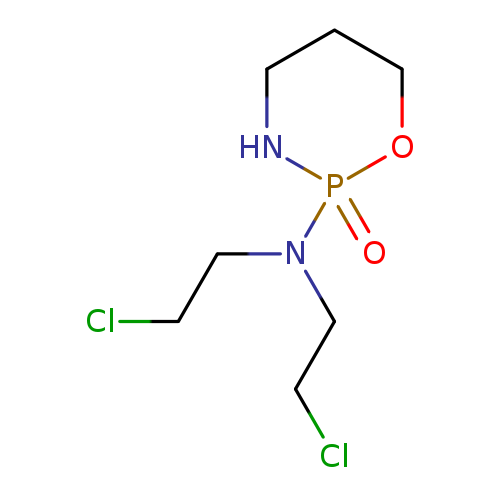
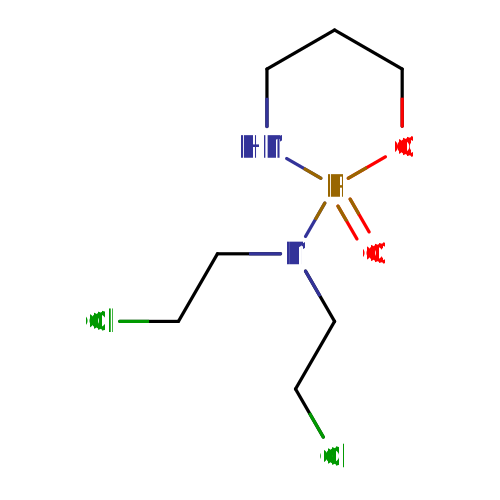
Chemical Structure
Thumb
Synonyms
ValueSource
(+-)-CyclophosphamideChEBI
(RS)-CyclophosphamideChEBI
2-[Bis(2-chloroethylamino)]-tetrahydro-2H-1,3,2-oxazaphosphorine-2-oxideChEBI
Bis(2-chloroethyl)phosphoramide cyclic propanolamide esterChEBI
Cyclophosphamide anhydrousChEBI
N,N-Bis(2-chloroethyl)tetrahydro-2H-1,3,2-oxazaphosphorin-2-amine 2-oxideChEBI
CytoxanKegg
Cyclophosphamide monohydrateHMDB
CytophosphanHMDB
SendoxanHMDB
Anhydrous, cyclophosphamideHMDB
Cyclophosphamide, (S)-isomerHMDB
CyclophosphaneHMDB
CytophosphaneHMDB
EndoxanHMDB
NeosarHMDB
Cyclophosphamide, (R)-isomerHMDB
Monohydrate, cyclophosphamideHMDB
ProcytoxHMDB
(+,-)-2-(Bis(2-chloroethyl)amino)tetrahydro-2H-1,3,2-oxazaphosphorine 2-oxide monohydrateHMDB
Chemical FormulaC7H15Cl2N2O2P
Average Molecular Mass261.086 g/mol
Monoisotopic Mass260.025 g/mol
CAS Registry NumberNot Available
IUPAC NameNot Available
Traditional Name2-[bis(2-chloroethyl)amino]-1,3,2lambda5-oxazaphosphinan-2-one
SMILESClCCN(CCCl)P1(=O)NCCCO1
InChI IdentifierInChI=1S/C7H15Cl2N2O2P/c8-2-5-11(6-3-9)14(12)10-4-1-7-13-14/h1-7H2,(H,10,12)
InChI KeyCMSMOCZEIVJLDB-UHFFFAOYSA-N
Chemical Taxonomy
Description belongs to the class of organic compounds known as nitrogen mustard compounds. Nitrogen mustard compounds are compounds having two beta-haloalkyl groups bound to a nitrogen atom.
KingdomOrganic compounds
Super ClassOrganic nitrogen compounds
ClassOrganonitrogen compounds
Sub ClassNitrogen mustard compounds
Direct ParentNitrogen mustard compounds
Alternative Parents
Substituents
  • Nitrogen mustard
  • Phosphoric monoester diamide
  • Organic phosphoric acid derivative
  • Oxazaphosphinane
  • Organic phosphoric acid amide
  • Oxacycle
  • Organoheterocyclic compound
  • Azacycle
  • Hydrocarbon derivative
  • Organic oxide
  • Organooxygen compound
  • Organochloride
  • Organopnictogen compound
  • Organohalogen compound
  • Organic oxygen compound
  • Alkyl chloride
  • Alkyl halide
  • Aliphatic heteromonocyclic compound
Molecular FrameworkAliphatic heteromonocyclic compounds
External Descriptors
Biological Properties
StatusDetected and Not Quantified
OriginExogenous
Cellular Locations
  • Cytoplasm
  • Extracellular
Biofluid LocationsNot Available
Tissue LocationsNot Available
PathwaysNot Available
ApplicationsNot Available
Biological RolesNot Available
Chemical RolesNot Available
Physical Properties
StateSolid
AppearanceWhite powder.
Experimental Properties
PropertyValue
Melting Point48-49°C
Boiling PointNot Available
SolubilitySoluble. 1-5 g/100 mL at 23°C
Predicted Properties
PropertyValueSource
Water Solubility15.1 g/LALOGPS
logP0.76ALOGPS
logP0.097ChemAxon
logS-1.2ALOGPS
pKa (Strongest Acidic)13.43ChemAxon
pKa (Strongest Basic)0.084ChemAxon
Physiological Charge0ChemAxon
Hydrogen Acceptor Count2ChemAxon
Hydrogen Donor Count1ChemAxon
Polar Surface Area41.57 ŲChemAxon
Rotatable Bond Count5ChemAxon
Refractivity58.48 m³·mol⁻¹ChemAxon
Polarizability23.72 ųChemAxon
Number of Rings1ChemAxon
Bioavailability1ChemAxon
Rule of FiveYesChemAxon
Ghose FilterYesChemAxon
Veber's RuleNoChemAxon
MDDR-like RuleNoChemAxon
Spectra
Spectra
Spectrum TypeDescriptionSplash KeyView
Predicted GC-MSPredicted GC-MS Spectrum - GC-MS (Non-derivatized) - 70eV, Positivesplash10-00dj-2930000000-a5e2529d99bd261703f0Spectrum
Predicted GC-MSPredicted GC-MS Spectrum - GC-MS (Non-derivatized) - 70eV, PositiveNot AvailableSpectrum
LC-MS/MSLC-MS/MS Spectrum - LC-ESI-qTof , Positivesplash10-0059-1490000000-36d8ebdb421248c38c7bSpectrum
LC-MS/MSLC-MS/MS Spectrum - LC-ESI-qTof , Positivesplash10-03di-1390000000-b8dc1a824ec33e388213Spectrum
LC-MS/MSLC-MS/MS Spectrum - LC-ESI-qTof , Positivesplash10-03di-0390000000-66983035d1db7ac36bd6Spectrum
LC-MS/MSLC-MS/MS Spectrum - LC-ESI-ITFT , positivesplash10-001l-0970000000-939110a705ed71803ab8Spectrum
LC-MS/MSLC-MS/MS Spectrum - LC-ESI-ITFT , positivesplash10-03di-0090000000-2bdfe4296c2bdf8d4a99Spectrum
LC-MS/MSLC-MS/MS Spectrum - LC-ESI-ITFT , positivesplash10-03di-0190000000-1e8e017f8e39fa5d73cfSpectrum
LC-MS/MSLC-MS/MS Spectrum - LC-ESI-ITFT , positivesplash10-0006-0930000000-d7459c8d20a8fc59f6f0Spectrum
LC-MS/MSLC-MS/MS Spectrum - LC-ESI-ITFT , positivesplash10-0006-0900000000-33cb20e845200f9d2618Spectrum
LC-MS/MSLC-MS/MS Spectrum - LC-ESI-ITFT , positivesplash10-0006-2900000000-09d33a8387b9d152f24aSpectrum
LC-MS/MSLC-MS/MS Spectrum - LC-ESI-ITFT , positivesplash10-01ox-6900000000-cdebe09ff6df7c25b477Spectrum
LC-MS/MSLC-MS/MS Spectrum - LC-ESI-ITFT , positivesplash10-03di-0090000000-d749f27c3144da2c431cSpectrum
LC-MS/MSLC-MS/MS Spectrum - LC-ESI-ITFT , positivesplash10-03di-0190000000-a6fa921df18384671a7cSpectrum
LC-MS/MSLC-MS/MS Spectrum - LC-ESI-ITFT , positivesplash10-0006-0930000000-abdb40162fc8a44200f7Spectrum
LC-MS/MSLC-MS/MS Spectrum - LC-ESI-ITFT , positivesplash10-0006-0900000000-8c0705ee62a5f9c7d44eSpectrum
LC-MS/MSLC-MS/MS Spectrum - LC-ESI-ITFT , positivesplash10-0006-2900000000-a299026342c77e92c48cSpectrum
LC-MS/MSLC-MS/MS Spectrum - LC-ESI-ITFT , positivesplash10-01ox-6900000000-fc2845c75bbccc83ad99Spectrum
LC-MS/MSLC-MS/MS Spectrum - LC-ESI-ITFT , positivesplash10-001l-0970000000-83e0f5b88b6fbe0a1ea7Spectrum
LC-MS/MSLC-MS/MS Spectrum - LC-ESI-ITFT , positivesplash10-0006-0900000000-5490a2b493bfde967fa3Spectrum
LC-MS/MSLC-MS/MS Spectrum - LC-ESI-ITFT , positivesplash10-0006-0900000000-456626f46e480e0ac670Spectrum
Predicted LC-MS/MSPredicted LC-MS/MS Spectrum - 10V, Positivesplash10-0006-9150000000-28408c9f0486cc7568f2Spectrum
Predicted LC-MS/MSPredicted LC-MS/MS Spectrum - 20V, Positivesplash10-052f-9600000000-fd85ba5646421fb4dd68Spectrum
Predicted LC-MS/MSPredicted LC-MS/MS Spectrum - 40V, Positivesplash10-0006-9100000000-dc67f093f2419f82cb18Spectrum
Predicted LC-MS/MSPredicted LC-MS/MS Spectrum - 10V, Negativesplash10-0002-1920000000-ef90686fe8c9da71ccd6Spectrum
Predicted LC-MS/MSPredicted LC-MS/MS Spectrum - 20V, Negativesplash10-0a4i-9000000000-c974342f3a086d037df6Spectrum
Predicted LC-MS/MSPredicted LC-MS/MS Spectrum - 40V, Negativesplash10-002u-9600000000-142aeef910da3ef2f6b3Spectrum
MSMass Spectrum (Electron Ionization)splash10-08fr-9470000000-53f4a8ff83c415492e03Spectrum
1D NMR1H NMR SpectrumNot AvailableSpectrum
1D NMR13C NMR SpectrumNot AvailableSpectrum
1D NMR1H NMR SpectrumNot AvailableSpectrum
1D NMR13C NMR SpectrumNot AvailableSpectrum
1D NMR1H NMR SpectrumNot AvailableSpectrum
1D NMR13C NMR SpectrumNot AvailableSpectrum
1D NMR1H NMR SpectrumNot AvailableSpectrum
1D NMR13C NMR SpectrumNot AvailableSpectrum
1D NMR1H NMR SpectrumNot AvailableSpectrum
1D NMR13C NMR SpectrumNot AvailableSpectrum
1D NMR1H NMR SpectrumNot AvailableSpectrum
1D NMR13C NMR SpectrumNot AvailableSpectrum
1D NMR1H NMR SpectrumNot AvailableSpectrum
1D NMR13C NMR SpectrumNot AvailableSpectrum
1D NMR1H NMR SpectrumNot AvailableSpectrum
1D NMR13C NMR SpectrumNot AvailableSpectrum
1D NMR1H NMR SpectrumNot AvailableSpectrum
1D NMR13C NMR SpectrumNot AvailableSpectrum
1D NMR1H NMR SpectrumNot AvailableSpectrum
1D NMR13C NMR SpectrumNot AvailableSpectrum
1D NMR1H NMR SpectrumNot AvailableSpectrum
1D NMR13C NMR SpectrumNot AvailableSpectrum
Toxicity Profile
Route of ExposureAfter oral administration, peak concentrations occur at one hour.
Mechanism of ToxicityAlkylating agents work by three different mechanisms: 1) attachment of alkyl groups to DNA bases, resulting in the DNA being fragmented by repair enzymes in their attempts to replace the alkylated bases, preventing DNA synthesis and RNA transcription from the affected DNA, 2) DNA damage via the formation of cross-links (bonds between atoms in the DNA) which prevents DNA from being separated for synthesis or transcription, and 3) the induction of mispairing of the nucleotides leading to mutations.
MetabolismMetabolism and activation occurs at the liver. 75% of the drug is activated by cytochrome P450 isoforms, CYP2A6, 2B6, 3A4, 3A5, 2C9, 2C18, and 2C19. The CYP2B6 isoform is the enzyme with the highest 4-hydroxylase activity. Cyclophosphamide undergoes activation to eventually form active metabolites, phosphoramide mustard and acrolein. Cyclophosphamide appears to induce its own metabolism which results in an overall increase in clearance, increased formation of 4-hydroxyl metabolites, and shortened t1/2 values following repeated administration.
Toxicity ValuesNot Available
Lethal DoseNot Available
Carcinogenicity (IARC Classification)1, carcinogenic to humans. (3)
Uses/SourcesCyclophosphamide is indicated for the treatment of malignant lymphomas, multiple myeloma, leukemias, mycosis fungoides (advanced disease), neuroblastoma (disseminated disease), adenocarcinoma of the ovary, retinoblastoma, and carcinoma of the breast. It is also indicated for the treatment of biopsy-proven minimal change nephrotic syndrome in pediatric patients.
Minimum Risk LevelNot Available
Health EffectsNot Available
SymptomsAdverse reactions reported most often include neutropenia, febrile neutropenia, fever, alopecia, nausea, vomiting, and diarrhea.
TreatmentNot Available
Concentrations
Not Available
DrugBank IDDB00531
HMDB IDHMDB0014672
FooDB IDNot Available
Phenol Explorer IDNot Available
KNApSAcK IDNot Available
BiGG IDNot Available
BioCyc IDNot Available
METLIN IDNot Available
PDB IDNot Available
Wikipedia LinkCyclophosphamide
Chemspider ID2804
ChEBI ID4027
PubChem Compound ID2907
Kegg Compound IDC07888
YMDB IDNot Available
ECMDB IDNot Available
References
Synthesis Reference

Riccardo Dalla-Favera, Alessandro Massimo Gianni, “Retroviral vector capable of transducing the aldehyde dehydrogenase-1 gene and making cells resistant to the chemotherapeutic agent cyclophosphamide and its derivatives and analogs.” U.S. Patent US6268138, issued March, 1999.

MSDSNot Available
General References
1. https://www.ncbi.nlm.nih.gov/pubmed/?term=15711186
2. https://www.ncbi.nlm.nih.gov/pubmed/?term=7850793
3. Brock N: Oxazaphosphorine cytostatics: past-present-future. Seventh Cain Memorial Award lecture. Cancer Res. 1989 Jan 1;49(1):1-7.
4. Brock N: The history of the oxazaphosphorine cytostatics. Cancer. 1996 Aug 1;78(3):542-7.
5. FDA label