Record Information
Version1.0
Creation Date2014-09-11 02:05:50 UTC
Update Date2026-05-14 17:53:16 UTC
Accession NumberCHEM003665
Identification
Common NamePhenacetin
ClassSmall Molecule
DescriptionPhenacetin was withdrawn from the Canadian market in June 1973 due to concerns regarding nephropathy (damage to or disease of the kidney).
Contaminant Sources
  • Clean Air Act Chemicals
  • HPV EPA Chemicals
  • IARC Carcinogens Group 1
  • STOFF IDENT Compounds
  • T3DB toxins
  • ToxCast & Tox21 Chemicals
Contaminant Type
  • Amide
  • Amine
  • Analgesic, Non-Narcotic
  • Drug
  • Ether
  • Human Neurotoxin
  • Organic Compound
  • Synthetic Compound
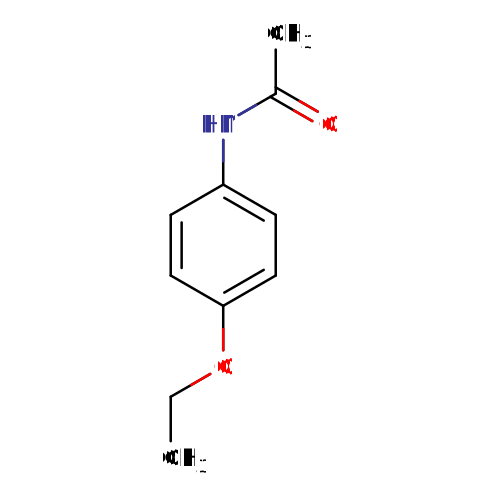
Chemical Structure
Thumb
Synonyms
ValueSource
1-Acetamido-4-ethoxybenzeneChEBI
4-EthoxyacetanilideChEBI
AcetophenetidinChEBI
AcetophenetidineChEBI
AcetophenetinChEBI
AcetphenetidinChEBI
AchrocidinChEBI
CodempiralChEBI
CommotionalChEBI
ContradolChEBI
ContradouleurChEBI
FenacetinaChEBI
N-(4-Ethoxyphenyl)acetamideChEBI
PhenacetineChEBI
PhenacetinumChEBI
Chemical FormulaC10H13NO2
Average Molecular Mass179.216 g/mol
Monoisotopic Mass179.095 g/mol
CAS Registry Number62-44-2
IUPAC NameN-(4-ethoxyphenyl)acetamide
Traditional Namephenacetin
SMILESCCOC1=CC=C(NC(C)=O)C=C1
InChI IdentifierInChI=1S/C10H13NO2/c1-3-13-10-6-4-9(5-7-10)11-8(2)12/h4-7H,3H2,1-2H3,(H,11,12)
InChI KeyCPJSUEIXXCENMM-UHFFFAOYSA-N
Chemical Taxonomy
Description belongs to the class of organic compounds known as acetanilides. These are organic compounds containing an acetamide group conjugated to a phenyl group.
KingdomOrganic compounds
Super ClassBenzenoids
ClassBenzene and substituted derivatives
Sub ClassAnilides
Direct ParentAcetanilides
Alternative Parents
Substituents
  • Acetanilide
  • N-acetylarylamine
  • Phenoxy compound
  • Phenol ether
  • N-arylamide
  • Alkyl aryl ether
  • Acetamide
  • Carboxamide group
  • Secondary carboxylic acid amide
  • Ether
  • Carboxylic acid derivative
  • Organic oxygen compound
  • Organopnictogen compound
  • Organooxygen compound
  • Organonitrogen compound
  • Organic nitrogen compound
  • Carbonyl group
  • Organic oxide
  • Hydrocarbon derivative
  • Aromatic homomonocyclic compound
Molecular FrameworkAromatic homomonocyclic compounds
External Descriptors
Biological Properties
StatusDetected and Not Quantified
OriginExogenous
Cellular Locations
  • Membrane
Biofluid LocationsNot Available
Tissue LocationsNot Available
PathwaysNot Available
ApplicationsNot Available
Biological RolesNot Available
Chemical RolesNot Available
Physical Properties
StateSolid
AppearanceWhite powder.
Experimental Properties
PropertyValue
Melting Point137.5°C
Boiling PointNot Available
Solubility766 mg/L (at 25°C)
Predicted Properties
PropertyValueSource
Water Solubility1.78 g/LALOGPS
logP1.62ALOGPS
logP1.41ChemAxon
logS-2ALOGPS
pKa (Strongest Acidic)14.98ChemAxon
pKa (Strongest Basic)-4.2ChemAxon
Physiological Charge0ChemAxon
Hydrogen Acceptor Count2ChemAxon
Hydrogen Donor Count1ChemAxon
Polar Surface Area38.33 ŲChemAxon
Rotatable Bond Count3ChemAxon
Refractivity52.13 m³·mol⁻¹ChemAxon
Polarizability19.82 ųChemAxon
Number of Rings1ChemAxon
Bioavailability1ChemAxon
Rule of FiveYesChemAxon
Ghose FilterYesChemAxon
Veber's RuleYesChemAxon
MDDR-like RuleNoChemAxon
Spectra
Spectra
Spectrum TypeDescriptionSplash KeyView
GC-MSGC-MS Spectrum - CI-B (Non-derivatized)splash10-001i-0900000000-335c6f93c6c61172facaSpectrum
Predicted GC-MSPredicted GC-MS Spectrum - GC-MS (Non-derivatized) - 70eV, Positivesplash10-0r09-1900000000-693fadbb890b194d9f4bSpectrum
Predicted GC-MSPredicted GC-MS Spectrum - GC-MS (Non-derivatized) - 70eV, PositiveNot AvailableSpectrum
LC-MS/MSLC-MS/MS Spectrum - LC-ESI-qTof , Positivesplash10-03di-6900100000-e5425770c8b511b991faSpectrum
LC-MS/MSLC-MS/MS Spectrum - LC-ESI-QTOF , positivesplash10-001i-0900000000-ff1bc2f7f827dd1711f6Spectrum
LC-MS/MSLC-MS/MS Spectrum - LC-ESI-QTOF , positivesplash10-01qi-0900000000-8d7f58b56528e6f12b90Spectrum
LC-MS/MSLC-MS/MS Spectrum - LC-ESI-QTOF , positivesplash10-03di-0900000000-632d2f940d3bf1e4b090Spectrum
LC-MS/MSLC-MS/MS Spectrum - LC-ESI-QTOF , positivesplash10-03di-2900000000-a8b75ec081cf2f9bd170Spectrum
LC-MS/MSLC-MS/MS Spectrum - LC-ESI-QTOF , positivesplash10-0c03-2900000000-115f1b03c65a7dc2e1e9Spectrum
LC-MS/MSLC-MS/MS Spectrum - , positivesplash10-001i-0900000000-375522dc595b7e227b62Spectrum
LC-MS/MSLC-MS/MS Spectrum - , positivesplash10-03di-6900100000-e5425770c8b511b991faSpectrum
LC-MS/MSLC-MS/MS Spectrum - 30V, Positivesplash10-03di-0900000000-698cff42b1b6605dd2c8Spectrum
LC-MS/MSLC-MS/MS Spectrum - 90V, Positivesplash10-03xr-8900000000-c35af434bc3a9f36b748Spectrum
LC-MS/MSLC-MS/MS Spectrum - 75V, Positivesplash10-03di-3900000000-8363e8eced8d1e99af1dSpectrum
LC-MS/MSLC-MS/MS Spectrum - 40V, Positivesplash10-03di-2900000000-a894326d86b9ce21e136Spectrum
LC-MS/MSLC-MS/MS Spectrum - 60V, Positivesplash10-03di-0900000000-ace73eb8b42719a7c2c3Spectrum
LC-MS/MSLC-MS/MS Spectrum - 15V, Positivesplash10-001i-0900000000-676cc1faca1027bed0ffSpectrum
LC-MS/MSLC-MS/MS Spectrum - 50V, Positivesplash10-0c03-2900000000-115f1b03c65a7dc2e1e9Spectrum
LC-MS/MSLC-MS/MS Spectrum - 30V, Positivesplash10-001i-0900000000-8d1dd9759f580c330fd0Spectrum
LC-MS/MSLC-MS/MS Spectrum - 45V, Positivesplash10-03ei-0900000000-922db44266944eac53c3Spectrum
LC-MS/MSLC-MS/MS Spectrum - 40V, Positivesplash10-03di-2900000000-a8b75ec081cf2f9bd170Spectrum
LC-MS/MSLC-MS/MS Spectrum - 30V, Positivesplash10-03di-0900000000-632d2f940d3bf1e4b090Spectrum
Predicted LC-MS/MSPredicted LC-MS/MS Spectrum - 10V, Positivesplash10-001r-0900000000-06f027a46bdc57e87bceSpectrum
Predicted LC-MS/MSPredicted LC-MS/MS Spectrum - 20V, Positivesplash10-000i-0900000000-c452f944a1db68cee3c0Spectrum
Predicted LC-MS/MSPredicted LC-MS/MS Spectrum - 40V, Positivesplash10-0api-5900000000-f70777770ccda7bb06c7Spectrum
Predicted LC-MS/MSPredicted LC-MS/MS Spectrum - 10V, Negativesplash10-004i-0900000000-cd4d0176028d2239a02bSpectrum
Predicted LC-MS/MSPredicted LC-MS/MS Spectrum - 20V, Negativesplash10-0kbr-1900000000-ffdf4ba50461a7f4a9e0Spectrum
Predicted LC-MS/MSPredicted LC-MS/MS Spectrum - 40V, Negativesplash10-0a4i-3900000000-b21ee1fba6c9e0e2a84fSpectrum
MSMass Spectrum (Electron Ionization)splash10-0a4i-3900000000-a251ba59f8f792deb3e1Spectrum
1D NMR1H NMR SpectrumNot AvailableSpectrum
1D NMR13C NMR SpectrumNot AvailableSpectrum
Toxicity Profile
Route of ExposureNot Available
Mechanism of ToxicityPhenacetin's analgesic effects are due to its actions on the sensory tracts of the spinal cord. In addition, phenacetin has a depressant action on the heart, where it acts as a negative inotrope. It is an antipyretic, acting on the brain to decrease the temperature set point. It is also used to treat rheumatoid arthritis (subacute type) and intercostal neuralgia.
MetabolismMetabolised in the body to paracetamol.
Toxicity ValuesAcute oral toxicity (LD50): 866 mg/kg [Mouse].
Lethal DoseNot Available
Carcinogenicity (IARC Classification)1, carcinogenic to humans. (5)
Uses/SourcesUsed principally as an analgesic.
Minimum Risk LevelNot Available
Health EffectsNot Available
SymptomsNot Available
TreatmentNot Available
Concentrations
Not Available
DrugBank IDDB03783
HMDB IDHMDB0256387
FooDB IDNot Available
Phenol Explorer IDNot Available
KNApSAcK IDNot Available
BiGG IDNot Available
BioCyc IDNot Available
METLIN IDNot Available
PDB IDNot Available
Wikipedia LinkPhenacetin
Chemspider ID4590
ChEBI ID8050
PubChem Compound IDNot Available
Kegg Compound IDC07591
YMDB IDNot Available
ECMDB IDNot Available
References
Synthesis Reference

Ernst Bocker, Wolfgang Kracht, Roland Rupp, Erhard Schellmann, Viktor Trescher, Martin Ullrich, “Preparation of melt-sprayed spherical phenacetin granules.” U.S. Patent US4086346, issued October, 1972.

MSDSNot Available
General References
1. https://www.ncbi.nlm.nih.gov/pubmed/?term=24201458
2. https://www.ncbi.nlm.nih.gov/pubmed/?term=24447449