Record Information
Version1.0
Creation Date2014-09-11 02:04:13 UTC
Update Date2026-04-16 20:50:24 UTC
Accession NumberCHEM003630
Identification
Common Name4,4'-Methylenedianiline
ClassSmall Molecule
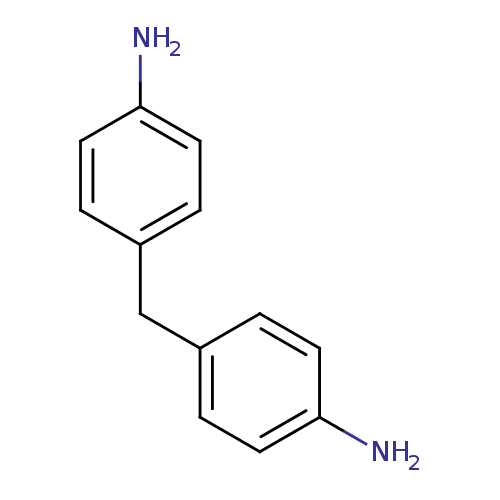
Description4,4'-methylenedianiline belongs to the family of Diphenylmethanes. These are compounds containing a diphenylmethane moiety, which consists of a methane wherein two hydrogen atoms are replaced by two phenyl groups[1].
Contaminant Sources
  • Clean Air Act Chemicals
  • ECHA Carcinogen
  • HPV EPA Chemicals
  • IARC Carcinogens Group 2B
  • OECD HPV Chemicals
  • STOFF IDENT Compounds
  • T3DB toxins
  • ToxCast & Tox21 Chemicals
Contaminant Type
  • Amine
  • Industrial/Workplace Toxin
  • Metabolite
  • Organic Compound
  • Pollutant
  • Synthetic Compound
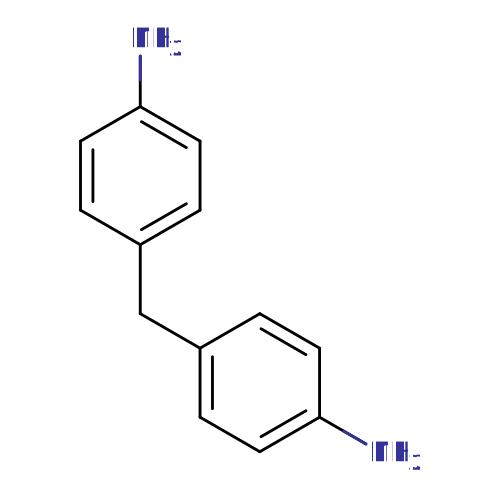
Chemical Structure
Thumb
Synonyms
ValueSource
4,4'-DiphenylmethanediamineChEBI
4,4'-Methylenebis(benzeneamine)ChEBI
4-(4-Aminobenzyl)anilineChEBI
alpha-(p-Aminophenyl)-p-toluidineChEBI
Bis(4-aminophenyl)methaneChEBI
Bis(p-aminophenyl)methaneChEBI
Bis-p-aminophenylmethaneChEBI
DADPMChEBI
DAPMChEBI
DDMChEBI
Di-(4-aminophenyl)methaneChEBI
Di-(p-aminophenyl)methaneChEBI
DianilinomethaneChEBI
p,P'-diaminodiphenylmethaneChEBI
p,P'-methylenedianilineChEBI
4,4'-DiaminodiphenylmethaneKegg
a-(p-Aminophenyl)-p-toluidineGenerator
Α-(p-aminophenyl)-p-toluidineGenerator
4, 4'-DiphenylmethanediamineHMDB
4, 4'-Methylenebis(aniline)HMDB
4,4'-DiaminodiphenylmethanHMDB
4,4'-Methylene(bisaniline)HMDB
4,4'-Methylene-dianilineHMDB
4,4'-Methylenebis-benzenamineHMDB
4,4'-Methylenebis[aniline]HMDB
4,4'-Methylenedi-anilineHMDB
4,4'-MethylenedibenzenamineHMDB
4,4-MethylenedianilineHMDB
4-(4-Aminobenzyl)phenylamine (acd/name 4.0)HMDB
Ancamine TLHMDB
Araldite hardener 972HMDB
Bis(aminophenyl)methaneHMDB
Bis-p-aminofenylmethanHMDB
CurithaneHMDB
Di(4-aminophenyl)methaneHMDB
DiaminodiphenylmethaneHMDB
DianilinemethaneHMDB
Epicure DDMHMDB
Epikure DDMHMDB
Jeffamine ap-20HMDB
MDAHMDB
Methylenebis(aniline)HMDB
Methylenebis[aniline]HMDB
MethylenedianilineHMDB
p, P'-methylenedianilineHMDB
p,P'-diaminodifenylmethanHMDB
Sumicure mHMDB
TonoxHMDB
4,4'-Diaminodiphenylmethane, sodium chloride (3:1)HMDB
4,4'-Diaminodiphenylmethane dihydrochlorideHMDB
4,4'-Methylene dianilineHMDB
4,4'-MethylenebisanilineHMDB
4,4'-MDAHMDB
4,4'-MethylenedianilineChEBI
Chemical FormulaC13H14N2
Average Molecular Mass198.264 g/mol
Monoisotopic Mass198.116 g/mol
CAS Registry Number101-77-9
IUPAC Name4-[(4-aminophenyl)methyl]aniline
Traditional Name4,4'-diaminodiphenylmethane
SMILESNC1=CC=C(CC2=CC=C(N)C=C2)C=C1
InChI IdentifierInChI=1S/C13H14N2/c14-12-5-1-10(2-6-12)9-11-3-7-13(15)8-4-11/h1-8H,9,14-15H2
InChI KeyYBRVSVVVWCFQMG-UHFFFAOYSA-N
Chemical Taxonomy
Description belongs to the class of organic compounds known as diphenylmethanes. Diphenylmethanes are compounds containing a diphenylmethane moiety, which consists of a methane wherein two hydrogen atoms are replaced by two phenyl groups.
KingdomOrganic compounds
Super ClassBenzenoids
ClassBenzene and substituted derivatives
Sub ClassDiphenylmethanes
Direct ParentDiphenylmethanes
Alternative Parents
Substituents
  • Diphenylmethane
  • Aniline or substituted anilines
  • Organic nitrogen compound
  • Organopnictogen compound
  • Hydrocarbon derivative
  • Primary amine
  • Organonitrogen compound
  • Amine
  • Aromatic homomonocyclic compound
Molecular FrameworkAromatic homomonocyclic compounds
External Descriptors
Biological Properties
StatusDetected and Not Quantified
OriginExogenous
Cellular Locations
  • Membrane
Biofluid LocationsNot Available
Tissue LocationsNot Available
PathwaysNot Available
ApplicationsNot Available
Biological RolesNot Available
Chemical RolesNot Available
Physical Properties
StateSolid
AppearanceWhite powder.
Experimental Properties
PropertyValue
Melting Point92.5 °C
Boiling PointNot Available
Solubility1 mg/mL at 25 °C
Predicted Properties
PropertyValueSource
Water Solubility0.061 g/LALOGPS
logP2.04ALOGPS
logP2.41ChemAxon
logS-3.5ALOGPS
pKa (Strongest Basic)4.83ChemAxon
Physiological Charge0ChemAxon
Hydrogen Acceptor Count2ChemAxon
Hydrogen Donor Count2ChemAxon
Polar Surface Area52.04 ŲChemAxon
Rotatable Bond Count2ChemAxon
Refractivity65.2 m³·mol⁻¹ChemAxon
Polarizability22.48 ųChemAxon
Number of Rings2ChemAxon
Bioavailability1ChemAxon
Rule of FiveYesChemAxon
Ghose FilterYesChemAxon
Veber's RuleNoChemAxon
MDDR-like RuleNoChemAxon
Spectra
Spectra
Spectrum TypeDescriptionSplash KeyView
Predicted GC-MSPredicted GC-MS Spectrum - GC-MS (Non-derivatized) - 70eV, Positivesplash10-052b-1900000000-a1316bc903c186c14318Spectrum
Predicted GC-MSPredicted GC-MS Spectrum - GC-MS (Non-derivatized) - 70eV, PositiveNot AvailableSpectrum
Predicted LC-MS/MSPredicted LC-MS/MS Spectrum - 10V, Positivesplash10-000t-0900000000-4644a7dbb46f9d7b2ba1Spectrum
Predicted LC-MS/MSPredicted LC-MS/MS Spectrum - 20V, Positivesplash10-000t-0900000000-a4548ac0cc34b55b0737Spectrum
Predicted LC-MS/MSPredicted LC-MS/MS Spectrum - 40V, Positivesplash10-0pe9-3900000000-4cb485ecb653179900c3Spectrum
Predicted LC-MS/MSPredicted LC-MS/MS Spectrum - 10V, Negativesplash10-0002-0900000000-31a3645696c4f9d211baSpectrum
Predicted LC-MS/MSPredicted LC-MS/MS Spectrum - 20V, Negativesplash10-0002-0900000000-0e89f98c9bcf3071812eSpectrum
Predicted LC-MS/MSPredicted LC-MS/MS Spectrum - 40V, Negativesplash10-000w-4900000000-9cfc5d89ecd51b783c25Spectrum
Predicted LC-MS/MSPredicted LC-MS/MS Spectrum - 10V, Positivesplash10-0002-0900000000-d89ea9976ffd35a15c71Spectrum
Predicted LC-MS/MSPredicted LC-MS/MS Spectrum - 20V, Positivesplash10-0002-2900000000-5ccfe3083b2af59df353Spectrum
Predicted LC-MS/MSPredicted LC-MS/MS Spectrum - 40V, Positivesplash10-004l-7900000000-07b5c14a9b509e0f3922Spectrum
Predicted LC-MS/MSPredicted LC-MS/MS Spectrum - 10V, Negativesplash10-0002-0900000000-d2d648aa4423d0c7a455Spectrum
Predicted LC-MS/MSPredicted LC-MS/MS Spectrum - 20V, Negativesplash10-0002-0900000000-d2d648aa4423d0c7a455Spectrum
Predicted LC-MS/MSPredicted LC-MS/MS Spectrum - 40V, Negativesplash10-001i-1900000000-b08e84c052ca33f2d5b9Spectrum
MSMass Spectrum (Electron Ionization)splash10-0002-1900000000-3ade5e930b45bb46e746Spectrum
1D NMR13C NMR SpectrumNot AvailableSpectrum
Toxicity Profile
Route of ExposureInhalation, oral, dermal
Mechanism of ToxicityAfter 4,4'-Methylenedianiline enters to our body, it is transported in the blood or stored in tissues. The N-N-acetylation of the compound leads to the formation of some toxic derivatives. The liver and thyroid are the targets of 4,4'-methylenedianiline in animals.
MetabolismNot Available
Toxicity ValuesNot Available
Lethal DoseNot Available
Carcinogenicity (IARC Classification)2B, possibly carcinogenic to humans. (4)
Uses/SourcesNot Available
Minimum Risk LevelNot Available
Health EffectsNot Available
SymptomsNot Available
TreatmentNot Available
Concentrations
Not Available
DrugBank IDNot Available
HMDB IDHMDB0041808
FooDB IDNot Available
Phenol Explorer IDNot Available
KNApSAcK IDNot Available
BiGG IDNot Available
BioCyc IDNot Available
METLIN IDNot Available
PDB IDNot Available
Wikipedia Link4,4'-Methylenedianiline
Chemspider ID7296
ChEBI ID32506
PubChem Compound ID7577
Kegg Compound IDC14288
YMDB IDNot Available
ECMDB IDNot Available
References
Synthesis ReferenceNot Available
MSDSNot Available
General References
1. https://www.ncbi.nlm.nih.gov/pubmed/?term=17061110
2. https://www.ncbi.nlm.nih.gov/pubmed/?term=17482318
3. https://www.ncbi.nlm.nih.gov/pubmed/?term=18844695
4. https://www.ncbi.nlm.nih.gov/pubmed/?term=22393703
5. https://www.ncbi.nlm.nih.gov/pubmed/?term=2607764
6. https://www.ncbi.nlm.nih.gov/pubmed/?term=7265110
7. https://www.ncbi.nlm.nih.gov/pubmed/?term=9022650
8. Pludro G, Karlowski K, Mankowska M, Woggon H, Uhde WJ: [Toxicological and chemical studies of some epoxy resins and hardeners. I. Study of acute and subacute toxicity of phthalic acid anhydride, 4,4'diaminodiphenylmethane and epoxy resin Epilox EG-34]. Acta Pol Pharm. 1969;26(4):353-8.
9. Yasuda SK: Determination of 3,3'-dichloro-4,4'-diaminodiphenylmethane in air. J Chromatogr. 1975 Feb 12;104(2):283-90.
10. Manis MO, Braselton WE Jr: Structure elucidation and in vitro reactivity of the major metabolite of 4,4'-methylenebis(2-chloroaniline) (MBOCA) in canine urine. Fundam Appl Toxicol. 1984 Dec;4(6):1000-8.
11. Giouleme O, Karabatsou S, Hytiroglou P, Xanthis A, Tsiaousi E, Katsaros M, Koliouskas D: 4,4'-Methylenedianiline-induced hepatitis in an industrial worker: case report and review of the literature. Hum Exp Toxicol. 2011 Jul;30(7):762-7. doi: 10.1177/0960327110376549. Epub 2010 Jul 9.
12. Oh JH, Yoon HJ, Lim JS, Park HJ, Cho JW, Kwon MS, Yoon S: Analysis of Gene Expression in 4,4'-Methylenedianiline-induced Acute Hepatotoxicity. Toxicol Res. 2009 Jun;25(2):85-92. doi: 10.5487/TR.2009.25.2.085. Epub 2009 Jun 1.