Record Information
Version1.0
Creation Date2014-09-08 02:39:15 UTC
Update Date2026-04-16 21:17:41 UTC
Accession NumberCHEM003599
Identification
Common Name2,5-Hexanedione
ClassSmall Molecule
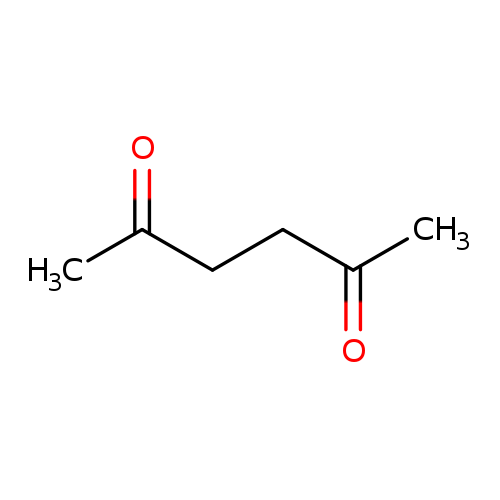
Description2,5-Hexanedione is an aliphatic diketone. It is a prototypical neurotoxicants metabolite of hexane and of 2-hexanone that presumably act through the formation of protein adducts. It appears that the neurotoxicity of 2,5-hexanedione resides in its gamma-diketone structure since 2,3-, 2,4-hexanedione and 2,6-heptanedione are not neurotoxic, while 2,5-heptanedione and 3,6-octanedione and other gamma-diketones are neurotoxic. 2,5-Hexanedione reacts with critical lysine residues in axonal proteins by Schiff base formation followed by cyclization to give pyrroles. Oxidation of the pyrrole residues then causes cross-linking between two n-hexane-modified proteins. The resulting denaturation of proteins perturbs axonal transport and function and causes damage to nerve cells.
Contaminant Sources
  • HPV EPA Chemicals
  • T3DB toxins
  • ToxCast & Tox21 Chemicals
Contaminant Type
  • Industrial/Workplace Toxin
  • Organic Compound
  • Synthetic Compound
Chemical Structure
Thumb
Synonyms
ValueSource
1,2-DiacetylethaneChEBI
2,5-DiketohexaneChEBI
2,5-HexadioneChEBI
Acetonyl acetoneChEBI
AcetonylacetoneChEBI
alpha,beta-DiacetylethaneChEBI
CH3COCH2CH2COCH3ChEBI
Hexane-2,5-dioneChEBI
NSC 7621ChEBI
a,b-DiacetylethaneGenerator
Α,β-diacetylethaneGenerator
alpha, beta-DiacetylethaneHMDB
DiacetonylHMDB
2,5-DioxohexaneHMDB
Acetone, acetonylHMDB
Chemical FormulaC6H10O2
Average Molecular Mass114.142 g/mol
Monoisotopic Mass114.068 g/mol
CAS Registry Number110-13-4
IUPAC Namehexane-2,5-dione
Traditional Name2,5-hexanedione
SMILESCC(=O)CCC(C)=O
InChI IdentifierInChI=1S/C6H10O2/c1-5(7)3-4-6(2)8/h3-4H2,1-2H3
InChI KeyOJVAMHKKJGICOG-UHFFFAOYSA-N
Chemical Taxonomy
Description belongs to the class of organic compounds known as ketones. These are organic compounds in which a carbonyl group is bonded to two carbon atoms R2C=O (neither R may be a hydrogen atom). Ketones that have one or more alpha-hydrogen atoms undergo keto-enol tautomerization, the tautomer being an enol.
KingdomOrganic compounds
Super ClassOrganic oxygen compounds
ClassOrganooxygen compounds
Sub ClassCarbonyl compounds
Direct ParentKetones
Alternative Parents
Substituents
  • Ketone
  • Organic oxide
  • Hydrocarbon derivative
  • Aliphatic acyclic compound
Molecular FrameworkAliphatic acyclic compounds
External Descriptors
Biological Properties
StatusDetected and Not Quantified
OriginExogenous
Cellular Locations
  • Actin Filament
  • Cell surface
  • Cytoplasm
  • Cytoskeleton
  • Cytosol
  • Endoplasmic reticulum
  • Extracellular
  • Intermediate Filament
  • Microtubule
  • Mitochondrion
  • Nerve Fiber
  • Perinuclear region
  • Plasma Membrane
  • Synaptic Vesicle
  • Tubulin
Biofluid LocationsNot Available
Tissue LocationsNot Available
Pathways
NameSMPDB LinkKEGG Link
ApoptosisNot Availablemap04210
Cell cycleNot Availablemap04110
Metabolic PathwaysNot AvailableNot Available
Pentose Phosphate PathwaySMP00031 map00030
Dna replicationNot Availablemap03030
ApplicationsNot Available
Biological RolesNot Available
Chemical RolesNot Available
Physical Properties
StateSolid
AppearanceWhite powder.
Experimental Properties
PropertyValue
Melting PointNot Available
Boiling PointNot Available
SolubilityNot Available
Predicted Properties
PropertyValueSource
Water Solubility50.8 g/LALOGPS
logP0.28ALOGPS
logP0.26ChemAxon
logS-0.35ALOGPS
pKa (Strongest Acidic)17.73ChemAxon
pKa (Strongest Basic)-7ChemAxon
Physiological Charge0ChemAxon
Hydrogen Acceptor Count2ChemAxon
Hydrogen Donor Count0ChemAxon
Polar Surface Area34.14 ŲChemAxon
Rotatable Bond Count3ChemAxon
Refractivity30.64 m³·mol⁻¹ChemAxon
Polarizability12.25 ųChemAxon
Number of Rings0ChemAxon
Bioavailability1ChemAxon
Rule of FiveYesChemAxon
Ghose FilterNoChemAxon
Veber's RuleYesChemAxon
MDDR-like RuleNoChemAxon
Spectra
Spectra
Spectrum TypeDescriptionSplash KeyView
Predicted GC-MSPredicted GC-MS Spectrum - GC-MS (Non-derivatized) - 70eV, Positivesplash10-0006-9000000000-d92e1919424eac03a7b0Spectrum
Predicted GC-MSPredicted GC-MS Spectrum - GC-MS (Non-derivatized) - 70eV, PositiveNot AvailableSpectrum
Predicted LC-MS/MSPredicted LC-MS/MS Spectrum - 10V, Positivesplash10-014j-8900000000-0939439a09c8f7b2e93eSpectrum
Predicted LC-MS/MSPredicted LC-MS/MS Spectrum - 20V, Positivesplash10-014j-9500000000-61e195dbb4527ae29973Spectrum
Predicted LC-MS/MSPredicted LC-MS/MS Spectrum - 40V, Positivesplash10-0fb9-9000000000-62487cfd16429e9987dbSpectrum
Predicted LC-MS/MSPredicted LC-MS/MS Spectrum - 10V, Negativesplash10-03di-1900000000-4f7742ff49533756a116Spectrum
Predicted LC-MS/MSPredicted LC-MS/MS Spectrum - 20V, Negativesplash10-03di-3900000000-5dd73a1849e09ffe97f6Spectrum
Predicted LC-MS/MSPredicted LC-MS/MS Spectrum - 40V, Negativesplash10-0005-9100000000-d506ae3a57d26118dc6fSpectrum
Predicted LC-MS/MSPredicted LC-MS/MS Spectrum - 10V, Positivesplash10-002b-9000000000-c8a6489ae02a5c461b88Spectrum
Predicted LC-MS/MSPredicted LC-MS/MS Spectrum - 20V, Positivesplash10-004i-9000000000-fdcbb1c7525a2d2b215fSpectrum
Predicted LC-MS/MSPredicted LC-MS/MS Spectrum - 40V, Positivesplash10-004l-9000000000-d90562a5cfb0bfa4edd2Spectrum
Predicted LC-MS/MSPredicted LC-MS/MS Spectrum - 10V, Negativesplash10-03di-3900000000-0eebb1bf4507776306ddSpectrum
Predicted LC-MS/MSPredicted LC-MS/MS Spectrum - 20V, Negativesplash10-0007-9100000000-057abf81800767fcc8efSpectrum
Predicted LC-MS/MSPredicted LC-MS/MS Spectrum - 40V, Negativesplash10-0007-9000000000-bbf5a0c5b8967d589b83Spectrum
MSMass Spectrum (Electron Ionization)splash10-0006-9000000000-32eba5bb2c4f125d9a03Spectrum
1D NMR1H NMR SpectrumNot AvailableSpectrum
1D NMR13C NMR SpectrumNot AvailableSpectrum
1D NMR1H NMR SpectrumNot AvailableSpectrum
1D NMR13C NMR SpectrumNot AvailableSpectrum
1D NMR1H NMR SpectrumNot AvailableSpectrum
1D NMR13C NMR SpectrumNot AvailableSpectrum
1D NMR1H NMR SpectrumNot AvailableSpectrum
1D NMR13C NMR SpectrumNot AvailableSpectrum
1D NMR1H NMR SpectrumNot AvailableSpectrum
1D NMR13C NMR SpectrumNot AvailableSpectrum
1D NMR1H NMR SpectrumNot AvailableSpectrum
1D NMR13C NMR SpectrumNot AvailableSpectrum
1D NMR1H NMR SpectrumNot AvailableSpectrum
1D NMR13C NMR SpectrumNot AvailableSpectrum
1D NMR1H NMR SpectrumNot AvailableSpectrum
1D NMR13C NMR SpectrumNot AvailableSpectrum
1D NMR1H NMR SpectrumNot AvailableSpectrum
1D NMR13C NMR SpectrumNot AvailableSpectrum
1D NMR1H NMR SpectrumNot AvailableSpectrum
1D NMR13C NMR SpectrumNot AvailableSpectrum
1D NMR1H NMR SpectrumNot AvailableSpectrum
Toxicity Profile
Route of ExposureNot Available
Mechanism of ToxicityNot Available
MetabolismNot Available
Toxicity ValuesNot Available
Lethal DoseNot Available
Carcinogenicity (IARC Classification)No indication of carcinogenicity to humans (not listed by IARC).
Uses/SourcesNot Available
Minimum Risk LevelNot Available
Health EffectsNot Available
SymptomsNot Available
TreatmentNot Available
Concentrations
Not Available
DrugBank IDNot Available
HMDB IDHMDB0245506
FooDB IDNot Available
Phenol Explorer IDNot Available
KNApSAcK IDNot Available
BiGG IDNot Available
BioCyc IDCPD-15521
METLIN IDNot Available
PDB IDNot Available
Wikipedia LinkHexane-2,5-dione
Chemspider ID7744
ChEBI ID85014
PubChem Compound ID8035
Kegg Compound IDNot Available
YMDB IDNot Available
ECMDB IDNot Available
References
Synthesis ReferenceNot Available
MSDSNot Available
General References
1. https://www.ncbi.nlm.nih.gov/pubmed/?term=1781736
2. https://www.ncbi.nlm.nih.gov/pubmed/?term=24634916
3. https://www.ncbi.nlm.nih.gov/pubmed/?term=25549948
4. Barupal DK, Fiehn O: Generating the Blood Exposome Database Using a Comprehensive Text Mining and Database Fusion Approach. Environ Health Perspect. 2019 Sep;127(9):97008. doi: 10.1289/EHP4713. Epub 2019 Sep 26.