Record Information
Version1.0
Creation Date2014-09-08 02:38:36 UTC
Update Date2026-04-17 16:06:32 UTC
Accession NumberCHEM003590
Identification
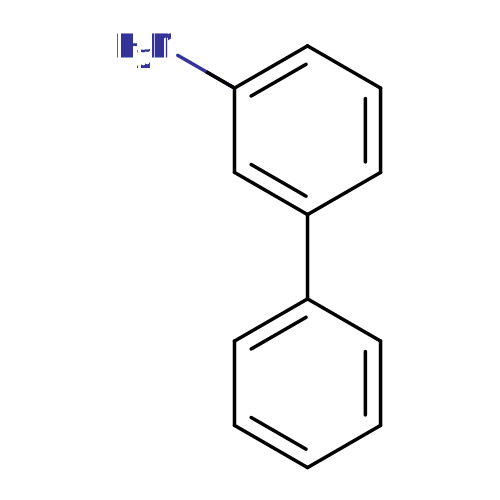
Common Name3-Aminobiphenyl
ClassSmall Molecule
Description3-Aminobiphenyl is an amine derivative of biphenyl. It is used to manufacture azo dyes. It is a known human carcinogen[2] and so it has been largely replaced by less toxic compounds.
Contaminant Sources
  • T3DB toxins
  • Tobacco Smoke Compounds
Contaminant Type
  • Amine
  • Dye
  • Industrial/Workplace Toxin
  • Organic Compound
  • Synthetic Compound
Chemical Structure
Thumb
SynonymsNot Available
Chemical FormulaC12H11N
Average Molecular Mass169.222 g/mol
Monoisotopic Mass169.089 g/mol
CAS Registry Number2243-47-2
IUPAC Name3-phenylaniline
Traditional Name3-phenylaniline
SMILESNC1=CC=CC(=C1)C1=CC=CC=C1
InChI IdentifierInChI=1S/C12H11N/c13-12-8-4-7-11(9-12)10-5-2-1-3-6-10/h1-9H,13H2
InChI KeyMUNOBADFTHUUFG-UHFFFAOYSA-N
Chemical Taxonomy
Description belongs to the class of organic compounds known as biphenyls and derivatives. These are organic compounds containing to benzene rings linked together by a C-C bond.
KingdomOrganic compounds
Super ClassBenzenoids
ClassBenzene and substituted derivatives
Sub ClassBiphenyls and derivatives
Direct ParentBiphenyls and derivatives
Alternative Parents
Substituents
  • Biphenyl
  • Aniline or substituted anilines
  • Organic nitrogen compound
  • Organopnictogen compound
  • Hydrocarbon derivative
  • Primary amine
  • Organonitrogen compound
  • Amine
  • Aromatic homomonocyclic compound
Molecular FrameworkAromatic homomonocyclic compounds
External DescriptorsNot Available
Biological Properties
StatusDetected and Not Quantified
OriginExogenous
Cellular Locations
  • Cytosol
  • Extracellular matrix
  • Membrane
  • Microsome
  • Soluble Fraction
Biofluid LocationsNot Available
Tissue LocationsNot Available
Pathways
NameSMPDB LinkKEGG Link
Nucleotide Excision RepairSMP00478 map03420
Metabolic PathwaysNot AvailableNot Available
Rna polymeraseNot Availablemap03020
Dna replicationNot Availablemap03030
Cell cycleNot Availablemap04110
Base excision repairNot Availablemap03410
ApplicationsNot Available
Biological RolesNot Available
Chemical RolesNot Available
Physical Properties
StateSolid
AppearanceWhite powder.
Experimental Properties
PropertyValue
Melting PointNot Available
Boiling PointNot Available
SolubilityNot Available
Predicted Properties
PropertyValueSource
Water Solubility0.13 g/LALOGPS
logP2.85ALOGPS
logP2.79ChemAxon
logS-3.1ALOGPS
pKa (Strongest Basic)4.34ChemAxon
Physiological Charge0ChemAxon
Hydrogen Acceptor Count1ChemAxon
Hydrogen Donor Count1ChemAxon
Polar Surface Area26.02 ŲChemAxon
Rotatable Bond Count1ChemAxon
Refractivity55.89 m³·mol⁻¹ChemAxon
Polarizability19.43 ųChemAxon
Number of Rings2ChemAxon
Bioavailability1ChemAxon
Rule of FiveYesChemAxon
Ghose FilterYesChemAxon
Veber's RuleYesChemAxon
MDDR-like RuleNoChemAxon
Spectra
Spectra
Spectrum TypeDescriptionSplash KeyView
Predicted GC-MSPredicted GC-MS Spectrum - GC-MS (Non-derivatized) - 70eV, Positivesplash10-014i-1900000000-eefc9d3748d3a45b9e53Spectrum
Predicted GC-MSPredicted GC-MS Spectrum - GC-MS (Non-derivatized) - 70eV, PositiveNot AvailableSpectrum
Predicted LC-MS/MSPredicted LC-MS/MS Spectrum - 10V, Positivesplash10-00di-0900000000-41dec8c22ce8df936ffdSpectrum
Predicted LC-MS/MSPredicted LC-MS/MS Spectrum - 20V, Positivesplash10-00di-0900000000-b50fac70772ced3d0211Spectrum
Predicted LC-MS/MSPredicted LC-MS/MS Spectrum - 40V, Positivesplash10-0ufu-3900000000-aa21514c4b0e0b2e4a74Spectrum
Predicted LC-MS/MSPredicted LC-MS/MS Spectrum - 10V, Negativesplash10-014i-0900000000-f6225dee4453c17fce79Spectrum
Predicted LC-MS/MSPredicted LC-MS/MS Spectrum - 20V, Negativesplash10-014i-0900000000-facff158d936485e473fSpectrum
Predicted LC-MS/MSPredicted LC-MS/MS Spectrum - 40V, Negativesplash10-014i-2900000000-9b44b7354e812f83bf05Spectrum
Predicted LC-MS/MSPredicted LC-MS/MS Spectrum - 10V, Positivesplash10-00di-0900000000-f04809ed8d3ffdb9e395Spectrum
Predicted LC-MS/MSPredicted LC-MS/MS Spectrum - 20V, Positivesplash10-00di-0900000000-f04809ed8d3ffdb9e395Spectrum
Predicted LC-MS/MSPredicted LC-MS/MS Spectrum - 40V, Positivesplash10-0f96-0900000000-8cd7851b79483bb4a03dSpectrum
Predicted LC-MS/MSPredicted LC-MS/MS Spectrum - 10V, Negativesplash10-014i-0900000000-c8884063706b25aca801Spectrum
Predicted LC-MS/MSPredicted LC-MS/MS Spectrum - 20V, Negativesplash10-014i-0900000000-c8884063706b25aca801Spectrum
Predicted LC-MS/MSPredicted LC-MS/MS Spectrum - 40V, Negativesplash10-014i-0900000000-fab6b85ce05246043909Spectrum
Toxicity Profile
Route of ExposureNot Available
Mechanism of ToxicityNot Available
MetabolismNot Available
Toxicity ValuesNot Available
Lethal DoseNot Available
Carcinogenicity (IARC Classification)Not listed by IARC.
Uses/SourcesIt is used to manufacture azo dyes.
Minimum Risk LevelNot Available
Health EffectsNot Available
SymptomsNot Available
TreatmentNot Available
Concentrations
Not Available
DrugBank IDNot Available
HMDB IDHMDB0245817
FooDB IDNot Available
Phenol Explorer IDNot Available
KNApSAcK IDNot Available
BiGG IDNot Available
BioCyc IDNot Available
METLIN IDNot Available
PDB IDNot Available
Wikipedia Link3-Aminobiphenyl
Chemspider ID15848
ChEBI IDNot Available
PubChem Compound ID16717
Kegg Compound IDNot Available
YMDB IDNot Available
ECMDB IDNot Available
References
Synthesis ReferenceNot Available
MSDSNot Available
General References
1. Barupal DK, Fiehn O: Generating the Blood Exposome Database Using a Comprehensive Text Mining and Database Fusion Approach. Environ Health Perspect. 2019 Sep;127(9):97008. doi: 10.1289/EHP4713. Epub 2019 Sep 26.