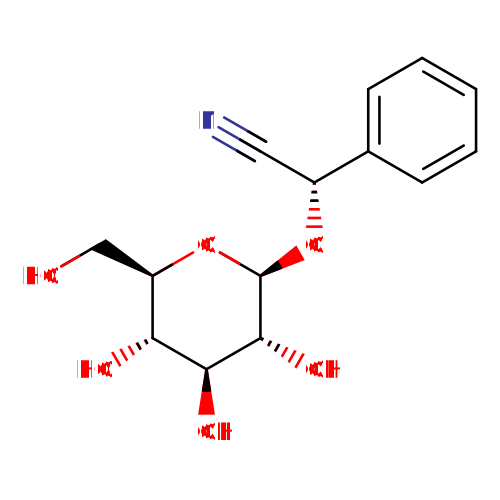
Record Information
Version1.0
Creation Date2014-09-05 17:14:54 UTC
Update Date2026-04-06 01:54:30 UTC
Accession NumberCHEM003579
Identification
Common NameSambunigrin
ClassSmall Molecule
DescriptionSambunigrin is found in black elderberry. Sambunigrin is isolated from leaves of elderberry (Sambucus nigra) and from other plantsSambunigrin belongs to the family of O-glycosyl Compounds. These are glycosides in which a sugar group is bonded through one carbon to another group via a O-glycosidic bond.
Contaminant Sources
  • FooDB Chemicals
  • T3DB toxins
Contaminant Type
  • Cyanogenic Glycoside
  • Ether
  • Food Toxin
  • Metabolite
  • Natural Compound
  • Nitrile
  • Organic Compound
  • Plant Toxin
Chemical Structure
Thumb
Synonyms
ValueSource
(2S)-SambunigrinChEBI
(S)-(beta-D-Glucopyranosyloxy)(phenyl)acetonitrileChEBI
(S)-Mandelonitrile beta-D-glucosideChEBI
(S)-O-beta-D-GlucopyranosylmandelonitrileChEBI
(S)-SambunigrinChEBI
L-PrunasinChEBI
(S)-(b-D-Glucopyranosyloxy)(phenyl)acetonitrileGenerator
(S)-(Β-D-glucopyranosyloxy)(phenyl)acetonitrileGenerator
(S)-Mandelonitrile b-D-glucosideGenerator
(S)-Mandelonitrile β-D-glucosideGenerator
(S)-O-b-D-GlucopyranosylmandelonitrileGenerator
(S)-O-Β-D-glucopyranosylmandelonitrileGenerator
(2S)-(beta-D-Glucopyranosyloxy)(phenyl)acetonitrileHMDB
(S)-PrunasinHMDB
SambunigrinMeSH
Chemical FormulaC14H17NO6
Average Molecular Mass295.288 g/mol
Monoisotopic Mass295.106 g/mol
CAS Registry Number99-19-4
IUPAC Name(2S)-2-phenyl-2-{[(2R,3R,4S,5S,6R)-3,4,5-trihydroxy-6-(hydroxymethyl)oxan-2-yl]oxy}acetonitrile
Traditional Name(S)-prunasin
SMILESOC[C@H]1O[C@@H](O[C@H](C#N)C2=CC=CC=C2)[C@H](O)[C@@H](O)[C@@H]1O
InChI IdentifierInChI=1S/C14H17NO6/c15-6-9(8-4-2-1-3-5-8)20-14-13(19)12(18)11(17)10(7-16)21-14/h1-5,9-14,16-19H,7H2/t9-,10-,11-,12+,13-,14-/m1/s1
InChI KeyZKSZEJFBGODIJW-YOVYLDAJSA-N
Chemical Taxonomy
Description belongs to the class of organic compounds known as cyanogenic glycosides. These are glycosides in which the aglycone moiety contains a cyanide group.
KingdomOrganic compounds
Super ClassOrganic oxygen compounds
ClassOrganooxygen compounds
Sub ClassCarbohydrates and carbohydrate conjugates
Direct ParentCyanogenic glycosides
Alternative Parents
Substituents
  • Cyanogenic glycoside
  • Hexose monosaccharide
  • O-glycosyl compound
  • Monocyclic benzene moiety
  • Monosaccharide
  • Oxane
  • Benzenoid
  • Secondary alcohol
  • Polyol
  • Nitrile
  • Carbonitrile
  • Acetal
  • Organoheterocyclic compound
  • Oxacycle
  • Primary alcohol
  • Organonitrogen compound
  • Hydrocarbon derivative
  • Alcohol
  • Organopnictogen compound
  • Organic nitrogen compound
  • Aromatic heteromonocyclic compound
Molecular FrameworkAromatic heteromonocyclic compounds
External Descriptors
Biological Properties
StatusDetected and Not Quantified
OriginExogenous
Cellular Locations
  • Cytoplasm
  • Extracellular
Biofluid LocationsNot Available
Tissue LocationsNot Available
PathwaysNot Available
ApplicationsNot Available
Biological RolesNot Available
Chemical RolesNot Available
Physical Properties
StateSolid
AppearanceWhite powder.
Experimental Properties
PropertyValue
Melting Point151 - 152 °C
Boiling PointNot Available
SolubilityNot Available
Predicted Properties
PropertyValueSource
Water Solubility28.2 g/LALOGPS
logP-0.56ALOGPS
logP-0.82ChemAxon
logS-1ALOGPS
pKa (Strongest Acidic)12.21ChemAxon
pKa (Strongest Basic)-3ChemAxon
Physiological Charge0ChemAxon
Hydrogen Acceptor Count7ChemAxon
Hydrogen Donor Count4ChemAxon
Polar Surface Area123.17 ŲChemAxon
Rotatable Bond Count4ChemAxon
Refractivity70.1 m³·mol⁻¹ChemAxon
Polarizability29.09 ųChemAxon
Number of Rings2ChemAxon
Bioavailability1ChemAxon
Rule of FiveYesChemAxon
Ghose FilterNoChemAxon
Veber's RuleNoChemAxon
MDDR-like RuleNoChemAxon
Spectra
Spectra
Spectrum TypeDescriptionSplash KeyView
Predicted GC-MSPredicted GC-MS Spectrum - GC-MS (Non-derivatized) - 70eV, Positivesplash10-02e9-5970000000-af7eea9783215b5077ecSpectrum
Predicted GC-MSPredicted GC-MS Spectrum - GC-MS (4 TMS) - 70eV, Positivesplash10-014i-2411490000-eb6d4c8c77d360144d24Spectrum
Predicted GC-MSPredicted GC-MS Spectrum - GC-MS (Non-derivatized) - 70eV, PositiveNot AvailableSpectrum
Predicted LC-MS/MSPredicted LC-MS/MS Spectrum - 10V, Positivesplash10-001j-0950000000-94af28ff3325aa91829fSpectrum
Predicted LC-MS/MSPredicted LC-MS/MS Spectrum - 20V, Positivesplash10-00lr-0900000000-c209318aed53a776a604Spectrum
Predicted LC-MS/MSPredicted LC-MS/MS Spectrum - 40V, Positivesplash10-067i-3900000000-f46229fde33733da738aSpectrum
Predicted LC-MS/MSPredicted LC-MS/MS Spectrum - 10V, Negativesplash10-000x-1890000000-a1a34454361f8a461a19Spectrum
Predicted LC-MS/MSPredicted LC-MS/MS Spectrum - 20V, Negativesplash10-001i-2910000000-9efa8331da9f7f35adb0Spectrum
Predicted LC-MS/MSPredicted LC-MS/MS Spectrum - 40V, Negativesplash10-003r-9800000000-6551bbcd67cdb9809506Spectrum
Predicted LC-MS/MSPredicted LC-MS/MS Spectrum - 10V, Negativesplash10-0006-0950000000-911e901878111f3552daSpectrum
Predicted LC-MS/MSPredicted LC-MS/MS Spectrum - 20V, Negativesplash10-0gc0-1910000000-e65f091dbdc8f43dd35cSpectrum
Predicted LC-MS/MSPredicted LC-MS/MS Spectrum - 40V, Negativesplash10-00lr-2900000000-ae791f613076bd282606Spectrum
Predicted LC-MS/MSPredicted LC-MS/MS Spectrum - 10V, Positivesplash10-014j-0930000000-b073c628b5ae90962ddbSpectrum
Predicted LC-MS/MSPredicted LC-MS/MS Spectrum - 20V, Positivesplash10-0159-1930000000-0195cac2f79233b86e61Spectrum
Predicted LC-MS/MSPredicted LC-MS/MS Spectrum - 40V, Positivesplash10-014i-6900000000-14cef03a9110265ac2a2Spectrum
1D NMR13C NMR SpectrumNot AvailableSpectrum
1D NMR1H NMR SpectrumNot AvailableSpectrum
1D NMR13C NMR SpectrumNot AvailableSpectrum
1D NMR1H NMR SpectrumNot AvailableSpectrum
1D NMR13C NMR SpectrumNot AvailableSpectrum
1D NMR1H NMR SpectrumNot AvailableSpectrum
1D NMR13C NMR SpectrumNot AvailableSpectrum
1D NMR1H NMR SpectrumNot AvailableSpectrum
1D NMR13C NMR SpectrumNot AvailableSpectrum
1D NMR1H NMR SpectrumNot AvailableSpectrum
1D NMR13C NMR SpectrumNot AvailableSpectrum
1D NMR1H NMR SpectrumNot AvailableSpectrum
1D NMR13C NMR SpectrumNot AvailableSpectrum
1D NMR1H NMR SpectrumNot AvailableSpectrum
1D NMR13C NMR SpectrumNot AvailableSpectrum
1D NMR1H NMR SpectrumNot AvailableSpectrum
1D NMR13C NMR SpectrumNot AvailableSpectrum
1D NMR1H NMR SpectrumNot AvailableSpectrum
1D NMR13C NMR SpectrumNot AvailableSpectrum
1D NMR1H NMR SpectrumNot AvailableSpectrum
Toxicity Profile
Route of ExposureNot Available
Mechanism of ToxicityOrganic nitriles decompose into cyanide ions both in vivo and in vitro. Consequently the primary mechanism of toxicity for organic nitriles is their production of toxic cyanide ions or hydrogen cyanide. Cyanide is an inhibitor of cytochrome c oxidase in the fourth complex of the electron transport chain (found in the membrane of the mitochondria of eukaryotic cells). It complexes with the ferric iron atom in this enzyme. The binding of cyanide to this cytochrome prevents transport of electrons from cytochrome c oxidase to oxygen. As a result, the electron transport chain is disrupted and the cell can no longer aerobically produce ATP for energy. Tissues that mainly depend on aerobic respiration, such as the central nervous system and the heart, are particularly affected. Cyanide is also known produce some of its toxic effects by binding to catalase, glutathione peroxidase, methemoglobin, hydroxocobalamin, phosphatase, tyrosinase, ascorbic acid oxidase, xanthine oxidase, succinic dehydrogenase, and Cu/Zn superoxide dismutase. Cyanide binds to the ferric ion of methemoglobin to form inactive cyanmethemoglobin. (2)
MetabolismOrganic nitriles are converted into cyanide ions through the action of cytochrome P450 enzymes in the liver. Cyanide is rapidly absorbed and distributed throughout the body. Cyanide is mainly metabolized into thiocyanate by either rhodanese or 3-mercaptopyruvate sulfur transferase. Cyanide metabolites are excreted in the urine. (1)
Toxicity ValuesNot Available
Lethal DoseNot Available
Carcinogenicity (IARC Classification)No indication of carcinogenicity to humans (not listed by IARC).
Uses/SourcesSambunigrin is found in black elderberry. Sambunigrin is isolated from leaves of elderberry (Sambucus nigra) and from other plantsSambunigrin belongs to the family of O-glycosyl Compounds.
Minimum Risk LevelNot Available
Health EffectsNot Available
SymptomsNot Available
TreatmentNot Available
Concentrations
Not Available
DrugBank IDNot Available
HMDB IDHMDB0034981
FooDB IDFDB013582
Phenol Explorer IDNot Available
KNApSAcK IDC00034206
BiGG IDNot Available
BioCyc IDCPD-20541
METLIN IDNot Available
PDB IDNot Available
Wikipedia LinkPrunasin
Chemspider ID82563
ChEBI ID27761
PubChem Compound ID91434
Kegg Compound IDC04273
YMDB IDNot Available
ECMDB IDNot Available
References
Synthesis ReferenceNot Available
MSDSNot Available
General References
1. https://www.ncbi.nlm.nih.gov/pubmed/?term=10854744
2. https://www.ncbi.nlm.nih.gov/pubmed/?term=32688921
3.
4. Yannai, Shmuel. (2004) Dictionary of food compounds with CD-ROM: Additives, flavors, and ingredients. Boca Raton: Chapman & Hall/CRC.