Record Information
Version1.0
Creation Date2014-09-05 17:12:30 UTC
Update Date2026-04-16 20:46:54 UTC
Accession NumberCHEM003560
Identification
Common NamePentadecanoic acid
ClassSmall Molecule
DescriptionPentadecanoic acid is a fatty acid of exogenous (primarily ruminant) origin. Many 'odd' length long chain amino acids are derived from the consumption of dairy fats (milk and meat). Pentadecanoic acid constitutes 1.05% of milk fat and 0.43% of ruminant meat fat. The content of heptadecanoic acid in the subcutaneous adipose tissue of humans appears to be a good biological marker of long-term milk fat intake in free-living individuals in populations with high consumption of dairy products. (8, 9).
Contaminant Sources
  • EAFUS Chemicals
  • FooDB Chemicals
  • HMDB Contaminants - Feces
  • HPV EPA Chemicals
  • T3DB toxins
  • ToxCast & Tox21 Chemicals
Contaminant Type
  • Animal Toxin
  • Food Toxin
  • Metabolite
  • Natural Compound
  • Organic Compound
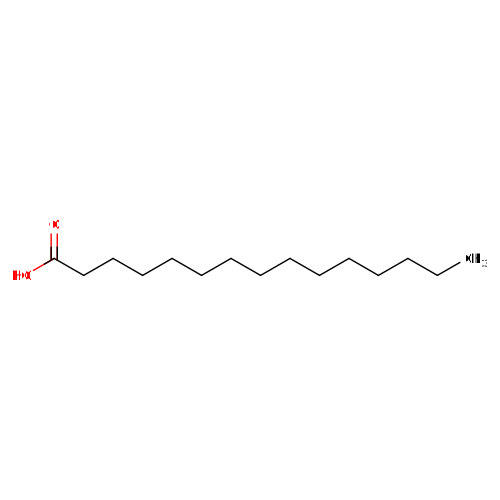
Chemical Structure
Thumb
Synonyms
ValueSource
15:00ChEBI
C15ChEBI
C15:0ChEBI
N-Pentadecanoic acidChEBI
Pentadecylic acidChEBI
N-PentadecanoateGenerator
PentadecylateGenerator
PentadecanoateGenerator
N-PentadecylateHMDB
N-Pentadecylic acidHMDB
PentadecyclateHMDB
Pentadecyclic acidHMDB
Pentadecanoic acidMeSH
FA(15:0)HMDB
14FAPhytoBank
Chemical FormulaC15H30O2
Average Molecular Mass242.398 g/mol
Monoisotopic Mass242.225 g/mol
CAS Registry Number1002-84-2
IUPAC Namepentadecanoic acid
Traditional Namepentadecanoic acid
SMILESCCCCCCCCCCCCCCC(O)=O
InChI IdentifierInChI=1S/C15H30O2/c1-2-3-4-5-6-7-8-9-10-11-12-13-14-15(16)17/h2-14H2,1H3,(H,16,17)
InChI KeyWQEPLUUGTLDZJY-UHFFFAOYSA-N
Chemical Taxonomy
Description belongs to the class of organic compounds known as long-chain fatty acids. These are fatty acids with an aliphatic tail that contains between 13 and 21 carbon atoms.
KingdomOrganic compounds
Super ClassLipids and lipid-like molecules
ClassFatty Acyls
Sub ClassFatty acids and conjugates
Direct ParentLong-chain fatty acids
Alternative Parents
Substituents
  • Long-chain fatty acid
  • Straight chain fatty acid
  • Monocarboxylic acid or derivatives
  • Carboxylic acid
  • Carboxylic acid derivative
  • Organic oxygen compound
  • Organic oxide
  • Hydrocarbon derivative
  • Organooxygen compound
  • Carbonyl group
  • Aliphatic acyclic compound
Molecular FrameworkAliphatic acyclic compounds
External Descriptors
Biological Properties
StatusDetected and Not Quantified
OriginEndogenous
Cellular Locations
  • Cytoplasm
  • Extracellular
  • Membrane
Biofluid LocationsNot Available
Tissue Locations
  • Adipose Tissue
PathwaysNot Available
ApplicationsNot Available
Biological Roles
Chemical RolesNot Available
Physical Properties
StateSolid
AppearanceWhite powder.
Experimental Properties
PropertyValue
Melting Point52.3 °C
Boiling PointNot Available
SolubilityNot Available
Predicted Properties
PropertyValueSource
Water Solubility0.00033 g/LALOGPS
logP6.65ALOGPS
logP5.81ChemAxon
logS-5.9ALOGPS
pKa (Strongest Acidic)4.95ChemAxon
Physiological Charge-1ChemAxon
Hydrogen Acceptor Count2ChemAxon
Hydrogen Donor Count1ChemAxon
Polar Surface Area37.3 ŲChemAxon
Rotatable Bond Count13ChemAxon
Refractivity72.48 m³·mol⁻¹ChemAxon
Polarizability32.23 ųChemAxon
Number of Rings0ChemAxon
Bioavailability0ChemAxon
Rule of FiveNoChemAxon
Ghose FilterNoChemAxon
Veber's RuleNoChemAxon
MDDR-like RuleNoChemAxon
Spectra
Spectra
Spectrum TypeDescriptionSplash KeyView
GC-MSGC-MS Spectrum - GC-MS (1 TMS)splash10-015a-2910000000-7f0113961bc4f281b68dSpectrum
GC-MSGC-MS Spectrum - GC-MS (Non-derivatized)splash10-015a-2910000000-7f0113961bc4f281b68dSpectrum
GC-MSGC-MS Spectrum - GC-EI-TOF (Non-derivatized)splash10-014i-1900000000-d69aa674fba2ef153294Spectrum
Predicted GC-MSPredicted GC-MS Spectrum - GC-MS (Non-derivatized) - 70eV, Positivesplash10-0006-9700000000-5fdb791c98a3d1afb3f2Spectrum
Predicted GC-MSPredicted GC-MS Spectrum - GC-MS (1 TMS) - 70eV, Positivesplash10-00ds-9440000000-c48712b46200e1d92783Spectrum
Predicted GC-MSPredicted GC-MS Spectrum - GC-MS (Non-derivatized) - 70eV, PositiveNot AvailableSpectrum
Predicted GC-MSPredicted GC-MS Spectrum - GC-MS (TBDMS_1_1) - 70eV, PositiveNot AvailableSpectrum
LC-MS/MSLC-MS/MS Spectrum - ESI-TOF 20V, Negativesplash10-00di-0900000000-6ec01ce9b8fdc68d94a9Spectrum
LC-MS/MSLC-MS/MS Spectrum - ESI-TOF 30V, Negativesplash10-00di-0900000000-6ec01ce9b8fdc68d94a9Spectrum
LC-MS/MSLC-MS/MS Spectrum - ESI-TOF 10V, Negativesplash10-00di-0900000000-6ec01ce9b8fdc68d94a9Spectrum
LC-MS/MSLC-MS/MS Spectrum - ESI-TOF , Negativesplash10-0006-0090000000-110165b889d231d09d59Spectrum
LC-MS/MSLC-MS/MS Spectrum - ESI-TOF 20V, Negativesplash10-0006-0090000000-e497b3530081726e5cedSpectrum
LC-MS/MSLC-MS/MS Spectrum - ESI-TOF 30V, Negativesplash10-0006-0090000000-15d18c0525685af6dadeSpectrum
LC-MS/MSLC-MS/MS Spectrum - ESI-TOF 10V, Negativesplash10-0006-0090000000-72b33052a241e98e015eSpectrum
LC-MS/MSLC-MS/MS Spectrum - ESI-TOF , Negativesplash10-0006-0090000000-110165b889d231d09d59Spectrum
LC-MS/MSLC-MS/MS Spectrum - LC-ESI-TOF , negativesplash10-0006-0090000000-e497b3530081726e5cedSpectrum
LC-MS/MSLC-MS/MS Spectrum - LC-ESI-TOF , negativesplash10-0006-0090000000-15d18c0525685af6dadeSpectrum
LC-MS/MSLC-MS/MS Spectrum - LC-ESI-TOF , negativesplash10-0006-0090000000-72b33052a241e98e015eSpectrum
LC-MS/MSLC-MS/MS Spectrum - 10V, Positivesplash10-0006-0090000000-1416cf4e0892e7961cf5Spectrum
LC-MS/MSLC-MS/MS Spectrum - 20V, Positivesplash10-0ab9-9100000000-7afbfa184267e53ce724Spectrum
LC-MS/MSLC-MS/MS Spectrum - 10V, Positivesplash10-0006-9550000000-66ce9961a17feae488d9Spectrum
LC-MS/MSLC-MS/MS Spectrum - 40V, Positivesplash10-066r-9000000000-d53184bd1b3b6d6a3eb5Spectrum
LC-MS/MSLC-MS/MS Spectrum - 30V, Negativesplash10-0006-0090000000-cb5c25c7dcdbbb67eb60Spectrum
LC-MS/MSLC-MS/MS Spectrum - 30V, Negativesplash10-0006-0090000000-30f81c19c47194f754c5Spectrum
LC-MS/MSLC-MS/MS Spectrum - 20V, Positivesplash10-052f-9100000000-250dbe37e10809fe3616Spectrum
LC-MS/MSLC-MS/MS Spectrum - 40V, Positivesplash10-0a4l-9000000000-bf26bddfb84b56f5d5efSpectrum
Predicted LC-MS/MSPredicted LC-MS/MS Spectrum - 10V, Positivesplash10-002f-0290000000-e7342714318939c2be52Spectrum
Predicted LC-MS/MSPredicted LC-MS/MS Spectrum - 20V, Positivesplash10-002e-4930000000-0b5a7be5eba92f894517Spectrum
Predicted LC-MS/MSPredicted LC-MS/MS Spectrum - 40V, Positivesplash10-052f-9500000000-4a20037c0dd6bfa5cd45Spectrum
Predicted LC-MS/MSPredicted LC-MS/MS Spectrum - 10V, Negativesplash10-0006-0190000000-af3122f573a9dcce9040Spectrum
Predicted LC-MS/MSPredicted LC-MS/MS Spectrum - 20V, Negativesplash10-0007-1590000000-76597eec59d238b7eb31Spectrum
Predicted LC-MS/MSPredicted LC-MS/MS Spectrum - 40V, Negativesplash10-0a4i-9400000000-5852258bf4f39de4722eSpectrum
MSMass Spectrum (Electron Ionization)splash10-06xx-9100000000-5bd17e6ee11dac1f2a7fSpectrum
1D NMR1H NMR SpectrumNot AvailableSpectrum
1D NMR13C NMR SpectrumNot AvailableSpectrum
Toxicity Profile
Route of ExposureNot Available
Mechanism of ToxicityNot Available
MetabolismNot Available
Toxicity ValuesNot Available
Lethal DoseNot Available
Carcinogenicity (IARC Classification)No indication of carcinogenicity to humans (not listed by IARC).
Uses/SourcesThis is an endogenously produced metabolite found in the human body. It is used in metabolic reactions, catabolic reactions or waste generation.
Minimum Risk LevelNot Available
Health EffectsNot Available
SymptomsNot Available
TreatmentNot Available
Concentrations
Not Available
DrugBank IDNot Available
HMDB IDHMDB0000826
FooDB IDFDB010033
Phenol Explorer IDNot Available
KNApSAcK IDC00007423
BiGG ID215864
BioCyc IDNot Available
METLIN ID5789
PDB IDNot Available
Wikipedia LinkPentadecanoic_acid
Chemspider ID13249
ChEBI ID42504
PubChem Compound ID13849
Kegg Compound IDC16537
YMDB IDNot Available
ECMDB IDNot Available
References
Synthesis ReferenceNot Available
MSDSLink
General References
1. Matsuo S, Nakamura Y, Nakae I, Matsumoto T, Takada M, Murata K, Horie M: Scintigraphic evaluation of cardiac metabolism in multicentric Castleman's disease. Intern Med. 2004 Jun;43(6):490-2.
2. Nanasato M, Hirayama H, Ando A, Isobe S, Nonokawa M, Kinoshita Y, Nanbu I, Yokota M, Murohara T: Incremental predictive value of myocardial scintigraphy with 123I-BMIPP in patients with acute myocardial infarction treated with primary percutaneous coronary intervention. Eur J Nucl Med Mol Imaging. 2004 Nov;31(11):1512-21. Epub 2004 Jul 1.
3. Jong MC, Voshol PJ, Muurling M, Dahlmans VE, Romijn JA, Pijl H, Havekes LM: Protection from obesity and insulin resistance in mice overexpressing human apolipoprotein C1. Diabetes. 2001 Dec;50(12):2779-85.
4. Seki H, Toyama T, Higuchi K, Kasama S, Ueda T, Seki R, Hatori T, Endo K, Kurabayashi M: Prediction of functional improvement of ischemic myocardium with (123I-BMIPP SPECT and 99mTc-tetrofosmin SPECT imaging: a study of patients with large acute myocardial infarction and receiving revascularization therapy. Circ J. 2005 Mar;69(3):311-9.
5. Akutsu Y, Kodama Y, Nishimura H, Kinohira Y, Li HL, Yamanaka H, Kayano H, Hamazaki Y, Shinozuka A, Katagiri T: Contractile reserve, thallium-201 reverse redistribution and mismatch between perfusion and metabolism in reperfused infarct-related myocardium with delayed and incomplete functional recovery. Jpn Heart J. 2004 Sep;45(5):739-48.
6. Tani T, Teragaki M, Watanabe H, Muro T, Yamagishi H, Akioka K, Yoshiyama M, Takeuchi K, Yoshikawa J: Detecting viable myocardium and predicting functional improvement: comparisons of positron emission tomography, rest-redistribution thallium-201 single-photon emission computed tomography (SPECT), exercise thallium-201 reinjection SPECT, I-123 BMIPP SPECT and dobutamine stress echocardiography. Circ J. 2004 Oct;68(10):950-7.
7. Bauwens K, Jacobi CA, Gellert K, Aurisch R, Zieren HU: [Diagnosis and therapy of postoperative chyloperitoneum]. Chirurg. 1996 Jun;67(6):658-60.
8. Wolk A, Vessby B, Ljung H, Barrefors P: Evaluation of a biological marker of dairy fat intake. Am J Clin Nutr. 1998 Aug;68(2):291-5.
9. Wolk A, Furuheim M, Vessby B: Fatty acid composition of adipose tissue and serum lipids are valid biological markers of dairy fat intake in men. J Nutr. 2001 Mar;131(3):828-33.
10. Soyeurt H, Dardenne P, Dehareng F, Lognay G, Veselko D, Marlier M, Bertozzi C, Mayeres P, Gengler N: Estimating fatty acid content in cow milk using mid-infrared spectrometry. J Dairy Sci. 2006 Sep;89(9):3690-5. doi: 10.3168/jds.S0022-0302(06)72409-2.
11. Jensen RG: The composition of bovine milk lipids: January 1995 to December 2000. J Dairy Sci. 2002 Feb;85(2):295-350. doi: 10.3168/jds.S0022-0302(02)74079-4.
12. Jensen RG, Ferris AM, Lammi-Keefe CJ: The composition of milk fat. J Dairy Sci. 1991 Sep;74(9):3228-43. doi: 10.3168/jds.S0022-0302(91)78509-3.
13. Colman E, Fokkink WB, Craninx M, Newbold JR, De Baets B, Fievez V: Effect of induction of subacute ruminal acidosis on milk fat profile and rumen parameters. J Dairy Sci. 2010 Oct;93(10):4759-73. doi: 10.3168/jds.2010-3158.
14. Keenan TW, Morre DJ, Olson DE, Yunghans WN, Patton S: Biochemical and morphological comparison of plasma membrane and milk fat globule membrane from bovine mammary gland. J Cell Biol. 1970 Jan;44(1):80-93.
15. van Gastelen S, Antunes-Fernandes EC, Hettinga KA, Dijkstra J: Relationships between methane emission of Holstein Friesian dairy cows and fatty acids, volatile metabolites and non-volatile metabolites in milk. Animal. 2017 Sep;11(9):1539-1548. doi: 10.1017/S1751731117000295. Epub 2017 Feb 21.
16. Glasser F, Ferlay A, Chilliard Y: Oilseed lipid supplements and fatty acid composition of cow milk: a meta-analysis. J Dairy Sci. 2008 Dec;91(12):4687-703. doi: 10.3168/jds.2008-0987.
17. Lawrence K. Creamer, Alastair K.H. MacGibbon. Some recent advances in the basic chemistry of milk proteins and lipids. International Dairy J. (1996) 6(6):539-568 doi: 10.1016/0958-6946(96)85309-X
18. https://www.ncbi.nlm.nih.gov/pubmed/?term=23442377
19. https://www.ncbi.nlm.nih.gov/pubmed/?term=24930002