Record Information
Version1.0
Creation Date2014-09-05 17:12:02 UTC
Update Date2026-04-16 22:53:48 UTC
Accession NumberCHEM003555
Identification
Common NameCaproic acid
ClassSmall Molecule
DescriptionIt is a colorless oily liquid smelling of cheese. It is a fatty acid found naturally in various animal fats and oils. Caproic acid is a medium chain triglycerides (MCT). MCTs are widely used for parenteral nutrition in individuals requiring supplemental nutrition and are being more widely used in foods, drugs and cosmetics; they are essentially non-toxic. It is safe for human dietary consumption up to levels of 1g/kg. (10).
Contaminant Sources
  • EAFUS Chemicals
  • FooDB Chemicals
  • HMDB Contaminants - Feces
  • HMDB Contaminants - Urine
  • HPV EPA Chemicals
  • OECD HPV Chemicals
  • STOFF IDENT Compounds
  • T3DB toxins
  • ToxCast & Tox21 Chemicals
Contaminant Type
  • Animal Toxin
  • Cosmetic Toxin
  • Food Additive
  • Food Toxin
  • Metabolite
  • Natural Compound
  • Organic Compound
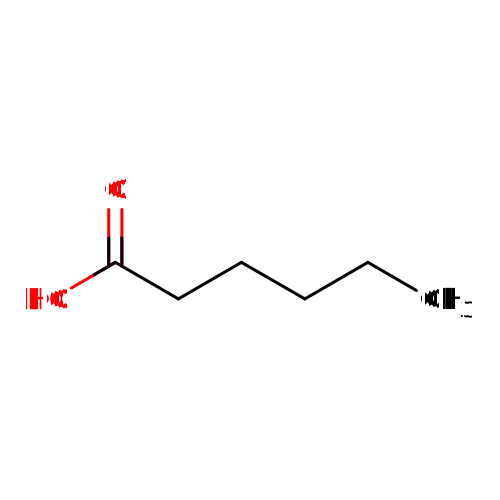
Chemical Structure
Thumb
Synonyms
ValueSource
1-Hexanoic acidChEBI
1-Pentanecarboxylic acidChEBI
6:0ChEBI
Butylacetic acidChEBI
C6:0ChEBI
Capronic acidChEBI
CH3-[CH2]4-COOHChEBI
HexanoateChEBI
Hexoic acidChEBI
Hexylic acidChEBI
N-Caproic acidChEBI
N-Hexanoic acidChEBI
N-Hexoic acidChEBI
N-Hexylic acidChEBI
Pentanecarboxylic acidChEBI
Pentiformic acidChEBI
Pentylformic acidChEBI
1-HexanoateGenerator
1-PentanecarboxylateGenerator
ButylacetateGenerator
CapronateGenerator
Hexanoic acidGenerator
HexoateGenerator
HexylateGenerator
N-CaproateGenerator
N-HexanoateGenerator
N-HexoateGenerator
N-HexylateGenerator
PentanecarboxylateGenerator
PentiformateGenerator
PentylformateGenerator
CaproateGenerator
Hexanoic acid, calcium saltMeSH, HMDB
Hexanoic acid, sodium salt, 1-(11)C-labeledMeSH, HMDB
Hexanoic acid, nickel (2+) saltMeSH, HMDB
Hexanoic acid, sodium saltMeSH, HMDB
Bismuth(III)hexanoateMeSH, HMDB
Hexanoic acid, copper (2+) saltMeSH, HMDB
Hexanoic acid, manganese (2+) saltMeSH, HMDB
Bi(ohex)3MeSH, HMDB
Hexanoic acid, barium saltMeSH, HMDB
Hexanoic acid, potassium saltMeSH, HMDB
Hexanoic acid, rhodium (2+) saltMeSH, HMDB
FA(6:0)HMDB
Calcium N-hexanoateMeSH, HMDB
Hexanoic acid, sodium salt (1:1)MeSH, HMDB
Sodium capronateMeSH, HMDB
Calcium hexanoateMeSH, HMDB
Caproic acid sodium saltMeSH, HMDB
Sodium caproateMeSH, HMDB
Sodium hexanoateMeSH, HMDB
Chemical FormulaC6H12O2
Average Molecular Mass116.158 g/mol
Monoisotopic Mass116.084 g/mol
CAS Registry Number142-62-1
IUPAC Namehexanoic acid
Traditional Namehexanoic acid
SMILESCCCCCC(O)=O
InChI IdentifierInChI=1S/C6H12O2/c1-2-3-4-5-6(7)8/h2-5H2,1H3,(H,7,8)
InChI KeyFUZZWVXGSFPDMH-UHFFFAOYSA-N
Chemical Taxonomy
Description belongs to the class of organic compounds known as medium-chain fatty acids. These are fatty acids with an aliphatic tail that contains between 4 and 12 carbon atoms.
KingdomOrganic compounds
Super ClassLipids and lipid-like molecules
ClassFatty Acyls
Sub ClassFatty acids and conjugates
Direct ParentMedium-chain fatty acids
Alternative Parents
Substituents
  • Medium-chain fatty acid
  • Straight chain fatty acid
  • Monocarboxylic acid or derivatives
  • Carboxylic acid
  • Carboxylic acid derivative
  • Organic oxygen compound
  • Organic oxide
  • Hydrocarbon derivative
  • Organooxygen compound
  • Carbonyl group
  • Aliphatic acyclic compound
Molecular FrameworkAliphatic acyclic compounds
External Descriptors
Biological Properties
StatusDetected and Not Quantified
OriginEndogenous
Cellular Locations
  • Cytoplasm
  • Extracellular
  • Membrane
Biofluid LocationsNot Available
Tissue LocationsNot Available
PathwaysNot Available
ApplicationsNot Available
Biological Roles
Chemical RolesNot Available
Physical Properties
StateSolid
AppearanceWhite powder.
Experimental Properties
PropertyValue
Melting PointNot Available
Boiling PointNot Available
Solubility10.3 mg/mL
Predicted Properties
PropertyValueSource
Water Solubility9.72 g/LALOGPS
logP1.88ALOGPS
logP1.81ChemAxon
logS-1.1ALOGPS
pKa (Strongest Acidic)5.09ChemAxon
Physiological Charge-1ChemAxon
Hydrogen Acceptor Count2ChemAxon
Hydrogen Donor Count1ChemAxon
Polar Surface Area37.3 ŲChemAxon
Rotatable Bond Count4ChemAxon
Refractivity31.07 m³·mol⁻¹ChemAxon
Polarizability13.27 ųChemAxon
Number of Rings0ChemAxon
Bioavailability1ChemAxon
Rule of FiveYesChemAxon
Ghose FilterNoChemAxon
Veber's RuleYesChemAxon
MDDR-like RuleNoChemAxon
Spectra
Spectra
Spectrum TypeDescriptionSplash KeyView
GC-MSGC-MS Spectrum - GC-MS (1 TMS)splash10-00yi-3900000000-8d7942410dfae70c7c9dSpectrum
GC-MSGC-MS Spectrum - EI-B (Non-derivatized)splash10-03di-9000000000-f4bf00b677d90d54ba69Spectrum
GC-MSGC-MS Spectrum - GC-MS (Non-derivatized)splash10-00yi-3900000000-8d7942410dfae70c7c9dSpectrum
Predicted GC-MSPredicted GC-MS Spectrum - GC-MS (Non-derivatized) - 70eV, Positivesplash10-0006-9000000000-9ee618fa3c0bd9d56748Spectrum
Predicted GC-MSPredicted GC-MS Spectrum - GC-MS (1 TMS) - 70eV, Positivesplash10-00fr-9200000000-be939d8c0455d1af93a6Spectrum
Predicted GC-MSPredicted GC-MS Spectrum - GC-MS (Non-derivatized) - 70eV, PositiveNot AvailableSpectrum
Predicted GC-MSPredicted GC-MS Spectrum - GC-MS (TBDMS_1_1) - 70eV, PositiveNot AvailableSpectrum
LC-MS/MSLC-MS/MS Spectrum - Quattro_QQQ 10V, Negative (Annotated)splash10-014i-0900000000-ba8c7078846c268d61a6Spectrum
LC-MS/MSLC-MS/MS Spectrum - Quattro_QQQ 25V, Negative (Annotated)splash10-03di-0900000000-151d5971be58b6799d2eSpectrum
LC-MS/MSLC-MS/MS Spectrum - Quattro_QQQ 40V, Negative (Annotated)splash10-02t9-1900000000-36096ef7dfebaa193910Spectrum
LC-MS/MSLC-MS/MS Spectrum - EI-B (HITACHI M-80B) , Positivesplash10-03di-9000000000-f4bf00b677d90d54ba69Spectrum
LC-MS/MSLC-MS/MS Spectrum - LC-ESI-QQ (API3000, Applied Biosystems) 10V, Negativesplash10-014i-0900000000-f5b00c5e9d90d801ab16Spectrum
LC-MS/MSLC-MS/MS Spectrum - LC-ESI-QQ (API3000, Applied Biosystems) 20V, Negativesplash10-014i-0900000000-5013166dd3b692762812Spectrum
LC-MS/MSLC-MS/MS Spectrum - LC-ESI-QQ (API3000, Applied Biosystems) 30V, Negativesplash10-014i-5900000000-52b3e7f8b01498621772Spectrum
LC-MS/MSLC-MS/MS Spectrum - LC-ESI-QQ (API3000, Applied Biosystems) 40V, Negativesplash10-0006-9000000000-e3af905666760ff49069Spectrum
LC-MS/MSLC-MS/MS Spectrum - LC-ESI-QQ , negativesplash10-014i-0900000000-f5b00c5e9d90d801ab16Spectrum
LC-MS/MSLC-MS/MS Spectrum - LC-ESI-QQ , negativesplash10-014i-0900000000-5013166dd3b692762812Spectrum
LC-MS/MSLC-MS/MS Spectrum - LC-ESI-QQ , negativesplash10-014i-5900000000-52b3e7f8b01498621772Spectrum
LC-MS/MSLC-MS/MS Spectrum - LC-ESI-QQ , negativesplash10-0006-9000000000-e3af905666760ff49069Spectrum
LC-MS/MSLC-MS/MS Spectrum - LC-ESI-IT , negativesplash10-01b9-6900000000-763e9a8e0f15e13fae3cSpectrum
LC-MS/MSLC-MS/MS Spectrum - 35V, Positivesplash10-0002-9000000000-df670aaa002d77689cc7Spectrum
Predicted LC-MS/MSPredicted LC-MS/MS Spectrum - 10V, Positivesplash10-014j-9700000000-5489131065e0934751a7Spectrum
Predicted LC-MS/MSPredicted LC-MS/MS Spectrum - 20V, Positivesplash10-05fs-9100000000-68f7c2883fb339578aceSpectrum
Predicted LC-MS/MSPredicted LC-MS/MS Spectrum - 40V, Positivesplash10-0a4l-9000000000-8e5e925d60baa2f176c2Spectrum
Predicted LC-MS/MSPredicted LC-MS/MS Spectrum - 10V, Negativesplash10-014i-2900000000-e877f22e42e8323f59e3Spectrum
Predicted LC-MS/MSPredicted LC-MS/MS Spectrum - 20V, Negativesplash10-01b9-9800000000-b5d583466919719819a1Spectrum
Predicted LC-MS/MSPredicted LC-MS/MS Spectrum - 40V, Negativesplash10-0a4l-9000000000-791ecce51d7cdde8f0f5Spectrum
Predicted LC-MS/MSPredicted LC-MS/MS Spectrum - 10V, Positivesplash10-05tg-9000000000-b176d73a7b4fabde1ad4Spectrum
Predicted LC-MS/MSPredicted LC-MS/MS Spectrum - 20V, Positivesplash10-006x-9000000000-08e066ae069da04a8689Spectrum
Predicted LC-MS/MSPredicted LC-MS/MS Spectrum - 40V, Positivesplash10-052f-9000000000-808b7302aa744c7a1c20Spectrum
Predicted LC-MS/MSPredicted LC-MS/MS Spectrum - 10V, Negativesplash10-0002-9000000000-21c5ae8d52f2e0f4cd33Spectrum
Predicted LC-MS/MSPredicted LC-MS/MS Spectrum - 20V, Negativesplash10-004j-9000000000-3e67c250e6a67f63a0ddSpectrum
MSMass Spectrum (Electron Ionization)splash10-03di-9000000000-fe3fab44832ddab1082eSpectrum
1D NMR1H NMR SpectrumNot AvailableSpectrum
1D NMR13C NMR SpectrumNot AvailableSpectrum
1D NMR1H NMR SpectrumNot AvailableSpectrum
1D NMR13C NMR SpectrumNot AvailableSpectrum
1D NMR1H NMR SpectrumNot AvailableSpectrum
1D NMR13C NMR SpectrumNot AvailableSpectrum
1D NMR1H NMR SpectrumNot AvailableSpectrum
1D NMR13C NMR SpectrumNot AvailableSpectrum
1D NMR1H NMR SpectrumNot AvailableSpectrum
1D NMR13C NMR SpectrumNot AvailableSpectrum
1D NMR1H NMR SpectrumNot AvailableSpectrum
1D NMR13C NMR SpectrumNot AvailableSpectrum
1D NMR1H NMR SpectrumNot AvailableSpectrum
1D NMR13C NMR SpectrumNot AvailableSpectrum
1D NMR1H NMR SpectrumNot AvailableSpectrum
1D NMR13C NMR SpectrumNot AvailableSpectrum
1D NMR1H NMR SpectrumNot AvailableSpectrum
1D NMR13C NMR SpectrumNot AvailableSpectrum
1D NMR1H NMR SpectrumNot AvailableSpectrum
1D NMR13C NMR SpectrumNot AvailableSpectrum
1D NMR1H NMR SpectrumNot AvailableSpectrum
1D NMR13C NMR SpectrumNot AvailableSpectrum
1D NMR1H NMR SpectrumNot AvailableSpectrum
2D NMR[1H,13C] 2D NMR SpectrumNot AvailableSpectrum
Toxicity Profile
Route of ExposureNot Available
Mechanism of ToxicityNot Available
MetabolismNot Available
Toxicity ValuesNot Available
Lethal DoseNot Available
Carcinogenicity (IARC Classification)No indication of carcinogenicity to humans (not listed by IARC).
Uses/SourcesThis is an endogenously produced metabolite found in the human body. It is used in metabolic reactions, catabolic reactions or waste generation.
Minimum Risk LevelNot Available
Health EffectsNot Available
SymptomsNot Available
TreatmentNot Available
Concentrations
Not Available
DrugBank IDNot Available
HMDB IDHMDB0000535
FooDB IDFDB013897
Phenol Explorer IDNot Available
KNApSAcK IDC00001218
BiGG IDNot Available
BioCyc IDHEXANOATE
METLIN ID5520
PDB IDNot Available
Wikipedia LinkHexanoic_acid
Chemspider ID8552
ChEBI ID30776
PubChem Compound ID8892
Kegg Compound IDC01585
YMDB IDYMDB01424
ECMDB IDECMDB24049
References
Synthesis ReferenceGao, Fei; Wu, Zongwei. Process for preparation of hexanoic acid by oxidation of 2-octanol with nitric acid. Faming Zhuanli Shenqing Gongkai Shuomingshu (2005), 7pp.
MSDSLink
General References
1. https://www.ncbi.nlm.nih.gov/pubmed/?term=10685018
2. https://www.ncbi.nlm.nih.gov/pubmed/?term=1556177
3. https://www.ncbi.nlm.nih.gov/pubmed/?term=24357269
4. https://www.ncbi.nlm.nih.gov/pubmed/?term=24924750
5. Gao, Fei; Wu, Zongwei. Process for preparation of hexanoic acid by oxidation of 2-octanol with nitric acid. Faming Zhuanli Shenqing Gongkai Shuomingshu (2005), 7pp.
6. Soyeurt H, Dardenne P, Dehareng F, Lognay G, Veselko D, Marlier M, Bertozzi C, Mayeres P, Gengler N: Estimating fatty acid content in cow milk using mid-infrared spectrometry. J Dairy Sci. 2006 Sep;89(9):3690-5. doi: 10.3168/jds.S0022-0302(06)72409-2.
7. Jensen RG: The composition of bovine milk lipids: January 1995 to December 2000. J Dairy Sci. 2002 Feb;85(2):295-350. doi: 10.3168/jds.S0022-0302(02)74079-4.
8. Jensen RG, Ferris AM, Lammi-Keefe CJ: The composition of milk fat. J Dairy Sci. 1991 Sep;74(9):3228-43. doi: 10.3168/jds.S0022-0302(91)78509-3.
9. Colman E, Fokkink WB, Craninx M, Newbold JR, De Baets B, Fievez V: Effect of induction of subacute ruminal acidosis on milk fat profile and rumen parameters. J Dairy Sci. 2010 Oct;93(10):4759-73. doi: 10.3168/jds.2010-3158.
10. GARTON GA: THE COMPOSITION AND BIOSYNTHESIS OF MILK LIPIDS. J Lipid Res. 1963 Jul;4:237-54.
11. Antunes-Fernandes EC, van Gastelen S, Dijkstra J, Hettinga KA, Vervoort J: Milk metabolome relates enteric methane emission to milk synthesis and energy metabolism pathways. J Dairy Sci. 2016 Aug;99(8):6251-6262. doi: 10.3168/jds.2015-10248. Epub 2016 May 26.
12. van Gastelen S, Antunes-Fernandes EC, Hettinga KA, Dijkstra J: Relationships between methane emission of Holstein Friesian dairy cows and fatty acids, volatile metabolites and non-volatile metabolites in milk. Animal. 2017 Sep;11(9):1539-1548. doi: 10.1017/S1751731117000295. Epub 2017 Feb 21.
13. Kurt J. Boudonck, Matthew W. Mitchell, Jacob Wulff and John A. Ryals. Characterization of the biochemical variability of bovine milk using metabolomics. Metabolomics (2009) 5:375?386
14. M. Ferrand et al. Determination of fatty acid profile in cow's milk using mid-infrared spectrometry: Interest of applying a variable selection by genetic algorithms before a PLS regression. Chemometrics and Intelligent Laboratory Systems 106 (2011) 183?189
15. Kurt J. Boudonck, Matthew W. Mitchell, Jacob Wulff, John A. Ryals. Characterization of the biochemical variability of bovine milk using metabolomics. Metabolomics (2009) 5:375-386 doi: 10.1007/s11306-009-0160-8
16. Lawrence K. Creamer, Alastair K.H. MacGibbon. Some recent advances in the basic chemistry of milk proteins and lipids. International Dairy J. (1996) 6(6):539-568 doi: 10.1016/0958-6946(96)85309-X
17. Fooddata+, The Technical University of Denmark (DTU): https://frida.fooddata.dk/QueryFood.php?fn=milk&lang=en
18. Gao, Fei; Wu, Zongwei. Process for preparation of hexanoic acid by oxidation of 2-octanol with nitric acid. Faming Zhuanli Shenqing Gongkai Shuomingshu (2005), 7pp.
19. Epps JM, Phillips JO, Mestecky J: IgA-mediated clearance and tissue deposition of dinitrophenylated human serum albumin at various DNP:HSA ratios. Mol Immunol. 1988 Aug;25(8):731-8.
20. Varani J, Orr W, Ward PA: Cell-associated proteases affect tumour cell migration in vitro. J Cell Sci. 1979 Apr;36:241-52.
21. Schoots AC, Mikkers FE, Cramers CA, Ringoir S: Profiling of uremic serum by high-resolution gas chromatography-electron-impact, chemical ionization mass spectrometry. J Chromatogr. 1979 Sep 11;164(1):1-8.
22. Jakobs C, Sweetman L, Nyhan WL: Hydroxy acid metabolites of branched-chain amino acids in amniotic fluid. Clin Chim Acta. 1984 Jul 16;140(2):157-66.
23. Nilsen SL, Castellino FJ: Expression of human plasminogen in Drosophila Schneider S2 cells. Protein Expr Purif. 1999 Jun;16(1):136-43.
24. Ohdoi C, Nyhan WL, Kuhara T: Chemical diagnosis of Lesch-Nyhan syndrome using gas chromatography-mass spectrometry detection. J Chromatogr B Analyt Technol Biomed Life Sci. 2003 Jul 15;792(1):123-30.
25. Varani J, Orr W, Ward PA: Comparison of cell attachment and caseinolytic activities of five tumour cell types. J Cell Sci. 1978 Dec;34:133-44.
26. Hoverstad T, Fausa O, Bjorneklett A, Bohmer T: Short-chain fatty acids in the normal human feces. Scand J Gastroenterol. 1984 May;19(3):375-81.
27. Harkness RA: Lesch-Nyhan syndrome: reduced amino acid concentrations in CSF and brain. Adv Exp Med Biol. 1989;253A:159-63.
28. Traul KA, Driedger A, Ingle DL, Nakhasi D: Review of the toxicologic properties of medium-chain triglycerides. Food Chem Toxicol. 2000 Jan;38(1):79-98.
29. Simons K, Toomre D: Lipid rafts and signal transduction. Nat Rev Mol Cell Biol. 2000 Oct;1(1):31-9.
30. Watson AD: Thematic review series: systems biology approaches to metabolic and cardiovascular disorders. Lipidomics: a global approach to lipid analysis in biological systems. J Lipid Res. 2006 Oct;47(10):2101-11. Epub 2006 Aug 10.
31. Sethi JK, Vidal-Puig AJ: Thematic review series: adipocyte biology. Adipose tissue function and plasticity orchestrate nutritional adaptation. J Lipid Res. 2007 Jun;48(6):1253-62. Epub 2007 Mar 20.
32. Lingwood D, Simons K: Lipid rafts as a membrane-organizing principle. Science. 2010 Jan 1;327(5961):46-50. doi: 10.1126/science.1174621.
33. Patel M, Fowler D, Sizer J, Walton C: Faecal volatile biomarkers of Clostridium difficile infection. PLoS One. 2019 Apr 15;14(4):e0215256. doi: 10.1371/journal.pone.0215256. eCollection 2019.
34. Elshenawy S, Pinney SE, Stuart T, Doulias PT, Zura G, Parry S, Elovitz MA, Bennett MJ, Bansal A, Strauss JF 3rd, Ischiropoulos H, Simmons RA: The Metabolomic Signature of the Placenta in Spontaneous Preterm Birth. Int J Mol Sci. 2020 Feb 4;21(3). pii: ijms21031043. doi: 10.3390/ijms21031043.
35. The lipid handbook with CD-ROM