Record Information
Version1.0
Creation Date2014-09-05 17:10:48 UTC
Update Date2026-04-03 07:36:09 UTC
Accession NumberCHEM003543
Identification
Common NameEthyl carbamate
ClassSmall Molecule
DescriptionEthyl carbamate (also known as urethane) is an ester of carbamic acid. It is not a component of polyurethanes. Urethane can be produced by the reaction of ammonia with ethyl chloroformate or by heating urea nitrate and ethyl alcohol. It was first prepared in the mid 1800’s. Ethyl carbamate was used as an antineoplastic agent in the treatment of multiple myeloma before it was found in 1943 to be toxic, carcinogenic and largely ineffective. Japanese usage in medical injections continued and from 1950 to 1975. Ethyl carbamate has now been withdrawn from pharmaceutical use. However, small quantities of ethyl carbamate are also used in laboratories as an anesthetic for animals. Studies have shown that most, if not all, yeast-fermented alcoholic beverages contain traces of ethyl carbamate (15 ppb to 12 ppm). Other foods and beverages prepared by means of fermentation also contain ethyl carbamate. For example, bread has been found to contain 2 ppb while as much as 20 ppb has been found in some samples of soy sauce. “Natural” ethyl carbamate is formed during distillation from natural precursors such as cyanide, urea, citrulline and other N-carbamoyl compounds.
Contaminant Sources
  • Clean Air Act Chemicals
  • FooDB Chemicals
  • HPV EPA Chemicals
  • IARC Carcinogens Group 2A
  • T3DB toxins
  • ToxCast & Tox21 Chemicals
Contaminant Type
  • Amine
  • Anesthetic, Intravenous
  • Antineoplastic Agent
  • Carcinogen
  • Ester
  • Ether
  • Food Toxin
  • Lachrymator
  • Metabolite
  • Organic Compound
  • Pollutant
  • Synthetic Compound
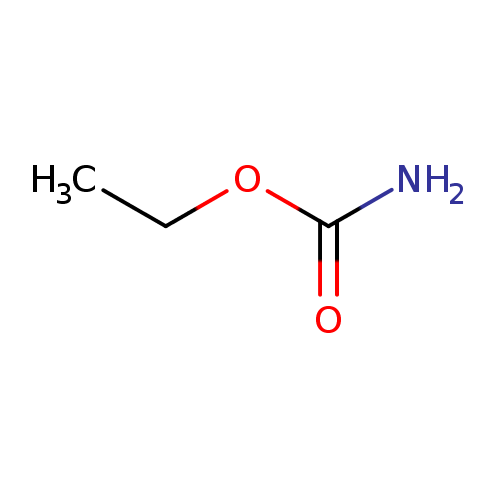
Chemical Structure
Thumb
Synonyms
ValueSource
Carbamic acid ethyl esterChEBI
Carbamate ethyl esterGenerator
Ethyl carbamic acidGenerator
AethylcarbamatHMDB
AethylurethanHMDB
Carbamate, ethylHMDB
Carbamic acid, ethyl esterHMDB
Estane 5703HMDB
Ethyl aminoformateHMDB
Ethyl ester OF carbamic acidHMDB
Ethyl urethanHMDB
Ethyl urethaneHMDB
EthylcarbamateHMDB
Ethylester kyseliny karbaminoveHMDB
EthylurethanHMDB
EthylurethaneHMDB
LeucethaneHMDB
LeucothaneHMDB
NH2COOC2H5HMDB
NSC 746HMDB
O-Ethyl carbamateHMDB
O-Ethyl urethaneHMDB
O-EthylurethaneHMDB
PracarbaminHMDB
PracarbamineHMDB
U-compoundHMDB
UretanHMDB
Uretan etylowyHMDB
UretanoHMDB
UrethanHMDB
UrethaneHMDB
Urethane + ethanol (combination)HMDB
Urethane, innHMDB
Ethyl carbamateChEBI
Chemical FormulaC3H7NO2
Average Molecular Mass89.093 g/mol
Monoisotopic Mass89.048 g/mol
CAS Registry Number51-79-6
IUPAC Nameethyl carbamate
Traditional Nameurethane
SMILESCCOC(N)=O
InChI IdentifierInChI=1S/C3H7NO2/c1-2-6-3(4)5/h2H2,1H3,(H2,4,5)
InChI KeyJOYRKODLDBILNP-UHFFFAOYSA-N
Chemical Taxonomy
Description belongs to the class of organic compounds known as carboximidic acids and derivatives. Carboximidic acids and derivatives are compounds containing a carboximidic group, with the general formula R-C(=NR1)OR2.
KingdomOrganic compounds
Super ClassOrganic acids and derivatives
ClassCarboximidic acids and derivatives
Sub ClassNot Available
Direct ParentCarboximidic acids and derivatives
Alternative Parents
Substituents
  • Carboximidic acid derivative
  • Organic nitrogen compound
  • Organic oxygen compound
  • Organopnictogen compound
  • Hydrocarbon derivative
  • Organooxygen compound
  • Organonitrogen compound
  • Imine
  • Aliphatic acyclic compound
Molecular FrameworkAliphatic acyclic compounds
External Descriptors
Biological Properties
StatusDetected and Not Quantified
OriginEndogenous
Cellular Locations
  • Cytoplasm
  • Extracellular
Biofluid LocationsNot Available
Tissue LocationsNot Available
PathwaysNot Available
ApplicationsNot Available
Biological Roles
Chemical RolesNot Available
Physical Properties
StateSolid
AppearanceWhite powder
Experimental Properties
PropertyValue
Melting Point48.5 - 50 °C
Boiling Point183 °C
Solubility4.8E+005 mg/L (at 15 °C)
Predicted Properties
PropertyValueSource
Water Solubility371 g/LALOGPS
logP-0.14ALOGPS
logP-0.054ChemAxon
logS0.62ALOGPS
pKa (Strongest Acidic)15.47ChemAxon
Physiological Charge0ChemAxon
Hydrogen Acceptor Count1ChemAxon
Hydrogen Donor Count1ChemAxon
Polar Surface Area52.32 ŲChemAxon
Rotatable Bond Count2ChemAxon
Refractivity20.84 m³·mol⁻¹ChemAxon
Polarizability8.64 ųChemAxon
Number of Rings0ChemAxon
Bioavailability1ChemAxon
Rule of FiveYesChemAxon
Ghose FilterNoChemAxon
Veber's RuleNoChemAxon
MDDR-like RuleNoChemAxon
Spectra
Spectra
Spectrum TypeDescriptionSplash KeyView
GC-MSGC-MS Spectrum - EI-B (Non-derivatized)splash10-01r7-9000000000-ba57e1f4b939a6bb2c1cSpectrum
GC-MSGC-MS Spectrum - EI-B (Non-derivatized)splash10-01r7-9000000000-4905daa85aa870eff5d7Spectrum
GC-MSGC-MS Spectrum - EI-B (Non-derivatized)splash10-01r7-9000000000-ba57e1f4b939a6bb2c1cSpectrum
GC-MSGC-MS Spectrum - EI-B (Non-derivatized)splash10-01r7-9000000000-4905daa85aa870eff5d7Spectrum
Predicted GC-MSPredicted GC-MS Spectrum - GC-MS (Non-derivatized) - 70eV, Positivesplash10-004l-9000000000-e97e597e9d87bdb17da9Spectrum
Predicted GC-MSPredicted GC-MS Spectrum - GC-MS (Non-derivatized) - 70eV, PositiveNot AvailableSpectrum
Predicted LC-MS/MSPredicted LC-MS/MS Spectrum - 10V, Positivesplash10-0006-9000000000-5187886e237ef9d66a60Spectrum
Predicted LC-MS/MSPredicted LC-MS/MS Spectrum - 20V, Positivesplash10-01oy-9000000000-8c895ae06181b5b4338dSpectrum
Predicted LC-MS/MSPredicted LC-MS/MS Spectrum - 40V, Positivesplash10-002f-9000000000-ec38f306aca381823adbSpectrum
Predicted LC-MS/MSPredicted LC-MS/MS Spectrum - 10V, Negativesplash10-0006-9000000000-f2310b881ad089adcd93Spectrum
Predicted LC-MS/MSPredicted LC-MS/MS Spectrum - 20V, Negativesplash10-0006-9000000000-143896eea6847dbb32c9Spectrum
Predicted LC-MS/MSPredicted LC-MS/MS Spectrum - 40V, Negativesplash10-0006-9000000000-51c772011dee8070de89Spectrum
Predicted LC-MS/MSPredicted LC-MS/MS Spectrum - 10V, Negativesplash10-000m-9000000000-df4925907c41e53b12dbSpectrum
Predicted LC-MS/MSPredicted LC-MS/MS Spectrum - 20V, Negativesplash10-0006-9000000000-719d518ee46e1ba1c4f6Spectrum
Predicted LC-MS/MSPredicted LC-MS/MS Spectrum - 40V, Negativesplash10-0006-9000000000-90726b17dc36e29c5299Spectrum
Predicted LC-MS/MSPredicted LC-MS/MS Spectrum - 10V, Positivesplash10-0006-9000000000-1abfabaf6ce4ac254e95Spectrum
Predicted LC-MS/MSPredicted LC-MS/MS Spectrum - 20V, Positivesplash10-0006-9000000000-6bd0c888cfe6b3835c30Spectrum
Predicted LC-MS/MSPredicted LC-MS/MS Spectrum - 40V, Positivesplash10-0006-9000000000-fd9f25340762315b4515Spectrum
MSMass Spectrum (Electron Ionization)splash10-01r7-9000000000-dbaaf921e6f73cb42292Spectrum
1D NMR1H NMR SpectrumNot AvailableSpectrum
1D NMR13C NMR SpectrumNot AvailableSpectrum
1D NMR1H NMR SpectrumNot AvailableSpectrum
1D NMR13C NMR SpectrumNot AvailableSpectrum
1D NMR1H NMR SpectrumNot AvailableSpectrum
1D NMR13C NMR SpectrumNot AvailableSpectrum
1D NMR1H NMR SpectrumNot AvailableSpectrum
1D NMR13C NMR SpectrumNot AvailableSpectrum
1D NMR1H NMR SpectrumNot AvailableSpectrum
1D NMR13C NMR SpectrumNot AvailableSpectrum
1D NMR1H NMR SpectrumNot AvailableSpectrum
1D NMR13C NMR SpectrumNot AvailableSpectrum
1D NMR1H NMR SpectrumNot AvailableSpectrum
1D NMR13C NMR SpectrumNot AvailableSpectrum
1D NMR1H NMR SpectrumNot AvailableSpectrum
1D NMR13C NMR SpectrumNot AvailableSpectrum
1D NMR1H NMR SpectrumNot AvailableSpectrum
1D NMR13C NMR SpectrumNot AvailableSpectrum
1D NMR1H NMR SpectrumNot AvailableSpectrum
1D NMR13C NMR SpectrumNot AvailableSpectrum
1D NMR1H NMR SpectrumNot AvailableSpectrum
Toxicity Profile
Route of ExposureIngestion; Inhalation; Injection
Mechanism of ToxicityEthyl carbamate is genotoxic and a potent carcinogen. It exerts its effects through the formation of DNA adducts (via its vinyl carbamate epoxide metabolite) that induce choromosomal aberrations, micronuclei and sister chromatid exchange. It also tends to induce specific mutations in the Kras oncogene in codon 61 of exon 2 including A:T transversions and A-->G transitions in the second base and A-->T transversions in the third base.
MetabolismEthyl carbamate is rapidly metabolized in the body with 95% being eliminated as carbon dioxide. It is readily absorbed from the gastrointestinal tract and the skin. Metabolism is mediated by cytochrome P450 2E1. Metabolites of ethyl carbamate include N-hydroxyethylcarbamate, alpha-hydroxyethylcarbamate and vinyl carbamate. After conjugation, N-hydroxyethylcarbamate is excreted in the urine, alpha-hydroxyethyl carbamate is metabolized to ammonia and CO2 and vinyl carbamate is converted to vinyl carbamate epoxide. The vinyl carbamate epoxide is thought to be the metabolite that is responsible for the carcinogenic properties of ethyl carbamate based on its ability to form etheno-DNA adducts (3)
Toxicity ValuesNot Available
Lethal DoseLD50 in rodents of 2g/kg (ingestion)
Carcinogenicity (IARC Classification)2A, probably carcinogenic to humans. (4)
Uses/SourcesSmall quantities of ethyl carbamate are still used in laboratories as an anesthetic for animals. Ethyl carbamate is found in many alcoholic beverages, especially distilled spirits.
Minimum Risk Level>0.3 mg/kg/day for lung cancer
Health EffectsEthyl carbamate can cause cancer. Acute exposure can cause severe eye irritation and skin irritation. Urethane is toxic to kidneys, the nervous system, liver, gastrointestinal tract. Repeated or prolonged exposure to urethane can produce organ damage.
SymptomsAcute exposure to eyes causes redness, watering, and itching.
TreatmentEYES: irrigate opened eyes for several minutes under running water. INGESTION: do not induce vomiting. Rinse mouth with water (never give anything by mouth to an unconscious person). Seek immediate medical advice. SKIN: should be treated immediately by rinsing the affected parts in cold running water for at least 15 minutes, followed by thorough washing with soap and water. If necessary, the person should shower and change contaminated clothing and shoes, and then must seek medical attention. INHALATION: supply fresh air. If required provide artificial respiration.
Concentrations
Not Available
DrugBank IDDB04827
HMDB IDHMDB0031219
FooDB IDFDB003243
Phenol Explorer IDNot Available
KNApSAcK IDNot Available
BiGG IDNot Available
BioCyc IDNot Available
METLIN IDNot Available
PDB IDNot Available
Wikipedia LinkEthyl_carbamate
Chemspider ID5439
ChEBI ID17967
PubChem Compound ID5641
Kegg Compound IDC01537
YMDB IDNot Available
ECMDB IDNot Available
References
Synthesis Reference

Norton A. Cashen, “Method of producing anhydrous crystalline reaction products of formaldehyde and methyl-, ethyl carbamate.” U.S. Patent US4002668, issued July, 1973.

MSDSNot Available
General References
1. https://www.ncbi.nlm.nih.gov/pubmed/?term=15790490
2. https://www.ncbi.nlm.nih.gov/pubmed/?term=24386880
3. Lijinsky W, Taylor HW: Carcinogenesis in Sprague-Dawley rats of N-nitroso-N-alkylcarbamate esters. Cancer Lett. 1976 May;1(5):275-9.
4. Lijinsky W, Reuber MD: Studies of a deuterium isotope effect in carcinogenesis by N-nitroso-N-alkylurethanes in rats. Cancer Lett. 1982 Sep;16(3):273-9.
5. Yannai, Shmuel. (2004) Dictionary of food compounds with CD-ROM: Additives, flavors, and ingredients. Boca Raton: Chapman & Hall/CRC.