Record Information
Version1.0
Creation Date2014-09-05 17:10:15 UTC
Update Date2026-05-14 19:06:26 UTC
Accession NumberCHEM003537
Identification
Common NameHydroquinone
ClassSmall Molecule
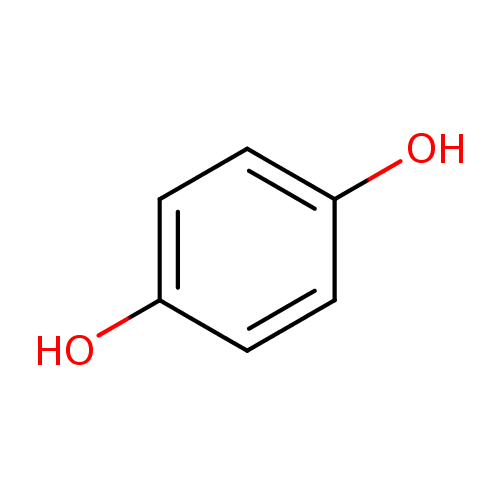
DescriptionHydroquinone, also benzene-1,4-diol, is an aromatic organic compound which is a type of phenol. Hydroquinone is commonly used as a biomarker for benzene exposure. The presence of hydroquinone in normal individuals stems mainly from direct dietary ingestion, catabolism of tyrosine and other substrates by gut bacteria, ingestion of arbutin containing foods, cigarette smoking, and the use of some over-the-counter medicines. In human medicine, hydroquinone is used as a topical application in skin whitening to reduce the color of skin. In 2006, the United States Food and Drug Administration revoked its previous approval of hydroquinone and proposed a ban on all over-the-counter preparations. The FDA stated that hydroquinone cannot be ruled out as a potential carcinogen. This conclusion was reached based on the extent of absorption in humans and the incidence of neoplasms in rats in several studies where adult rats were found to have increased rates of tumours, including thyroid follicular cell hyperplasias, anisokaryosis, mononuclear cell leukemia, hepatocellular adenomas and renal tubule cell adenomas. Numerous studies have revealed that hydroquinone can cause exogenous ochronosis, a disfiguring disease in which blue-black pigments are deposited onto the skin, if taken orally; however, skin preparations containing the ingredient are administered topically. The FDA has classified hydroquinone currently as a safe product, as currently used. (Wikipedia)
Contaminant Sources
  • Clean Air Act Chemicals
  • Cosmetic Chemicals
  • FooDB Chemicals
  • HMDB Contaminants - Urine
  • HPV EPA Chemicals
  • IARC Carcinogens Group 3
  • OECD HPV Chemicals
  • STOFF IDENT Compounds
  • T3DB toxins
  • Tobacco Smoke Compounds
  • ToxCast & Tox21 Chemicals
Contaminant Type
  • Cigarette Toxin
  • Food Toxin
  • Household Toxin
  • Human Neurotoxin
  • Metabolite
  • Organic Compound
  • PFAS
  • Phytotoxin
  • Pollutant
  • Synthetic Compound
Chemical Structure
Thumb
Synonyms
ValueSource
1,4-BenzenediolChEBI
1,4-DihydroxybenzeneChEBI
4-HydroxyphenolChEBI
Benzene-1,4-diolChEBI
EldoquinChEBI
p-BenzenediolChEBI
p-HydroquinoneChEBI
p-HydroxyphenolChEBI
QuinolChEBI
ArtraMeSH
EldopaqueMeSH
EsotericaMeSH
HidroquilaudeMeSH
HidroquinMeSH
Hidroquinona isdinMeSH
LicostrataMeSH
LustraMeSH
MelanasaMeSH
MelanexMeSH
MelpaqueMeSH
MelquinMeSH
Neostrata HQMeSH
PhiaquinMeSH
SolaquinMeSH
UltraquinMeSH
beta-QuinolMeSH
Hydroquinone, copper (1+) saltMeSH
Hydroquinone, lead (2+) salt (2:1)MeSH
Hydroquinone, monocopper (2+) saltMeSH
1,4-Dihydroxy-benzeenHMDB
1,4-Dihydroxy-benzolHMDB
1,4-DihydroxybenzenHMDB
1,4-DiidrobenzeneHMDB
a-HydroquinoneHMDB
alpha-HydroquinoneHMDB
b-QuinolHMDB
BenzohydroquinoneHMDB
BenzoquinolHMDB
DihydroquinoneHMDB
DihydroxybenzeneHMDB
HydrochinonHMDB
HydrochinoneHMDB
HydroquinolHMDB
HydroquinoleHMDB
Hydroquinone for synthesisHMDB
Hydroquinone GRHMDB
HydroquinoueHMDB
IdrochinoneHMDB
p-DihydroxybenzeneHMDB
P-DioxobenzeneHMDB
p-DioxybenzeneHMDB
P-HydroxybenzeneHMDB
Solaquin forteHMDB
Eldoquin forteMeSH, HMDB
Stratus brand 1 OF hydroquinoneMeSH, HMDB
ICN brand 1 OF hydroquinoneMeSH, HMDB
Plough brand 2 OF hydroquinoneMeSH, HMDB
Eldopaque forteMeSH, HMDB
ICN brand 4 OF hydroquinoneMeSH, HMDB
Black and whiteMeSH, HMDB
ICN brand 2 OF hydroquinoneMeSH, HMDB
ICN brand 3 OF hydroquinoneMeSH, HMDB
Plough brand 1 OF hydroquinoneMeSH, HMDB
Stratus brand 2 OF hydroquinoneMeSH, HMDB
1,4-BenzoquinolPhytoBank
1,4-PhenylenediolPhytoBank
1,4-p-BenzenediolPhytoBank
p-DihydroquinonePhytoBank
p-PhenylenediolPhytoBank
p-QuinolPhytoBank
Chemical FormulaC6H6O2
Average Molecular Mass110.111 g/mol
Monoisotopic Mass110.037 g/mol
CAS Registry Number123-31-9
IUPAC Namebenzene-1,4-diol
Traditional Nameα-hydroquinone
SMILESOC1=CC=C(O)C=C1
InChI IdentifierInChI=1S/C6H6O2/c7-5-1-2-6(8)4-3-5/h1-4,7-8H
InChI KeyQIGBRXMKCJKVMJ-UHFFFAOYSA-N
Chemical Taxonomy
Description belongs to the class of organic compounds known as hydroquinones. Hydroquinones are compounds containing a hydroquinone moiety, which consists of a benzene ring with a hydroxyl groups at positions 1 and 4.
KingdomOrganic compounds
Super ClassBenzenoids
ClassPhenols
Sub ClassBenzenediols
Direct ParentHydroquinones
Alternative Parents
Substituents
  • Hydroquinone
  • 1-hydroxy-2-unsubstituted benzenoid
  • Monocyclic benzene moiety
  • Organic oxygen compound
  • Hydrocarbon derivative
  • Organooxygen compound
  • Aromatic homomonocyclic compound
Molecular FrameworkAromatic homomonocyclic compounds
External Descriptors
Biological Properties
StatusDetected and Not Quantified
OriginExogenous
Cellular Locations
  • Cytoplasm
  • Extracellular
Biofluid LocationsNot Available
Tissue Locations
  • Bone Marrow
  • Fibroblasts
  • Kidney
  • Liver
  • Skin
  • Stratum Corneum
PathwaysNot Available
ApplicationsNot Available
Biological Roles
Chemical RolesNot Available
Physical Properties
StateSolid
AppearanceHydroquinone is a white granular solid at room temperature and pressure.
Experimental Properties
PropertyValue
Melting Point172.3 °C
Boiling Point286°C (546.8°F)
Solubility72.0 mg/mL at 25 °C
Predicted Properties
PropertyValueSource
Water Solubility95.5 g/LALOGPS
logP0.71ALOGPS
logP1.37ChemAxon
logS-0.06ALOGPS
pKa (Strongest Acidic)9.68ChemAxon
pKa (Strongest Basic)-5.9ChemAxon
Physiological Charge0ChemAxon
Hydrogen Acceptor Count2ChemAxon
Hydrogen Donor Count2ChemAxon
Polar Surface Area40.46 ŲChemAxon
Rotatable Bond Count0ChemAxon
Refractivity30.02 m³·mol⁻¹ChemAxon
Polarizability10.75 ųChemAxon
Number of Rings1ChemAxon
Bioavailability1ChemAxon
Rule of FiveYesChemAxon
Ghose FilterNoChemAxon
Veber's RuleNoChemAxon
MDDR-like RuleNoChemAxon
Spectra
Spectra
Spectrum TypeDescriptionSplash KeyView
GC-MSGC-MS Spectrum - GC-MS (2 TMS)splash10-0f79-2490000000-6b4fec222a3499d93790Spectrum
GC-MSGC-MS Spectrum - EI-B (Non-derivatized)splash10-03di-9800000000-c90fd4986fea9691ecbfSpectrum
GC-MSGC-MS Spectrum - EI-B (Non-derivatized)splash10-03e9-9300000000-f8b11742557329691e8aSpectrum
GC-MSGC-MS Spectrum - GC-MS (Non-derivatized)splash10-0f79-2490000000-6b4fec222a3499d93790Spectrum
GC-MSGC-MS Spectrum - GC-EI-TOF (Non-derivatized)splash10-0f79-2690000000-7306adcc7121a11d67ccSpectrum
Predicted GC-MSPredicted GC-MS Spectrum - GC-MS (Non-derivatized) - 70eV, Positivesplash10-03di-5900000000-954dc96d8e3eb85b8324Spectrum
Predicted GC-MSPredicted GC-MS Spectrum - GC-MS (2 TMS) - 70eV, Positivesplash10-00e9-8950000000-512c0cf5ddc0b120ec8eSpectrum
Predicted GC-MSPredicted GC-MS Spectrum - GC-MS (Non-derivatized) - 70eV, PositiveNot AvailableSpectrum
LC-MS/MSLC-MS/MS Spectrum - Quattro_QQQ 10V, Positive (Annotated)splash10-03di-9600000000-e670ba090cb27367db12Spectrum
LC-MS/MSLC-MS/MS Spectrum - Quattro_QQQ 25V, Positive (Annotated)splash10-01p6-9000000000-5fc32c7688c1612df1e7Spectrum
LC-MS/MSLC-MS/MS Spectrum - Quattro_QQQ 40V, Positive (Annotated)splash10-000i-9000000000-c5853ce8ef225ea5c353Spectrum
LC-MS/MSLC-MS/MS Spectrum - EI-B (Unknown) , Positivesplash10-03di-9800000000-c90fd4986fea9691ecbfSpectrum
LC-MS/MSLC-MS/MS Spectrum - , negativesplash10-0a4i-0900000000-5635f0157cd37deb1121Spectrum
LC-MS/MSLC-MS/MS Spectrum - , positivesplash10-03di-2900000000-05be113033a709130eedSpectrum
LC-MS/MSLC-MS/MS Spectrum - 20V, Negativesplash10-0a4i-9600000000-e0d15b2e4ea35a7a76beSpectrum
LC-MS/MSLC-MS/MS Spectrum - 20V, Positivesplash10-01r6-9000000000-946504408977df40269aSpectrum
LC-MS/MSLC-MS/MS Spectrum - 10V, Negativesplash10-0a4i-0900000000-c16180dd26c127563155Spectrum
LC-MS/MSLC-MS/MS Spectrum - 40V, Positivesplash10-03dl-9000000000-cea1cb486f12ea31e3a1Spectrum
LC-MS/MSLC-MS/MS Spectrum - 10V, Positivesplash10-01ox-9000000000-3a9d5710c88793e698f1Spectrum
LC-MS/MSLC-MS/MS Spectrum - 40V, Negativesplash10-0006-9000000000-60eeaa79bff371773b2eSpectrum
LC-MS/MSLC-MS/MS Spectrum - 20V, Negativesplash10-0a4i-0900000000-3a9e293da186985db7faSpectrum
LC-MS/MSLC-MS/MS Spectrum - 40V, Negativesplash10-0pb9-9000000000-84bb0a9b4c3cd16da2a7Spectrum
LC-MS/MSLC-MS/MS Spectrum - 10V, Negativesplash10-0a4i-7900000000-2256214c81a3e04e01b7Spectrum
Predicted LC-MS/MSPredicted LC-MS/MS Spectrum - 10V, Positivesplash10-03di-0900000000-8d8328e4f7cd2ebaa27dSpectrum
Predicted LC-MS/MSPredicted LC-MS/MS Spectrum - 20V, Positivesplash10-03di-1900000000-9290fcb93f170fc3143fSpectrum
Predicted LC-MS/MSPredicted LC-MS/MS Spectrum - 40V, Positivesplash10-01si-9200000000-9f707b9d0c4ad0b73b30Spectrum
Predicted LC-MS/MSPredicted LC-MS/MS Spectrum - 10V, Negativesplash10-0a4i-0900000000-d3aae38632ac4c40fd4fSpectrum
Predicted LC-MS/MSPredicted LC-MS/MS Spectrum - 20V, Negativesplash10-0a4i-0900000000-74f15490ba4f49cf8c18Spectrum
Predicted LC-MS/MSPredicted LC-MS/MS Spectrum - 40V, Negativesplash10-0a4i-9800000000-1cb01248e88fce387578Spectrum
Predicted LC-MS/MSPredicted LC-MS/MS Spectrum - 10V, Negativesplash10-0a4i-0900000000-9f2c82efe2cba7470e17Spectrum
Predicted LC-MS/MSPredicted LC-MS/MS Spectrum - 20V, Negativesplash10-0a4i-0900000000-9f2c82efe2cba7470e17Spectrum
Predicted LC-MS/MSPredicted LC-MS/MS Spectrum - 40V, Negativesplash10-0f6x-9000000000-8213c13cc381b346f976Spectrum
Predicted LC-MS/MSPredicted LC-MS/MS Spectrum - 10V, Positivesplash10-03di-0900000000-fd10fd64675560620b8dSpectrum
MSMass Spectrum (Electron Ionization)splash10-03di-9500000000-1fa8477944a662535e76Spectrum
1D NMR1H NMR SpectrumNot AvailableSpectrum
1D NMR13C NMR SpectrumNot AvailableSpectrum
1D NMR1H NMR SpectrumNot AvailableSpectrum
1D NMR13C NMR SpectrumNot AvailableSpectrum
1D NMR1H NMR SpectrumNot AvailableSpectrum
1D NMR13C NMR SpectrumNot AvailableSpectrum
1D NMR1H NMR SpectrumNot AvailableSpectrum
1D NMR13C NMR SpectrumNot AvailableSpectrum
1D NMR1H NMR SpectrumNot AvailableSpectrum
1D NMR13C NMR SpectrumNot AvailableSpectrum
1D NMR1H NMR SpectrumNot AvailableSpectrum
1D NMR13C NMR SpectrumNot AvailableSpectrum
1D NMR1H NMR SpectrumNot AvailableSpectrum
1D NMR13C NMR SpectrumNot AvailableSpectrum
1D NMR1H NMR SpectrumNot AvailableSpectrum
1D NMR13C NMR SpectrumNot AvailableSpectrum
1D NMR1H NMR SpectrumNot AvailableSpectrum
1D NMR13C NMR SpectrumNot AvailableSpectrum
1D NMR1H NMR SpectrumNot AvailableSpectrum
1D NMR13C NMR SpectrumNot AvailableSpectrum
1D NMR1H NMR SpectrumNot AvailableSpectrum
2D NMR[1H,13C] 2D NMR SpectrumNot AvailableSpectrum
Toxicity Profile
Route of ExposureNot Available
Mechanism of ToxicityNot Available
MetabolismNot Available
Toxicity ValuesNot Available
Lethal DoseNot Available
Carcinogenicity (IARC Classification)3, not classifiable as to its carcinogenicity to humans. (15)
Uses/SourcesHydroquinone has a variety of uses principally associated with its action as a reducing agent which is soluble in water. It is a major component in most photographic developers where, with the compound Metol, it reduces silver halides to elemental silver. In human medicine, hydroquinone is used as a topical application in skin whitening to reduce the color of skin.
Minimum Risk LevelNot Available
Health EffectsNot Available
SymptomsNot Available
TreatmentNot Available
Concentrations
Not Available
DrugBank IDDB09526
HMDB IDHMDB0002434
FooDB IDFDB000885
Phenol Explorer ID660
KNApSAcK IDC00002656
BiGG IDNot Available
BioCyc IDHYDROQUINONE
METLIN ID6681
PDB IDNot Available
Wikipedia LinkHydroquinone
Chemspider ID764
ChEBI ID17594
PubChem Compound ID785
Kegg Compound IDC00530
YMDB IDNot Available
ECMDB IDECMDB02434
References
Synthesis ReferenceMiyanohara, Isao; Yanagihara, Tadahisa. Hydroquinone. Jpn. Kokai Tokkyo Koho (1977), 4 pp.
MSDSLink
General References
1. https://www.ncbi.nlm.nih.gov/pubmed/?term=11170505
2. https://www.ncbi.nlm.nih.gov/pubmed/?term=12213471
3. https://www.ncbi.nlm.nih.gov/pubmed/?term=1395635
4. https://www.ncbi.nlm.nih.gov/pubmed/?term=15618234
5. https://www.ncbi.nlm.nih.gov/pubmed/?term=15894107
6. https://www.ncbi.nlm.nih.gov/pubmed/?term=1899343
7. https://www.ncbi.nlm.nih.gov/pubmed/?term=19148301
8. https://www.ncbi.nlm.nih.gov/pubmed/?term=24407054
9. https://www.ncbi.nlm.nih.gov/pubmed/?term=24858384
10. https://www.ncbi.nlm.nih.gov/pubmed/?term=25586344
11. Miyanohara, Isao; Yanagihara, Tadahisa. Hydroquinone. Jpn. Kokai Tokkyo Koho (1977), 4 pp.
12. Miyanohara, Isao; Yanagihara, Tadahisa. Hydroquinone. Jpn. Kokai Tokkyo Koho (1977), 4 pp.
13. Gaskell M, McLuckie KI, Farmer PB: Comparison of the repair of DNA damage induced by the benzene metabolites hydroquinone and p-benzoquinone: a role for hydroquinone in benzene genotoxicity. Carcinogenesis. 2005 Mar;26(3):673-80. Epub 2004 Dec 23.
14. McDonald TA, Holland NT, Skibola C, Duramad P, Smith MT: Hypothesis: phenol and hydroquinone derived mainly from diet and gastrointestinal flora activity are causal factors in leukemia. Leukemia. 2001 Jan;15(1):10-20.
15. Inayat-Hussain SH, McGuinness SM, Johansson R, Lundstrom J, Ross D: Caspase-dependent and -independent mechanisms in apoptosis induced by hydroquinone and catechol metabolites of remoxipride in HL-60 cells. Chem Biol Interact. 2000 Aug 15;128(1):51-63.
16. Carbonnelle P, Lison D, Leroy JY, Lauwerys R: Effect of the benzene metabolite, hydroquinone, on interleukin-1 secretion by human monocytes in vitro. Toxicol Appl Pharmacol. 1995 Jun;132(2):220-6.
17. Keh ES, Hayakawa I, Takahashi H, Watanabe A, Iwasaki Y, Akiyoshi K, Nakabayashi N: Improving a self-curing dental resin by eliminating oxygen, hydroquinone and water from its curing process. Dent Mater J. 2002 Dec;21(4):373-82.
18. Subrahmanyam VV, Kolachana P, Smith MT: Hydroxylation of phenol to hydroquinone catalyzed by a human myeloperoxidase-superoxide complex: possible implications in benzene-induced myelotoxicity. Free Radic Res Commun. 1991;15(5):285-96.
19. Li X, Zhuang Z, Liu J, Huang H, Wei Q, Yang X: [Protein changes in human embryonic lung fibroblasts after hydroquinone stimulation using proteomic technique]. Wei Sheng Yan Jiu. 2004 Nov;33(6):654-7.
20. Bucks DA, McMaster JR, Guy RH, Maibach HI: Percutaneous absorption of hydroquinone in humans: effect of 1-dodecylazacycloheptan-2-one (azone) and the 2-ethylhexyl ester of 4-(dimethylamino)benzoic acid (Escalol 507). J Toxicol Environ Health. 1988;24(3):279-89.
21. Barber ED, Hill T, Schum DB: The percutaneous absorption of hydroquinone (HQ) through rat and human skin in vitro. Toxicol Lett. 1995 Oct;80(1-3):167-72.
22. Boyle J, Kennedy CT: Hydroquinone concentrations in skin lightening creams. Br J Dermatol. 1986 Apr;114(4):501-4.
23. Nilsson LB: High sensitivity determination of the remoxipride hydroquinone metabolite NCQ-344 in plasma by coupled column reversed-phase liquid chromatography and electrochemical detection. Biomed Chromatogr. 1998 Mar-Apr;12(2):65-8.
24. Oliveira NL, Kalf GF: Induced differentiation of HL-60 promyelocytic leukemia cells to monocyte/macrophages is inhibited by hydroquinone, a hematotoxic metabolite of benzene. Blood. 1992 Feb 1;79(3):627-33.
25. Wester RC, Melendres J, Hui X, Cox R, Serranzana S, Zhai H, Quan D, Maibach HI: Human in vivo and in vitro hydroquinone topical bioavailability, metabolism, and disposition. J Toxicol Environ Health A. 1998 Jun 26;54(4):301-17.
26. Kooyers TJ, Westerhof W: [Toxicological aspects and health risks associated with hydroquinone in skin bleaching formula]. Ned Tijdschr Geneeskd. 2004 Apr 17;148(16):768-71.