Record Information
Version1.0
Creation Date2014-08-30 21:04:32 UTC
Update Date2026-05-14 16:59:43 UTC
Accession NumberCHEM003521
Identification
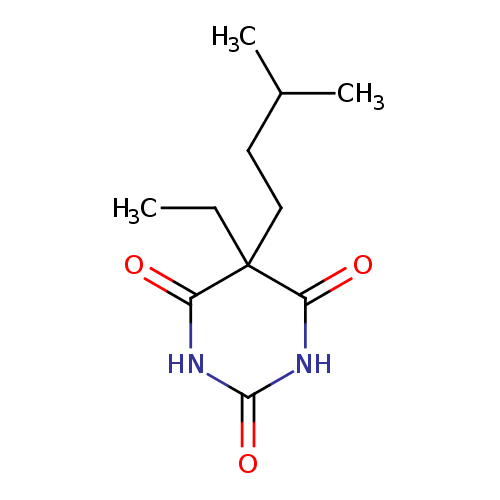
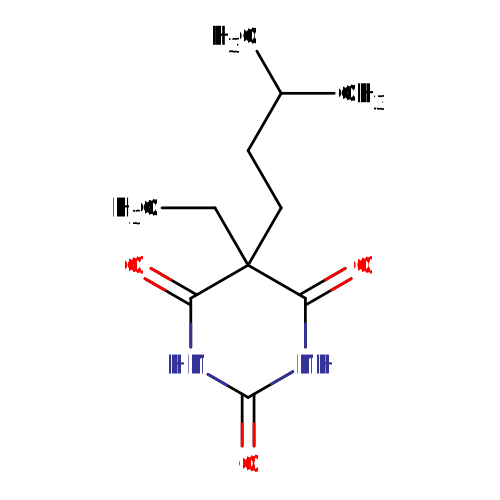
Common NameAmobarbital
ClassSmall Molecule
DescriptionA barbiturate with hypnotic and sedative properties (but not antianxiety). Adverse effects are mainly a consequence of dose-related CNS depression and the risk of dependence with continued use is high. (From Martindale, The Extra Pharmacopoeia, 30th ed, p565)
Contaminant Sources
  • HMDB Contaminants - Urine
  • STOFF IDENT Compounds
  • T3DB toxins
  • ToxCast & Tox21 Chemicals
Contaminant Type
  • Amide
  • Amine
  • Drug
  • Organic Compound
  • Synthetic Compound
Chemical Structure
Thumb
Synonyms
ValueSource
5-Ethyl-5-(3-methylbutyl)-2,4,6(1H,3H,5H)-pyrimidinetrioneChEBI
5-Ethyl-5-(3-methylbutyl)barbituric acidChEBI
5-Ethyl-5-isoamylbarbituric acidChEBI
5-Ethyl-5-isopentylbarbituric acidChEBI
AmylobarbitoneChEBI
AmytalChEBI
BarbamilChEBI
BarbamylChEBI
IsomytalKegg
5-Ethyl-5-(3-methylbutyl)barbitateGenerator
5-Ethyl-5-(3-methylbutyl)barbitic acidGenerator
5-Ethyl-5-isoamylbarbitateGenerator
5-Ethyl-5-isoamylbarbitic acidGenerator
5-Ethyl-5-isopentylbarbitateGenerator
5-Ethyl-5-isopentylbarbitic acidGenerator
Adams brand OF amorbarbitalHMDB
Amorbarbital miquel brandHMDB
ICN brand OF amorbarbitalHMDB
Sodium amobarbitalHMDB
Amobarbital, sodiumHMDB
AmsalHMDB
Amylbarb sodiumHMDB
Amytal sodiumHMDB
Hosbon brand OF amorbarbitalHMDB
Lilly brand OF amobarbital sodiumHMDB
Neur-amylHMDB
NeurAmylHMDB
PentymalHMDB
Protea brand OF amobarbital sodiumHMDB
Amobarbital sodiumHMDB
AmylobetaHMDB
Bramble brand OF amobarbital sodiumHMDB
EunoctalHMDB
Fawns and mcallan brand OF amorbarbitalHMDB
Flynn brand OF amobarbital sodiumHMDB
Houdé brand OF amobarbital sodiumHMDB
Isoamitil sedanteHMDB
Lilly brand OF amobarbitalHMDB
Novopharm brand OF amobarbital sodiumHMDB
PlacidelHMDB
Sodium amytalHMDB
Adams brand OF amobarbital sodiumHMDB
Flynn brand OF amobarbitalHMDB
IsonalHMDB
Miquel brand OF amorbarbitalHMDB
NovamobarbHMDB
Sodium, amobarbitalHMDB
TransitalHMDB
Chemical FormulaC11H18N2O3
Average Molecular Mass226.272 g/mol
Monoisotopic Mass226.132 g/mol
CAS Registry Number57-43-2
IUPAC Name5-ethyl-5-(3-methylbutyl)-1,3-diazinane-2,4,6-trione
Traditional Nameamobarbital
SMILESCCC1(CCC(C)C)C(=O)NC(=O)NC1=O
InChI IdentifierInChI=1S/C11H18N2O3/c1-4-11(6-5-7(2)3)8(14)12-10(16)13-9(11)15/h7H,4-6H2,1-3H3,(H2,12,13,14,15,16)
InChI KeyVIROVYVQCGLCII-UHFFFAOYSA-N
Chemical Taxonomy
Description belongs to the class of organic compounds known as pyrimidones. Pyrimidones are compounds that contain a pyrimidine ring, which bears a ketone. Pyrimidine is a 6-membered ring consisting of four carbon atoms and two nitrogen centers at the 1- and 3- ring positions.
KingdomOrganic compounds
Super ClassOrganoheterocyclic compounds
ClassDiazines
Sub ClassPyrimidines and pyrimidine derivatives
Direct ParentPyrimidones
Alternative Parents
Substituents
  • Pyrimidone
  • Hydropyrimidine
  • 2,5-dihydropyrimidine
  • Carbonic acid derivative
  • Propargyl-type 1,3-dipolar organic compound
  • Organic 1,3-dipolar compound
  • Azacycle
  • Organic oxide
  • Organooxygen compound
  • Organonitrogen compound
  • Organopnictogen compound
  • Organic oxygen compound
  • Carbonyl group
  • Organic nitrogen compound
  • Hydrocarbon derivative
  • Aliphatic heteromonocyclic compound
Molecular FrameworkAliphatic heteromonocyclic compounds
External Descriptors
Biological Properties
StatusDetected and Not Quantified
OriginExogenous
Cellular Locations
  • Membrane
Biofluid LocationsNot Available
Tissue LocationsNot Available
PathwaysNot Available
ApplicationsNot Available
Biological RolesNot Available
Chemical RolesNot Available
Physical Properties
StateSolid
AppearanceWhite powder.
Experimental Properties
PropertyValue
Melting Point157 °C
Boiling PointNot Available
Solubility603 mg/L (at 25 °C)
Predicted Properties
PropertyValueSource
Water Solubility0.9 g/LALOGPS
logP1.87ALOGPS
logP1.89ChemAxon
logS-2.4ALOGPS
pKa (Strongest Acidic)7.48ChemAxon
Physiological Charge0ChemAxon
Hydrogen Acceptor Count3ChemAxon
Hydrogen Donor Count2ChemAxon
Polar Surface Area75.27 ŲChemAxon
Rotatable Bond Count4ChemAxon
Refractivity58 m³·mol⁻¹ChemAxon
Polarizability23.45 ųChemAxon
Number of Rings1ChemAxon
Bioavailability1ChemAxon
Rule of FiveYesChemAxon
Ghose FilterYesChemAxon
Veber's RuleNoChemAxon
MDDR-like RuleNoChemAxon
Spectra
Spectra
Spectrum TypeDescriptionSplash KeyView
GC-MSGC-MS Spectrum - CI-B (Non-derivatized)splash10-004i-0090000000-5962005393da49f25b6dSpectrum
GC-MSGC-MS Spectrum - EI-B (Non-derivatized)splash10-0a4l-3900000000-4b439f0aa2820ea498c7Spectrum
GC-MSGC-MS Spectrum - CI-B (Non-derivatized)splash10-004i-0090000000-5962005393da49f25b6dSpectrum
GC-MSGC-MS Spectrum - EI-B (Non-derivatized)splash10-0a4l-3900000000-4b439f0aa2820ea498c7Spectrum
Predicted GC-MSPredicted GC-MS Spectrum - GC-MS (Non-derivatized) - 70eV, Positivesplash10-0006-9620000000-6298f9a27728bfc9722aSpectrum
Predicted GC-MSPredicted GC-MS Spectrum - GC-MS (Non-derivatized) - 70eV, PositiveNot AvailableSpectrum
Predicted LC-MS/MSPredicted LC-MS/MS Spectrum - 10V, Positivesplash10-004i-1390000000-7c25547f91d65d34b75eSpectrum
Predicted LC-MS/MSPredicted LC-MS/MS Spectrum - 20V, Positivesplash10-0a4i-4900000000-0c36377cb01094db4c2dSpectrum
Predicted LC-MS/MSPredicted LC-MS/MS Spectrum - 40V, Positivesplash10-0a4i-9100000000-fa8c8d196256959bdd9cSpectrum
Predicted LC-MS/MSPredicted LC-MS/MS Spectrum - 10V, Negativesplash10-0036-7950000000-45e6dd876654c6919ca7Spectrum
Predicted LC-MS/MSPredicted LC-MS/MS Spectrum - 20V, Negativesplash10-0006-9610000000-40925dd102ce4be321f7Spectrum
Predicted LC-MS/MSPredicted LC-MS/MS Spectrum - 40V, Negativesplash10-0006-9600000000-e4f4b95f285a9be2c43aSpectrum
Predicted LC-MS/MSPredicted LC-MS/MS Spectrum - 10V, Positivesplash10-004i-0090000000-48d9a204e1fb509f9844Spectrum
Predicted LC-MS/MSPredicted LC-MS/MS Spectrum - 20V, Positivesplash10-0a4i-3900000000-203e128dc6607ceba540Spectrum
Predicted LC-MS/MSPredicted LC-MS/MS Spectrum - 40V, Positivesplash10-0pb9-8900000000-3bee53e0f49ce37552a5Spectrum
Predicted LC-MS/MSPredicted LC-MS/MS Spectrum - 10V, Negativesplash10-004i-0090000000-ff2ca28a72e0e94de818Spectrum
Predicted LC-MS/MSPredicted LC-MS/MS Spectrum - 20V, Negativesplash10-0006-9040000000-ec4b92281eba0906d9e1Spectrum
Predicted LC-MS/MSPredicted LC-MS/MS Spectrum - 40V, Negativesplash10-0006-9400000000-cffa2ffcfdf19b76d1d3Spectrum
MSMass Spectrum (Electron Ionization)splash10-0a4l-4900000000-8b443325c415e154ac85Spectrum
1D NMR1H NMR SpectrumNot AvailableSpectrum
1D NMR13C NMR SpectrumNot AvailableSpectrum
Toxicity Profile
Route of ExposureNot Available
Mechanism of ToxicityAmobarbital (like all barbiturates) works by binding to the GABAA receptor at either the alpha or the beta sub unit. These are binding sites that are distinct from GABA itself and also distinct from the benzodiazepine binding site. Like benzodiazepines, barbiturates potentiate the effect of GABA at this receptor. This GABAA receptor binding decreases input resistance, depresses burst and tonic firing, especially in ventrobasal and intralaminar neurons, while at the same time increasing burst duration and mean conductance at individual chloride channels; this increases both the amplitude and decay time of inhibitory postsynaptic currents. In addition to this GABA-ergic effect, barbiturates also block the AMPA receptor, a subtype of glutamate receptor. Glutamate is the principal excitatory neurotransmitter in the mammalian CNS. Amobarbital also appears to bind neuronal nicotinic acetylcholine receptors.
MetabolismNot Available
Toxicity ValuesNot Available
Lethal DoseNot Available
Carcinogenicity (IARC Classification)No indication of carcinogenicity to humans (not listed by IARC).
Uses/SourcesNot Available
Minimum Risk LevelNot Available
Health EffectsNot Available
SymptomsNot Available
TreatmentNot Available
Concentrations
Not Available
DrugBank IDDB01351
HMDB IDHMDB0015440
FooDB IDNot Available
Phenol Explorer IDNot Available
KNApSAcK IDNot Available
BiGG IDNot Available
BioCyc IDCPD-5742
METLIN IDNot Available
PDB IDNot Available
Wikipedia LinkAmobarbital
Chemspider ID2079
ChEBI ID2673
PubChem Compound ID2164
Kegg Compound IDC07536
YMDB IDNot Available
ECMDB IDNot Available
References
Synthesis ReferenceNot Available
MSDSNot Available
General References
1. Tang BK, Kalow W, Grey AA: Amobarbital metabolism in man: N-glucoside formation. Res Commun Chem Pathol Pharmacol. 1978 Jul;21(1):45-53.
2. McCall WV: The addition of intravenous caffeine during an amobarbital interview. J Psychiatry Neurosci. 1992 Nov;17(5):195-7.
3. Soine PJ, Soine WH: High-performance liquid chromatographic determination of the diastereomers of 1-(beta-D-glucopyranosyl)amobarbital in urine. J Chromatogr. 1987 Nov 27;422:309-14.
4. Maynert EW: The alcoholic metabolites of pentobarbital and amobarbital in man. J Pharmacol Exp Ther. 1965 Oct;150(1):118-21.
5. Kim HS, Wan X, Mathers DA, Puil E: Selective GABA-receptor actions of amobarbital on thalamic neurons. Br J Pharmacol. 2004 Oct;143(4):485-94. Epub 2004 Sep 20.