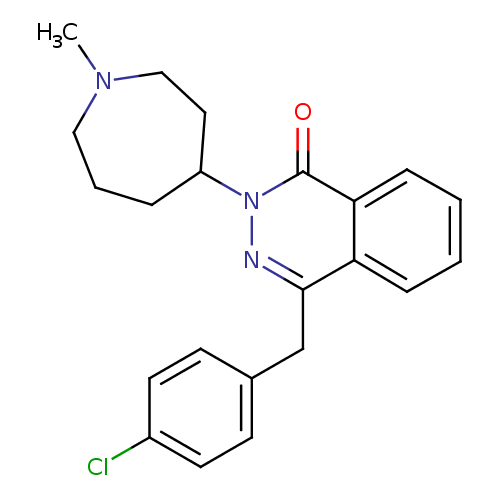
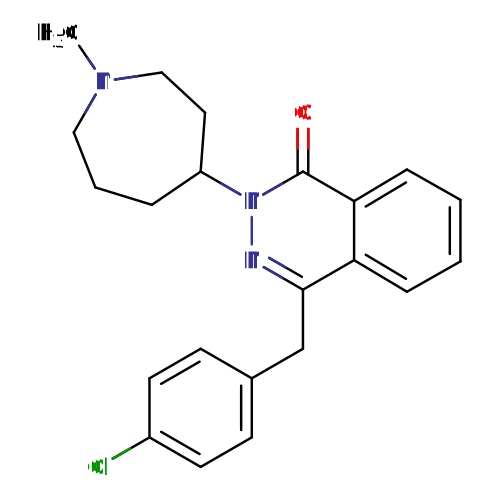
Record Information
Version1.0
Creation Date2014-08-30 21:04:10 UTC
Update Date2026-05-14 16:54:33 UTC
Accession NumberCHEM003518
Identification
Common NameAzelastine
ClassSmall Molecule
DescriptionAzelastine, a phthalazine derivative, is an antihistamine and mast cell stabilizer available as a nasal spray for hay fever and as eye drops for allergic conjunctivitis. Azelastine is also available as a combination product of azelastine hydrochloride and fluticasone propionate called Dymista®. Dymista® is indicated in patient over 12 years old for symptomatic relief of seasonal allergic rhinitis.
Contaminant Sources
  • HMDB Contaminants - Urine
  • STOFF IDENT Compounds
  • T3DB toxins
Contaminant Type
  • Amine
  • Anti-Allergic Agent
  • Bronchodilator Agent
  • Drug
  • Histamine H1 Antagonist, Non-Sedating
  • Lipoxygenase Inhibitor
  • Organic Compound
  • Organochloride
  • Synthetic Compound
Chemical Structure
Thumb
Synonyms
ValueSource
4-(p-Chlorobenzyl)-2-(hexahydro-1-methyl-1H-azepin-4-yl)-1-(2H)-phthalazinoneChEBI
AzelastinaChEBI
AzelastinumChEBI
OptivarKegg
4-(p-Chlorobenzyl)-2-(N-methylperhydroazepinyl-(4))-1-(2H)-phthalazinoneHMDB
AfluonHMDB
AstelinHMDB
Dagra brand OF azelastine hydrochlorideHMDB
Muro brand OF azelastineHMDB
OptilastHMDB
Orion brand OF azelastine hydrochlorideHMDB
Viatris brand OF azelastine hydrochlorideHMDB
Wallace brand OF azelastine hydrochlorideHMDB
4-((4-Chlorophenyl)methyl)-2- (hexahydro-1-methyl-1H-azepin-4-yl)-1(2H)- phthalazinone HCLHMDB
ASTA medica brand OF azelastine hydrochlorideHMDB
CorifinaHMDB
LoxinHMDB
RhinolastHMDB
Vividrin akut azelastinHMDB
AzeptinHMDB
Bayer brand OF azelastine hydrochlorideHMDB
Sanfer brand OF azelastine hydrochlorideHMDB
AllergodilHMDB
Mann brand OF azelastine hydrochlorideHMDB
Azelastine hydrochlorideHMDB
Chemical FormulaC22H24ClN3O
Average Molecular Mass381.898 g/mol
Monoisotopic Mass381.161 g/mol
CAS Registry Number58581-89-8
IUPAC Name4-[(4-chlorophenyl)methyl]-2-(1-methylazepan-4-yl)-1,2-dihydrophthalazin-1-one
Traditional Nameazelastine
SMILESCN1CCCC(CC1)N1N=C(CC2=CC=C(Cl)C=C2)C2=CC=CC=C2C1=O
InChI IdentifierInChI=1S/C22H24ClN3O/c1-25-13-4-5-18(12-14-25)26-22(27)20-7-3-2-6-19(20)21(24-26)15-16-8-10-17(23)11-9-16/h2-3,6-11,18H,4-5,12-15H2,1H3
InChI KeyMBUVEWMHONZEQD-UHFFFAOYSA-N
Chemical Taxonomy
Description belongs to the class of organic compounds known as phthalazinones. Phthalazinones are compounds containing a phthalazine bearing a ketone group.
KingdomOrganic compounds
Super ClassOrganoheterocyclic compounds
ClassDiazanaphthalenes
Sub ClassBenzodiazines
Direct ParentPhthalazinones
Alternative Parents
Substituents
  • Phthalazinone
  • Azepane
  • Chlorobenzene
  • Halobenzene
  • Pyridazinone
  • Monocyclic benzene moiety
  • Aryl chloride
  • Pyridazine
  • Aryl halide
  • Benzenoid
  • Heteroaromatic compound
  • Lactam
  • Tertiary amine
  • Tertiary aliphatic amine
  • Azacycle
  • Hydrocarbon derivative
  • Organic oxide
  • Organic nitrogen compound
  • Organooxygen compound
  • Organonitrogen compound
  • Organochloride
  • Organohalogen compound
  • Organopnictogen compound
  • Organic oxygen compound
  • Amine
  • Aromatic heteropolycyclic compound
Molecular FrameworkAromatic heteropolycyclic compounds
External Descriptors
Biological Properties
StatusDetected and Not Quantified
OriginExogenous
Cellular Locations
  • Membrane
Biofluid LocationsNot Available
Tissue LocationsNot Available
PathwaysNot Available
Applications
Biological Roles
Chemical Roles
Physical Properties
StateSolid
AppearanceWhite powder.
Experimental Properties
PropertyValue
Melting Point225 °C (hydrochloride salt)
Boiling PointNot Available
SolubilitySparingly soluble (hydrochloride salt)
Predicted Properties
PropertyValueSource
Water Solubility0.0092 g/LALOGPS
logP3.81ALOGPS
logP4.04ChemAxon
logS-4.6ALOGPS
pKa (Strongest Basic)8.88ChemAxon
Physiological Charge1ChemAxon
Hydrogen Acceptor Count3ChemAxon
Hydrogen Donor Count0ChemAxon
Polar Surface Area35.91 ŲChemAxon
Rotatable Bond Count3ChemAxon
Refractivity110.52 m³·mol⁻¹ChemAxon
Polarizability41.54 ųChemAxon
Number of Rings4ChemAxon
Bioavailability1ChemAxon
Rule of FiveYesChemAxon
Ghose FilterYesChemAxon
Veber's RuleYesChemAxon
MDDR-like RuleNoChemAxon
Spectra
Spectra
Spectrum TypeDescriptionSplash KeyView
Predicted GC-MSPredicted GC-MS Spectrum - GC-MS (Non-derivatized) - 70eV, Positivesplash10-03di-9886000000-488eee761663db10fdf7Spectrum
Predicted GC-MSPredicted GC-MS Spectrum - GC-MS (Non-derivatized) - 70eV, PositiveNot AvailableSpectrum
LC-MS/MSLC-MS/MS Spectrum - , positivesplash10-001i-0219000000-689aed0dccf673820d4eSpectrum
LC-MS/MSLC-MS/MS Spectrum - LC-ESI-QFT , positivesplash10-03e9-2908000000-3d19ebb91515adce237bSpectrum
LC-MS/MSLC-MS/MS Spectrum - 35V, Positivesplash10-03e9-1908000000-95d1d10eb0ad7e0a5caaSpectrum
LC-MS/MSLC-MS/MS Spectrum - 40V, Positivesplash10-00di-0593000000-58523cbdb28285c913e4Spectrum
LC-MS/MSLC-MS/MS Spectrum - 50V, Positivesplash10-05i0-0940000000-8644fd48c2a4a3af1cebSpectrum
LC-MS/MSLC-MS/MS Spectrum - 50V, Positivesplash10-05i0-0950000000-344a725e518078163651Spectrum
LC-MS/MSLC-MS/MS Spectrum - 20V, Positivesplash10-001i-0009000000-47ec9bd1fd4efec1a393Spectrum
LC-MS/MSLC-MS/MS Spectrum - 35V, Positivesplash10-001i-1349000000-8e49a62427e3060b124fSpectrum
LC-MS/MSLC-MS/MS Spectrum - 10V, Positivesplash10-001i-0009000000-66d30432d2e83b7bef0bSpectrum
LC-MS/MSLC-MS/MS Spectrum - 30V, Positivesplash10-001i-0129000000-f11386dc3536cefda978Spectrum
Predicted LC-MS/MSPredicted LC-MS/MS Spectrum - 10V, Positivesplash10-001i-0019000000-3cb870845555c5786c73Spectrum
Predicted LC-MS/MSPredicted LC-MS/MS Spectrum - 20V, Positivesplash10-053r-0369000000-b74e000f63bb368b99b1Spectrum
Predicted LC-MS/MSPredicted LC-MS/MS Spectrum - 40V, Positivesplash10-03l0-9410000000-7199ebf04c51eb076d6cSpectrum
Predicted LC-MS/MSPredicted LC-MS/MS Spectrum - 10V, Negativesplash10-001i-0019000000-9890b690027006b28ee1Spectrum
Predicted LC-MS/MSPredicted LC-MS/MS Spectrum - 20V, Negativesplash10-001i-1159000000-752e6f7ffd2b5aeeca78Spectrum
Predicted LC-MS/MSPredicted LC-MS/MS Spectrum - 40V, Negativesplash10-014i-1190000000-e1fac913b1bac2247139Spectrum
Predicted LC-MS/MSPredicted LC-MS/MS Spectrum - 10V, Positivesplash10-001i-0009000000-65debeb41831c291ecebSpectrum
Predicted LC-MS/MSPredicted LC-MS/MS Spectrum - 20V, Positivesplash10-001i-0209000000-d6632dfc2bb4c411543cSpectrum
Predicted LC-MS/MSPredicted LC-MS/MS Spectrum - 40V, Positivesplash10-03fr-3942000000-125e45b36545578394a0Spectrum
Predicted LC-MS/MSPredicted LC-MS/MS Spectrum - 10V, Negativesplash10-001i-0009000000-e093c6464a3534f2d448Spectrum
Predicted LC-MS/MSPredicted LC-MS/MS Spectrum - 20V, Negativesplash10-001i-0019000000-d58a8236055ebf7fd0e3Spectrum
Predicted LC-MS/MSPredicted LC-MS/MS Spectrum - 40V, Negativesplash10-05o0-6963000000-f9e3f6b0ea6656234db4Spectrum
Toxicity Profile
Route of ExposureAbsorption of azelastine following ocular administration was relatively low. Systemic bioavailability is approximately 40% after nasal administration.
Mechanism of ToxicityAzelastine competes with histamine for the H1-receptor sites on effector cells and acts as an antagonist by inhibiting the release of histamine and other mediators involved in the allergic response.
MetabolismAzelastine hydrochloride is oxidatively metabolized to the principal metabolite, N-desmethylazelastine, by the cytochrome P450 enzyme system, however the exact cytochrome P450 isoenzyme involved has not been determined. The major metabolite, desmethylazelastine, also has H1-receptor antagonist activity. Route of Elimination: Approximately 75% of an oral dose of radiolabeled azelastine hydrochloride was excreted in the feces with less than 10% as unchanged azelastine. Azelastine hydrochloride is oxidatively metabolized to the principal metabolite, N-desmethylazelastine, by the cytochrome P450 enzyme system. Half Life: Elimination half-life (based on intravenous and oral administration) is 22 hours. Elimination half-life of the active metabolite, desmethylazelastine, is 54 hours (after oral administration of azelastine).
Toxicity ValuesNot Available
Lethal DoseNot Available
Carcinogenicity (IARC Classification)No indication of carcinogenicity to humans (not listed by IARC).
Uses/SourcesFor the symptomatic treatment of seasonal allergic rhinitis and non-allergic rhinitis, as well as symptomatic relief of ocular itching associated with allergic conjunctivitis.
Minimum Risk LevelNot Available
Health EffectsNot Available
SymptomsNot Available
TreatmentNot Available
Concentrations
Not Available
DrugBank IDDB00972
HMDB IDHMDB0015107
FooDB IDNot Available
Phenol Explorer IDNot Available
KNApSAcK IDNot Available
BiGG IDNot Available
BioCyc IDNot Available
METLIN IDNot Available
PDB IDNot Available
Wikipedia LinkAzelastine
Chemspider ID2180
ChEBI ID2950
PubChem Compound ID2267
Kegg Compound IDC07768
YMDB IDNot Available
ECMDB IDNot Available
References
Synthesis Reference

Yutaka Morita, Noritoshi Koyama, Shigemitsu Ohsawa, “Methods employing stable preparation containing azelastine hydrochloride.” U.S. Patent US6117864, issued December, 1990.

MSDSNot Available
General References
1. https://www.ncbi.nlm.nih.gov/pubmed/?term=22339679
2. Horak F: Effectiveness of twice daily azelastine nasal spray in patients with seasonal allergic rhinitis. Ther Clin Risk Manag. 2008 Oct;4(5):1009-22.
3. Bernstein JA: Azelastine hydrochloride: a review of pharmacology, pharmacokinetics, clinical efficacy and tolerability. Curr Med Res Opin. 2007 Oct;23(10):2441-52.