Record Information
Version1.0
Creation Date2014-08-29 06:51:44 UTC
Update Date2026-03-31 19:09:24 UTC
Accession NumberCHEM003478
Identification
Common NameLinuron
ClassSmall Molecule
DescriptionLinuron is an herbicide for the pre- and post-emergence control of annual grass and broad-leaved weeds using selective and systemic action with contact and residual action. It is known to inhibit photosynthesis (photosystem II).
Contaminant Sources
  • Clean Air Act Chemicals
  • EPA Endocrine Screening
  • HPV EPA Chemicals
  • My Exposome Chemicals
  • STOFF IDENT Compounds
  • T3DB toxins
  • ToxCast & Tox21 Chemicals
Contaminant Type
  • Herbicide
  • Organic Compound
  • Organochloride
  • Pesticide
  • Synthetic Compound
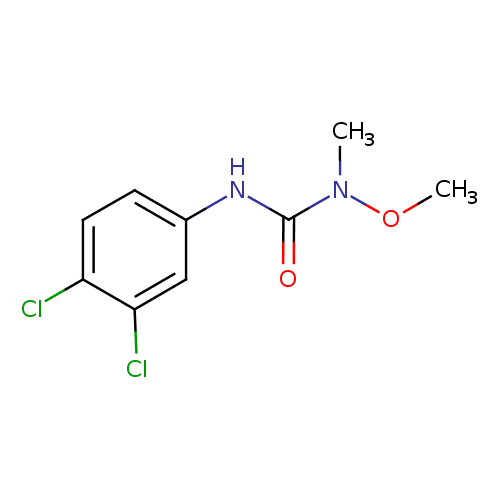
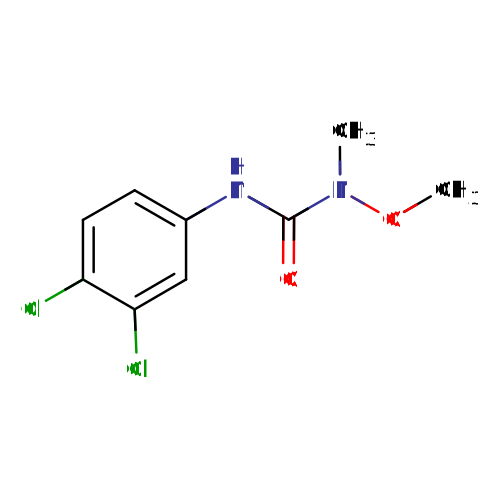
Chemical Structure
Thumb
Synonyms
ValueSource
1-Methoxy-1-methyl-3-(3,4-dichlorophenyl)ureaChEBI
3-(3,4-Dichlorophenyl)-1-methoxy-1-methylureaChEBI
N'-(3,4-dichlorophenyl)-N-methoxy-N-methyl ureaChEBI
AfalonMeSH
Chemical FormulaC9H10Cl2N2O2
Average Molecular Mass249.094 g/mol
Monoisotopic Mass248.012 g/mol
CAS Registry Number330-55-2
IUPAC Name1-(3,4-dichlorophenyl)-3-methoxy-3-methylurea
Traditional Namelinuron
SMILESCON(C)C(=O)NC1=CC=C(Cl)C(Cl)=C1
InChI IdentifierInChI=1S/C9H10Cl2N2O2/c1-13(15-2)9(14)12-6-3-4-7(10)8(11)5-6/h3-5H,1-2H3,(H,12,14)
InChI KeyXKJMBINCVNINCA-UHFFFAOYSA-N
Chemical Taxonomy
Description belongs to the class of organic compounds known as n-phenylureas. N-phenylureas are compounds containing a N-phenylurea moiety, which is structurally characterized by a phenyl group linked to one nitrogen atom of a urea group.
KingdomOrganic compounds
Super ClassBenzenoids
ClassBenzene and substituted derivatives
Sub ClassN-phenylureas
Direct ParentN-phenylureas
Alternative Parents
Substituents
  • N-phenylurea
  • 1,2-dichlorobenzene
  • Chlorobenzene
  • Halobenzene
  • Aryl chloride
  • Aryl halide
  • Carbonic acid derivative
  • Organic nitrogen compound
  • Organochloride
  • Organohalogen compound
  • Organonitrogen compound
  • Organooxygen compound
  • Hydrocarbon derivative
  • Organic oxide
  • Organopnictogen compound
  • Carbonyl group
  • Organic oxygen compound
  • Aromatic homomonocyclic compound
Molecular FrameworkAromatic homomonocyclic compounds
External Descriptors
Biological Properties
StatusDetected and Not Quantified
OriginExogenous
Cellular Locations
  • Lysosome
  • Membrane
  • Mitochondrion
  • Peroxisome
  • Plasma Membrane
Biofluid LocationsNot Available
Tissue LocationsNot Available
Pathways
NameSMPDB LinkKEGG Link
Metabolic PathwaysNot AvailableNot Available
Aflatoxin BiosynthesisNot AvailableNot Available
ApplicationsNot Available
Biological RolesNot Available
Chemical RolesNot Available
Physical Properties
StateSolid
AppearanceWhite powder.
Experimental Properties
PropertyValue
Melting PointNot Available
Boiling PointNot Available
SolubilityNot Available
Predicted Properties
PropertyValueSource
Water Solubility0.1 g/LALOGPS
logP2.82ALOGPS
logP2.68ChemAxon
logS-3.4ALOGPS
pKa (Strongest Acidic)11.94ChemAxon
pKa (Strongest Basic)-4.7ChemAxon
Physiological Charge0ChemAxon
Hydrogen Acceptor Count2ChemAxon
Hydrogen Donor Count1ChemAxon
Polar Surface Area41.57 ŲChemAxon
Rotatable Bond Count2ChemAxon
Refractivity60.35 m³·mol⁻¹ChemAxon
Polarizability23.26 ųChemAxon
Number of Rings1ChemAxon
Bioavailability1ChemAxon
Rule of FiveYesChemAxon
Ghose FilterYesChemAxon
Veber's RuleNoChemAxon
MDDR-like RuleNoChemAxon
Spectra
Spectra
Spectrum TypeDescriptionSplash KeyView
Predicted GC-MSPredicted GC-MS Spectrum - GC-MS (Non-derivatized) - 70eV, Positivesplash10-000i-3910000000-06403414f74cd43e045eSpectrum
Predicted GC-MSPredicted GC-MS Spectrum - GC-MS (Non-derivatized) - 70eV, PositiveNot AvailableSpectrum
LC-MS/MSLC-MS/MS Spectrum - 55V, Positivesplash10-053r-0900000000-58defb2ae9c51a83691eSpectrum
LC-MS/MSLC-MS/MS Spectrum - 45V, Positivesplash10-0a59-0900000000-fc28f465e47143fb5927Spectrum
LC-MS/MSLC-MS/MS Spectrum - 60V, Positivesplash10-0a59-0900000000-63e2a0b93419ffc4eafbSpectrum
LC-MS/MSLC-MS/MS Spectrum - 35V, Positivesplash10-0bu1-1930000000-ab84eba117f7c5ab98adSpectrum
LC-MS/MSLC-MS/MS Spectrum - 40V, Negativesplash10-0f6t-0890000000-f1b31df027603c7cd878Spectrum
LC-MS/MSLC-MS/MS Spectrum - 30V, Positivesplash10-0a5a-0940000000-4c2350ca6138da576cdfSpectrum
LC-MS/MSLC-MS/MS Spectrum - 55V, Positivesplash10-0a59-0900000000-248384e486fe00066678Spectrum
LC-MS/MSLC-MS/MS Spectrum - 75V, Positivesplash10-06si-0900000000-7190cc3af8bf9fde6ef9Spectrum
LC-MS/MSLC-MS/MS Spectrum - 15V, Positivesplash10-0002-0190000000-43475d3d09de3d66940aSpectrum
LC-MS/MSLC-MS/MS Spectrum - 15V, Negativesplash10-0a4i-0910000000-f709c06637f21ffef280Spectrum
LC-MS/MSLC-MS/MS Spectrum - 80V, Positivesplash10-01q9-0900000000-c2ba2c42df804483c4bfSpectrum
LC-MS/MSLC-MS/MS Spectrum - 35V, Positivesplash10-053r-0900000000-5f48adbb98c12803d608Spectrum
LC-MS/MSLC-MS/MS Spectrum - 30V, Negativesplash10-0a4i-0910000000-59ba8adaef398a8bd29aSpectrum
LC-MS/MSLC-MS/MS Spectrum - 45V, Negativesplash10-0a4i-0920000000-4e379a2e3c68a80a9f39Spectrum
LC-MS/MSLC-MS/MS Spectrum - 75V, Negativesplash10-03dj-0970000000-7fc321d13458dd5f03f2Spectrum
LC-MS/MSLC-MS/MS Spectrum - 60V, Negativesplash10-0bt9-0950000000-3807c2876fc72308cc65Spectrum
LC-MS/MSLC-MS/MS Spectrum - 50V, Positivesplash10-001i-0900000000-d7ad86577f8019000d68Spectrum
LC-MS/MSLC-MS/MS Spectrum - 90V, Negativesplash10-0002-0910000000-5f4398f81ba0940aa138Spectrum
LC-MS/MSLC-MS/MS Spectrum - 30V, Positivesplash10-08gi-0900000000-844c0e7b8f1bae30354dSpectrum
Predicted LC-MS/MSPredicted LC-MS/MS Spectrum - 10V, Positivesplash10-0002-2390000000-69016a05781705508d3eSpectrum
Predicted LC-MS/MSPredicted LC-MS/MS Spectrum - 20V, Positivesplash10-03di-9340000000-21d61a1ea4afdade4fdfSpectrum
Predicted LC-MS/MSPredicted LC-MS/MS Spectrum - 40V, Positivesplash10-000i-8900000000-3ceff76441f309a84632Spectrum
Predicted LC-MS/MSPredicted LC-MS/MS Spectrum - 10V, Negativesplash10-0002-1090000000-09719403e6831b7d7ae5Spectrum
Predicted LC-MS/MSPredicted LC-MS/MS Spectrum - 20V, Negativesplash10-02tj-1490000000-00d02fd3109d9782a7ccSpectrum
Predicted LC-MS/MSPredicted LC-MS/MS Spectrum - 40V, Negativesplash10-0550-9700000000-8e7c824eb58d822210adSpectrum
MSMass Spectrum (Electron Ionization)splash10-03di-9200000000-02a9a624235ddb48448dSpectrum
1D NMR1H NMR SpectrumNot AvailableSpectrum
1D NMR13C NMR SpectrumNot AvailableSpectrum
Toxicity Profile
Route of ExposureNot Available
Mechanism of ToxicityLinuron is a weak competitive inhibitor of androgen receptor binding and it inhibits androgen-induced gene expression in vitro. This may partially contribute to the malformations of androgen-dependent tissues in male rats. (1)
MetabolismNot Available
Toxicity ValuesNot Available
Lethal DoseNot Available
Carcinogenicity (IARC Classification)No indication of carcinogenicity to humans (not listed by IARC).
Uses/SourcesThis is a man-made compound that is used as a pesticide.
Minimum Risk LevelNot Available
Health EffectsLinuron affects the male reproductive system of the offspring after maternal exposure during mid and late pregnancy.
SymptomsNot Available
TreatmentNot Available
Concentrations
Not Available
DrugBank IDNot Available
HMDB IDNot Available
FooDB IDNot Available
Phenol Explorer IDNot Available
KNApSAcK IDNot Available
BiGG IDNot Available
BioCyc IDNot Available
METLIN IDNot Available
PDB IDNot Available
Wikipedia LinkLinuron
Chemspider IDNot Available
ChEBI ID6482
PubChem Compound ID9502
Kegg Compound IDC11007
YMDB IDNot Available
ECMDB IDNot Available
References
Synthesis ReferenceNot Available
MSDSNot Available
General References
1. https://www.ncbi.nlm.nih.gov/pubmed/?term=23586778
2. https://www.ncbi.nlm.nih.gov/pubmed/?term=24410802
3. https://www.ncbi.nlm.nih.gov/pubmed/?term=25238184