Record Information
Version1.0
Creation Date2014-08-29 06:51:34 UTC
Update Date2016-11-09 01:09:08 UTC
Accession NumberCHEM003430
Identification
Common NameHydroxyphenyllactic acid
ClassSmall Molecule
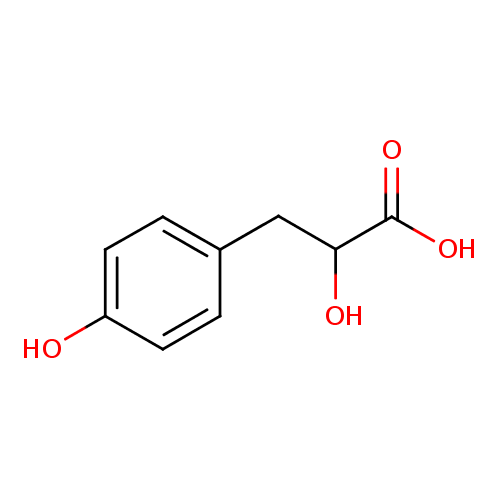
DescriptionHydroxyphenyllactic acid or 4-hydroxyphenyllactate (the L-form) is a tyrosine metabolite. The level of L-hydroxyphenyllactic acid is elevated in patients with a deficiency of the enzyme p-hydroxyphenylpyruvate oxidase (EC 1.14.2.2). L-hydroxyphenyllactate is present in relatively higher concentrations in the cerebrospinal fluid and urine of patients with phenylketonuria (PKU) and tyrosinemia. However the D-form of hydroxyphneyllactate is of bacterial origin and is also found in individuals with bacterial overgrowth or unusual gut microflora Microbial hydroxyphenyllactate is likely derived from phenolic or polyphenolic compounds in the diet. Bifidobacteria and lactobacilli produced considerable amounts of phenyllactic and p-hydroxyphenyllactic acids It has also been shown that hydroxyphenyllactate decreases ROS (reactive oxygen species) production in both mitochondria and neutrophils and so hydroxyphenyllactate may function as a natural anti-oxidant (2, 3, 3, 4, 4).
Contaminant Sources
  • FooDB Chemicals
  • HMDB Contaminants - Urine
  • T3DB toxins
Contaminant Type
  • Animal Toxin
  • Food Toxin
  • Industrial/Workplace Toxin
  • Metabolite
  • Natural Compound
  • Organic Compound
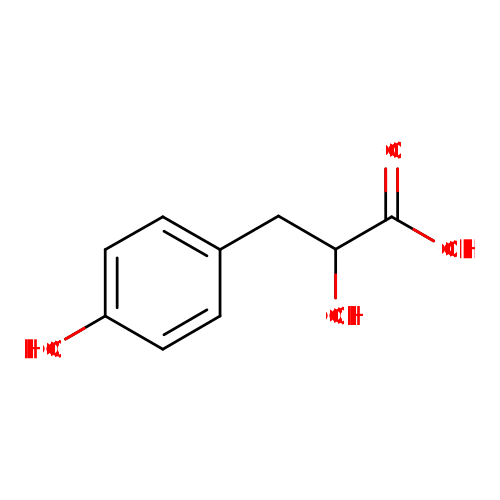
Chemical Structure
Thumb
Synonyms
ValueSource
2-Hydroxy-3-(4-hydroxyphenyl)propanoateChEBI
2-Hydroxy-3-(p-hydroxyphenyl)propionic acidChEBI
4-Hydroxyphenyllactic acidChEBI
beta-(4-Hydroxyphenyl)lactic acidChEBI
beta-(p-Hydroxyphenyl)lactic acidChEBI
DL-p-Hydroxyphenyllactic acidChEBI
p-Hydroxyphenyl lactic acidChEBI
4-HydroxyphenyllactateKegg
p-HydroxyphenyllactateKegg
2-Hydroxy-3-(4-hydroxyphenyl)propanoic acidGenerator
2-Hydroxy-3-(p-hydroxyphenyl)propionateGenerator
b-(4-Hydroxyphenyl)lactateGenerator
b-(4-Hydroxyphenyl)lactic acidGenerator
beta-(4-Hydroxyphenyl)lactateGenerator
Β-(4-hydroxyphenyl)lactateGenerator
Β-(4-hydroxyphenyl)lactic acidGenerator
b-(p-Hydroxyphenyl)lactateGenerator
b-(p-Hydroxyphenyl)lactic acidGenerator
beta-(p-Hydroxyphenyl)lactateGenerator
Β-(p-hydroxyphenyl)lactateGenerator
Β-(p-hydroxyphenyl)lactic acidGenerator
DL-p-HydroxyphenyllactateGenerator
p-Hydroxyphenyl lactateGenerator
p-Hydroxyphenyllactic acidGenerator
HydroxyphenyllactateGenerator
(RS)-3-(4-Hydroxyphenyl)lactateHMDB
(RS)-3-(4-Hydroxyphenyl)lactic acidHMDB
3-(4-Hydroxyphenyl)-DL-lactateHMDB
3-(4-Hydroxyphenyl)-DL-lactic acidHMDB
3-(4-Hydroxyphenyl)lactateHMDB
3-(p-Hydroxyphenyl)-lactateHMDB
3-(p-Hydroxyphenyl)-lactic acidHMDB
a,4-DihydroxybenzenepropanoateHMDB
a,4-Dihydroxybenzenepropanoic acidHMDB
b-(p-Hydroxyphenyl)-DL-lactateHMDB
b-(p-Hydroxyphenyl)-DL-lactic acidHMDB
beta-(p-Hydroxyphenyl)-DL-lactateHMDB
beta-(p-Hydroxyphenyl)-DL-lactic acidHMDB
DL-3-(4-Hydroxyphenyl)lactateHMDB
DL-3-(4-Hydroxyphenyl)lactic acidHMDB
HPLAHMDB
4-Hydroxyphenyllactic acid, (DL)-isomerHMDB
Para-hydroxyphenyllactic acidHMDB
2-HydroxyphloretateHMDB
2-Hydroxy-3-(4'-hydroxyphenyl)propanoic acidHMDB
2-Hydroxy-3-(4'-hydroxyphenyl)propanoic acid HMDB
Chemical FormulaC9H10O4
Average Molecular Mass182.173 g/mol
Monoisotopic Mass182.058 g/mol
CAS Registry Number306-23-0
IUPAC Name2-hydroxy-3-(4-hydroxyphenyl)propanoic acid
Traditional Namehydroxyphenyllactic acid
SMILESOC(CC1=CC=C(O)C=C1)C(O)=O
InChI IdentifierInChI=1S/C9H10O4/c10-7-3-1-6(2-4-7)5-8(11)9(12)13/h1-4,8,10-11H,5H2,(H,12,13)
InChI KeyJVGVDSSUAVXRDY-UHFFFAOYSA-N
Chemical Taxonomy
Description belongs to the class of organic compounds known as phenylpropanoic acids. Phenylpropanoic acids are compounds with a structure containing a benzene ring conjugated to a propanoic acid.
KingdomOrganic compounds
Super ClassPhenylpropanoids and polyketides
ClassPhenylpropanoic acids
Sub ClassNot Available
Direct ParentPhenylpropanoic acids
Alternative Parents
Substituents
  • 3-phenylpropanoic-acid
  • 1-hydroxy-2-unsubstituted benzenoid
  • Phenol
  • Alpha-hydroxy acid
  • Monocyclic benzene moiety
  • Benzenoid
  • Hydroxy acid
  • Secondary alcohol
  • Carboxylic acid derivative
  • Carboxylic acid
  • Monocarboxylic acid or derivatives
  • Alcohol
  • Organooxygen compound
  • Hydrocarbon derivative
  • Carbonyl group
  • Organic oxide
  • Organic oxygen compound
  • Aromatic homomonocyclic compound
Molecular FrameworkAromatic homomonocyclic compounds
External Descriptors
Biological Properties
StatusDetected and Not Quantified
OriginEndogenous
Cellular Locations
  • Cytoplasm
  • Extracellular
  • Mitochondria
Biofluid LocationsNot Available
Tissue Locations
  • Epidermis
  • Prostate
Pathways
NameSMPDB LinkKEGG Link
Tyrosinemia Type 2 (or Richner-Hanhart syndrome)SMP00369 Not Available
ApplicationsNot Available
Biological Roles
Chemical RolesNot Available
Physical Properties
StateSolid
AppearanceWhite powder.
Experimental Properties
PropertyValue
Melting PointNot Available
Boiling PointNot Available
Solubility12.9 mg/mL at 16°C
Predicted Properties
PropertyValueSource
Water Solubility4.79 g/LALOGPS
logP0.87ALOGPS
logP0.88ChemAxon
logS-1.6ALOGPS
pKa (Strongest Acidic)3.58ChemAxon
pKa (Strongest Basic)-3.8ChemAxon
Physiological Charge-1ChemAxon
Hydrogen Acceptor Count4ChemAxon
Hydrogen Donor Count3ChemAxon
Polar Surface Area77.76 ŲChemAxon
Rotatable Bond Count3ChemAxon
Refractivity45.44 m³·mol⁻¹ChemAxon
Polarizability17.51 ųChemAxon
Number of Rings1ChemAxon
Bioavailability1ChemAxon
Rule of FiveYesChemAxon
Ghose FilterYesChemAxon
Veber's RuleNoChemAxon
MDDR-like RuleNoChemAxon
Spectra
Spectra
Spectrum TypeDescriptionSplash KeyView
GC-MSGC-MS Spectrum - GC-MS (3 TMS)splash10-004i-1911000000-424dc0a114976e4a6052Spectrum
GC-MSGC-MS Spectrum - GC-MS (Non-derivatized)splash10-004i-1911000000-424dc0a114976e4a6052Spectrum
GC-MSGC-MS Spectrum - GC-EI-TOF (Non-derivatized)splash10-004i-0900000000-b7f0ddb24f5c187d4540Spectrum
Predicted GC-MSPredicted GC-MS Spectrum - GC-MS (Non-derivatized) - 70eV, Positivesplash10-0a4r-3900000000-aece5a68ba54ab74c5eeSpectrum
Predicted GC-MSPredicted GC-MS Spectrum - GC-MS (3 TMS) - 70eV, Positivesplash10-003r-5496000000-fbb65d0c963e70625e95Spectrum
Predicted GC-MSPredicted GC-MS Spectrum - GC-MS (Non-derivatized) - 70eV, PositiveNot AvailableSpectrum
Predicted GC-MSPredicted GC-MS Spectrum - GC-MS (TMS_1_1) - 70eV, PositiveNot AvailableSpectrum
Predicted GC-MSPredicted GC-MS Spectrum - GC-MS (TMS_1_2) - 70eV, PositiveNot AvailableSpectrum
Predicted GC-MSPredicted GC-MS Spectrum - GC-MS (TMS_1_3) - 70eV, PositiveNot AvailableSpectrum
Predicted GC-MSPredicted GC-MS Spectrum - GC-MS (TMS_2_1) - 70eV, PositiveNot AvailableSpectrum
Predicted GC-MSPredicted GC-MS Spectrum - GC-MS (TMS_2_2) - 70eV, PositiveNot AvailableSpectrum
Predicted GC-MSPredicted GC-MS Spectrum - GC-MS (TMS_2_3) - 70eV, PositiveNot AvailableSpectrum
Predicted GC-MSPredicted GC-MS Spectrum - GC-MS (TBDMS_1_1) - 70eV, PositiveNot AvailableSpectrum
Predicted GC-MSPredicted GC-MS Spectrum - GC-MS (TBDMS_1_2) - 70eV, PositiveNot AvailableSpectrum
Predicted GC-MSPredicted GC-MS Spectrum - GC-MS (TBDMS_1_3) - 70eV, PositiveNot AvailableSpectrum
Predicted GC-MSPredicted GC-MS Spectrum - GC-MS (TBDMS_2_1) - 70eV, PositiveNot AvailableSpectrum
Predicted GC-MSPredicted GC-MS Spectrum - GC-MS (TBDMS_2_2) - 70eV, PositiveNot AvailableSpectrum
Predicted GC-MSPredicted GC-MS Spectrum - GC-MS (TBDMS_2_3) - 70eV, PositiveNot AvailableSpectrum
Predicted GC-MSPredicted GC-MS Spectrum - GC-MS (TBDMS_3_1) - 70eV, PositiveNot AvailableSpectrum
LC-MS/MSLC-MS/MS Spectrum - Quattro_QQQ 10V, Positive (Annotated)splash10-00li-2900000000-ea59f9dcf58b55bec6caSpectrum
LC-MS/MSLC-MS/MS Spectrum - Quattro_QQQ 25V, Positive (Annotated)splash10-054n-9300000000-5b39aa5183630ccd7f4dSpectrum
LC-MS/MSLC-MS/MS Spectrum - Quattro_QQQ 40V, Positive (Annotated)splash10-0k92-9200000000-c698fdbe1eefac6e9eabSpectrum
LC-MS/MSLC-MS/MS Spectrum - LC-ESI-QTOF (UPLC Q-Tof Premier, Waters) , Negativesplash10-01qi-0900000000-640a5a477752571a1443Spectrum
LC-MS/MSLC-MS/MS Spectrum - LC-ESI-IT , negativesplash10-03di-0900000000-45b5f23bae1a9641fb0bSpectrum
LC-MS/MSLC-MS/MS Spectrum - LC-ESI-QTOF , negativesplash10-01qi-0900000000-640a5a477752571a1443Spectrum
LC-MS/MSLC-MS/MS Spectrum - , negativesplash10-03ei-0900000000-d89828d3625adabd215bSpectrum
LC-MS/MSLC-MS/MS Spectrum - 40V, Positivesplash10-00ou-9000000000-60dd6237cac5c79c7508Spectrum
LC-MS/MSLC-MS/MS Spectrum - 10V, Positivesplash10-00ri-2900000000-69365cb4d9937f6a96e0Spectrum
LC-MS/MSLC-MS/MS Spectrum - 35V, Negativesplash10-00li-1900000000-03a7d2e8f219eba66eeeSpectrum
LC-MS/MSLC-MS/MS Spectrum - 35V, Negativesplash10-029i-0900000000-fd70bef080a1a354df5aSpectrum
LC-MS/MSLC-MS/MS Spectrum - 20V, Positivesplash10-0006-9400000000-65da3c598368dbad66cdSpectrum
LC-MS/MSLC-MS/MS Spectrum - 20V, Positivesplash10-052b-9100000000-6ad54b488ac0183ff4bfSpectrum
LC-MS/MSLC-MS/MS Spectrum - 10V, Positivesplash10-0002-9400000000-af41107b1e7be38f765cSpectrum
LC-MS/MSLC-MS/MS Spectrum - 40V, Positivesplash10-0a4i-9000000000-023a994f4d18e32123cdSpectrum
LC-MS/MSLC-MS/MS Spectrum - 40V, Negativesplash10-001i-5900000000-8fcf87adaaae828f3aaeSpectrum
LC-MS/MSLC-MS/MS Spectrum - 20V, Negativesplash10-00ri-2900000000-ed974245d122fcbc31c0Spectrum
LC-MS/MSLC-MS/MS Spectrum - 10V, Negativesplash10-03ei-1900000000-fd1d5ff4f32cdcdf0a38Spectrum
LC-MS/MSLC-MS/MS Spectrum - 40V, Negativesplash10-00ec-9400000000-9b26dc9e6bb4e1a72cfbSpectrum
Predicted LC-MS/MSPredicted LC-MS/MS Spectrum - 10V, Positivesplash10-05o9-0900000000-a343595d5c411e940c25Spectrum
Predicted LC-MS/MSPredicted LC-MS/MS Spectrum - 20V, Positivesplash10-0ap0-0900000000-1f777ab6b9486c181355Spectrum
Predicted LC-MS/MSPredicted LC-MS/MS Spectrum - 40V, Positivesplash10-0a6r-9800000000-db82c9bf8afdb32af6deSpectrum
Predicted LC-MS/MSPredicted LC-MS/MS Spectrum - 10V, Negativesplash10-001i-2900000000-3e1a7023e9214816e8a5Spectrum
Predicted LC-MS/MSPredicted LC-MS/MS Spectrum - 20V, Negativesplash10-052r-2900000000-c05e995d8c57a180bae7Spectrum
Predicted LC-MS/MSPredicted LC-MS/MS Spectrum - 40V, Negativesplash10-05mx-9800000000-729b43ad9499a14c2d01Spectrum
1D NMR1H NMR SpectrumNot AvailableSpectrum
1D NMR13C NMR SpectrumNot AvailableSpectrum
1D NMR1H NMR SpectrumNot AvailableSpectrum
1D NMR13C NMR SpectrumNot AvailableSpectrum
1D NMR1H NMR SpectrumNot AvailableSpectrum
1D NMR13C NMR SpectrumNot AvailableSpectrum
1D NMR1H NMR SpectrumNot AvailableSpectrum
1D NMR13C NMR SpectrumNot AvailableSpectrum
1D NMR1H NMR SpectrumNot AvailableSpectrum
1D NMR13C NMR SpectrumNot AvailableSpectrum
1D NMR1H NMR SpectrumNot AvailableSpectrum
1D NMR13C NMR SpectrumNot AvailableSpectrum
1D NMR1H NMR SpectrumNot AvailableSpectrum
1D NMR13C NMR SpectrumNot AvailableSpectrum
1D NMR1H NMR SpectrumNot AvailableSpectrum
1D NMR13C NMR SpectrumNot AvailableSpectrum
1D NMR1H NMR SpectrumNot AvailableSpectrum
1D NMR13C NMR SpectrumNot AvailableSpectrum
1D NMR1H NMR SpectrumNot AvailableSpectrum
1D NMR13C NMR SpectrumNot AvailableSpectrum
2D NMR[1H,13C] 2D NMR SpectrumNot AvailableSpectrum
Toxicity Profile
Route of ExposureNot Available
Mechanism of ToxicityNot Available
MetabolismNot Available
Toxicity ValuesNot Available
Lethal DoseNot Available
Carcinogenicity (IARC Classification)No indication of carcinogenicity to humans (not listed by IARC).
Uses/SourcesThis is an endogenously produced metabolite found in the human body. It is used in metabolic reactions, catabolic reactions or waste generation.
Minimum Risk LevelNot Available
Health EffectsNot Available
SymptomsNot Available
TreatmentNot Available
Concentrations
Not Available
DrugBank IDNot Available
HMDB IDHMDB0000755
FooDB IDFDB017136
Phenol Explorer ID577
KNApSAcK IDC00050491
BiGG ID2392410
BioCyc ID4-HYDROXYPHENYLLACTATE
METLIN ID5723
PDB IDNot Available
Wikipedia LinkNot Available
Chemspider ID9010
ChEBI ID17385
PubChem Compound ID9378
Kegg Compound IDC03672
YMDB IDYMDB00457
ECMDB IDNot Available
References
Synthesis ReferenceDeng, Xi-ling; Wang, Xin-bing; Xiang, Ying; Zhu, Shi-fa. Synthesis of b-(4-hydroxyphenyl)lactic acid. Shihezi Daxue Xuebao, Ziran Kexueban (2005), 23(1), 11-13.
MSDSLink
General References
1. https://www.ncbi.nlm.nih.gov/pubmed/?term=20226379
2. https://www.ncbi.nlm.nih.gov/pubmed/?term=22752168
3. https://www.ncbi.nlm.nih.gov/pubmed/?term=22770225
4. https://www.ncbi.nlm.nih.gov/pubmed/?term=8582432
5.
6. Deng, Xi-ling; Wang, Xin-bing; Xiang, Ying; Zhu, Shi-fa. Synthesis of b-(4-hydroxyphenyl)lactic acid. Shihezi Daxue Xuebao, Ziran Kexueban (2005), 23(1), 11-13.
7. Deutsch JC: Determination of p-hydroxyphenylpyruvate, p-hydroxyphenyllactate and tyrosine in normal human plasma by gas chromatography-mass spectrometry isotope-dilution assay. J Chromatogr B Biomed Sci Appl. 1997 Mar 7;690(1-2):1-6.
8. Guneral F, Bachmann C: Age-related reference values for urinary organic acids in a healthy Turkish pediatric population. Clin Chem. 1994 Jun;40(6):862-6.
9. Mrochek JE, Dinsmore SR, Ohrt DW: Monitoring phenylalanine-tyrosine metabolism by high-resolution liquid chromatography of urine. Clin Chem. 1973 Aug;19(8):927-36.
10. Higa S, Kishimoto S: Isolation of 2-hydroxycarboxylic acids with a boronate affinity gel. Anal Biochem. 1986 Apr;154(1):71-4.
11. Roth K, Cohn R, Yandrasitz J, Preti G, Dodd P, Segal S: Beta-methylcrotonic aciduria associated with lactic acidosis. J Pediatr. 1976 Feb;88(2):229-35.
12. Jakobs C, Sweetman L, Nyhan WL: Chemical analysis of succinylacetone and 4-hydroxyphenyllactate in amniotic fluid using selective ion monitoring. Prenat Diagn. 1984 May-Jun;4(3):187-94.
13. Bennett MJ, Ragni MC, Hood I, Hale DE: Comparison of post-mortem urinary and vitreous humour organic acids. Ann Clin Biochem. 1992 Sep;29 ( Pt 5):541-5.
14. Raw I, Schmidt BJ, Merzel J: Catecholamines and congenital pain insensitivity. Braz J Med Biol Res. 1984;17(3-4):271-9.
15. Sreekumar A, Poisson LM, Rajendiran TM, Khan AP, Cao Q, Yu J, Laxman B, Mehra R, Lonigro RJ, Li Y, Nyati MK, Ahsan A, Kalyana-Sundaram S, Han B, Cao X, Byun J, Omenn GS, Ghosh D, Pennathur S, Alexander DC, Berger A, Shuster JR, Wei JT, Varambally S, Beecher C, Chinnaiyan AM: Metabolomic profiles delineate potential role for sarcosine in prostate cancer progression. Nature. 2009 Feb 12;457(7231):910-4. doi: 10.1038/nature07762.
16. Beloborodova N, Bairamov I, Olenin A, Shubina V, Teplova V, Fedotcheva N: Effect of phenolic acids of microbial origin on production of reactive oxygen species in mitochondria and neutrophils. J Biomed Sci. 2012 Oct 12;19:89. doi: 10.1186/1423-0127-19-89.
17. Spaapen LJ, Ketting D, Wadman SK, Bruinvis L, Duran M: Urinary D-4-hydroxyphenyllactate, D-phenyllactate and D-2-hydroxyisocaproate, abnormalities of bacterial origin. J Inherit Metab Dis. 1987;10(4):383-90.
18. Beloborodova NV, Khodakova AS, Bairamov IT, Olenin AY: Microbial origin of phenylcarboxylic acids in the human body. Biochemistry (Mosc). 2009 Dec;74(12):1350-5.
19. Elshenawy S, Pinney SE, Stuart T, Doulias PT, Zura G, Parry S, Elovitz MA, Bennett MJ, Bansal A, Strauss JF 3rd, Ischiropoulos H, Simmons RA: The Metabolomic Signature of the Placenta in Spontaneous Preterm Birth. Int J Mol Sci. 2020 Feb 4;21(3). pii: ijms21031043. doi: 10.3390/ijms21031043.
20. Charles Scriver, Arthur Beaudet, William Sly, David Valle, Barton Childs, Kenneth Kinzler, Bert Vogelstein. The Metabolic and Molecular Bases of Inherited Disease. McGraw-Hill Professional; 8 edition (Dec 15 2000).